Notify Me
Product Overview
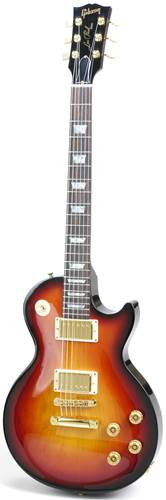
Sometimes less is better. In the case of the Les Paul Studio from Gibson USA, however, a little less is breathtaking! Ever since hitting the streets in 1983, Gibson’s Les Paul Studio has been the ultimate offering of traditional Les Paul performance with a modern, no-frills attitude.
Introduced as a guitar mainly for studio musicians, the Les Paul Studio has become one of the most desired – and popular – Les Pauls for its tremendous harmonic and sonic qualities. All of the essential elements of a Les Paul Standard are there, including a carved maple top, solid mahogany back and genuine Gibson humbucker pickups. What the Les Paul Studio lacks in extras, it makes up for in performance. If you don’t believe us, ask any one of the thousands of musicians who call it their No. 1 axe. The Les Paul Studio is one of Gibson USA’s best-selling instruments. Don’t you want to find out why?
Mahogany Back and Maple Top
There isn’t anything more critical than the marriage of the Les Paul’s mahogany back with a maple cap, as well as the regimen involved in selecting the right wood and the formula to dry it out. First, the wood is personally inspected and qualified by Gibson’s team of skilled wood experts before it enters the Gibson factories. Inside the Gibson factories, humidity is maintained at 45 percent, and the temperature at 70 degrees. This ensures all woods are dried to a level of “equilibrium,” where the moisture content does not change during the manufacturing process. This guarantees tight-fitting joints and no expansion, and controls the shrinkage and warping of the woods, in addition to reducing the weight. It also improves the woods’ machinability and finishing properties, and adherence to glue. Consistent moisture content means that a Gibson guitar will respond evenly to temperature and humidity changes long after it leaves the factory.
Chambered Body
There’s something about playing a guitar with perfect tone, balance, and weight. One of the ways the expert craftsmen at Gibson USA achieve this equilibrium is by carving carefully mapped-out chambers in the Les Paul’s solid mahogany back using a Computer Numeric Controlled (CNC) router before the maple top is glued on. The positioning of the routes was established after careful examination of the resonant characteristics of the Les Paul. Gibson approached this process with the awareness that every change to the formula would have repercussions on the instrument’s sound. So, in addition to relieving the stress on a player’s back and shoulder, these lighter Gibson guitars also enhance the tone palette in a manner unique only to these guitars. The results are comfortable, lightweight guitars that are acoustically louder, with increased sustain and resonance.
Nitrocellulose Finish
Applying a nitrocellulose finish to any Gibson guitar—including the Gibson Les Paul Studio—is one of the most labor-intensive elements of the guitar-making process. A properly applied nitro finish requires extensive man hours, several evenly applied coats, and an exorbitant amount of drying time. But this fact has never swayed Gibson into changing this time-tested method, employed ever since the first guitar was swathed with lacquer back in 1894. Why? For starters, a nitro finish dries to a much thinner coat than a polyurethane finish, which means there is less interference with the natural vibration of the instrument, allowing for a purer tone. A nitro finish is also a softer finish, which makes it easily repairable. You can touch up a scratch or ding on a nitro finish, but you can’t do the same on a poly finish. In addition, a nitro finish is very porous in nature, and actually gets thinner over time. It does not “seal” wood in an airtight shell—as a poly finish does—and allows the wood to breathe and age properly.
50's Neck Profile
No guitar neck profiles are more distinguishable than the neck profiles employed on the Gibson models of today. The more traditional ’50s neck profile—found on the Les Paul Studio—is the thicker, rounder profile, emulating the neck shapes of the iconic 1958 and 1959 Les Paul Standards. The neck is machined in Gibson’s rough mill using wood shapers to make the initial cuts. But once the fingerboard gets glued on, the rest—including the final sanding—is done by hand. That means there are no two necks with the exact same dimensions. So while it still has the basic characteristics of its respective profile, each neck will be slightly different, with a distinct but traditional feel.
Angled Headstock
The angled headstock is another example of Gibson’s industry-changing way of thinking. Every Gibson headstock is carved out of the same piece of mahogany as the neck then fitted with Gibson’s traditional wing blocks. It is not a “glued-on” headstock, and the process takes craftsmanship, time, and effort. But the rewards are worth the effort. The headstock is carefully angled at 17 degrees, which increases pressure on the strings and helps them stay in the nut slots. An increase in string pressure also means there is no loss of string vibration between the nut and the tuners, which equals better sustain.
22-Fret Rosewood Fingerboard
Both rosewood and ebony have always graced the fingerboards of the world’s finest stringed instruments, including many of today’s Gibsons. The fingerboards on Gibson’s Les Paul Studios are constructed from the highest grade rosewood and ebony on the planet. Both are personally inspected and qualified by Gibson’s team of skilled wood experts before they enter the factories to be fitted onto the neck of the Les Paul Studio. The resilience of these dense and durable woods makes these fingerboards extremely balanced and stable, and gives each chord and note unparalleled clarity and bite. The 12-inch radius of the fingerboard provides smooth note bending capabilities and eliminates “dead” or “choked out” notes, common occurrences on fingerboards with lesser radiuses. The ebony fingerboard is only available on the Les Paul Studios in Classic White or Alpine White. The Rosewood fingerboard is only available on the Studios in Ebony, Wine Red, and Fireburst.
Nickel and Silver Alloy Fret Wire
The fret wire on most Gibson guitars is a combination nickel and silver alloy (approximately 80 percent nickel and 20 percent silver) specifically designed for long life and superior wear. Gibson’s traditional “medium/jumbo” fret wire is first shaped by hand, then cut to an exact 12-inch radius. After hand pressing it into the fingerboard, a machine press finishes the job to eliminate the gap between the bottom of the fret wire and the fingerboard.
Material
The nut on the Les Paul Studio is made from Corian, which is mainly composed of acrylic polymer. It’s a very durable material, delivers enhanced sustain, and holds the tolerances of the precision cuts made in the slotting process. It is installed into the top surface of the neck, butting up to the end of the fingerboard to ensure proper tone and sustain transfer.
Width
The width of the nut on the Flying V is approximately 1.695”.
Gibson"s 490R and 498T Pickups
The mid to late 1960s saw the emergence of a very different type of music coming from the clubs of England. This new genre’s players were demanding more powerful amplifiers with increased volume outputs to satisfy their sonic explorations. This led to a call for a more versatile pickup, and Gibson answered the call with the 490T and 490R pickups (“T” for treble, and “R” for rhythm), humbuckers with the tonal characteristics of an original PAF, but with a slight increase in upper mid-range response. The Gibson 498T bridge pickup is the 490’s ideal complement. Taking the 490 one step further, the 498 swaps the Alnico II magnet to an Alnico V, thus making it slightly hotter with emphasis on mid-ranges and highs. The pole pieces on the 498T are also aligned a little further apart to accommodate the spacing of the strings at the bridge, which is different than the spacing of the strings at the neck.
TonePros Locking Tune-o-matic Bridge and Locking Stopbar Tailpiece
The Tune-o-matic bridge was the brainchild of legendary Gibson president Ted McCarty in 1954, setting the standard for simplicity and functionality that has never been bettered. The guitar features TonePros locking Nashville Tune-o-matic in a chrome finish, which has saddle adjustment screws on the pickup side, and pre-notched saddles for quick installation. The chrome locking stopbar tailpiece is also from TonePros. These parts come with locking studs designed to secure both components firmly to the body so that there is no lean, yielding a great union between the strings and body which results in excellent tone and sustain.