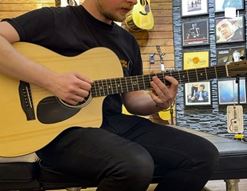
When it comes to acoustic guitars, no company has done more to define the look, feel and - most importantly - the sound of the instrument than Martin. They invented the dreadnought, which is far and away the most popular acoustic guitar design ever. They gave us X-bracing, which is the most-used style of natural tone-shaping in guitar building. They also gave us a number of wood combinations that have also come to be definitive. If ‘spruce and rosewood’ immediately has you hearing a certain tone in your head, it’s because the famous Martin D-28 guitar provided that very sound to the world.
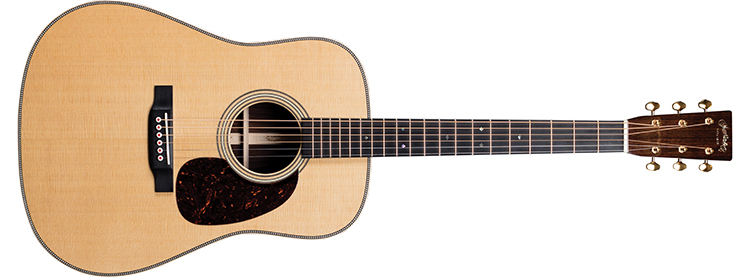
So, today I’ll look into the tonewoods that make our guitars sound the way they do. Let me clear from the beginning: the tonal differences between guitars have as much to do with bracing, body shape, nut material and other factors as they do with timbers. Wood plays a part: a large part, I’d say - at least with acoustic guitars - but a part nonetheless.
In today’s guide, I’ll look at the main timbers used for guitar tops and for their bodies (back & sides, in other words). Here’s what I’ve found from playing and selling Martin acoustic guitars for decades. Join me!
Soundboard Timbers
The soundboard - or simply ‘top’ - is perhaps the most significant part of a guitar build in terms of tone production. The top has to be rigid enough to hold the build together, but supple enough to handle and carry vibrations. This is where the tone is created, before being shaped within the open space of the acoustic body by the bracing (attached to the underside of the guitar’s top) and the wood of the body. They all play a part, but it starts with what the top gives them. For this reason, the soundboard tonewood is perhaps more significant than the body.
Here are the main timers used in Martin soundboard creation.

Spruce
Spruce is the most commonly used tonewood for a guitar’s top. Why? Well, it’s plentiful in supply, it is light in weight, and it’s durable. It possesses a bright but even tone, so it makes more of whatever it’s paired with. It also adds a little bit of sparkle but less than, say, maple might. It allows for articulation, and by that I mean that the notes you play don’t necessarily ‘glue’ together like they might with, say, a cedar top.
Sitka spruce: in truth, lots of wood simply titled ‘spruce’ is actually Sitka spruce. Some are actually named that, and the Sitka part is referring to a town in Alaska that must be completely covered in spruce trees, judging by how many builders and brands use it.
Adirondack spruce/Eastern Red spruce: a stiffer variety of timber than Sitka spruce, and therefore louder. Is it also more aggressive sounding? Some would say so.
Englemann spruce: paler looking than other species of spruce, Englemann spruce also sounds quieter and softer due to it being more flexible.
Cedar
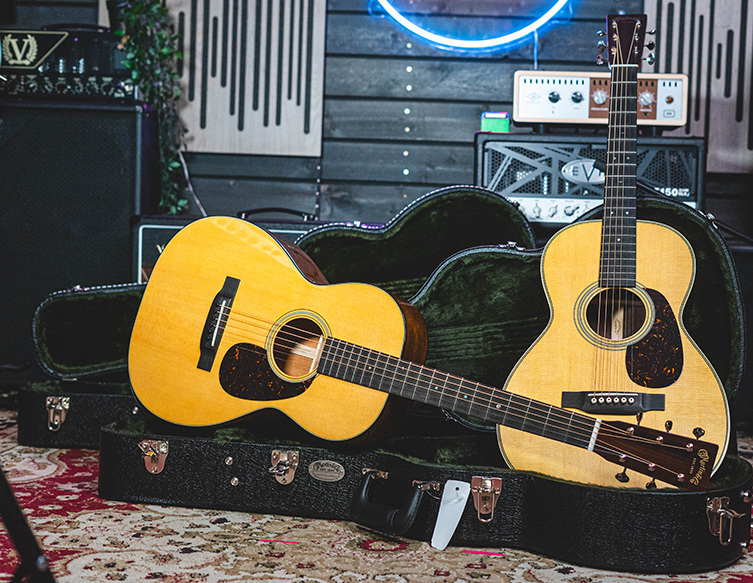
Cedar is a softer timber, and sounds correspondingly soft and warm compared with spruce. There’s less volume but lots of character and harmonic overtones from a good piece of cedar. This makes it an excellent choice for any player who values fingerpicking.
Body Timbers
If tone begins with the strings, and is carried via soundwave vibrations through the neck and top, it is shaped and ‘EQ’d’ by the inner bracing and body timbers. Bracing is a subject for another day, but let me take a little time to talk about the most-used body woods you’ll find on Martin guitars, alongside a few exotic timbers reserved only for Custom Shop builds.
Rosewood
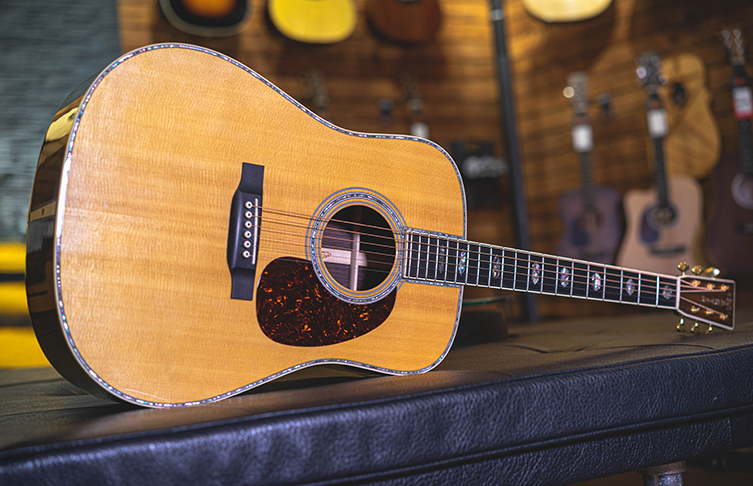
Rosewood is one half of the most famously sought after Martin guitar tone. Pairing rosewood with spruce results in a sound that is, for many players, perfection.
I’ve spoken about spruce already, so let’s deal with rosewood. Rosewood is a dense wood. It’s harder, if fact, then most timbers and that is why those lovely George Harrison Telecasters weigh a metric tonne: it’s generally too heavy for electric guitar building. It’s great for fingerboards because it's so strong and tough, but it's also excellent for acoustic bodies. Rosewood has a warm and direct sound, so it’s a good ‘focuser’. Its warmth meshes well with spruce’s articulation to deliver a great tonal palette.
Brazilian rosewood is very dense too, and has beautiful black and orange flecks in its grain.
Indian rosewood is very dark looking, and has a deep bassy sound. Both of these varieties deliver lots of harmonic overtones, and are considered upmarket, boutique choices.
Mahogany
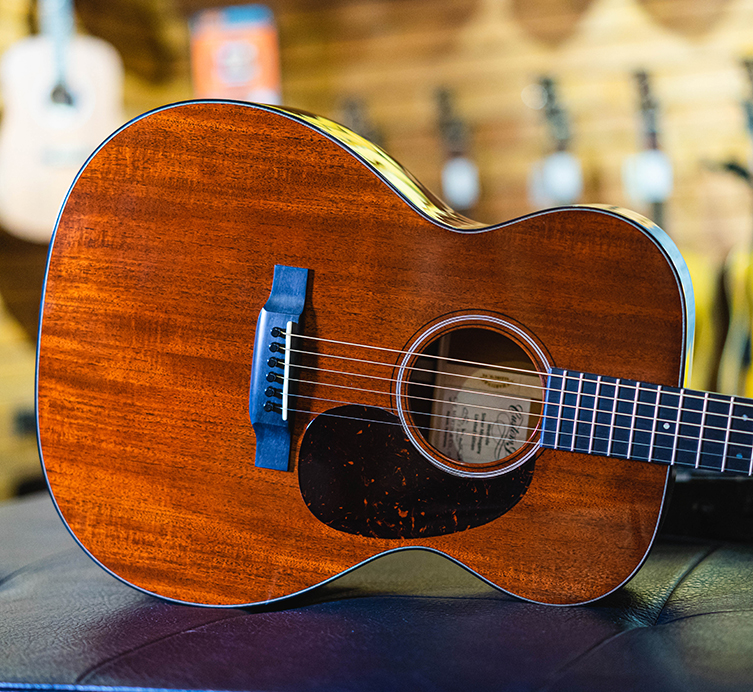
Mahogany is of course often used in electric guitar production, as well as for a great many acoustic guitar necks. Mahogany has a characteristically warm sound, though not a dull one. It projects well too, with plenty of volume, and is not as dense as woods like rosewood or maple. This is why it’s a great choice for the likes of the Martin 15 series, which use mahogany for the top, sides, back and neck. What that gives is strength and clarity, with lots of sustain for the fingerpickers.
Sapele is a popular substitute for mahogany. It’s a plentiful African wood that shares a lot of physical and sonic similarities with mahogany. Visually, it’s sometimes a little different, grain-wise, but it’s been a great value stand-in for mahogany for decades now.
Maple
We don’t see too many Martin guitars made with maple (the Modern Grand Performance models do come to mind though), but it’s still a popular tonewood so it’s worth a mention. Maple is famously good looking, with many different types of natural figuring and striping appearing when the trees are logged. Curly, flamed, tiger-striped and other terms are all used to describe the dramatic look that maple can have.
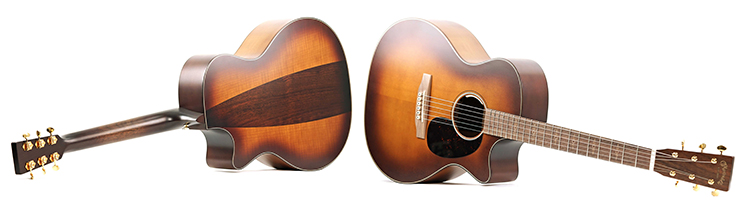
Physically, maple is one seriously dense timber that sounds bright and full of attack. Its treble properties are useful to add liveliness to large, boomy guitars. Seen here, it is mixed with Black Walnut to provide a particularly rich balance of frequencies.
Koa
Koa is a fairly unique looking wood with a wide variety of striking grain configurations. In terms of physical density, it sits somewhere in between rosewood and mahogany. Tonally, it's often described as being a smooth version of mahogany, and I’d agree with that. Koa is often found to have greater sustain than many tonewoods, and is particularly useful since it is beautiful both in looks and sounds. Koa is located in only one place in the whole world: the Hawaiian islands.
Walnut
Walnut is a very dense wood, so it’s another one you’ll not often find used for a complete guitar. It is great as an acoustic body wood though, as it shares many tonal similarities with koa, though generally speaking, walnut has more midrange strength and, to speak frankly, a plainer look.
Exotic Timbers
Mostly, Martin stick to the traditional timbers, since it was mainly them who made those woods the traditional choices! But for special edition builds and custom orders, they will use some more exotic woods too. Here’s a brief reference point to a few of these…
Cocobolo: essentially a species of rosewood, though more bright & trebly. Also very pretty!
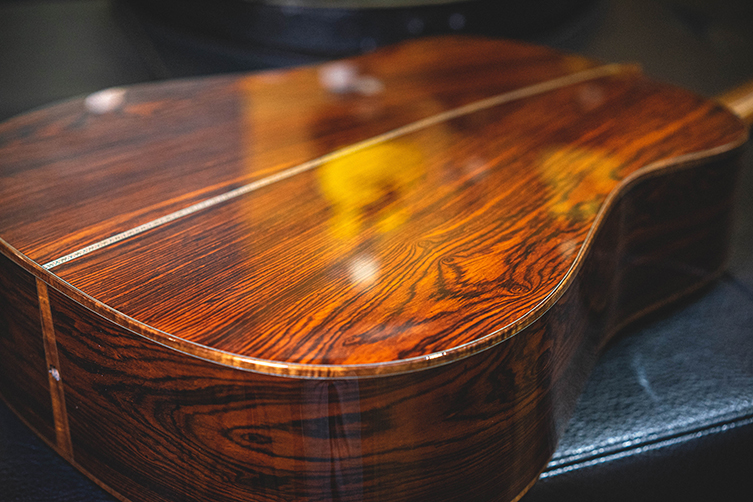
Ziricote: spectacular looking wood from Central America, with great note separation and clarity. This hard wood sounds as punchy as it looks.
Sinker Mahogany: old logs that were milled and then floated downriver. They got snagged, sank and lay at the bottom of the river for decades (sometimes a century+), and when found, have displayed different tonal characteristics thanks to the nutrients from the riverbed and water.
What is Torrefaction?
You’ll likely have heard the term ‘torrefaction’ being used in recent years, right? Or ‘roasted’, ‘caramelised’ or other terms. It’s part of the lifestyle now, but what does it really mean?
Torrefaction is a process that is applied to a guitar’s timber - and with acoustic guitars, it’s most normally the top - in order to remove the moisture from it. There is a good reason for this. Some of the very best sounding acoustic guitars on planet earth are antique Martins. Their century or more of being alive and used has not only dried them out, but changed the very structure of the wood, resulting in a sound that is very clear, loud, resonant and alive. They sound fully played in, because of course they are!
So, torrefaction seeks to achieve a similar end by treating the timber to very high temperatures in an oxygen-free environment. This process not only dries all of the moisture from the timber, but actually changes its molecular structure, something that naturally takes many decades to achieve. The result is not only a guitar that sounds incredible, but one that has a more stable top since the process makes the wood far stronger.
It costs a little more for torrefied timber on a guitar (usually), but the consensus is that it’s absolutely worth it.
Popular Combinations
Those were the most popular woods used in guitar building. But how are they used? What combinations make the sounds that we love? Here are a few examples of wood combos that deliver the type of tones that have endured for decades…
Spruce and rosewood: this is possibly the most revered combo. You’ll find it on many famous Martin acoustics, not least the D-28 dreadnoughts. That firm, bright top, slightly scooped midrange and very present bass response gives lots of what you want, and very little of what you don’t. There’s lots of headroom here, and complexity in terms of harmonic overtones.For many, this is as good as it gets, and is considered the ‘real’ Martin acoustic sound.
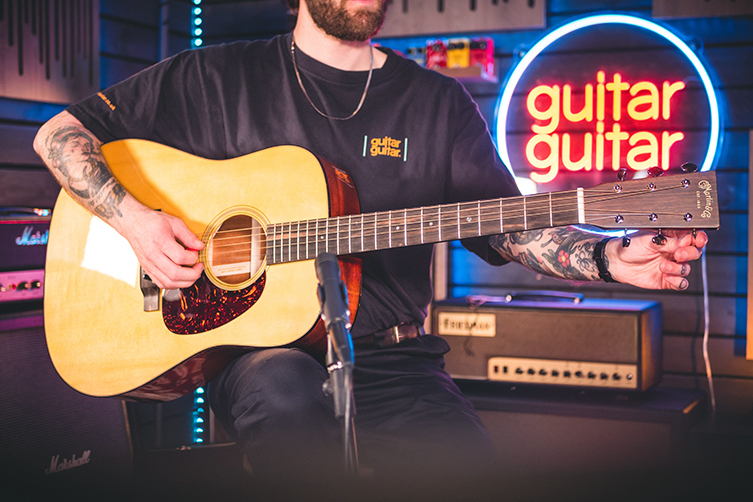
Spruce and mahogany: another popular choice - particularly with the Martin D-18, this is perhaps a more balanced sounding combination, which has more midrange strength. It;s a powerful sound with lots of articulation. It’s very versatile, and a good place to start when investigating tonewoods.
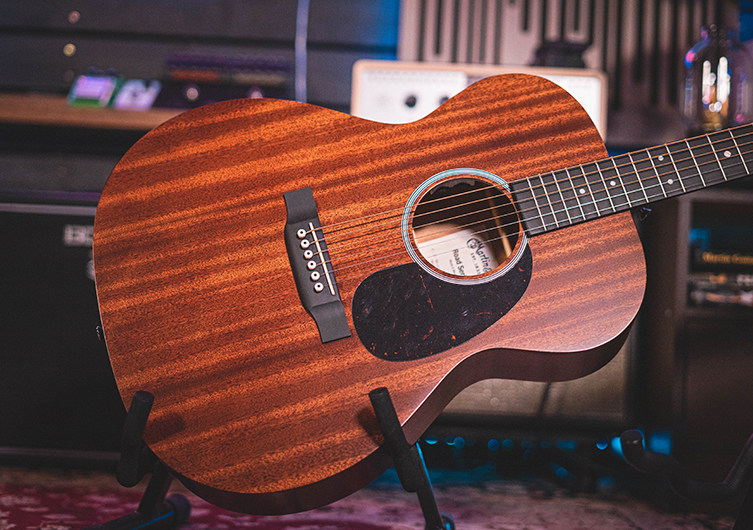
All-mahogany: you’ll find these in 15 series guitars, often referred to as ‘Depression Era’ models since they were invented in the late 20s when money was tight. Mahogany was a less expansive timber to use, and so Martin could offer good guitars for less money than they’d have to change for spruce and rosewood. Tonally, all-mahogany guitars tend to have a warm and yet direct tone, with less in the way of harmonic overtones but lots of ‘mellow strength’, if that even makes sense? It does to me! Smoothness is key here.
Which Styles Fit Which Woods?
So, do you need a specific combination of woods for a certain musical style? I’d say that, overall, you don’t. I think you can and should use whatever you prefer, in order to play whatever you want.
That said, there are some loose rules of thought that might be worth you at least knowing about, so here they are…
- Singer-songwriters: spruce and rosewood
- Bluegrass/flatpicking: spruce and mahogany, particularly Adirondack spruce.
- Folk/fingerstyle: all-mahogany, spruce & mahogany
- Recording: hugely dependent on desired outcome, but all-mahogany will control the overtones, and cedar tops record really well.
It’s All Relative
As I say, it’s all relative. Choosing a great combination of timbers is a good way to work towards a sound that you want. Ultimately, though, your fingers, skills and timing will do more to make you sound great than anything else. That’s something we all have to continually work on, but finding the tonewoods that work best for us will make us all sound the best we can, and that’s well worth spending some time on if you ask me.
Click to View our Martin Acoustic Guitars