Buy with confidence today & exchange until 31st January 2027 with our Extended Christmas Exchange Guarantee.
Learn More
- Free Next Day Delivery Available
- Buy today and exchange until 2027
- 3 Year Warranty
- Proudly Employee Owned
Old Blood Noise Endeavors IOTA Tone Generator Vintage Yellow
New Arrival


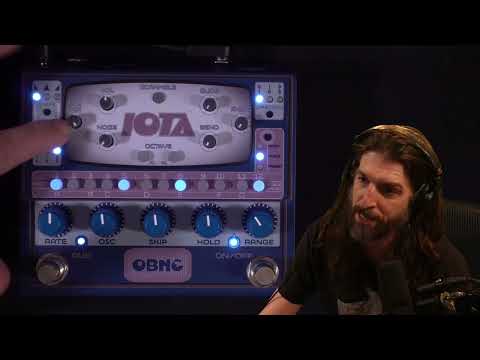


Image & Video Gallery
£339.00
Stock Arriving Soon
Includes 3-Year Warranty & Extended Exchange
Frequently Bought Together
Manufacturer's ID: OBN-OBN-IOTAVY
Sequenced Tone Generator
Often credited with making pedals that act as instruments, Old Blood Noise Endeavors proudly announces their first actual instrument, the IOTA Tone Generator.
IOTA takes an oscillator and sends it through your pedalboard based on a number of parameters you set. Pick the root note, scale intervals and the octave for your sequence and then press the footswitch to set it all in beautiful sonic motion.
But the fun doesn’t end here. Now you can scramble up the notes if you want, set how they bend, glide or swing, you can even apply an envelope with a few different shapes and timings as well as set the direction, rate and range for the sequencer. Or how about adding in some random or patterned skips and holds to breathe some serious rhythmic life into your arpeggios? IOTA is a synthetic pedal-shaped playground that’ll make you approach your pedalboard, creativity and sound designs in amazing new ways.
The heart of IOTA is the note bank. Twelve neatly sequenced light-up buttons greet you, while the neighbouring mode switch lets you alter what the buttons do. Root mode lets you engage one button at a time, effectively setting the base note that your whole sequence is built around. Scale mode lets you engage several buttons, with each one resembling a semitone interval measured from the root - one is the root itself, twelve is the major 7th, a half step below the next octave. So lighting 1, 4, 8 and 11 creates the sequence of a major 7th chord. Might sound daunting, but trust us, you’ll get the hang of it in no time.
The scramble button shuffles the order of the selected intervals and holds it until switched off, reshuffling every time it comes back on, so a line you have heard many times still returns in unfamiliar and inspiring ways.
The OSC knob lets you change the sound of the core oscillator. Starting at a smooth sine wave at noon, while morphing into a mid-focused harmonic wave when going counter-clockwise, and a bit-crushed chip-tune inspired sound when turning clockwise. The Noise control mixes white noise into the oscillator - at maximum there is only white noise present, but it stays filtered by whichever note is playing, so it moves musically with the sequence instead of sitting flat. The envelope section shapes each note in time, with Mix opening the volume wide or giving the envelope room to close, Length setting a quarter, half or full sequencer rate, and Shape deciding whether the note rises, falls or does both.
From there the sequencer is yours: Rate from nearly stalled to a blur, with the aux footswitch turning the knob into a subdivision selector from ÷4 to x4; Direction up, down or both; Range stacking five octave copies of your scale into a list of five to sixty notes. Skip drops triggers in sixteen fixed patterns or by rising random chance, Hold re-triggers the previous note and stays put, while Swing drags every other note behind the beat. Glide stretches pitch between notes all the way to constant portamento, and Bend adds vibrato up to a semitone deep, one cycle per note. All different ways to add some serious character and motion to your notes.
Switching to Preset mode allows you to save your entire sequenced creation to any one of twelve onboard preset locations, and the twelve buttons themselves are as much a part of playing this instrument as the strings on a guitar. Chords, root notes, sounds and whole arrangements can be moved through just by using the footswitches. The aux switch assists by handling manual note triggering, tap tempo or preset cycling, and the expression jack takes any combination of knobs at once, which can be assigned heel to toe and saved individually per preset.
MIDI handles the rest: clock to drive the rate, note messages to set the root, CC over every control and up to 127 presets, all useable via the 3.5 mm TRS jacks that also pass messages through to your other MIDI connected devices. Notes can bounce hard left to hard right in stereo or remain centred in mono. Firmware updates are handled via USB-C, and holding both footswitches for ten seconds restores the pedal to its factory settings.
As you can probably tell, IOTA does a lot. But it’s all presented and organised in a way that will feel natural and intuitive to anyone who’s ever used a guitar pedal before. Just plug it in, and let sequences of inspiration take you and your songs to places you’ve never been before.
Specification
- Sequenced notes, arpeggios and drones from a chosen root and scale
- Scramble shuffles the note order and holds it until switched off
- Seven sequencer subdivisions, ÷4 to x4, on an aux hold
- Five-octave range, from five to sixty notes in the sequence
- Sixteen skip patterns, plus random skip probability
- Twelve onboard presets and 127 available via MIDI
- Global overrides lock chosen settings to the face of the pedal
- Aux footswitch assignable to note trigger, tap tempo or preset switching
- Expression control over any combination of knobs, saved per preset
- MIDI in and out on 3.5 mm TRS type A, with clock, note and CC
- Soft touch switching - short press to latch, long press to hold
- Firmware updatable over USB-C
- Designed by Andy Othling - hand-made in Oklahoma, USA
- Powered by (opt.) 9V DC PSU
- (9V DC, centre -, 2.1mm, ~85mA current draw, 1000mA pass-through)