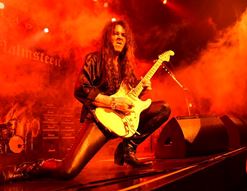
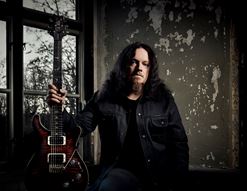
Did you go to see Hans Zimmer’s live show recently? For the last decade or so, the Oscar-winning Hollywood composer has brought some of his biggest and loudest film scores to life, touring the world with a huge crew and some of the world’s best musicians in tow. Zimmer fans may already have checked out my two interviews with guitarist Guthrie Govan and another with cellist Tina Guo (who is not on the current tour), but today, I’m looking in another direction entirely…
Everyone who witnesses the awesome spectacle of the current tour will have seen a rather monstrous looking synthesizer in the centre platform of the stage. This huge bank of dials, meters, knobs and cables is over 20 feet long and is the very first thing we see and hear at the beginning of the concert. To say it makes an impression is quite the understatement, and part of me actually expected it to be nothing more than a fancy piece of staging. It couldn’t really be an actual working synth could it? Nobody in their right mind would actually build something that enormous, let alone take it out on a worldwide tour, would they?
Or would they?
I think you probably know the answer to that one already. Yes, it most certainly is a real and fully functional synth! This glorious thing is the Giorgio III, and as soon as I knew it was real, I just had to know more. After some research, I found that the Giorgio III was mainly the work of two men: Yves Usson and Pierre Jean Tardiveau. I reached out to Yves, hoping for the best. Yves, being a wonderful human being, agreed to answer my increasingly nerdy questions, and even supplied some excellent progress photos of the Giorgio III synth. It's a rare peek behind the curtain of a fascinating and unique instrument, for a world-class composer and sound designer, designed by an innovative team.
Here’s my interview with Yves. Enjoy!
Interview with Yves Usson
Guitarguitar: Did you have a previous relationship with Hans prior to him contacting you about the Giorgio III?
Yves Usson: I had a very basic and informal relationship with Hans via Facebook, because he is passionate about big modular synths like I am, and also because we are the same age (same year, same month but one day difference). As such, we informally exchanged our “tips and tricks” about synthesizers.
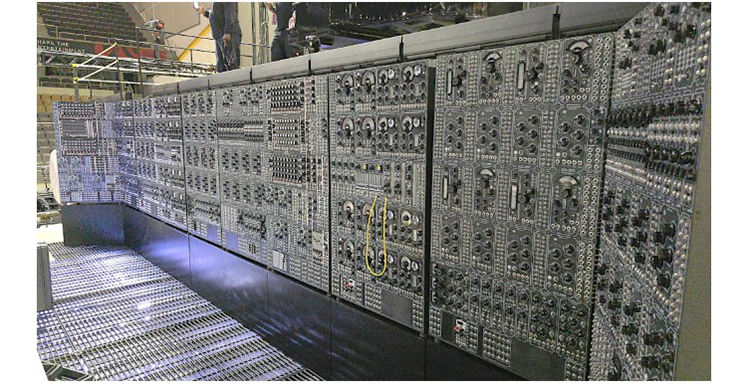
GIORGIO III on stage before the show.
GG: What was his initial design brief or vision for the synth?
YU: It was very clear. He wanted, I quote: ”two very large Tangerine Dream type” modular synths for his next tour. Up until that time he was working with the late Gert Jalass (Moon Modular), who unfortunately passed away some months before.
GG: In simple terms, what was this synth expected to accomplish, sound-wise?
YU: Well, Hans wanted a very classic vintage structure, with a four voice architecture. He wanted a classic but powerful Moog sound. When this basis was achieved we were free to propose additional modules that would bring less classic sounds. As such there were triple resonators, a “metalizer” wavefolder, a wavetable VCO and some other original modules.
GG: Is it polyphonic? I’m wondering how many oscillators, VCAs, filters and so on are involved in the final design?
YU: Basically, you may consider it as three (4 voices) modulars that can be played independently or synchronised. These can be patched together to provide up to 12 voice polyphony (but it is not it’s intended use). GiorgioIII features a grand total of 24 VCOs, 24 Wavetable DCOs, 12 lpVCFs (ARP4075 like VCF), 12 Steiner multimode VCF, 36 delayable ADSRs, 6 Triple Resonators, 12 digital LFOs, 6 Metallizer wavefolders. 3 ring modulators and plenty of ancillary modules (mixers, gate delays, attenuverters, logic module, routers…)
GG: It looks extraordinarily complicated: is the learning curve to operate it as potentially complex as it looks?
YU: No it is not complicated! it looks impressive: that is different. On first contact you might be overwhelmed by the number (and unique look) of the modules and dials and lights, but all these are usual VCO, VCF, VCA, EG modules, but with unusual verniers. Therefore it does not take long to program it and make it sound.
GG: Did its immense visual impact cause any sonic problems? (i.e. compromises to the circuits in order to make it look a certain way)
YU: No compromise with the sound, the modules look and sound great. But that’s true that the look and design by Pierre-Jean Tardiveau is so dense and beautiful. It could have been difficult to maintain the right number of input/outputs and controls.
As a matter of fact, the specifications and design of the modules came first. Once the modules would match these, then the front plate design would start…
GG: What challenges did you encounter whilst designing and building the Giorgio III? Given the nature of modular synthesis - the fact that anything can largely be connected to anything else - was there ever any concerns about stability, power issues or unwanted noise?
YU: The design of a decent power supply system has been quite a challenge indeed. Pierre-Jean designed a huge noise filtering unit that comes between the industrial PSUs and the distribution bus. (photo of power bus).
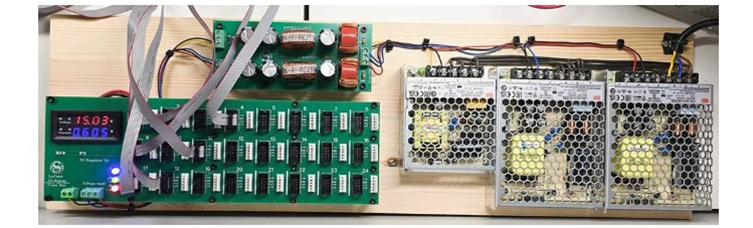
Base power supply for a single cabinet : left distribution board including voltmeters; top strong noise filter and right: Industrial switch powers for +5V,+15V and -15V
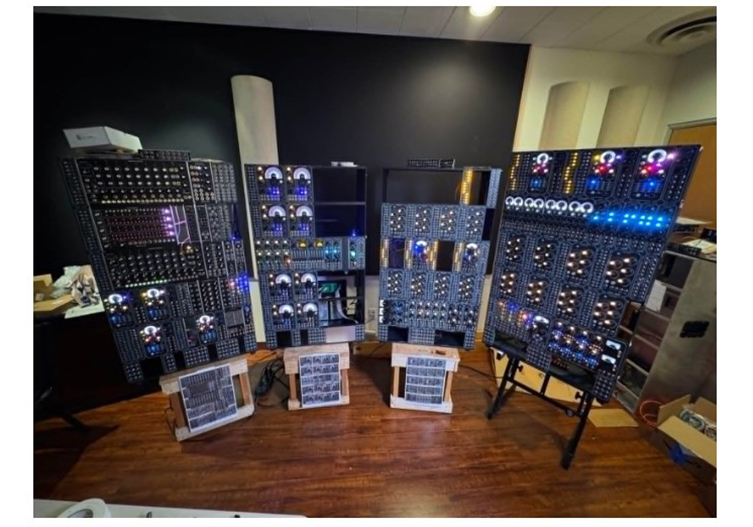
Assembly of the 12 cabinets (here 4 only) in Santa Monica
I must say that Hans Zimmer‘s team in Santa Monica under the supervision of Chuck Choi did a great job at assembling Giorgio III, and Chaz Labreque who designed in collaboration with Syntesla (Chaz designed the electronics and Syntesla made the panels) a large number of ancillary modules to allow prepatching of every single module to the internal bus.
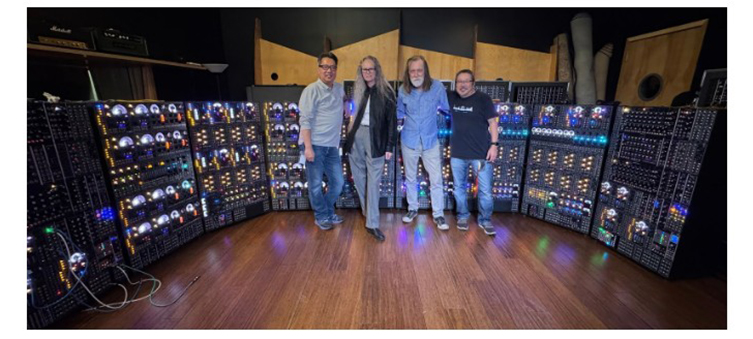
The Santa Monica dream-team : from left to right Chuck Choi, Cindy Newman, Chaz Labrecque, and Ryan Ouchida
GG: Would I be correct in saying that the instrument is a collaboration between you and Pierre Jean Tardiveau of SynTesla? If so, how did that working relationship apply to this particular build?
YU: Yes you would be perfectly correct! As a matter of fact, when Hans (HZ) contacted me it was because he had seen one of the steampunk synths designed by Pierre-Jean (PJ) and Hans wanted to get in touch with Syntesla. I joined the project soon after the first contact between HZ and PJ was established.
Pierre-Jean was a bit of a beginner in the domain of analogue electronic design and he asked me to join in. Therefore my part was essentially the analogue electronic design of the modules, then Pierre-Jean was handling the industrialisation process - that is, PCB design, component layout and Faceplate design - and final building.
Note that PJ completely designed some modules such as the digital LFO and the Wave-table VCO. Maybe it is interesting to know that PJ lives near Paris and I live in Lourdes which is 800km away. Therefore, we had a working meeting through the internet every second day.
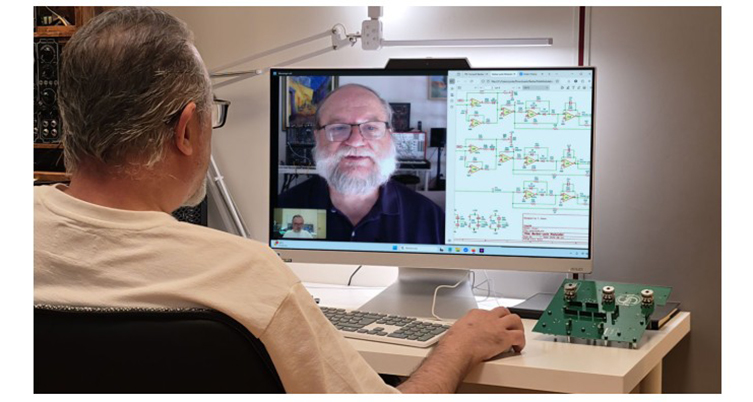
An example of an internet working session with Yves onscreen.
GG: Do you happen to know why it’s called the Giorgio III? Were there two previous models?
YU: Yes I do. It is called Giorgio as an homage to Giorgio Moroder. Hans Zimmer is a great admirer of Giorgio’s soundtracks (in particular Midnight Express). Giorgio Moroder was a great inspiration for him.
There is a Giorgio I and a Giorgio II. The Giorgio II was built by Gert Jalaas and used for the 2024-2025 Hans Zimmer tour.
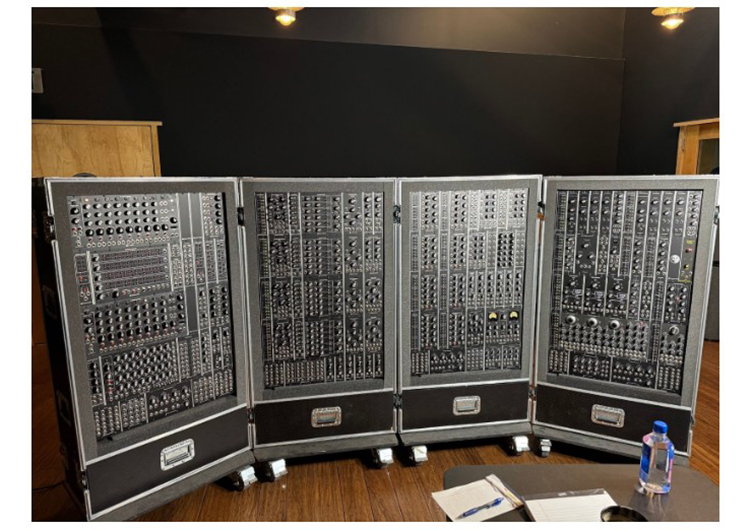
The GIORGIO II by Gert Jalass
GG: In terms of the inner workings, did you base any parts on existing synth modules?
YU: Yes, I based some on the yusynth modular circuits, but not straight away. I reworked them a lot deeper because the aim was no longer to provide easy to build synth modules (as was the yusynth project), but to provide professional modules with high stability, and heavy duty use.
Therefore some are adaptations of the yusynth circuits. Some are complete redraws based on more modern circuits (for instance the VCO - which sounds great and is very stable - is based on the SSI2130 chip).
GG: On stage, there are lots of additional keyboard instruments: how much of the synth work that we hear at the Hans Zimmer show are actually this one?
YU: Yes, There are three keyboards (Waldorf Quantum) mounted just in front of GIORGIO III that are used with the MIDI THRU connection to play it. They are also used as polyphonic synths during the show but I can’t say more because we were not involved in the artistic part of the show. You will have to interview Hans to know how much GIORGIO III is played through-out the show! One thing for sure is that it is used every time you see it illuminated on stage.
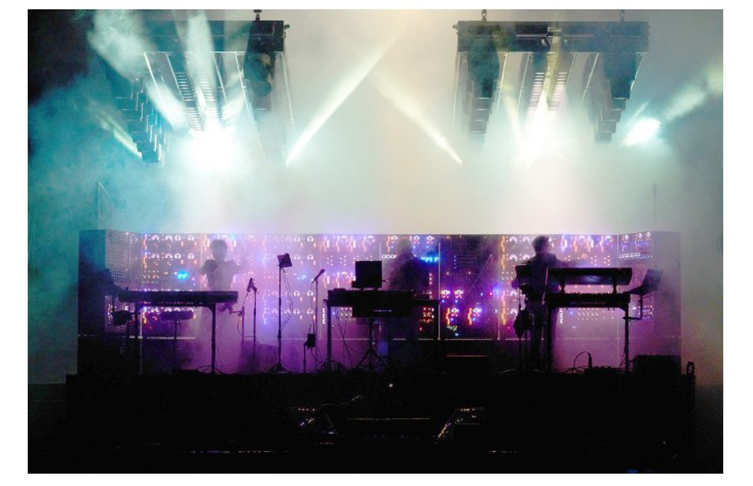
Hans Zimmer The Next Level : opening, the Dark Knight
GG: Can the Giorgio III accomplish anything that cannot be achieved on a smaller synthesizer?
YU: Honestly, no. I think that with at least smaller synths you would. But this is a great tool for a great composer!
GG: Do you have plans to work with Hans again?
YU: Yes we do. Hans wants to extend the Giorgio III with less classic modules, so we are currently working on that.
GG: You’re very well known for your work with Arturia for the Brute synths (which I love, congratulations!) What is your favourite part or function of the Giorgio III?
YU: Maybe the Wavefolder that I originally created back in 2010 for the Minibrute, which is the infamous Metallizer.
GG: Finally, what is your own all-time favourite synthesizer?
YU: If I were to keep only one it would be the Roland 700 Modular sound system. Although I am amazed by new synths like the Osmose.
There you have the inside scoop on what is surely the synth of the year! I’m so glad to learn that it is as powerful and expressive as it looks, and that all of the hard work of the crew moving this thing around is worth it! It’s an incredible stage prop for all audiences to admire and enjoy, but it’s also a sonic powerhouse that literally shook the foundations of the venue when I attended a recent show! It’s been a wonderful thing to learn the story behind the Giorgio III, and yes, I have gone back to re-listen to the Midnight Express soundtrack!
Hans Zimmer knows his synths for sure, and Yves was obviously the right man for the job here. You may not be able to put something like the Giorgio III into your own studio, but remember what Yves said about smaller synths, and perhaps check out some of his innovations within the synths that Arturia have released.
My thanks to Yves for taking part, and for providing these incredible pictures!