Once in a generation, if we are lucky, we get to share time and space with exceptional people. They come in many guises, but they all change the world with their actions. David Bowie was obviously holding the universe together with his talents, because since he died in 2016, everything has been slightly less good, hasn’t it?
The legendary figure known as a pioneering singer, songwriter, musician and actor changed the face of popular music a number of times in his 69 years. His chameleonic nature and thirst for new artistic vistas mean that his recording career is quite the kaleidoscopic listen.
If you’re looking to get into Bowie, then you’ll have quickly realised that no Best Of records or playlists can adequately cover his whole oeuvre.
What you need is a friendly guide to pick out some choice tracks from each of his eras and ‘characters’; somebody who has spent decades being slightly obsessed with the great man’s output.
This is where I humbly raise my hand.
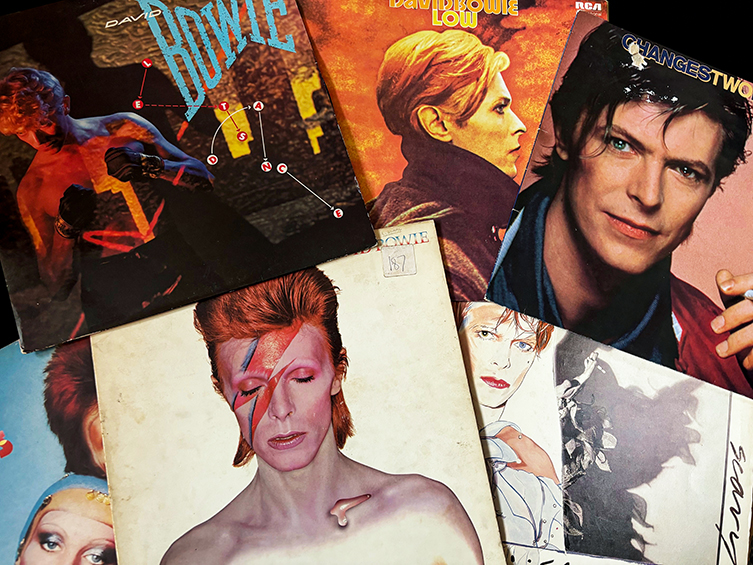
I’m here for you! As a lifelong Bowie fan, I’ve probably sunk more listening hours into his catalogue than any other artist, and I’ve had the honour of interviewing two of his guitarists: Reeves Gabrels and Gerry Leonard. Both players gave me some wonderful insights into David, and helped further inform my knowledge base.
What I’m going to do with you today, if you choose to come with me, is to skip chronologically through David’s storied career, talking a little about each era and selecting some favourite songs to illustrate the point. What I hope to give you is a specially curated beginner’s guide to the genius that is David Bowie…
Pre-Glam David
David Bowie wasn’t born an instant icon. Indeed, he tried many styles in his early days before finding his first bona fide hit with Space Oddity in 1969. Early songs like The Laughing Gnome became something of an albatross around his neck in later years, but it put him on the map for a short while, and allowed him space to develop.
1969’s Space Oddity album is perhaps not up to the standard of what came next, but there are still a few gems on there! I’d start with Memories of a Free Festival, and then the ubiquitous Space Oddity itself, which was released in order to capture the media fever around the Apollo moon landings, and the movie 2001: A Space Odyssey. Listen out for a famous performance of the one and only Stylophone!
Things really started going when Bowie released The Man Who Sold the World. The record brought an uncharacteristically heavy sound from him, with the late, great Mick Ronson tearing into his Les Paul Custom in a way he never again did for David. It’s a good - not great - album, with a couple of crackers on it such as the title track and also The Supermen, which was the first of many future references to philosopher Friedrich Nietzsche.
It was also the beginning of David’s reputation for playful interview patter: when asked about why he wore a woman’s dress for the cover art, he simply reasoned: “Oh dear. You must misunderstand that it’s not a woman’s. It’s a man’s dress.” He bought it, so it was a man’s, I suppose! Using gender identity roles subversively was something David did throughout his career, and this was merely an early example.
Hunky Dory, and the Birth of Ziggy
Bowie’s next album was 1971’s Hunky Dory. This introduced the world to many defining characteristics of his style, such as grand arrangements, non-standard song structure, and lyrical subject matter that touched on sexuality, celebrity and the occult.
It’s actually a very acoustic-based album, which is something that David did a lot of. People don’t remark on it too much, but during his whole early period, most of his songs were written on a 12-string Hagstrom Bjarton BJ-12. A song like Quicksand is a great example of his songwriting from this period: it contains the lush 12-string strumming and has lyrical references to Aleister Crowley and the magickal group The Golden Dawn, subjects which fascinated him then and after.
The most famous tune from Hunky Dory, though, isn’t so much representative of where he was as a writer, but where he was going. Life On Mars? was also the first time that the British public got to see his (as yet unnamed) Ziggy Stardust persona, with bright red hair and full makeup. It’s interesting to note how quickly all of this happened back then. As we’ll see, Ziggy wasn’t around for a long time at all, as the restless Bowie moved from one idea to the next.
Anyway, Life on Mars? is also a good example of a song he wrote on the piano, as opposed to the guitar. Check out the chords on a guitar and it’s wildly complicated: move across to the piano and you’ll find it sitting nicely under the fingers! This song actually came to David as he was out for a walk in a local park. Humming the melody to himself, he got home, sat down at his grand piano, and put together the rest of what is undoubtedly one of his best ever songs:
The Era of Ziggy Stardust
The Ziggy album - The Fall and Rise of Ziggy Stardust and the Spiders From Mars, to give it its full title - feels like it arrived in a fully-formed package by an artist from outer space. Overnight, seemingly, Bowie had transformed into an androgynous alien, with a set of songs that sounded almost nothing like his previous work.
Glam rock was born, almost singlehandedly. Well, actually, Bowie’s close friend Marc Bolan arguably invented glam a year before, in 1971. But Bowie - who quickly became known as the King of Glam - took what Bolan started and upped the theatricality and glamour well beyond what T-Rex were doing. Ziggy Stardust was the epicentre of it, and you can’t reasonably say you know Bowie’s work without having had a good listen to it.
The album is stuffed with classic songs, so I’ll include a few here. 5 Years, the album opener, has a sound that is almost 50s rock mixed with musical theatre. You can hear the direct influence of this on the Rocky Horror Show, which followed a year later on theatre stages.
Bowie’s glam sound featured distinctly melodic songs peppered with Mick Ronson’s sonorous, muscular guitar parts. Using a half-closed wah pedal, his Les Paul Custom (with the finish removed from the top) and Marshall stack sound became the definitive glam rock tone.
The Ziggy riff (above) is a classic, but it's arguably an inferior tune to the album’s lead single, Starman. This is a classic Ziggy-era track, complete with the ubiquitous 12-string acoustic (at this point a Harptone P-12N) and an instruction to ‘let the children boogie’.
Starman doubled-down on Bowie’s fascination with the space age, something he’d return to throughout his career. Rather than looking towards the future, though, the 25 year old Londoner was finding himself, for the first time, as one of those people creating the future for others.
Aladdin Sane followed a year later, distilling Bowie’s red-headed, lightning-bolted face as a permanent vision of rock ‘n’ roll iconography. Musically, Aladdin Sane was much more adventurous than Ziggy, with new musicians such as New York pianist Mike Garson adding a decidedly avant-garde edge to the material.
Aladdin Sane (yes, a play on mental illness, which related to his family in ways that lie outside the scope of this guide) is another essential album for all Bowie acolytes. Understanding his cultural cache here is important when digesting the music: he was at his absolute peak in terms of fame and tabloid column inches at this point. A bona fide rock legend, and so the mercurial nature of much of Aladdin Sane’s content is actually a very bold move. It’s no Ziggy II, and in fact simultaneously more subtle and more obvious a statement. The album contains Bowie staples such as Drive-In Saturday (more space age ruminations) and The Jean Genie, as well as the famously mysterious title track. Mike Garson’s epic solo is pretty wild for a huge pop single in 1972!
But it’s Lady Grinning Soul that I’d like to share with you today, thanks to its continuation of The Man Who Sold The World’s otherworldly, mystical vibe imbued with a lush exoticism. We’d hear this sort of sonic landscape again from Bowie, but never with so much ‘Bond theme’ -style archness.
The Death of Ziggy, Diamond Dogs
Bowie grew frustrated with the limitations of both his Ziggy Stardust character, and of the Spiders From Mars themselves. He ‘killed them off’ as it were, in July 1973 at the Hammersmith Odeon. Over 50 years on from then, it seems crazy to think that the Ziggy persona had only ever been around for a year and a month! Ziggy was killed off a mere three months after the release of Aladdin Sane. These timeless moments are infinite in our retrospective minds, but it still surprises how fleeting they were at the time.
After disbanding The Spiders, Bowie created a new short-lived persona - Halloween Jack - and wrote a dystopian concept album called Diamond Dogs. Diamond Dogs is worthy of a deep dive on its own, but I’ll include the superlative Sweet Thing here to illustrate how exquisite David’s vocals were at this point.
The Thin White Duke
You may at some point notice that I’ve missed out Young Americans, David’s ‘plastic soul’ record from 1975. It’s a good album, and another that’s worth a good spin, but there’s a lot of music to get through here, and what’s coming up is, frankly, more significant.
This point until 1980 is basically an unbroken run of masterpieces. The famed Berlin trilogy is to come soon, but before that, we find David in Los Angeles, drugged out of his mind and paranoid that occultists were after him. Staying inside a home that was filled with black candles and guarded by two stone Egyptian dog statues, Bowie led a life of hallucinations and fear. There are stories of haunted swimming pools and exorcisms, but I’ll let you find that stuff out for yourself! This all culminated in a quite incredible album, 1976’s Station to Station. This was when he was referred to as the Thin White Duke, thanks to his suited image, awesome orange hair and highly aloof behaviour.
Station to Station is a titan of a record, and again displays a huge stylistic shift. Filled with funk and soul influences, it’s clear also that Bowie was also paying close attention to the motorik beats of Krautrock, and leaning into his lifelong love for singer Scott Walker. The results were gobsmacking, and the album remains not only one of his best-loved, but one that has hardly dated, sonically. The occult obsessions are there (the title refers to the Kabbalah), the songs are soulful and melodic, and there’s just a wonderful sense of icy confidence throughout.
I’ll use the epic, imperial title song as evidence here: from the faux-train sounds at the beginning to the funky yet very stark verse groove, it’s unlike anything he’d ever made before. It’s entrancing stuff, and about as far from Starman as a popular song could be.
The Berlin Era
This is one of Bowie’s most celebrated eras, and rightly so. The level of invention and innovation displayed through the Berlin trilogy is quite staggering by anyone’s standards, but by one of the world’s most popular mainstream rockstars, it’s simply beyond what anyone else had done before or has done since. If you think that sounds like hyperbole, give the records a listen, and consider them in the context of the mid-to-late 70s. Staggering stuff.
Anyway, Low is the first of these records, and Bowie had ex-Roxy Music keyboardist/boffin Brian Eno in tow for the sessions at Hansa Studios in Berlin. Bowie had drawn a line under the excesses of Los Angeles, and had moved to as opposite a city as he could think of: an austere, still-divided Berlin. Here is where he’d record Low & “Heroes”, the first two Berlin Trilogy albums.
Low was a dramatic departure from even Station to Station. It’s perhaps the most instrumentally adventurous, the record threaded with revolutionary vocal-free pieces that leaned more towards Kraftwerk and Stockhausen - and indeed his surrounding city - than whatever was troubling the charts at that time. I've chosen to illustrate this with Warsawa, the most symphonic and epic cut on Low. It sounds like nothing else on the record, but still somehow sums it up. Bowie and Eno apparently plotted the arrangement by drawing out dots on paper and adjusting synths and other instruments each time they encountered a dot.
“Heroes” is one of Bowie’s most famous albums thanks to the triumphant title track. There’s loads to love in here - not least ex-King Crimson guitarist Robert Fripp’s incendiary electric guitar playing throughout the record - but on this whistlestop tour, I’ll keep it brief.
The instrumental ‘side’ returns magnificently with German-referencing tunes like Neukölln and V-2 Schneider, but it’s the vocal tracks on here that make this a classic. It’s essential listening, so I hope you check it out from start to finish, because it’s one of Bowie’s master-statements as an artist.
This was the album where Bowie began using William Burroughs’ ‘Cut Up’ lyric technique, where he’d write phrases on a sheet of paper, cut each phrase with scissors, throw them on the floor and assemble them as song lyrics.
Other notable things: Bowie’s saxophone playing is on many tracks and is underrated; Eno used his famous ‘Oblique Strategies’ cards to suggest unorthodox approaches for the musicians, producer Tony Visconti inspired the title track with an illicit kiss near the Berlin Wall’s border; Fripp’s guitar on Heroes has no E-bow or other device, it’s just naturally overloading through the studio monitors; and not enough people talk about the fantastic final track, The Secret Life of Arabia. Listen to it now, and whilst you take in the awesome bassline and intro guitar part (courtesy of George Murray and Carlos Alomar, respectively), think about how this does call back a little to the mysterious sound of Aladdin Sane, though far funkier.
Skipping through now to the final record of the trilogy, Lodger from 1979 wasn’t made in Berlin at all, but Switzerland. It did, however, carry on the adventurous creative spirit of the previous two albums. The Oblique Strategies cards were out, the lyrics sheets were getting chopped up more than ever, and the resulting album is pretty bonkers, to be honest.
Future King Crimson guitarist Adrian Belew (there’s a pattern emerging here…) was brought on board to contribute his wild, expressive playing, and no better example exists than Red Sails. On this track, Belew was invited to record a lead guitar part without any info on the song’s chords or key, and without having heard the song beforehand. The result is pretty triumphant…
Scary Monsters
As the 70s ended, Bowie had already covered more artistic ground than most lifetimes, and he was only in his early 30s. Now, we’ll get to the 80s in a second, but prior to that, he had one further knockout album in his perfect run that began back with Station to Station.
Scary Monsters saw Bowie lean back towards pop songwriting, though he brought a noisy, post-punk sensibility to a musical landscape that was setting about dismantling the old heroes. Punk had hit and evaporated, and a new decade was ushering in fresh sounds.
David left Eno but retained Visconti and Fripp, and turned in a set of caustic, energetic songs that brought him straight back to the front of culture. The signature song for this record is surely Ashes to Ashes (complete with a video that was genuinely groundbreaking for the time), but I’d rather introduce you to two other songs.
First up is Fashion, a hit single with an incredibly sparse bassline and perhaps the most violent sounding lead guitars ever to be found in the top ten:
My second choice is a tune that Bowie actually never performed live. I’m not sure why (it was rehearsed for the Glass Spider tour but never made the setlist), except that its enormously effective ending requires a full choir of Bowies in order to sound correct! Because You’re Young is an amazing song, and one well worth knowing. A certain Pete Townshend supplies the lead guitar on this one, but it’s really all about those vocals.
Bowie and the 80s
The 80s were an odd time for Bowie. On the one hand, his biggest commercial success was released in the form of 1983’s Let’s Dance. On the other hand, it wasn’t his best album by a long shot, and the two that followed were arguably his worst. This isn’t so much a personal opinion as a widely held fact, and something that wasn’t lost on Bowie himself.
Let’s Dance was a great song though, and introduced a non-blues audience to the guitar talents of Stevie Ray Vaughan, so it’s well worth inclusion here:
The 80s had their moments for him, but they were few and far between. Loving the Alien was a high quality song that found a second life with Bowie as a quasi-acoustic number in his 2003 tour, for example.
For many people born after his Ziggy peak, though, David Bowie was and somehow always will be Jareth the Goblin King from Jim Henson’s fantasy movie Labyrinth. Like a lot of classic movies, it was underappreciated at the time, but later became an enduring classic thanks to its high visibility on TV during late 80s Christmas programming. For more on David’s acting career, read the box below. For more music, keep going and skip the box until later!
Bowie as an Actor
David Bowie was serious about acting from an early point in his career. When his debut record, David Bowie, sank in the charts in 1967, he took up lessons with mime artist Lindsay Kemp, who later taught Kate Bush.
His first significant role was in Nicholas Roeg’s The Man Who Fell to Earth, based on the Walter Tevis novel. Perfectly cast as an alien masquerading as a human being, Bowie actually won a Saturn award for best actor.
In the late 1980s, Bowie performed onstage as Joseph Merrick in The Elephant Man, a performance that gained good reviews. The 80s saw him star in Merry Christmas Mr Lawrence, and of course donning the tights and wig in Labyrinth!
Bowie also had a small role in David Lynch’s seminal Twin Peaks, as a dimension-hopping FBI agent. Again, perfect casting! Christopher Nolan cast him in The Prestige as no less a character than scientific genius Nikola Tesla, which again seemed to be exactly the right role for him. There were more pieces here and there (he made a very curious Pontius Pilate in Scorsese's The Last Temptation of Christ) but further roles in Blade Runner 2047 and Dune were unfulfilled due to his failing health.
Still, as far as acting musicians go, his career was definitely one of the more respectable ones!
Bowie’s 90s Renaissance
After a somewhat lost and bleak 80s, Bowie seemed to relocate his mojo in the 90s. I’ve sidestepped Tin Machine’s two albums (he was the singer in the band, not a singer with a band, if you see what I mean) since it’s really its own little thing, but after it, Bowie seemed to be ready to provoke again.
He became a co-editor of an art magazine, he toured his back catalogue, renegotiated his record deal, and went ‘full arty’. First, he created a soundtrack to the subversive TV show The Buddha of Suburbia, and then teamed back up with Brian Eno and Tin Machine guitarist Reeves Gabrels to create one of his great latter-day records: Outside.
Outside was a sprawling concept album based around a futuristic murder, and contained multitudes: crazed quasi-techno, grimy future rock, broken crooner-ballads and even snatches of spoken word, performed by Bowie in character for a number of the story’s ‘cast members’. It’s thrillingly inspired stuff, if perhaps too much for a fair-weather Bowie fan to take in one sitting. But it signalled his return to art, and to taking risks. Listen to Hearts Filthy Lesson (also used in the dark serial killer movie Se7en) and if you like it, then go straight into the album proper, because you will most likely love it.
Bowie was back, and he followed it up with Earthling. Earthling is an explosion of 90s joy, basically. Bowie was back in the centre of things, talking to Tricky about the Bristol scene, taking notes from The Prodigy and generally making himself relevant. Earthling saw Bowie and his band indulge in a spirited mix of cyber-rock and electronica, and the results were sonic fireworks. Little Wonder was the somewhat throwaway single, but deeper cuts like Seven Years in Tibet were where the real art was happening.
Bowie’s Later Years
Into his fifth and sixth decades, David continued to release music. Heathen is an album worth taking a long sit with, not least for its mortality-addressing title track, which seems to somehow combine Bowie’s whole worldview into one song. It’s quietly breathtaking stuff.
Reality followed Heathen, and provided him with upbeat material to tour with. The Reality tour (2003-4) was to be the last time Bowie toured the world. Moving off the radar for a number of years, we later learned that he’d suffered some significant health problems. Indeed, it would be ten years before another album came around, 2013’s The Next Day.
Fresh sounding whilst still revelling in his trademark melancholy, The Next Day sounded like the work of a confident artist who was happy to have some fun alongside the more reflective moments.
Three years later, the ten minute opus Blackstar was released, showing an aged and ill Bowie. The old sparkle was very much still in his eyes, but he was no longer the ageless rockstar alien he’d been for decades before.
Indeed, he’d been concealing a sad secret that was made clear two months later. The Blackstar album was released on 8th January 2016, and David passed away two days after from liver cancer. The world was in shock, and people clung to the album like a final gift from a dear friend.
If you’ve not worked through David’s body of music, I’d let this one wait until you’ve absorbed the majority of his oeuvre. Come back around to it later. It’s a cracking record, but not an easy one to sit with when you consider its inception.
The Greatest Single Body of Work
Okay, here we are: we’ve reached the end, more or less, of Bowie’s musical story. One posthumous album did appear (2021’s Toy), but it’s for completists more than newcomers.
I don’t think there is one other single artist who has delivered such a large and varied body of work, with such a high level of quality, to such a huge amount of success.
He was an art-freak who managed to get under the radar and into the mainstream. He changed music, culture and fashion multiple times throughout his life, and wore it all lightly. He’s clearly one of the greats, and it’s a fantastic thing to be interested in his work. I hope this article has given you the keys to the treasure chest, because it’s an endless and ever-giving gift. Enjoy!