Is there a genre of music more pedal-friendly than shoegaze? This sub-section of indie rock got its name from practitioners staring at their feet during gigs, but they were probably looking at their gargantuan pedal collections and anticipating the next tap-dance required!
Shoegaze is all about texture, expansive scale and impressionistic washes of heavily effected sound. It’s a whole way of playing and a whole way of sounding.
Now, shoegaze was originally a thing in the late 80s with bands like My Bloody Valentine and Slowdive, but the scene has come back in a big way in recent years. Bands like DIIV and Temple of Angels are proving that there’s lots of mileage in the epic, expressive sounds of shoegaze.
Maybe you want to investigate these sorts of sounds yourself? If so, today’s blog is for you. I’m going to suggest a suitable pedal setup that will cover many of the expected bases required for authentic, blissed-out, shoegaze guitar. I’ll look at how you might want to chain them together, and I’ll suggest effective ways to use the effects, when appropriate. Of course, so much about this approach is in finding your own cool sounds, so disregarding rules and advice might prove as useful as following it!
Either way, this blog will contain handy tips for you, so stick on your favourite Ride record and let’s put together the ultimate shoegaze pedal board!
What is a Shoegaze Guitar Sound?
Shoegaze is one of those genres that is identified by the overall sound of the songs. Whether it’s early pre-shoegaze stuff like the Cocteau Twins, classic shoegaze like My Bloody Valentine or contemporary shoegaze like A Place to Bury Strangers, there are common threads in the sound that provide a through-line for listeners.
Chief amongst these are thick walls of textured, fuzzed-up guitars, covered in layers of ambience. Everyone does it their own way, but the overall effect is a huge wash of distorted sound. In addition, there is far less emphasis on typical lead guitar playing in favour of what I’ll call ‘impressionistic’ guitar work that sets up atmospheres and supports the overall song. So, guitars are very important in shoegaze, but they are employed in a different manner to typical classic rock.
The Shoegaze Sound (box)
- Highly textured distortion achieved with fuzz and overdrive
- Layers of ambience, with an emphasis on reverb in particular
- Pitch manipulation, either physically (‘glide guitar’ techniques with long-arm tremolos) or via pedals like chorus effects
- Sound applied as washes of texture as opposed to overly defined ‘classic rock’ riffs and leads
What Guitar is Best for Shoegaze?
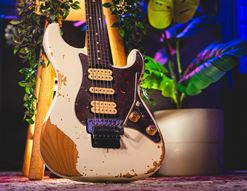
So, what type of guitar should you choose for playing shoegaze music? Well, my first impulse is to direct you towards a Fender offset guitar with a whammy bar. The Jaguar and Jazzmaster are overwhelmingly the first choice for shoegaze players, and that’s for a number of reasons.
Firstly, their particular tremolo suits a certain style of playing known as ‘glide guitar’, made famous by Kevin Shields. You hold the long tremolo arm in your picking hand and let your strums push and pull the bar slightly as you play, which subtly changes the pitch. You know the sound! In reality, you can do this with any tremolo, but it’s far easier with the long arms of the Fender offset guitars.
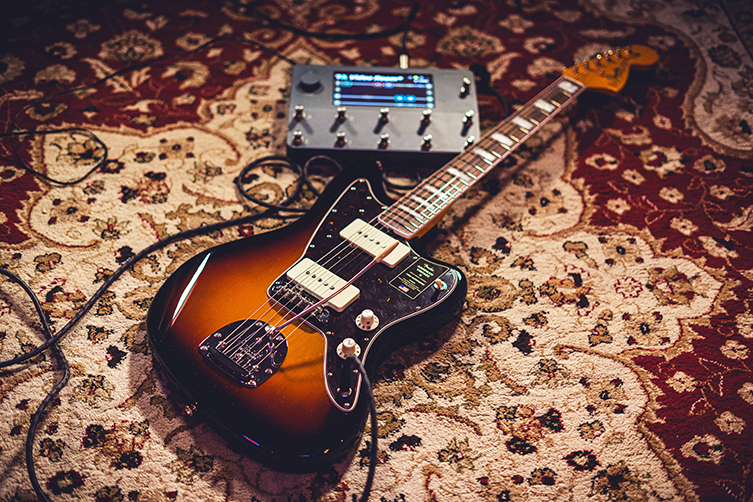
Secondly, there is a shoegaze aesthetic that requires an offset guitar over, say, a Strat or Les Paul. It’s a scene thing, and a cultural thing, but offsets are seen as countercultural, even if more people play them now than ever before. There is an unspoken consensus that Jags and Jazzmasters are for players who eschew traditional playing (lead guitar solos etc) and whether that’s actually true or not is beside the point: it’s a message to your audience and fellow players about what type of guitarist you are.
Now, here’s the unvarnished truth for you. Any electric guitar will be great for playing shoegaze music. Anything. A cheap Strat copy, an Ibanez RG, an 8 string, an old Mosrite…whatever you already have is perfect. Why? Because in terms of sonics, the pedals - and maybe sheer volume - will be dictating so much of your sound that the guitar itself doesn’t hugely matter. Anything with a working sound will get where you need to go. A Tele is fine. A PRS is fine. A Les Paul is fine. I promise you.
Admittedly, something with a whammy bar is a bonus, but even that can be gotten around. What would I use? I’d use a Fender or Squier Jaguar, but this is about you, not me! If you’re shopping for a new guitar, consider the Fender-style offsets for shoegaze. If you are just here for the pedals, then whatever guitar you already have will be absolutely perfect.
What Amp is Best for Shoegaze?
Traditionally, shoegaze bands would use classic valve amps. This boils down to three general groups: Marshall stacks, Fender combos and the Vox AC30. It’s all standard, good quality, expected stuff, nothing unusual. In today’s climate, we have so much choice when it comes to amplifiers, and indeed whether we use one at all! Digital modellers have freed us all up a lot. Shoegaze players didn’t use them because they weren’t around in 1991, but you and I have more choices than they did.
What I’d say, therefore, is to either go with whatever amplifier you have and incorporate it into your sound, or if you’ve gone ‘digital’, try a few basic setups (gain, delay and reverb maybe) with different amp models, perhaps focussing on Marshall, Fender and Vox. Play with each and I expect one will signal itself to you as being more what you like than the others. Go with that one, whatever your expectations might have been prior to starting.
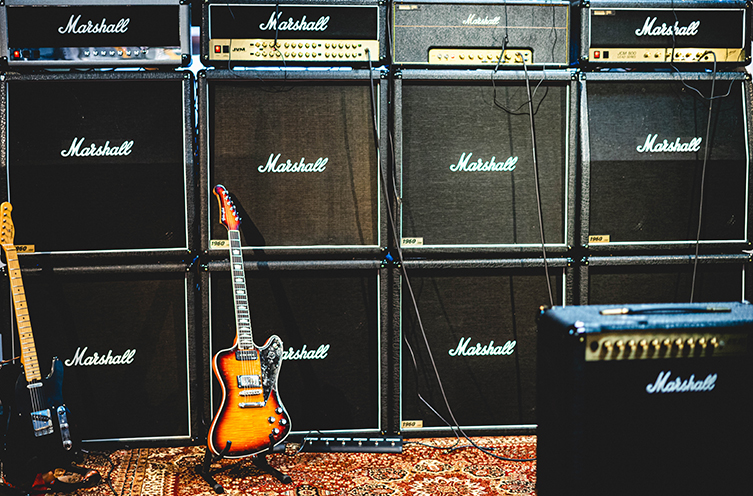
For example, regardless of what sort of style I’m trying to create a sound for, I’ve noticed that I always end up preferring a Fender Bassman amp model. Now, I have no real world preference for such an amp (if anything, I’m inclined towards the opposite), but by simply observing what my ears like and what my fingers react to, I invariably land on a Bassman. So, I recommend you do the same: not going for a Bassman specifically, but trying a few and being honest with what comes through the best for you, whatever it may be. Shoegaze with a Dual Rectifier? Maybe, and why not?
Shoegaze Pedal Board
So what for the pedals? There are essentials, and there are things that will be nice to have. What are the essentials for shoegaze, then? At a push, I’d say fuzz and reverb as a bare minimum. Those two effects do most of the heavy lifting for shoegaze tones, but let’s commit to the topic here! Use the following general list of effects for effective shoegaze tones:
GUITAR - FUZZ - OVERDRIVE - EQ - CHORUS - DELAY - REVERB - AMP
That is what I believe you need, in the order in which I reckon you should put them together. Now, I didn’t put a tuner pedal in there, but that’s because you should already know that you need that, right? Don’t be spending money on top-tier reverb effects if you don’t even have a tuner. Don’t be that person!
My chain is pretty standard: drives first, followed by modulation and ending with ambience. It’s how to get the ‘expected results’, but I’ve also found lots of fun to be had in sticking a drive pedal AFTER a reverb. Just saying…
Okay, so we have a plan of what effect types we need, and in which order. But what specific pedals are going to do the job? Read on!
The Best Fuzz Pedals for Shoegaze
The subject of fuzz pedals is a pretty subjective one. Considering how simple a typical fuzz circuit is, it’s amazing how much diversity there is in the sound. For shoegaze, I’d say it pays to have a fuzz pedal with lots of gain on tap, so you can really crush your sound. Here are a few that I’d recommend:
- Electro-Harmonix Big Muff Pi: a classic and still brilliant for chewing up your sound and making it a thrilling, buzzy mess!
- Death by Audio Fuzz War: a modern classic, OTT fuzz made by Oliver Ackermann from A Place to Bury Strangers. You have to try it.
- Fender Shields Blender: about as shoegaze as it gets! This tweaked reissue of the already-awesome Fender Blender fuzz is a collaboration with MBV’s Kevin Shields. Say no more!
- ProCo Rat: Is it a fuzz? Is it a distortion? Who cares, it's filthy sounding and absolutely brilliant!
The Best Overdrive Pedals for Shoegaze
I’d put overdrive after fuzz, personally, so that the OD’s circuit gets a chance to shape and further clip the fuzz. Placed ahead of a fuzz, it’ll just get eaten up and spat out, never to be heard in the mixture. So, for overdrives, I’d say that all of the usual contenders from BOSS and Ibanez are worth inclusion (you’ll have your favourites, I expect), along with these:
- Earthquaker Devices Plumes: a boutique overdrive with a 3-way switch to alter the ‘clip’, which means three tonal options for you. This is Earthquaker’s best-selling pedal, and once you add it to your board, you’ll quickly understand why.
- Electro-Harmonix Soul Food: whether you buy into all the mania surrounding the Klon Centaur or not (and it’s definitely a nice sounding pedal!), the fact is that this Soul Food OD from E-HX is American made, sounds pretty much exactly the same as a Klon and costs way, way, less. It’s mild, but it can be very useful in a number of ways, not least when thrown after an angry fuzz.
- The usual suspects: I feel like you’ll already know plenty about the Ibanez TS-808, TS9, BOSS SD-1 and BD-2 pedals, so let me say that they are all very appropriate choices for this part of the board.
Get An EQ Pedal
I keep saying this in these guides, and it’s based purely on personal experience. Do you want to be able to fix your live sound without trying to describe things to the engineer? Do you want one pedal that can carve your tone, without having to change settings on everything else? Do you want a pedal that can also act as an effective solo boost?
Of course you want these things: we all do! So go and buy an EQ pedal and see how much better you can sound, as well as how much you can begin to understand your sound.
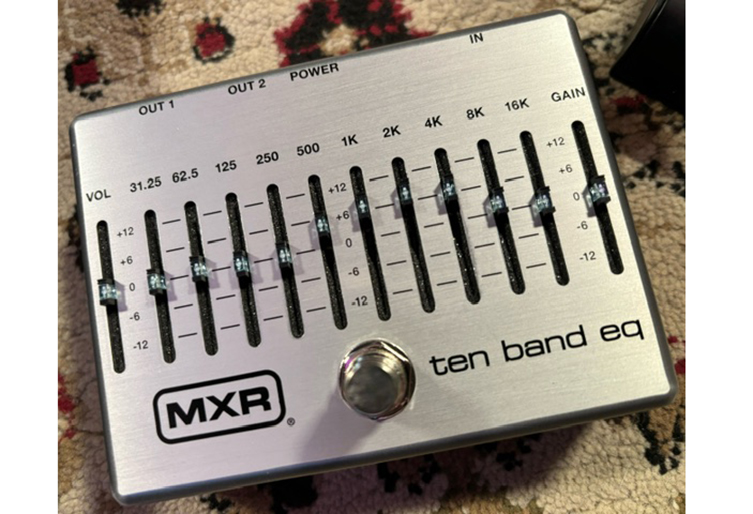
If space permits, grab a ten band EQ (the MXR 10 Band Equaliser is perfect) but if pedalboard space is limited - and if you are a shoegazer then it definitely will be! - then the 6 band equivalent from MXR or BOSS will be just what you need.
EQ tip: if you use a Big Muff pedal and get frustrated when you kick it on and your sound just disappears, then stick an EQ after it with boosted upper mids and welcome yourself back to the party!
The Best Chorus Pedals for Shoegaze
Lots of shoegaze guitar tones use modulation effects for a little movement within the sound. Modulation - and by that I mean chorus, flanger, phaser and vibe effects - all work with waves of frequencies, so there’s a pulse that travels through the sound, changing it as it goes.
For me, I believe that a chorus pedal is the correct choice for shoegaze. Flangers are more post-punk and space-rock if you ask me, and phasers are more 70s funk and hard rock. Chorus is maybe the most subtle of all of these, although it’s still pretty obvious when it is applied. A wash of chorus in your sound adds that essential ‘dreaminess’ and lushness to your playing, in a way that you can’t really achieve otherwise. Use it clean, use it on distortion, and see what happens. Here are a few good shoegaze-friendly chorus pedals:
- BOSS CE-2W: upgraded version of the ol’faithful, and as lush as ever.
- EHX Nano Clone: cheap, simple and amazing sounding.
- JAM Pedals Waterfall: boutique choice with added vibrato option.
- Old Blood Noise Endeavours BL-82 Chorus: some originality built in here with a slider offering some bizarre modulated delays.
The Best Delay Pedals for Shoegaze
Earlier, I mentioned that reverb is perhaps more important to shoegaze styles than delay. I stand by this, but we’re talking about tiny increments here, and I don’t think I’d be happy with my shoegaze pedal board unless I had both.
Delay comes in many forms these days, and you can have your delay pedal be as simple or as complex as you prefer. I’m thinking that, as a budding architect of sound, you’ll be wanting to really go to town with your ambient effects, right? It’s not a simple digital delay for you: you want multiple lines, with options to add special effects like reverse delays or modulated repeats. More than any other genre, shoegaze facilitates the effects pedal uber-nerds so why not indulge, and get some ultimate ambience? Here are my picks for you…
- Strymon Timeline: If you only buy one delay, then this is all you’ll need. It’s deep, it’s powerful and it’s decidedly musical with it. Gobsmacking quality with almost endless permutations. My top choice, basically.
- Earthquaker Devices Avalanche Run: quality boutique pedal with both reverb and delay, with swell, reverse mode and other goodies. Very creative.
- BOSS RE-2: most of the fun from the amazing Roland Space Echo head in a compact pedal format. Yes, you can do the wild oscillation effects!
- Meris LVX Modular Delay: an expensive but enormously creative delay pedal, the Meris allows you to build your own delay sound, based on the best bits of different delays. You can have the start of a digital delay and the end of a tape echo, if you get me? There’s pitch, modulation and loads of other options here, with a user interface that isn’t intimidating.
The Best Reverb Pedals for Shoegaze
Reverb is a very significant factor in any shoegaze guitarist’s sound. Today’s reverb pedals are, like the delays we just saw, able to go really deep into the edits to create some gigantic, fully ‘sculpted’ reverb signals. Using ever-increasing algorithms (‘room’ and ‘hall’ are not enough: we now need ‘cave’ and ‘cathedral’) and even creating custom atmospheres through the idea of ‘convolution’ (too much for today but basically the acoustic ‘fingerprint’ of a three dimensional space) to magic up all manner of epic sounds.
As with delays, I encourage you to lean into this. It’s fun for one thing, and it's also an area where you can investigate entirely new ways to create sound. Basically, if you just use a simple reverb pedal and turn some of the knobs up a bit, then you’re not making the most of the potential here! These reverb pedals will give you lots of power and control…
- Strymon Cloudburst: a small pedal, but it’s almost exactly what most of you will be looking for. I call this ‘shoegaze in a box’, and it is a simple and direct way to get some very inspiring sounds. All of Strymon’s big box reverbs are incredible (the Big Sky MX and the Night Sky), so treat the Cloudburst as your starting point and delve further if you require more!
- Eventide Space: this spectacular box is worth it for the ‘Black Hole’ preset on its own! Eventide are the original high-concept, high-delivery effects company, and the Space Reverb and Beyond (to give it its full title) is an unbelievably powerful bit of kit.
- Old Blood Noise Endeavours Dark Star Stereo Reverb: is this named after the John Carpenter movie? Bonus points if it is, but either way, any pedal with control knobs for Filter, Pitch 1, Pitch 2, Crush and Lag is going to be listed under ‘essential’ in my book! Another enormously powerful reverb unit, the Dark Star Stereo Reverb has onboard pitch-shifting and bit crushing, as well as an Auxiliary footswitch that can be used for octave pitching, endless sustain and more. Talk about inspiring?
No Rules!
Okay, there’s a selection of pedals that are all perfect for transforming your humble guitar signal into a momentous behemoth of sound. From crystalline to fully scorched; from bubbling under to soaring across the night sky, your guitar lines will now become musical comet trails in your songs. Take any of these recommendations or simply follow your own instincts, and I’m sure you’ll land on a setup that brings out the best in you.
It’s helpful to study the pedalboards of guitarists you admire, but it’s also good to boldly forge your own path ahead, listening to what your music asks of you, and delivering the goods. There are no rules, so use whatever you want, in whichever order you feel like, and with the controls set up how YOU like them.
Can’t wait to hear it!