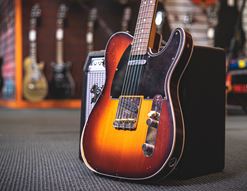
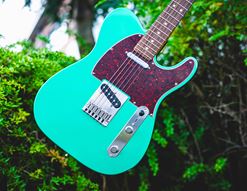
The Fender Telecaster: not only the original electric guitar, but the original riff guitar. It seems built for riffing on: it’s solid, it’s punchy and there’s no nonsense to it. This is a guitar that sets out to take care of business, so it comes as no surprise to me that so many top guitarists have wielded the Telecaster when riff-writing!
Today, I want to take you on a brief, curated trip through the world of Telecaster riffs, beginning with perhaps the most famous practitioner of all and including a few different genres as I go. If you are a Tele-maniac then these riffs are essential!

Brown Sugar - The Rolling Stones
This simple chordal riff from Keith Richards sums up a whole attitude. We all know this song, and the sound comes from Keef’s most famous Tele, a 1957 model gifted to him by none other than Eric Clapton. This guitar is known as ‘Micawber’ and generally only has 5 strings on it in order to optimise Richards’ preferred open G tuning.
Sources debate whether he used a Dan Armstrong guitar or a Gibson SG on this tune, so let’s take this as being a ‘general Keith Richards sound’, given that he plays this on his Tele live. Richards also used a similar sound for riffs like Start Me Up and Honky Tonk Women.
Here’s the equipment most likely used on the track…
Keith Richards' Brown Sugar Guitar Gear
- Fender 1957 Telecaster nicknamed ‘Micawber’, modded with a neck PAF humbucker
- 5 strings on guitar (no low E string) tuned to Open G tuning, gauge 11-42
- Fender Twin Reverb amp (a ‘Silverface’ with JBL speakers)
- Ampeg VT22 amp
Green Onions - Booker T & The MG’s
Everybody knows this tune. It sounds as if it was custom made for cheeky gangster films or Tarantino scenes with people swaggering down empty streets. It’s just a cool groove, and Steve Cropper’s minimalistic guitar part is one of those all-time classic performances. By playing so little, Cropper makes his presence massively ‘there’ when he does play, and his parts are amazingly tight and cutting.
It’s actually not amazingly clear whether Cropper used a Tele or an Esquire for this track, but since it’s clearly a bridge pickup being used, I’m going to call it and say that either guitar will do the job: the only difference between them is the pickup that isn’t even used on this record!
It’s a great Tele tone to aim for, so let’s check out what he actually used on the record…
Steve Cropper’s Tele Tone
- Fender Telecaster or 1956 Esquire
- Fender Harvard amplifier (small combo with two inputs, one volume and one tone control)
- Gibson Sonomatic Strings in gauges 10 and 11 (no longer available), also Ernie Ball Regular Slinky 10-46.
-
Custom made pick (not many details available)
Good Times Bad Times - Led Zeppelin
Most guitar freaks will know by now that immortal Les Paul god Jimmy Page actually played a fair amount of Led Zep songs on his Telecaster. An alumni of the 60s session scene, Page often opted for a Tele due to its versatile and clear sound: producers could work with the tone afterwards to make it fit into the song however they intended.
Page still used his Tele on early Zeppelin recordings. Good Time Bad Times is a good example because I don’t think it’s too overtly obvious that it’s a Tele at all. It is, though, and I believe it’s the well-known white blonde one (given to him by Jeff Beck) that later became the ‘Dragon Tele’ after his friend painted it.
He also used a Supro valve combo and a Tone Bender fuzz pedal, which is pretty standard gear for the late 60s. As I mentioned, I don’t think it’s too obviously ‘Tele’ in sound: it’s fatter and rounder, so maybe Page rolled off his tone control a little?
The key to the sound is in the space, and in some well thought-out phrases. Also, the guitar solo went through a Leslie speaker (a rotating cabinet mostly found inside organs) for that cool psychedelic sound. Lots of digital modelers today will give you a version of that, so see if you already have one in your armoury!
Jimmy Page Good Times Bad Times Guitar Gear
- Fender 1959 Telecaster, White Blonde and then custom-painted with a dragon
- Supro Coronado 1690T Amplifier
- Leslie Speaker Cabinet
- Sola Sound Tone Bender MK II Fuzz
- Ernie Ball Super Slinky 9-42 strings
Born to Run - Bruce Springsteen
The Boss is a well known Telecaster addict, and for a deeper dive, please have a read of my Bruce Springsteen Gear Guide, but for today, here’s a brief lowdown on the gear he used to get that immortal twang on the Born to Run riff. It’s a classic, biting sound, which is required for such a busy and epic arrangement. It’s a huge song, but it doesn’t need a huge guitar sound: more, the guitar is required to cut through that sonic density, which it does brilliantly.
Bruce Springsteen’s Born to Run Guitar Gear
- Fender Telecaster with a 1957 Esquire neck
- Fender Bassman amps or Peavey Vintage 410 ‘Bassman-style’ amps
- MXR Distortion +
Life in the Fast Lane - The Eagles
It’s a cracking riff from a player - Joe Walsh - who wasn’t short on quality riffs. Walsh is well-known as a Les Paul player, but this one has the unmistakable sound of the Telecaster about it, to me! It’s twangy but punchy, which is pretty much the calling card of the Tele!
Walsh is also a Fender amp guy and though he has utilised a number of ‘Blackface’ combos live, it seems that it was a Tweed Deluxe on this occasion.
Live, he seems to like using a Strat for that intro riff, but if the original recording isn’t a Telecaster, I will eat my cowboy hat.
Joe Walsh Life in the Fast Lane Guitar Gear
- Fender Telecaster
- Fender 1953 Tweed Deluxe amplifier
- Herco 75 guitar picks, or celluloid heavy
- Ernie Ball Regular Slinky 10-46 strings
Let’s Go Crazy - Prince
Now, let’s just get this one out of the way: it’s not a Fender! Don’t worry folks, I know that Prince’s famous natural Telecaster is nothing of the sort. It’s a rather fancy copy, better known as a Hohner Madcat, and it had an ash body, flamed maple top and a leopard print pickguard. The bridge pickup is slightly closer to the bridge, making for an arguably sharper sound.
These guitars originated in the 70s by a company called H.S. Anderson, who were then bought out by Hohner. It’s a Hohner one that Prince famously used during much of his career, and particularly on his Purple Rain album, from which my song choice today comes!
Let’s Go Crazy was actually recorded as a live band performance, a pretty unusual thing to do in the technology-obsessed early 80s.
Here’s what Prince used on the recording…
Prince’s Let’s Go Crazy Guitar Gear
- Hohner Madcat Telecaster copy
- MESA/Boogie MkII B amplifier
- BOSS DS-1 Distortion
- BOSS OC-2 Octaver
- BOSS BF-2 Flanger
- Colorsound Wah
- GHS Boomers strings, gauge 11-50
- Regular gauge celluloid pick
Dream Brother - Jeff Buckley
Near-mythical songwriter Jeff Buckley was quite an exceptional talent on both guitar and vocals. Unusually for an artist in the grungy early 90s, Jeff mainly opted for clean tones, which more ably showcased his unusual chord voicings.
Dream Brother appears later on in his only solo studio album, Grace. The hypnotic intro riff is classic Buckley: mysterious and exotic, whilst hinting at things to come later in the song. It’s a haunted-sounding guitar part, and not just because of Jeff’s tragic life.
Jeff’s main guitar was actually never in his possession. It was a borrowed 1983 Telecaster that was lent to him by his friend Janine Nicholls. Matt Bellamy from Muse - a massive Buckley fan - actually bought it in 2020!
Check out the box below for what Jeff used to get his timeless, snaking guitar sound…
Jeff Buckley’s Dream Brother Guitar Gear
- Fender 1983 Telecaster with a ‘top loader’ bridge, mirrored pickguard and a hot rails bridge humbucker
- Fender ‘63 Vibroverb Reissue
- MESA/Boogie Dual Rectifier Trem-O-Verb combo
- Alesis Quadraverb rack unit
- Dean Markley Blue Steel strings, 10-46
- Dunlop Tortex 0.73mm pick
Wake Up - Rage Against The Machine
Rage Against the Machine’s game-changing guitar master Tom Morello is a guy who sticks to the same equipment. Given how outlandish he often sounds, it’s maybe surprising to learn that his guitar setup is pretty straightforward. It’s perhaps more a question of how he approaches sound, and the potential he sees in his gear, particularly the Digitech Whammy pedal.
He’s also known to enjoy a riff or two! One fun rule of thumb is this: if the guitar is in standard tuning, it’s likely to be his ‘Arm The Homeless’ guitar, and if it’s in Drop-D, then it’s his black Fender Telecaster. This means that Killing in the Name is a Tele song, and so is this belter from the band’s debut album. Wake Up was featured at the end of The Matrix too, introducing even more people to Tom Morello’s humongous riffing.
Here’s Tom’s setup for this song…
Tom Morello’s Wake Up Guitar Equipment
- Fender USA Standard Telecaster, nicknamed ‘Sandero Luminoso’, drop-D tuning
- Ernie Ball Hybrid Slinky 9-46 strings
- Marshall JCM800 2205 50-watt head
- Peavey 4x12 cabinet
- Digitech Whammy
- DOD FX40B EQ pedal
- Ibanez DFL Flanger
- BOSS DD-2
- BOSS DD-3
Paranoid Android - Radiohead
Radiohead’s Jonny Greenwood is a very iconoclastic guitarist, who continually plays parts that are unorthodox and sonically inventive. I get the feeling that he’s lead guitarist by default - the other two guitarists are busy doing other things - and that he’d actually rather be doing something else, musically. This leads to a great sense of tension and dramatic dissonance in his work, all of which has a strong sense of character.
Paranoid Android is a mini epic: over six minutes of off-kilter groove and claustrophobic atmosphere. A rhythmic change two minutes in introduces us to a riff that then erupts a few bars later to give us an iconically nasty Radiohead riff. They used to be famous for this sort of thing! This riff is followed by a couple of pretty extraordinary solos, so I’ll include the gear used for those moments too, just for fun.
Jonny Greenwood Paranoid Android Guitar Gear
- Fender Telecaster Plus with Lace Sensor Blue and dual Red pickups arranged as a humbucker
- Fender ‘65 Twin Reverb (previous Fender amps stolen, including a Fender 85 and Studio 112)
- Marshall Shredmaster distortion
- Roland RE201 Space Echo
- Mutronics Mutator (for outro solo)
Jesus Frankenstein - Rob Zombie
Bearded horror fanatic Rob Zombie knows a thing or two about crushing riffs. From his early days fronting White Zombie to his latter period solo career, his music has routinely placed a high value on the power of a well-placed riff. He’s enjoyed the company of a number of top players, but surely nobody beats John 5?
Jesus Frankenstein is ample proof. It’s the intro track to Hellbilly Deluxe 2, and it’s a chunky bruiser of a riff, complete with phaser and kill-switch stuttering adding a bevy of surprises to the horrific riffing. John 5 is perhaps THE most committed Telecaster fan in the entire guitar community, owning one from every year of the guitar’s production.
John 5’s Jesus Frankenstein Guitar Gear
- Fender John 5 Signature Telecaster
- Dean Markley Signature strings 9-42
- Fender Medium celluloid picks
- Marshall JCM900
- BOSS SD-1 Super Overdrive
- BOSS OC-3 Octave
- BOSS DM-2 Delay
Telecasters are Riff Machines
Well, there are ten good reasons right there to support my argument that the Telecaster is a top-choice riff guitar. We’ve had classic rock, spooky clean and bone-crunching, with a number of stops in between. Are you convinced?
I think it takes a certain confidence to riff out on a Telecaster, but what you give out, you definitely get back, and so does your audience. True, some of the Telecasters spoken about today have humbuckers, but would you say they aren’t Telecasters? I don’t know: I wouldn’t say a 50s Les Paul wasn’t a Les Paul just because it had P90s rather than humbuckers!
What’s obvious is that the Telecaster is able to fit into a large number of genres with authority. More so than a Strat? I’d say so. What about you?