Do you want to build a pedalboard? Of course you do! It’s heaps of fun and you get to make so many cool individual choices about the exact pedals you want, the way the want to chain them up…you’re basically curating your own custom set of sounds! It’s exciting, but as you may have noticed from any rough mental calculations you’ve no doubt made over and over, the cost very quickly adds up.
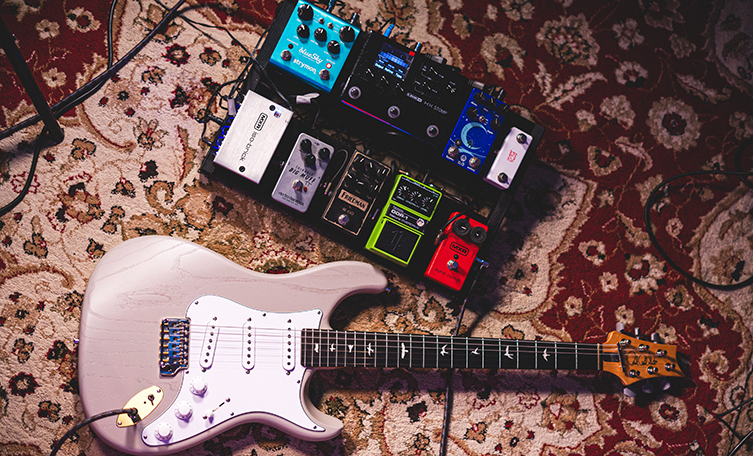
One angle is to deliberately put together a reasonably low-cost pedal board, filled with a few key ‘foundation pieces’ that you can expand upon or even swap out somewhere along the road, as you continue your pedalboard quest. Fixing a budget is a good idea, I feel. Keeping within that budget? Not so easy, but very doable, and part of the fun too if you ask me!
Today, I’ll talk you through some of the questions you might want to ask yourself as you take this journey. I’ll consider what you need, what you can leave until later, and I’ll include all of the essentials that you’ll need but may not have thought of.
After researching and talking this through with some colleagues, I’ve landed on a price ceiling of £500. Does that sound expensive? For 5 pedals and everything else you need? Not so expensive after all! In fact, just enough to cover it, more like! We’ll find out together as we put it all together.
It’s time you had a pedalboard. Lets’ do this!
Identify Which Sounds You Need
Okay, we’re going to start thinking about what’s required for your board. At this point, the sky’s the limit - within budget of course - so you can dream big and consider what sort of palette of sounds appeals to you the most. I have ideas on this, and later on I’ll put together a pedalboard to illustrate what can be had for the cash, but there’s no reason for you to go along with my ideas!
What I would suggest, though, is running through some of your repertoire critically, being mindful of what you need sound-wise in order to perform them properly. For example, I know that we all like to play lots of styles, but if you primarily play Chicago blues, say, then a high gain metal distortion can maybe wait for another time. Conversely, you may love a vintage tremolo sound for one song, but that isn’t enough to justify the precious ‘real estate’ on your pedalboard.
Identifying what you need may take a little time, but certain sounds will raise their heads to you more than others, and these are the sounds you want to have on your board. I call these pedalboard foundations, and I’ll talk about them below.
Pedalboard Foundations
My suggestions here would be to have an overdrive, a modulation and some sort of ambient pedal. With these three, you can cover a heck of a lot of ground, and you’ll be in a position to know what else you might need, from the experience of playing with this small core of effects.
Drives
An overdrive is indispensable for pretty much all guitarists. You’ll have your own ideas about which flavours you enjoy, but we’re talking about lighter, less compressed overdrive sounds, so all of your BOSS BD-2, Ibanez TS808 type effects belong here. If, however, you play grungy or alternative stuff, then perhaps you should consider a more heavy distortion as your primary flavour of distortion. If you play metal exclusively, then you definitely want to get a high gain distortion above all other choices!
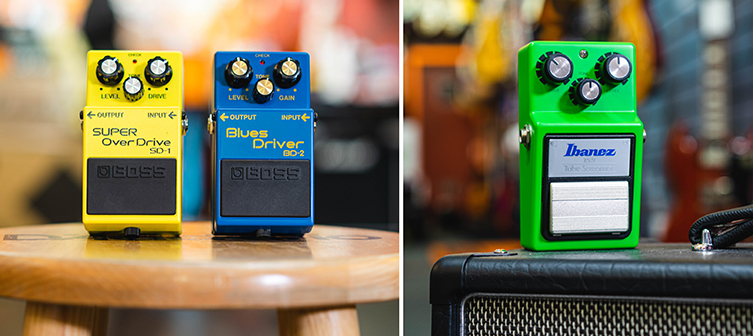
If you need a lighter overdrive, I recommend also having something that also goes a bit harder: a proper distortion pedal. Most guitar music at some point needs to get heavier and more distorted, plus it’s just one of the most fun sounds you can play with! So, check out higher gain pedals that avoid the word ‘overdrive’, since the industry takes this to mean lower gain. You’ll see my personal choice below, but also look at classics such as the BOSS DS-1 and the Marshall JCM800 pedal.
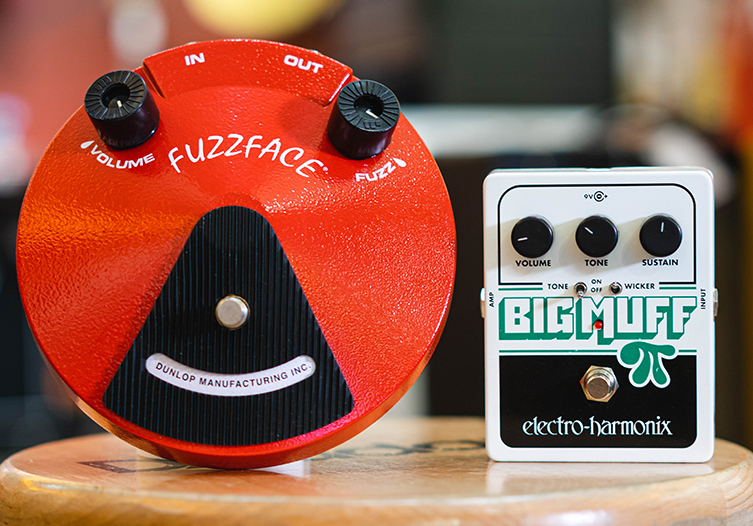
Fuzz pedals are a separate issue. I adore fuzz pedals, but I also see them as being somewhat specific to certain styles, so please understand that you’ll get a whole different experience with fuzz than you will with distortion. They sound square, squashed and over-the-top, in a glorious way. The Electro Harmonix Big Muff is the obvious choice for the budding fuzz enthusiast, since it is not only affordable, but also one of the most revered and copied fuzz circuits in existence. I won’t be putting a fuzz pedal on today’s pedalboard (boo!), but if you have the cash and the space on the floor for it, then have one!
Modulations
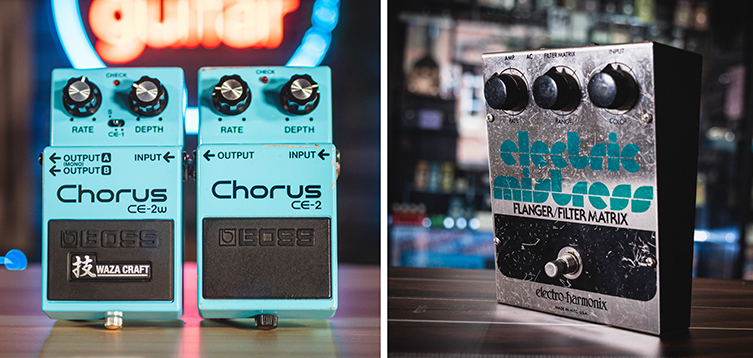
Is modulation something you need? Most guitarists do enjoy a bit of movement in their sound from time to time. Chorus is great for 80s clean tones and for stylised distortions (it can be very effective when used subtly, and horribly cheesy when used otherwise).
Flanger pedals can do chorusey sounds and also futuristic jet engine noises depending on how you set them up.
Phasers are like more psychedelic versions of flangers, and work well on most instruments. Slow settings will put you in Van Halen territory; slightly faster will help your guitar ‘Breathe’ like Pink Floyd; faster settings will sound bizarre like a 50s B-movie. All of these are valid!
For brands, it’s really up to your requirements and budgets. BOSS and MXR are industry standards, and there are endless boutique options for those who want something more specific.
One thing I would say about them all is this: some modulation pedals begin their modulation sweep (the characteristic up and down whoosh they all do to one degree or another) when you start playing, whilst others are constantly sweeping, whether you are playing or not.
This means that you’ll meet a constantly different part of the sweep when you play, if you get me? It won’t always begin at the start of the journey, as it were. This may sound like a minor thing, but as a fan of modulation pedals, I definitely have opinions on this! Your preference may differ from mine on this, but it’s good to have a preference at all!
Reverb & Delay
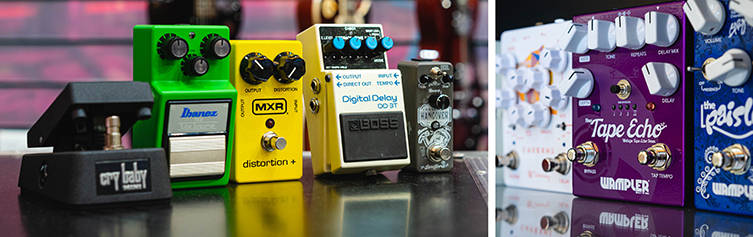
I’m going to say that some type of ambience is essential for you. Reverb and delay are required, basically. In my experience, delay is far more useful since it doesn’t wash your sound out, and because live venue spaces generally add natural reverb from the room to your sound, whether you want it or not.
Reverb & delay pedals can become very convoluted and correspondingly expensive, so I recommend either keeping things simple, or else thinking ahead about the specifics of what you might need and matching those needs. If you are playing in a cover band, a simple digital delay pedal with do you fine, but if you are playing shoegaze, then a lot of your budget may go on a sophisticated reverb pedal with lots of power and control.
The Board
You need something to put these pedals on now, don’t you? You could certainly DIY something if you’re handy that way, and I’ve seen plenty of guitarists carrying chunks of pedal-encrusted wood around that look like broken chunks of shipwreck. The same goes for the ‘charity shop briefcase’, which is cheap and effective, if a little self-conscious.
However, if we get past all of that and start considering practicalities such as weight, transport and how the pedals will fix onto the board, it soon becomes clear that investing in a purpose-made pedalboard is the only feasible way to go.
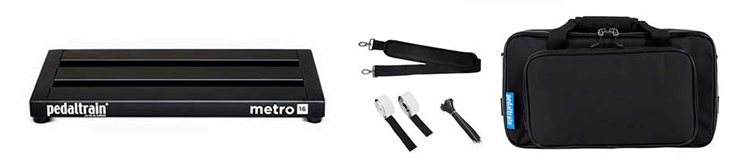
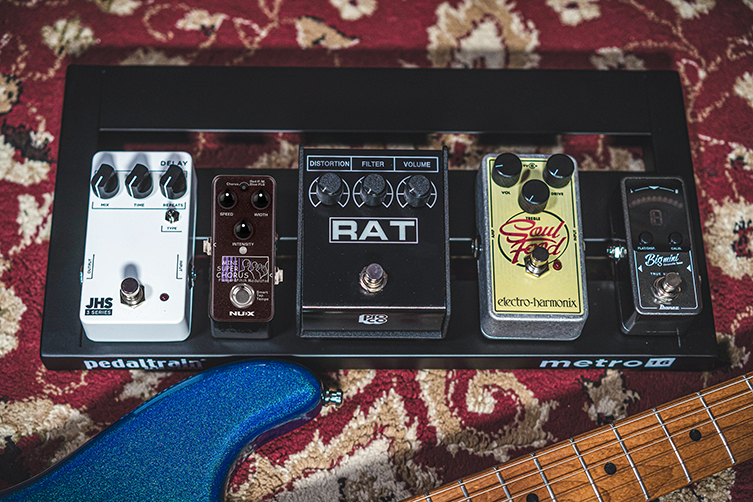
The big question is this: do you ‘futureproof’ the board by buying a larger one than you need? This gives you space for further pedal purchases, but it means lugging around more than you require, and spending more to begin with. You can decide if that’s a good shout, but I’d recommend something like the Pedaltrain Metro 16. It fits our budget well, has enough space for the pedals I’ve chosen, and it’s a trusted brand who make good stuff. This one comes with cables ties, velcro and a soft case, so it’s a good all-round package.
The Other Essentials
Building a pedalboard requires more than just a set of pedals and a board. There are other essentials involved, and they need to be purchased within our budget!
So what do we need? Thankfully, the Metro 16 pedalboard I chose for us already has the velcro and cable ties, so those boxes are checked. In addition, we need the following:
Patch cables are what I call consumables. Like strings and picks, they have a lifespan and will eventually need replacing. Buying top quality patch cables helps here immensely, but our budget won’t allow for them, so standard quality, dependable Ordo patch cables will do.
For the power supply, an isolated power supply unit allows each pedal to connect individually, rather than sharing a single power cable with ‘daisy chain’ connections. The isolated version means that you wont lose your entire sound if something happens with one of your pedals. It’s not an often occurrence, but it’s something to safeguard against nonetheless.
I’ve opted for the Ordo OP-6 power supply because it fits out needs and does not cost much cash! Again, in the future, you might want to upgrade to something from MXR, T-Rex or Voodoo Labs, but we’ve got a ceiling on prices, and this one will get us moving.
B&Q Time
I’m budgeting a tenner for a trip to B&Q or wherever. The petrol money is coming out of our own pockets, pals, not the £500! This tenner is for longer screws and bits of rubber to use as larger ‘feet’ for the pedalboard. Why? Because I want to mount the power supply underneath the board! This keeps things tidy, compact and efficient, which is a good way to handle our pedal affairs, I feel. Our chosen Pedaltrain is currently too tight size-wise, so boosting the height of the board a little (it still needs to go into the included soft case) will give us the extra room we need on the underside. Rubber feet increases the height, and longer screws allow us to attach the power supply to the board. If in doubt, don’t do this part and just be sure to keep things as neat and tidy as possible on the floor.
The Board I Built
Okay, so let’s get down to it. We’ve now chosen a board, a power supply and some patch cables. What about the actual pedals themselves? What did I decide on?
Firstly, here is the order in which the pedals will be chained on the board…
- Tuner
- Overdrive
- Distortion
- Modulation
- Reverb/Delay
This is the standard, accepted order for such pedals, and I’m not messing with that today. It’s standard because it gets the best out of every pedal, and that’s how we win this!
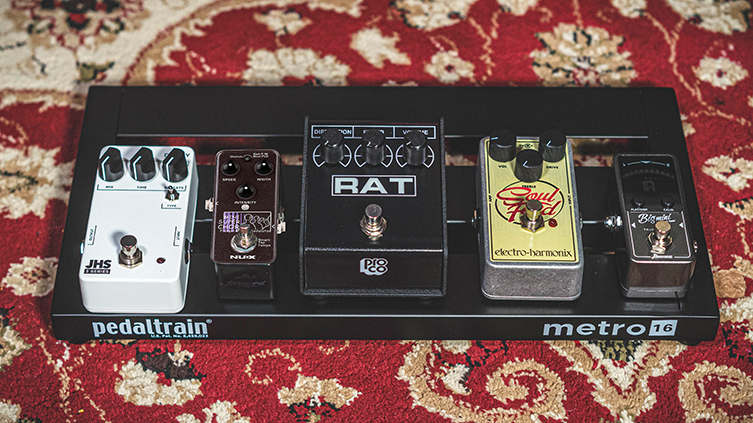
I’ve used pedalboard space for a tuner. I advise you do, too. You can have a headstock tuner if you want to live life that way, but regular readers of this blog will know that I consider it bad form to play shows with a tuner attached to your guitar’s headstock. It looks bad, and it doesn’t mute your guitar sound. Not a fan. Nothing tells your audience you’re a rookie more than performing live with a headstock tuner on your guitar. Offstage? Love them! I have one in every guitar case! But onstage? No way. Get a tuner pedal and join the pros!
Now, here are my pedal choices:
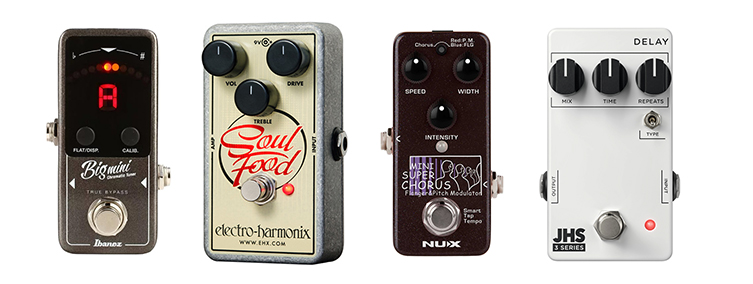
It’s a good price, it’s an excellent size for our little board, and it’s made by one of the most trusted names in the business. Ibanez are a company I know I can rely on out on the road, and this tuner does what we need, with a nice bright screen and no extra faffing about.
Overdrive: Electro-Harmonix Soul Food
In guitar circles, there is a semi-mythical overdrive pedal called the Klon Centaur. It is revered for its beautiful ‘transparent overdrive’ sound, and people pay grotesque prices for original units. I’m talking about seven thousand quid here, ok?
The Electro-Harmonix Soul Food absolutely nails the sound and feel of the Centaur. It NAILS it! Plus it’s also made in the USA by one of the pedal world’s most famous brands, and it comes in at well under a hundred quid. What beats this? Nothing, frankly.
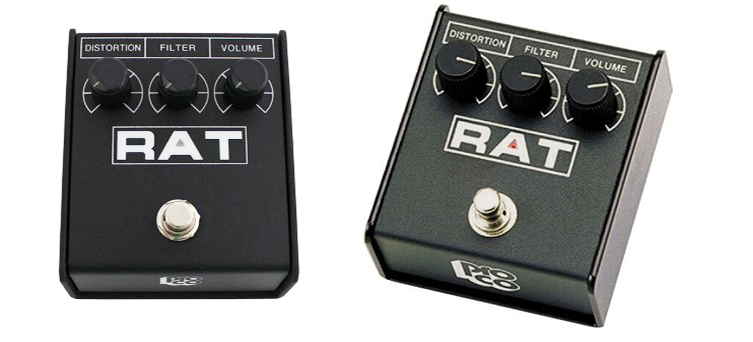
The ProCo Rat 2 is an indisputable classic. Part heavy distortion, part fuzz, it’s an aggressive pedal that somehow manages to keep your own personality intact within its sound. I love the Rat, and I don’t think any of the expensive boutique copycats (copyrats?) have out-ratted the original. It’s a great price, and it’s one helluva pedal. Between this and the Soul Food, your gain stages are absolutely dealt with, without breaking the bank!
Modulation: NUX Mini Super Chorus
Purists will want an analog chorus pedal, because they reckon the sound is ‘chewier’ or something. We do use odd terms to discuss pedals, don’t we? Well, the purists can be a boring bunch, let’s face it. We’ll leave them to their musings as we simply have fun with this digital NUX Mini Super Chorus. It’s the perfect teeny size for our board, and it’s actually three pedals in one: a chorus, a pitch modulation (a second chorus by another name) and a flanger! You can tap tempo the speed of the sweep, too. This is a cracking pedal with good quality sounds, a USB input for updates and a metal chassis for a long gig-life. For this price, it’s a steal!
Reverb/delay: JHS 3 Series Delay
The JHS 3 Series was and is a game-changer. JHS are a boutique brand, who hand-build their pedals in the USA. This 3 series is also that (made by the same people in the same place) but built to be extremely affordable. It’s a great concept, and many other boutique brands have followed suit, which is only great news for us!
The JHS 3 Series Delay is a great, regular, no-frills delay pedal. There’s a switch for choosing between digital (clear) delay or analog-style (warmer sounding) and you get up to 800 ms of delay time which is more than enough for general use. Having a pedal like this for the price they ask is a real blessing for us, because it’s light years better than comparably cheap delay pedals. This is a solid, pro tool that sounds lovely.
Did I Make It Under £500?
Okay, those were my choices! How much did it all come to? Did I make it under our self-imposed ceiling of £500? Let’s find out, using today’s (31st August 2026) pricing…
Pedaltrain Metro 16 pedalboard with soft case: £65
Ordo OP-6 Power Supply: £29
Ordo patch cables (right angle, 10cm, £3.99 each) x5: £19.95
Ibanez Big Mini Tuner: £55
Electro-Harmonix Soul Food Overdrive: £79
ProCo Rat 2 Distortion: £85
NUX Mini Super Chorus: £59
JHS Pedals 3 Series Delay: £99
B&Q trip for larger screws and rubber feet: £10
Grand total cost for pedal board: £500.95
I overspent by 95p! Do you think the team at guitarguitar would let me off with a quid?
I have to say, I’m very happy with this pedalboard! It’s versatile, filled with inspiring pedals, and I managed to get lots of good, trustworthy brands in there, too! Five excellent pedals and a power supply, a good pedalboard with a case, AND all of the cables, all for (practically) £500? I reckon we’re winning here!
No Right, No Wrong
This article is just brain food and suggestions for you. Your pedal board should of course meet your needs, not mine, even though I thought hard about what would work for most players without it being bland. If all you want to do is chain together five fuzz pedals, then more power to you! Let me hear your rig when you’re ready!
But for most of us, we do need a good selection of sounds, because they are all colours on our painter’s palette. I think I’ve put together a pretty good pedalboard for a modest price, once all factors are taken care of. Plugged into a decent clean tube amp, I think anybody would sound great with my selections, but then of course I’d say that!
Anyway, the point is: there is no right or wrong when it comes to figuring out your pedalboard. That includes pedal choices, the order in which they occupy the board, and the order in which they are chained, since those are two quite separate things.
Have fun, experiment, form opinions on the sounds that you make, and HAVE FUN!