How much do you love fuzz pedals? They are some of the oldest effects made for guitars, and they are still some of the wildest, most expressive and extreme, too. Nothing messes up a guitar tone as gloriously as a dimed fuzz pedal, and those sounds have inspired some of the coolest songs in history.
Want proof? Check out these twenty examples from throughout the decades, alongside some info on exactly which fuzz was used on each track. These are not in chronological order, because fuzz tones are timeless!
Turn on, turn up and get fuzzed out on this list!
(I Can’t Get No) Satisfaction - The Rolling Stones
We all know the story here. Keith Richards wanted his guitar to sound like a horn section, so plugged into a Gibson Maestro and played one of the most famous riffs in guitar history. Did he succeed in achieving his horn section vibe? I’d say ‘sort of’ but maybe made something better in the process.
Plug In Baby - Muse
Matt Bellamy’s early years as a guitarist were perhaps his most inventive, and this song from Muse’s second album Origin of Symmetry is a prime example. It’s one of his most distinctive signature riffs, filled with barmy neoclassical notes that threaten to disintegrate under their own giddiness. Sonically, Matt’s Z-Vex Fuzz Factory is responsible for the mangled tone and those sci-fi noises at the start.
Purple Haze - Jimi Hendrix Experience
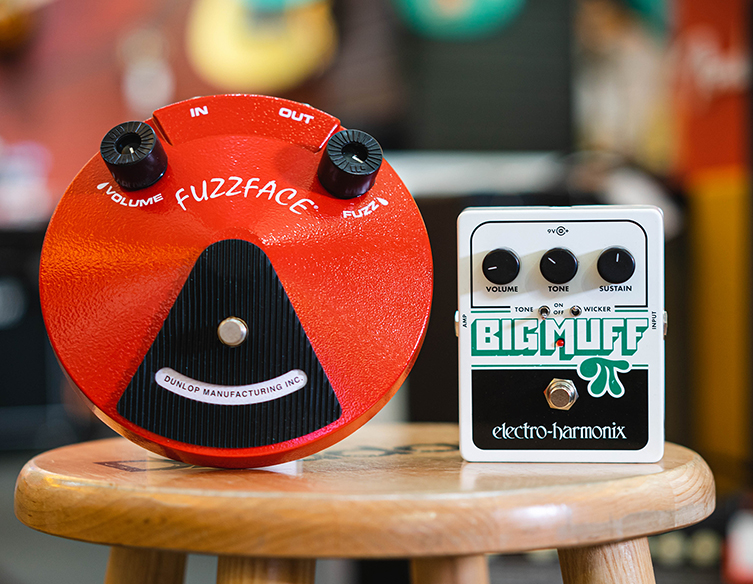
Fuzz Face AND Octavia? Yes, if you are the most legendary guitarist of all time. Hendrix used the Dallas Arbiter Fuzz Face for his main distortion tone (that and volume) but for Purple Haze, he used his other famous pedal, the Octavia. This Roger Mayer-designed unit added an upper harmonic octave note to certain frequencies, lending an other-worldly quality to Jimi’s iconic riff and solo. Bridge pickup for the riff, neck for the solo, to get more out of those octaves!
Touch Me I’m Sick - Mudhoney
Any band who has an EP title made up solely of fuzz pedals is going to be an obvious choice for this list! So it is with Seattle grune progenitors Mudhoney, whose members were once in Green River, the band who became Pearl Jam. Touch Me I’m Sick was their first single from the EP Superfuzz Big Muff (indeed, those are the two fuzzes you hear on this song), and you can absolutely hear where Nirvana got their inspiration from.
A Place to Call Home - Big Wreck
He must get sick of constantly hearing this, but Big Wreck’s Ian Thornley is the world’s most underrated guitarist. A monster on the fingerboard, he’s also a supersonic singer and writes tunes that Canada loves but the rest of the world seem to keep missing. This tune’s epic guitar parts are harmonized tracks of Thornley’s Prescription Electronics Experience fuzz pedal. Live, he uses his signature Suhr Thornicus fuzz for his fuzzy filth needs.
Spirit in the Sky - Norman Greenbaum
It’s a classic riff, and almost sounds like a retro organ with its syncopated stabs. So which fuzz pedal was used? Actually, not a pedal at all, but a custom fuzz circuit which Greenbaum had built into his Telecaster! Fuzz aficionados point towards the circuits possibly being a progenitor of the Jordan Boss Tone, and others saying that a dying battery is required to get that lovely sag and squelch captured on the record.
Cherub Rock - Smashing Pumpkins
Siamese Dream, the Pumpkins’ second record, is covered in quality fuzz tones, including leads recorded with a vintage Fender Blender pedal. But it’s the gargantuan riff and rhythm parts that make the biggest impression, and they all come from an Op Amp model Big Muff.
Guitarist Billy Corgan’s trick was to connect his Lace Sensor-equipped Strat into the pedal, and then into his Marshall JCM800’s low input. Then, he’d turn the master volume all the way up, but the input preamp volume was almost off. This made the Marshall effectively a clean, loud power section with very little of its own gain sound. Unorthodox for sure, but what a sound!
Rebel Rebel - David Bowie
When Bowie began writing and recording Diamond Dogs - his segue away from Ziggy towards his ‘plastic soul’ phase - he decided to ditch his backing band and handle all guitar duties himself. This timeless riff upon which all of Rebel Rebel hangs, then, is Bowie’s handiwork, and he used a Sola Sound Tone Bender fuzz to achieve that distinctive clang.
Blue Orchid - White Stripes
A latter-day connoisseur of fuzz, Jack White’s guitar tones are always worth paying attention to. I opted for Blue Orchid because it’s one of his catchiest and most memorable guitar hooks. And because the tone is superb! This one requires two selections from Electro Harmonix: the Big Muff and the Nano POG, in order to get those freaky low octave notes.
Time - Pink Floyd
Whilst you may or may not associate David Gilmour with fuzz sounds, one of his most inarguably great guitar solos is covered in it! Yes, the mighty Time solo from Dark Side of the Moon sees Dave using a Dallas Arbiter Fuzz Face alongside an ambient tape-style echo. It seems to me that the neck pickup is where you want to be for this, if you’re going for it yourself!
I Wanna Be Your Dog - The Stooges
Iggy and the Stooges are the blueprint for so many guitar bands that followed, in both attitude and songcraft. This is one of their most famous tunes, and speculation runs rife as to just what guitarist Ron Asheton used to create his sound. Some sources maintain that it was a Gibson Maestro fuzz, others say a Voz Tone Bender, some think it’s a Mosrite FUZZrite, and others again think it’s more like he plugged straight into an overdriven mixing desk! More on that later, but the real take away here is that it’s awesome, and all about the execution.
Elephant Talk - King Crimson
King Crimson are a kind of treasure trove of guitar excellence, particularly so during the 80s ‘Discipline’ era. With Adrian Belew joining Robert Fripp on duelling, weaving guitars, there’s loads to love. I’ll draw your attention towards Belew’s performance on Discipline's opener Elephant Talk. Those wild elephant noises are little more than an Electro-Harmonix Graphic Fuzz, a flanger, and technique. For further fuzz nastiness, hang on for Belew’s guitar solo later on. Fans of this style will love Belew’s solo on KC’s Waiting Man, which in fact is manipulated, fuzz-laden feedback, where the guitar’s body itself is worked on to produce the noise.
American Woman - The Guess Who
Another classic, this song from the Guess Who is a road anthem with a delicious fuzz melody line on the guitar. Guitarist Randy Bachman plugged his ‘59 Les Paul into a Herzog preamp for the fuzz, before it went through a Garnet model amp. Tech 21 have since recreated that iconic tone with their American Woman pedal.
Iron Man - Black Sabbath
We all know the story about Tony Iommi’s fingertips by now, right? Let me just highlight the gear used for this gargantuan sound, then. Not a fuzz per-se, but Iommi’s thick, mangled tone relied on his Gibson SG, his Laney Supergroup 100 amps cranked loud, and a Dallas Rangemaster treble booster in front of that to push the preamp into righteous gain. Iron Man was before Iommi tuned to C#, so standard tuning with a very light touch is required.
Sabotage - Beastie Boys
Why do guitarists get to have all the fun? Fuzz bass is also an excellent thing, and my example for today is from hip hop pioneers The Beastie Boys. I’ll take any excuse to show this wonderful video again, to be honest, but we’re onto some legitimately awesome fuzz here with the late, great MCA’s bass sound. On the record, he used a Black Cat Superfuzz, which itself is (I believe) a copy of the Univox Super fuzz.
Seer - Witch
Does it get any fuzzier than this? I could use so many superlatives here, like ‘grinding’, ‘wheezing’, ‘disgusting haze’ and more, but really, it’s just tons of mangled fuzz, and towards the end, the fuzz takes over completely. J Mascis is in this band, but he’s not even on guitar duty. This fuzz odyssey has Kyle Thomas and Graham Clise on six-string duties, and whilst the riffing is fairly generic doom/blues stuff, it’s the sound itself that makes the tune such a joy.
Loud amps, seemingly no bassist, and fuzz pedals that have so far defied my identification are all in play here. I’d be surprised if they used Big Muffs here: somebody has suggested the D*A*M/Emanating Fist Effects Black Dust pedal, so that may be a good place to start looking!
Drunken Butterfly - Sonic Youth
Were you wondering when this lot were going to show up on the list? Sonic Youth are so associated with off-kilter indie rock/violence that it’s more a question of which one track best shows off their fuzz mastery. I admit that the noisy bits of Candle were my immediate choice, but upon thinking a little longer, this one came out on top.
Straight away, you’ll hear why so many alternative artists love Sonic Youth so much. Wave upon wave of seasick, out-of-tune-adjacent guitars, treated with (I’m taking an educated guess here) the unholy trinity of Sovtek-era ‘Civil War’ Big Muff, MXR Blue Box and ProCo Rat, and all of it a joyous journey into the dramatic and the atonal.
To Here Knows When - My Bloody Valentine
I don’t know about you, but I feel like there’s something almost heroic about the amount of sheer abstraction involved in this sound. Kevin Shields’ reputation is based around this sort of approach, which involves an original tuning (E-B-E-E-B-E, capo 3rd fret to save you Googling), huge swathes of fuzz, a backwards reverb patch (he used the Yamaha SPX90) and judicious use of Shields’ ‘glide guitar’ technique, which amounts to strumming whilst gently pushing on the guitar’s tremolo arm so mess with your pitches ever so slightly.
Now, that’s enough already, but it’s not the full story! No, I’ve heard reports that the whole guitar part is ‘reamped’, and by that I mean that the already fuzzy guitar sound is recorded, and that audio is fed back through an amp sound to add yet more distortion and noise!
Like I said: heroic.
In-A-Gadda-Da-Vida - Iron Butterfly
These San Francisco hippies were ahead of their time, creating a proto hard rock sound in the late 60s that foreshadowed heavy metal by a few summers at least. This song (the title is a pun on ‘In the Garden of Eden’) is actually 17 minutes long in its true form: it takes up a whole side of vinyl, and most of us only know a chopped down radio edit. From what I can gather, this tune is another example of the use of the Mosrite FUZZrite, played by guitarist Erik Braunn with a Mosrite guitar and a Vox Super Beatle amp.
Discotheque - U2
Now, be honest: were you expecting to see U2 on here? The Edge isn’t exactly renowned for being a fuzz maniac, is he? Well, that may be the case, but jump across to the 2m13 point of this single from 1997’s Popmart album, and you’ll hear one of the foulest, nastiest and most abrasive fuzz sounds to ever make it to a finished song.
What is the pedal? I believe it’s a Lovetone Big Cheese, which has controls for ‘curds’ and ‘whey’. A word of warning: take a deep breath before checking out the prices for these pedals on the used market.
The Fuzz Factor
What did you make of these 20 prime examples of fuzz-rocity? There are endless examples of cool sounding fuzz pedals out there, but I hope that this collection has delivered a nicely rounded look at the varieties of filth that exist out there in the world. From classic 60s rock to some unfathomably messed up sounding guitars in modern music, fuzz has always been a way to create extra art and texture from simple guitar playing.
Did any of this inspire you to check out fuzz pedals? I hope so! They are too much fun to pass up on. Below is a little carousel of some great fuzzes that are available today. Treat yourself, and remind yourself how fun guitar playing can be when you make a horrendous racket!