Do you love Neil Young? He’s one of the most celebrated songwriters in history, with a back catalogue that is as labyrinthine as it is picked over by his obsessive fans. The Canadian rocker has worn a great many musical hats over his 6 decades of performing and writing, and has even been sued by his own record company for releasing music that wasn’t ‘Neil Young enough’!
So, for newbies, that means that you can expect a few curveballs from time to time, in a career that has been unpredictable to say the least. From a folkie-hippie on the Laurel Canyon scene to the Godfather of Grunge, Neil Young isn’t someone who hangs around in any one place for too long. Ordinarily, this might lead to questions about just what his style and author’s voice is really like, but it seems to me that no matter what angle he writes from, that singing voice and writing style are unmistakable.
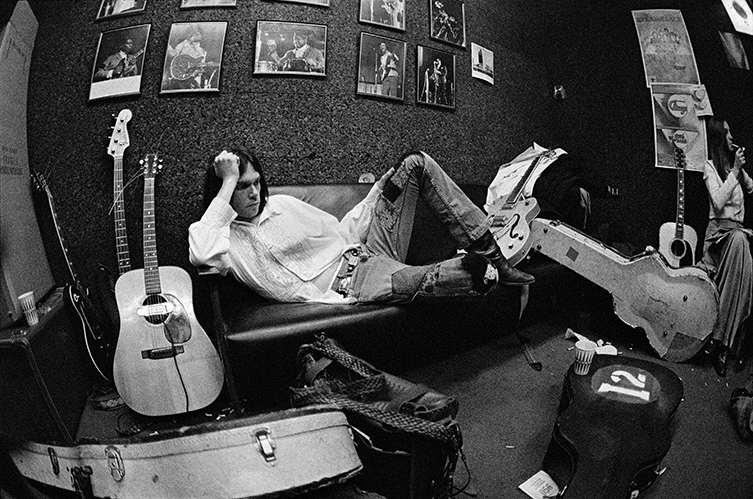
(Pic: Joel Bernstein)
So, with that in mind, I’ve sifted through the racks to pull out what I consider to be Neil Young’s best albums. I’ve not included them all of course, because there are over 45 of them, and to be frank, not all of them are amazing records! But the ones on this list are, and as a long-time Neil Young fan, I feel like I’ve stayed with them long enough to foster some genuine, unbiased opinions. From my selections today, I’m starting from the least incredible and moving towards the most incredible, though again: there is nothing but great tunes here!
Have a look and see what you think!
Comes a Time (1978)
I feel like this record is a spiritual sequel to Young’s superlative Harvest album. He formally followed that smash with 1992’s Harvest Moon (see below), but Comes a Time has a very similar, easy-going charm with a slight edge given by the tunes that have Crazy Horse playing on them. That said, this is a mostly solo effort, and is an example of Young occupying his most ‘almost serene’ mood.
Zuma (1975)
Appearing after some of Young’s darkest records - known collectively as the Ditch Trilogy (see a few in this list below) -, Zuma saw Young and Crazy Horse go off into one of their best extended cosmic jams. This is the album that will either make you love Young’s guitar style, or it’ll be solid proof of how much you don’t!
Zuma goes back to the crunchy 70s country rock sound that Young played with Crazy Horse on records like Everybody Knows This is Nowhere, complete with extended guitar solos on songs like the famous Cortez the Killer. Whilst perhaps not the place to begin on a journey through Young’s music, it is one that reveals itself as great after you’re fully immersed in his style and sound.
Harvest Moon (1992)
The official sequel to Harvest, this record sees Neil Young 20 years older and perhaps 20 years more reflective, though he always was, wasn’t he? Harvest Moon is a relaxed affair: a sensitive, self-aware record that features several musicians from the original Harvest album.
Much of the serenity on display here is a direct response to Young’s previous record, Weld. Basically, Weld came after the already noisy Ragged Glory, and ended up giving him tinnitus, so he took a hint and turned his amp down! For a while at least, until Pearl Jam showed up for Mirror Ball, but that’s another story.
Everybody Knows This is Nowhere (1969)
Young’s second solo album, and the first credited to ‘Neil Young and Crazy Horse’. Crazy Horse were a three piece band made up of Danny Whitten, Billy Talbot and Ralph Molina. Initially called The Rockets, Young renamed them War Babies when they agreed to become his backing band, and then quickly changed to Crazy Horse.
This album has a number of all-time classic songs, not least Cinnamon Girl (with co-lead vocals by Danny Whitten), Cowgirl in the Sand and Down By the River. One of these songs has a literal one note guitar solo, and another has a guitar solo that just won’t quit. That’s Neil Young for you!
Tonight’s the Night (1975)
A haunted record, but only if you know the context. On the surface, it’s a vibey, melodic album with crunchy band jams and some wonderful solo songs (Borrowed Tune always stands out to me), but knowing the world that this album was birthed into does change things. Written in 1973 and performed live, Young was still reeling from Danny Whitten’s death, whilst still having Crazy Horse play on a number of songs here. As I say, haunted. Young was 28 when he made this but sounds decades older. His record company actually didn’t want to release the album because it sounded so bleak (again, I don’t hear it superficially!), and it took two years to show up on the racks.
Ragged Glory (1991)
If the 80s were a bit of a confusing time for Young - with record company lawsuits and all the rest - then the 90s were where he refound his mojo. In fact, it was a year earlier, with 1989’s Freedom album, which just narrowly missed inclusion today.
Ragged Glory is talked about as being the harbinger of grunge, but I feel like it’s looking back towards early Crazy Horse records more than anything else, and that those records (Everybody Knows This is Nowhere and Zuma, both on this list) are in fact the grunge blueprint albums. Ragged Glory is like an angry animal reclaiming its territory, rather than discovering new pastures.
All of that would mean nothing if the songs weren't up to scratch, but Ragged Glory is a ball to listen to, filled with melody and buzzing feedback in equal measure. Best Crazy Horse record? I reckon so!
On the Beach (1974)
Written after Tonight’s the Night and unavailable for a number of years, 1974’s On the Beach sees Young fully immersed in the emotional and existential pain of loss. Loss of his friend, loss of the dreams of the 60s, and loss of a certain level of personal identity due to this, Young nevertheless serves up an album of some of his best songs.
On the Beach is part of Young’s unofficial ‘Ditch Trilogy’ that I mentioned earlier, alongside Time Fades Away and Tonight’s the Night, and represent the songwriter at perhaps his most potent.There’s melody here for days, and whilst the outlook could be considered bleak, the album still sounds as distinctive and appealingly ‘Neil Young’ as his best work.
Rust Never Sleeps (1979)
Half-acoustic, half-electric: all live, all new. What a concept! Rust Never Sleeps presents a platter of songwriting gold in a fully live format (these are the official, definitive versions of the songs: no ‘studio’ renditions supersede these), with the first half ostensibly solo acoustic. This is where you’ll find the famous My, My, Hey Hey (Out of the Blue), with it’s famous line of ‘It’s better to burn out, than to fade away’ being quoted by Kurt Cobain in his suicide note.
The song’s twin version - Hey Hey, My, My (Into the Black) - appears on the raucous, full-band section of the second half. This is where Young’s fans say that he invented grunge (they do say that a lot about him), and whilst you’ll have your own opinions on that, it’s still a pretty powerful collection of tunes, played with venom and swagger unequal measures.
Harvest (1972)
Neil Young and the early 70s is one potent combination! Harvest, his fourth solo record, is an ambitious, widescreen album that bridges many of his subsequent ‘eras’, to coin an annoying modernism. From delicate, brooding acoustic laments (The Needle and the Damage Done) to the almost cinematic epic vistas of There’s a World and A Man Needs a Maid, Young was able to sing about the twilight of hippie culture, the emergence of something altogether less wholesome, and do all that without having any direct references to those things. I suppose that’s the real art of this album.
Those feelings can be felt - encapsulated, actually - on The Needle and the Damage Done. A solo acoustic song about addiction, this song was written in reference to the heroin problems suffered by Crazy Horse guitarist Danny Whitten. Already fired from that band, Young hired him for another band The Stray Gators, but eventually had to let him go due to his impaired performance. Immediately after being fired, Whitten overdosed fatally on diazepam and alcohol. Young lost a close friend, a musical foil, and a sense of optimism. It’s all in that song, written when Whitten was still struggling. “Every junky’s like a setting sun”, must be one of the angriest lyrics ever written.
After the Goldrush (1970)
As a collection of songs, After the Goldrush is pretty hard to beat. It’s melodic smash after melodic smash, but even that hardly takes in the immensity of what this record really is. Written in several places and recorded with different line-ups, it’s a remarkably cohesive album, and I see it as Young taking stock of the entirety of the 1960s, and then also looking ahead into the future. In fact, it’s almost like a handbook of American songwriting, featuring country, folk, rock, balladeering and scuzzy rock, all with a deftness of touch and Young’s trademark sense of elegy. This is prior to the loss of Whitten and other friends to heroin, too.
After the Goldrush was actually inspired by an unproduced movie script of the same name, partly-written by Blue Velvet and Quantum Leap (!) actor Dean Stockwell! Needless to say, this is not essential prior knowledge required to enjoy the record. Indeed, this is not only Young’s best collection of songs, but his most accessible too, alongside Harvest. Absolutely, completely essential listening for anyone who enjoys music, basically.
Every Musician Should Listen
Considering that Neil Young’s singing voice is something of an acquired taste - and maybe more so for his guitar solos - I still believe that every budding songwriter should pay close attention to the albums at the top (bottom, in this case!) of today’s list. Simply put, After the Goldrush and Harvest are blueprints on how to write timelessly great songs, and about how to put them together as albums. They stand toe to toe with any other artists’ best efforts, and are continually relevant to modern life, which in itself is a notoriously difficult task for any musician to achieve.
It may be true that Young’s impact as an artist is sometimes diluted by the sheer volume of music he puts out, but try these ten records and I think you’ll find that there is a lot of gold to mine here. After that, there’s only another 30-plus albums to consider!