Welcome, Martin guitar fan! Thanks for clicking through here today. I expect you love Martin guitars but are a little bewildered by the barrage of styles, series and numbers that accompany this brand, right? Well, let me present it all right here in a hopefully straightforward and easy to understand manner.
For those looking to get more detail on the different Martin body shapes, I will cover that here, but click through to my Martin Body Shapes & Sizes guide for more. In today’s article, I’ll group together the styles (in other words, the number part of a Martin guitar name), and the different series that exist (Modern Deluxe, Streetmaster etc) and hopefully bring you everything you need to understand the Martin ranges.
I’ll be your guide today so please, save your questions till the end and step right this way…
The Prefix: Martin Body Shapes, Briefly
Martin make several guitar body shapes, all of which will be well known to you since they’ve been so influential over the years. As I mentioned a little earlier, there’s a deeper dive into the body shapes available in a separate blog (see above), but for a quick reference, I’ve got them all here, from smallest to largest.
- Backpacker - small lute-like travel guitar, made for ultimate portability
- LX - Little Martin - downsized travel guitar with a roughly dreadnought-shaped body
- 0 - Concert - Martin’s smallest full-sized guitar, and one of its oldest, too. Parlour-ish, and good for a soft, gentle tone.
- 00 - Grand Concert - a little larger and louder than the 0, this is a popular style for acoustic blues. Another 19th century guitar design.
- SC - a new offset style that is designed to balance well and be particularly easy to play.
- 000 - Auditorium - (nicknamed ‘triple oh’) larger and louder than the 00, this is a very popular shape. Delivers a good mix of sounds and is still more slender than a dreadnought.
- OM - Orchestral - actually the same body shape and size as the 000, but distinct due to it having a slightly longer scale length og 25.4”, as opposed to the 000’s 24.9”
- GP - Grand Performance - a relatively new shape, this is a smaller version of the Grand Auditorium/Jumbo shape, and is considered a mix of the 000 and Dreadnought.
- D - Dreadnought - the most popular shape of all time. The dreadnought delivers plenty of volume and low end, making it effective at all styles of playing.
- J or 0000 - Grand Auditorium - sometimes referred to as a ‘jumbo’, this is Martin’s largest acoustic body and is actually relatively rarely made.
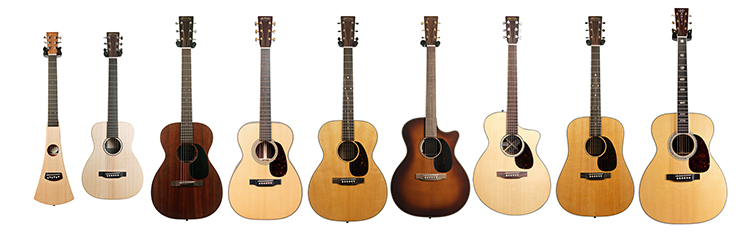
(Martin guitar bodies l-r: Backpacker, Little Martin, 0, 00, 000, GP, SC, Dreadnought and Jumbo)
Also worth noting: H - an H in front of a model (HD-28, for example) denotes extra herringbone purfling around the top, next to the binding. There’s more to the differences between the models, actually, but that’s another story.
The Suffix: Martin Style Numbers Decoded
Okay, now for the part that tends to be a little confusing. The number part of a Martin guitar’s name tells you the style and also the level of decoration involved in the build. What I expect you’ll notice is that things basically get fancier and more expensive as the numbers increase. This can refer to the timbers as much as the bling, since it’s just a fact that Indian rosewood is more expensive to buy than mahogany, for example.
Do please note that I said ‘more expensive’, not ‘automatically better’. Which is better is between you, your fingers and your ears. But for reference, here’s what those numbers mean:
10 - solid sapele top, satin finish
11 - solid spruce top, solid sapele back & sides, gloss top, satin b&s
12 - same as above but full gloss finish with black binding on body
13 - same as above but with white binding on body
15 - all solid mahogany top, back and sides, satin finish
16 - different woods depending on models (“Martin’s playground for experimentation”), all solid construction with a gloss top. All 16 models have thinner bodies, too.
17 - solid spruce top, solid mahogany back & sides, satin finish, specific 1930s looks in terms of decoration and finishes
18 - solid spruce top, solid mahogany back & sides, full gloss finish
28 - solid spruce top, solid rosewood back & sides, full gloss finish. Bigger tone, arguably the definitive Martin tonewood combination.
35 - solid spruce top, rosewood back & sides, with the back being built as a 3-piece decorative design. Lighter bracing for a warner sound.
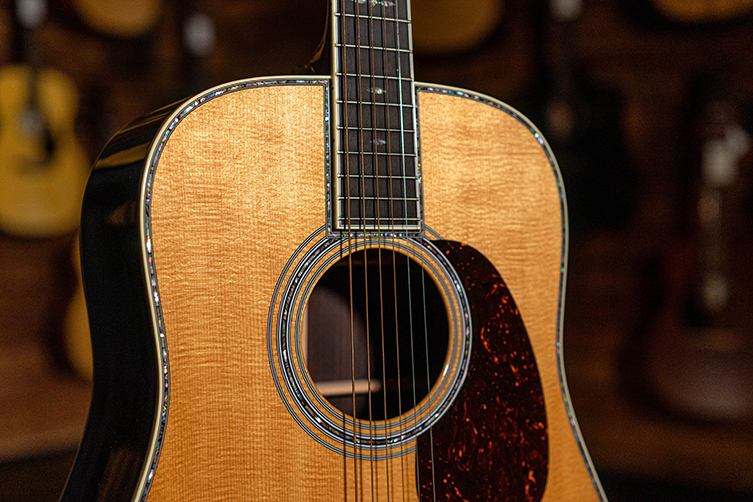
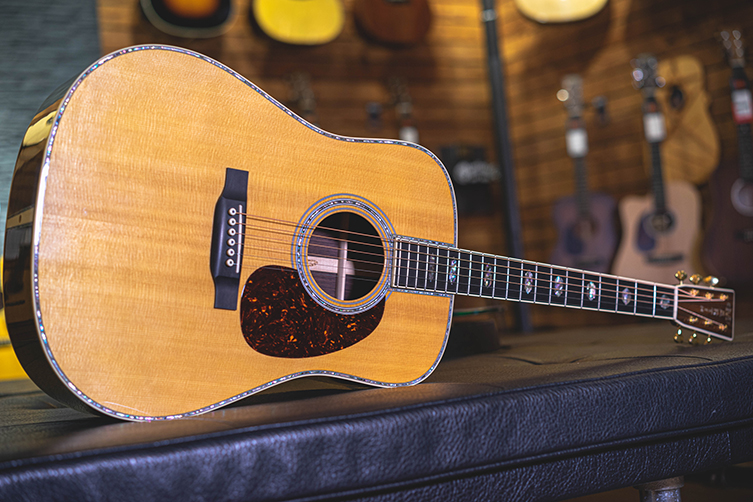
40 through 45 - solid spruce top, solid rosewood back & sides, increasing amounts of decorative work including abalone purfling, inlays and more.
The above list doesn’t include Martin Custom creations, simply because custom guitars routinely break the imposed rules of a range. After all, they’d hardly be ‘custom’ if they conformed to what already existed, right?
Extra Naming Conventions
As a little addition to the above, here’s a few more things that are handy to know about Martin guitar naming…
- HD - I mentioned this before, but here it is again. ‘H’ refers to herringbone purfling. You’ll most likely encounter this with a Martin HD-28, so the H counts for the herringbone, and for different inner bracing, resulting in a different sound as well as a different look.
- X - Martin’s X series. If the guitar has an X in the name, then it’s from the Mexican-made X series.
- C - this guitar has a cutaway in the body (almost always a Venetian cutaway shape these days).
- E - Electronics - any guitar with an E in the title has a pickup system fitted.
Martin Series
Lastly, let me talk you through the line ranges available from Martin. This will cover most of the guitars that you’ll encounter, but some areas such as Martin Custom Shop, will not be included here.
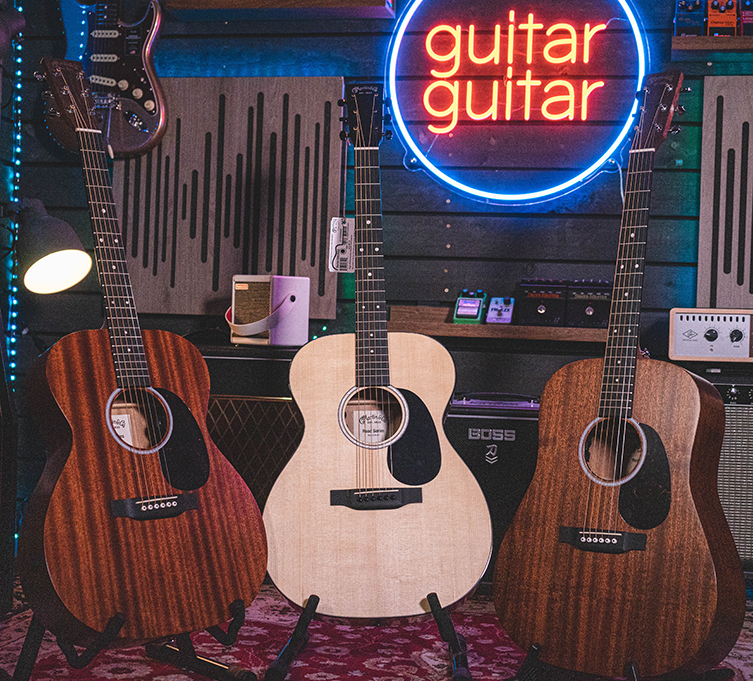
- X Series: Mexican-made range that offers value for money and gig-ready guitars. Also described as eco-conscious, since Martin use High Pressure Laminate to create the instrument bodies. X1 guitars are entirely made from HPL, whereas X2 models have a solid timber top.
- Standard: the real-deal, full-fat Martin range, made in Nazareth, Pennsylvania. The models adhere to more traditional styles and builds.
- Reimagined Standard: a 2018 overhaul of the Standard range that brought certain elements into a more modern context (wider nut, neck carve), but sought for more vintage authenticity in other areas, such as altering the bracing and using aged toner for the finishes.
- Modern Deluxe: a contemporary alternative to the Standard series, which blends classic Martin shapes with more modern features. Carbon fibre bridges, asymmetrical ‘Vintage Deluxe’ neck profiles and spruce tops that are treated with Martin’s VTS (vintage tone system) process.
- Authentic: directly referencing Golden Age guitars (from 1920-1942, roughly), these are all about keeping faithful to the original historical models. Martin use their VTS system (see above) for this, which is their own name for torrefaction. Torrefaction is a process of drying out timber in an oxygen-free kiln to strengthen the wood and achieve tones that sound the same as century old guitars.
- Streetmaster: These are factory-aged guitars with satin finishes, similar to the ‘relic’ guitars you’re no doubt familiar with. These guitars have aged tuners and some more retro-centric detailing so complete the illusion of them being old guitars.
- North Street - Martin North Street guitars are a line of Custom Shop guitars that are only available in the UK and Ireland. These are also based on 1930s Golden Era instruments.
- Road Series - Popular Mexican range that sits between X series and 15 series guitars. Split into Retro and Modern subranges, there designed specifically for gigging players.
A Martin Guitar for Every Player
I think that covers just about everything! How did you get on? I hope this guide makes for an easy reference for you when you are checking out Martin guitars. They offer a lot of guitars, and the differences aren’t always obvious just by looking at them.
Again, I think it’s important to reiterate that the more expensive guitars aren’t automatically better than cheaper ones. A Martin D45, for example, looks significantly more ornamental than, say, a D28, but do they sound or feel massively different? You tell me!
I didn’t include artist guitars today, for the obvious reason that those guitars are carefully spec’d for the artist, so they aren’t designed to make sense within any particular range. Still, there’s a host of excellent artist models available, and one of those may just prove to be the perfect Martin guitar for you.
Click to Browse and Buy Your Perfect Martin Guitar