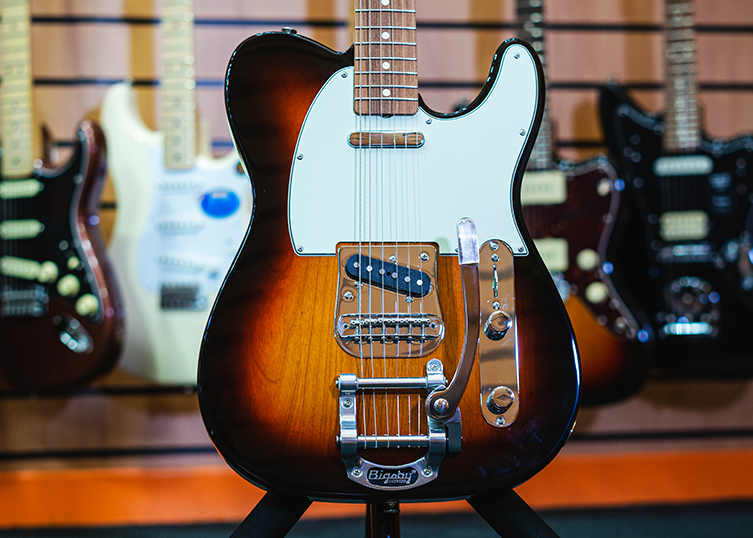
Are you familiar with the Bigsby tremolo? Have you seen them on guitars and wondered about them? You won’t be the first! Bigsbys inspire attraction and intrigue in roughly equal measures, and so it’s worth knowing about what they are, what they do, and also what they don’t do.
If you’re looking for answers to these questions, then you’ve come to the right place! I’ve used, abused and restrung Bigsby tremolos for decades now, so hopefully I’m in a suitable position to offer you some info and insights into this curiously cool piece of guitar hardware.
For everything Bigsby, keep reading!
What is a Bigsby?
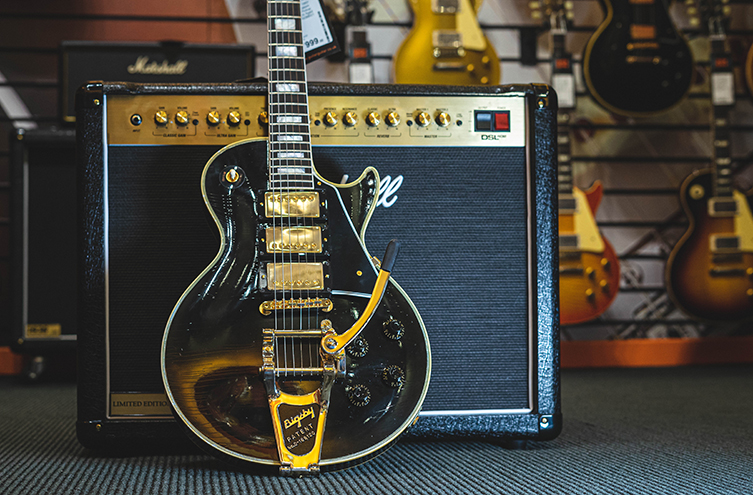
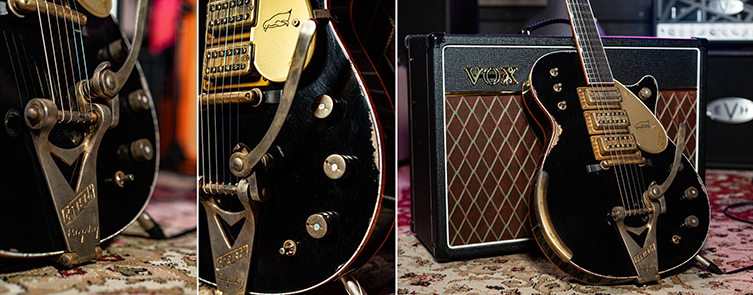
A Bigsby, in guitar playing terms, is a tremolo system (or vibrato tailpiece, to give it its proper term) invented by Paul Bigsby in the late 1940s. So, it’s a person as well as a device! More on this in a second, but first, let me describe what the Bigsby actually is.
The Bigsby tremolo appears in a few variations (which I’ll introduce you to soon), but all of them conform to the same basic design. It’s a surface-mounted metal unit which has a large flat lever tremolo arm, and operates via a thick spring. Manipulating the tremolo actually moves the bridge itself, and that’s what allows the change in pitch. The spring offers resistance to you pushing or pulling the arm, so that the bridge returns to its proper neutral position. There are no locking nuts or anything of that nature: it’s a relatively unsophisticated piece of machinery, in truth.
In practice, the Bigsby offers what I’d maybe call a ‘gentle’ amount of pitch fluctuation. Pushed down, you’ll get maybe a tone or a tone and a half of pitch drop, so about three frets’ worth at most. Pulling up, it’s roughly a ½ step - or one fret - of pitch that gets raised. So, we are demonstrably not talking about Floyd Rose levels of divebombs here!
That isn’t the point of course! The Bigsby is used for a subtle ‘shimmer’ or a dip in pitch, to provide extra emotion and expression to notes and - crucially - chords.
Who Invented the Bigsby Vibrato Tailpiece?
So, we know that it was guitar maker Paul A Bigsby who invented the unit. Early country star Merle Travis inadvertently brought about the invention when he asked Bigsby to design some sort of vibrato tailpiece that would be an improvement on the Kaufman tremolo (seen also on vintage Rickenbackers) that he’d been wrestling with on his Gibson L-10.
Gauntlet well and truly thrown down, Bigsby got to work and devised the simple, effective system we are talking about today. Travis took delivery of his unit in early 1951, which seems to be the first one ever, as far as I can tell. Paul Bigsby created guitars too, but the success of his new vibrato tailpiece eclipsed his guitar sales and he quickly shifted focus to make the tremolos exclusively.
Bigsby Models
There are several versions of the Bigsby tailpiece available. As mentioned earlier, they all operate in the same manner, but vary in terms of size. Different models suit different guitars, basically. Here is a brief look at the differences:
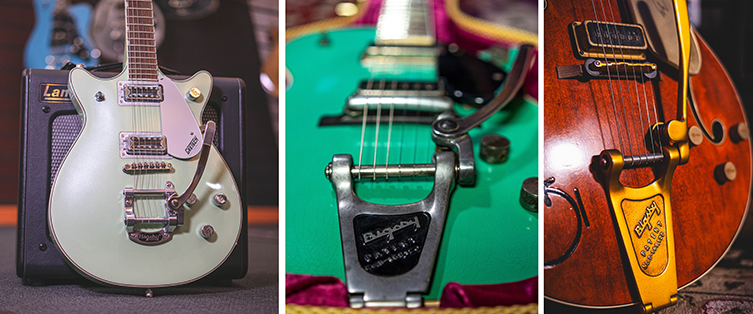
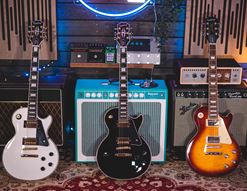
- Bigsby B7: to many, the definitive Bigsby tremolo. It has a long metal tailpiece that screws to the bottom strap button area of the guitar body. The B7 has a ‘tension bar’ under which the strings pass before reaching the bridge, to provide sufficient downwards tension. The B7 unit is mostly found on guitars with carved or arched tops, such as the Gibson ES-335, Les Paul and so on.
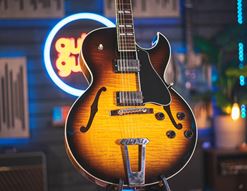
- Bigsby B6: Very similar to the B7 model, but without the tension bar. This gives the unit a looser feel due to the lower pressure on the strings. You’ll find a B6 on deeper bodied archtops, such as jazz boxes like the Gibson ES-175.
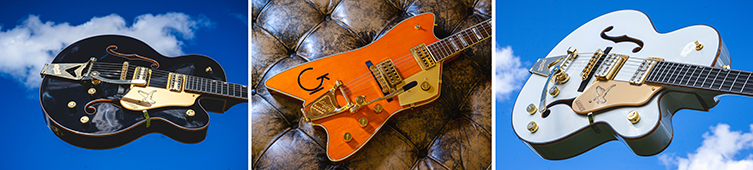
- Bigsby B3: Basically a slightly shorter version of the B6, again without the tension bar. Lots of Gretsch guitars have a Bigsby B3 fitted. They can be called a B3G due to a Gretsch logo being incorporated into the tailpiece design.
- Bigsby B5: the ‘horseshoe’ Bigsby, this is the one that has no long tailpiece. It mounts directly to the body of the guitar and is therefore used on flat-topped instruments like the Fender Telecaster or Gibson SG.
- Bigsby B50, B70, B700: these models are imported budget-friendly models based on the B5 and B7. They don’t necessarily align with the American models in terms of exact overall shape or screw pattern. These are more affordable versions, made with softer metals (and die-cast instead of sand-cast), with nylon bearings on the roller bar instead of metal ones. I believe the main difference between the B70 and B700 is the final finishing: the B700 is plated to allow for colours such as black or gold.
USA Bigsby Tremolos VS Licensed Models
I touched on this a tiny bit there, but yes, there are Bigsby models made in the USA (B5, B6, B7 etc) and those made via licence elsewhere. They all look very similar and operate in a more-or-less identical way, so the differences come down to the materials and build method. Here’s a quick comparison…
USA Bigsby tremolos
- ‘Sand-cast’construction, which involves creating a breakable silica sand mould for each tremolo (it gets destroyed in the process each time) and filling it with molten metal. The sand mould is broken off to reveal the tremolo unit once the metal has cooled and set.
- Mostly made from aluminium alloy, with a stainless steel tremolo arm.
- Slower and more expensive to make, they are also more stable and hardwearing.
Licensed Bigsby tremolos
- ‘Die-cast’,from a reusable steel mould
- Made from a zinc-based alloy, often referred to as ‘pot metal’
- Quicker and cheaper to make.
Do Guitars Come Fitted with Bigsby Tremoloes?
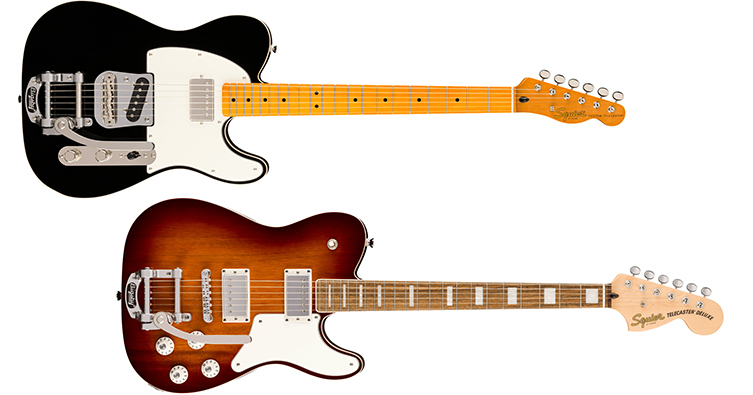
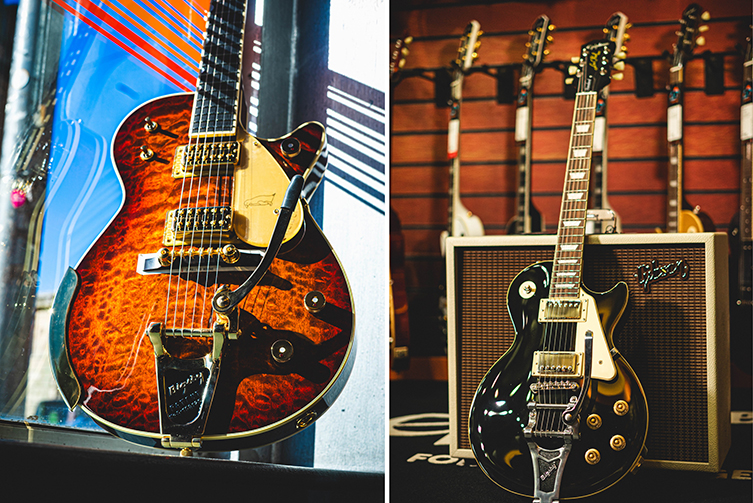
Yes, a great many guitars come factory-fitted with Bigsby tremolos. You’ll see lots of Gibson and Gretsch guitars with Bigsbies, but also certain Fender, Epiphone, Cort, Squier and other brands. Some of these guitars are limited edition models with the Bigsby added as a special feature, and others are catalogue constants which always feature a Bigsby.
Can I Fit a Bigsby Tremolo to My Guitar?
Bigsby tremolos can be retrofitted to a wide variety of guitars. Since the design is always top-mounted (as opposed to a Stratocaster tremolo which is positioned through the middle of the guitar’s body), no extra routing is needed, although it is likely that new holes will need to be drilled into the guitar’s body.
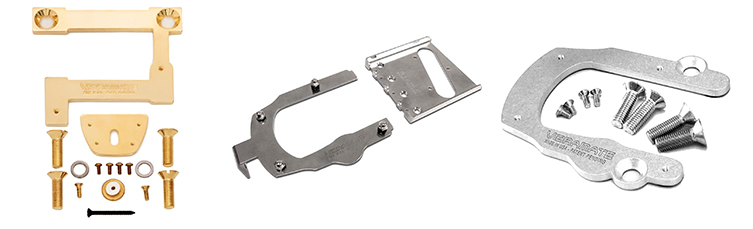
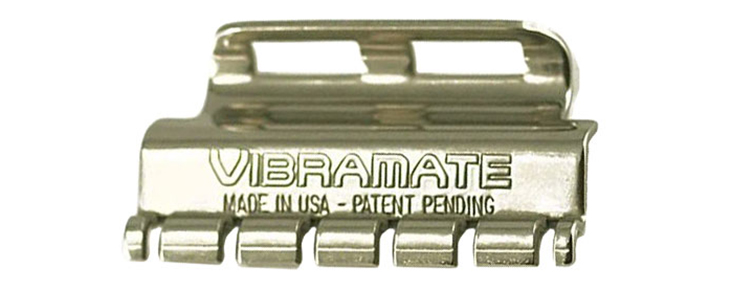
That is, unless you have a Vibramate. This simple and clever accessory allows you to mount a Bigsby B5 or B7 unit onto certain guitars without invading the guitar’s body with drills at all. The Vibramate makes the whole operation reversible, which is good news if you ever plan to return the guitar to ‘stock’!
Keeping a Bigsby Guitar In Tune
Bigsby tremolos - like all vibrato bridges that exist on guitars - do have an effect on a guitar’s tuning stability. Notice I didn’t say ‘negative’, because it’s really down to you and how you maintain the guitar! A Bigsby doesn’t have to cause undue problems in terms of tuning, if you follow these pieces of advice…
Title
- Stretch your strings: I hope you do this with all guitars anyway! Stretch them in with your hands every time you restring, to help settle the metal, as it were.
- Lubricate the nut and bridge: These are the primary points of contact for the strings, so lubrication is essential. Whether you use a dedicated lubrication paste or simple old pencil graphite drawn into the nut slots, make sure it’s part of your restring process.
- Use an appropriate string gauge: A personal recommendation, I’ve had far more success with Bigsby trems when using gauge 10 and 11 string sets than with anything lighter. Actually, I’d say go even heavier for best results (skinny string gauges did not exist when the Bigsby was invented!) but I realise you still need to play in a way that’s comfortable to you.
- Use a roller bridge: the bridge saddles are often the cause of tuning problems, so make life easier here by using a bridge with roller saddles that allow free movement of the string.
- Graphite saddles: If you do not like the look of the roller bridge - and I appreciate that as a Bigsby user, you are interested in aesthetics above many things - then consider swapping the metal saddles in your bridge for graphite or even nylon saddles. These materials are much more forgiving on string movement, and may make life a lot easier for you!
These are all fairly common-sense approaches to tuning stability in general, and should be used with Bigsby tremolos as a matter of practice. Badly-cut nuts and strings that are not stretched in are far and away the primary cause of tuning woes. Try all of these things before losing the plot!
Restringing a Bigsby Tremolo
I have one word for you here: PATIENCE! You will need it to begin with, but it all gets easier, trust me! Back in my shop floor days, I sorted a lot of anxious and fed-up Bigsby owners by demonstrating a few things that help make restringing such a guitar far less of a chore. The first few times can be a pain, it’s true, but I feel like it’s just a matter of leaping over a slight learning curve, and then you’ll be fine.
To that end, I have some tips and tricks that I know from practice really help. Here’s the magic…
Bend the string ball-end into a curve with a pen or pliers: gently wrap the end of the string around a pen to give the string a natural curve. This makes an ENORMOUS difference when getting the string around the roller bar and onto the little ‘teeth’ bearings. Pliers are also good for this, as long as you are gentle with the strings and don’t put any kinks into them!
Capo the upper frets: once you have the strings around the roller bar (and under the tension bar first, if your Bigsby has one) then clamp all of the strings in place at, say, the 10th fret or thereabouts. The capo acts as a handy third hand, allowing you both of yours to finish the restringing job at the headstock.
Try a handy device: check out the Steve Hunter (yes, THAT Steve Hunter!) String Change Buddy, which is a block of foam that is indecently handy at keeping strings in place as you restring, and also acts as a cool string mute! Also look at the Stingray tool, which does a similar job but with a nylon clamp. Finally, there’s this thing…
Buy a Vibramate Spoiler: honestly, this piece of metal is a game-changer. It fits permanently to any USA-made Bigsby set up by simply attaching to the roller bar, and it gives you a set of easily accessible, normal string slots to place the strings in and get on with your life. It’s a major relief to get one of these, fit it, and forget about restringing hassles!
Famous Bigsby Players
You hear Bigsby tremolos being used all over rock, blues and country music. Since the Bigsby has been a thing, famous guitarists have used it to put a unique stamp on their music, and to add a certain something to their image, too. Let’s not undervalue the visual magnificence of the Bigsby!
Anyway, here’s a small smattering of famous players who love to use a Bigsby tremolo…
- Merle Travis
- Duane Eddy
- George Harrison
- Neil Young
- Chet Aktins
- Poison Ivy
- Brian Setzer
- Johnny Marr
- Bernard Butler
- PJ Harvey
- Jack White
Try a Bigsby Today
It’s time for you to try out a Bigsby tremolo. Visit any guitarguitar store and see the huge range of Bigsby-equipped guitars we have ready to play. Have a play, assess how the Bigsby can fit into your personal repertoire, and then it’s a simple decision: modify an instrument you own, or simply buy a new guitar? Ah, decisions, decisions…