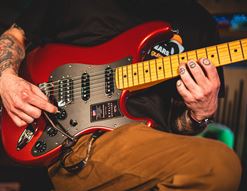
Slide guitar is a world that all guitarists appreciate, but relatively few commit to entering. It’s a tough technique to master, and requires special equipment, tunings and manoeuvres in order to master the subtleties. It’s a traditional technique that goes back to acoustic blues styles and also finds its way into the avant-garde.
Slide’s a lot of things to a lot of people, and the cool thing is that everybody approaches it in their own unique way. What I’d like to do today is talk about a handful of players whom I consider to be amongst the best slide players out there. This sampling menu of slide supremacy will hopefully get you listening to more slide music, and also have you rooting about in your desk drawer for your old bottleneck to have a go yourself!
Derek Trucks
I don’t know about you, but Derek Trucks is the first name I think of when anybody mentions ‘slide guitar’ to me. He’s just the absolute world leader of getting expression and emotion from his red Gibson SG and bottleneck. A humble guy who just does what he does, Trucks is the high watermark of greatness in this area, and his slide guitar voice is remarkably close to a human one at times.
Gauge 11 strings, no guitar pick and a preference for Open E tuning with a Dunlop Blues Bottle on his ring finger is what Trucks works with. Pay close attention to his pitching: there’s no bluffing with wide vibrato here, he is nailing those micro-pitches perfectly at all times.
Duane Allman
The late Duane Allman is Derek Trucks’ biggest influence on slide guitar. The ex-Allman brothers player - most famous for that riff on Clapton’s Layla - was equally lauded for his tasteful blues playing as for his peerless slide technique.
Favouring a little Coricidin bottle on his ring finger for a slide, Allman’s Open E slide technique on either his ‘59 Les Paul or his 1961 Gibson SG, saw him using the bridge pickup with the tone rolled back to help deliver that gorgeous, trademark sound.
Robby Krieger
Doors frontman Jim Morrison reportedly loved his bandmate Robby Krieger’s slide playing so much, he remarked that he wanted it on every song the band created. Whilst that didn’t quite happen, Krieger’s soulful and inventive slide technique is still a large feature of that band’s truly un-copyable sound.
Krieger himself told me that in those days he preferred to break the head off a champagne bottle and use that for a slide because it sounded better!
Joanna Connor
Joanna Connor has been a major force in blues rock slide guitar for decades now. Her technique - gentle on the strings and bunching left hand fingers together for supportive mutes - is both revelatory and highly practical. She’s one of only a few players who choose to play primarily in standard tuning, and her guitars are not set up with the usual high action for slide, either, since she plays a lot of rhythm as well.
Joanna favours Les Pauls for their sustain and for their fullness, and has her slide on her pinky finger. She focuses her technique towards the top end of the slide, as she mentioned to me a couple of years ago:
“I always aim for the top half inch of the slide, like all the time in the same spot. I always tell people, everything about the guitar is small anyway but with slide, it’s even smaller. It’s increments with slide, because you know, you have to be so precise, being right over the fret. With your vibrato, you gotta not go too far to the left or too far to the right, even if you’re being extremely relaxed with the left hand and arm. And that’s kind of it, really! I mean, if you can do all that, you can get it done!“
Bonnie Rait
Once you’ve heard the solo on The Spit of Love, you know there’s something deep going on with Bonnie Raitt’s slide playing. It’s elemental, hugely expressive and kind of spooked. Despite a lifetime’s success, I feel that Bonnie Raitt’s still an underappreciated titan of slide guitar. Raitt has always given space for a superlative set of slide licks, as long as they’re in service to the song.
A Stratocaster devotee, Raitt’s number one Strat is a Partscaster of some pedigree: a 1965 body with a later period neck. Strung with 13s and tuned to open A, this setup gets those amazing ‘glancing notes’ as the slide moves between pitches, creating that haunted sound.
Ry Cooder
From Paris, Texas to Buena Vista Social Club, Ry Cooder is a chameleon of a musician. It’s less about genre with him, and more about authentic expression. Little surprise, then, that he’s a huge slide player.
Talking about authenticity, Cooder reckons an actual glass bottle is better than a manufactured glass slide (just like Robby Krieger), and is another player who prefers not to use a pick. He’s a pinky player, and he likes Open D and Open G tunings for the most part.
David Tronzo
Professor David Tronzo is a whole other kind of slide master. A real experimenter, Tronzo approaches the guitar as a blank canvas, and uses all kinds of concepts and contortions to bring his notes to life. His style of music sits in the avant-garde jazz’ idiom, mostly because that’s where people put you when they don’t know what to do with you!
Another player who uses his pinky for the slide and who prefers no pick, Tronzo instead likes to form complex jazz chords that incorporate the moving nature of the slide. His main instrument seems to be an old SIlvertone 1448 (yes, the one that came in a set with an amp built into the case!) Introducing a volume pedal, his style can easily end up sounding like a lap steel at one moment, and a metallic orchestra the next.
Not only that, he’s adept at ‘prepared guitar’, a term popular in experimental camps and which refers to placing objects like corks in between strings, then pushing wooden sticks behind pickups to approximate exotic instruments. It’s effective and fun, but on top of that, he is a mesmerising slide player who works almost entirely in his own idiom.
Slide Playing is All Personality
So those are some of the most impressive and emotionally expressive slide guitar players out there, in my opinion. I think there’s something special about each artist, and all are worth a deep dive if you’ve felt the shoulder tap of inspiration.
Researching each player’s technique, I’ve come away with a few observations on things that seem to pop up again and again…
- The pinky finger seems to be far and away the most popular candidate for being the ‘slide host’
- Players tend not to use a plectrum when performing slide.
- Both hands are used for damping and muting unwanted strings.
- Open tunings remain the predominant form of expression for slide. By no means the only, but definitely the dominant.
- A genuinely light left hand touch with the slide over the fret is key.
- Even within slide music, notes played using the slide can be more effective when used sparingly.
Maybe those points will help to clarify your own thoughts on slide guitar as you see it. The coolest thing is that there are absolutely no rules as to what you should play, what type of sound you should aim for, or what type of gear you should play. Slide is actually one of the freest forms of guitar playing that exists, and if that’s not a great reason to get stuck in, then I don’t know what is!
Click to Browse our Selection of Slides