Which bands and artists are known for their synth riffs? We love talking about guitar riffs of course, but the power of a great synthesizer riff is something to behold too. Whether as the calling card of a huge rock tune, or indeed the centre piece to an entire synthpop track, a well aimed synth riff can be one of the most potent forces in music.
Today, I’ve scoured the decks to uncover a number of solid-gold synth riffs. Some are undeniable classics, and some are slightly more underground. All of them are sterling examples of the craft, and should be known by all music fans, not just synthheads.
What I don’t have are epic synth solos or anything like that: this is about the short, sharp recognisable identity of a riff.
So without further ado, and in my particular order of merit, here are the greatest synthesizer riffs EVER!
Jump - Van Halen
Since this is guitarguitar, I may as well start off with the ultimate guitar hero-synth riff! By 1984, synths had already been sneaking their way into VH tunes, but this was the first time they’d been so front-and-center. Talking synth duties was guitar legend Eddie Van Halen, who performed the riff and wild arpeggios on an Oberheim OB-X synth. No arpeggiators: all skill!
Take On Me - Aha
Only the bravest souls at the office Christmas party will stand up to attempt a karaoke rendition of this song. Morten Harket’s famously high voice is only one of the song’s notable trademarks, though: the other is the jaunty synth riff. I’m predicting that you’re actually humming it at this exact moment, right? It’s catchy, especially considering how many notes are in it.
Aha used a Roland Juno 60 for this, synth fans!
Final Countdown - Europe
Another instant classic, from Swedish soft-rockers Europe. This song has ‘keyboard shop demo’ written all over it, as it’s slightly fancy, universally known and musically timeless. The main riff was apparently written by vocalist Joey Tempest, who borrowed a Korg Poly/Six from the band’s keys player Mic Michaeli, and gave the band their most famous piece of music. The other members of Europe had to be convinced to work on the track, since it differed so much from their usual bag of tricks.
Good thing they did!
Don’t Go - Yazzoo
In between ditching Depeche Mode and starting up Erasure, synth talent Vince Clarke made some great songs with vocalist Alison Moyet as Yazzoo. They were ‘Yazz’ in the states, due to legal heat from the US blues label Yazzoo, from which Moyet originally bumped the name.
The short-lived project included a couple of all-time classics in the form of Only You and this track. Don’t Go has a belter off a riff - written and played on an ARP 2600 - that feels like you’ve known it forever.
I Feel Love - Donna Summer
The best electronic music feels like it's from the future, no matter how long ago it was created. This is absolutely the case with I Feel Love, Donna Summer’s stone-cold classic from 1977. Co-written by Giorgio Moroder - who basically ruled the 80s from his synth-throne - and featuring a showstopping Moog arpeggio sequence, I Feel Love had a specific role to fulfil.
On Donna’s fifth album I Remember Yesterday, each song was intended to be produced to sound like it was from a different decade. For I Feel Love, that decade was far in the future, and Moroder’s use of the Moog Modular 3P extended to the entire backing track, apart from the kick drum. I count the Moog part as a riff since it very much displays a repetitive ‘riff’ figure, which simply changes key with the song.
Impressive and visionary stuff indeed, the song went on to influence basically all electronic music that followed.
Sweet Dreams (Are Made of This) - Eurythmics
What is starting to become clear is that amazing synth riffs are mostly attached to amazing songs. This is another clear example. It’s a song everyone knows, and the synth line is not only immediately recognisable, but it’s as singable as the vocal melody.
Eurythmic Dave Stewart performed this on two different synths, each panned hard left and right in the mix. It sounds like a fairly straightforward subtractive synthesis sound, and I believe he was into both the Oberheim OB-X and the Roland Juno 6 at this time, so those are fairly likely culprits from what I can tell.
Just Can’t Get Enough - Depeche Mode
Moody synth pop heroes Depeche Mode have more than their fair share of exciting synth moments in their long career. The entire Violator album could happily exist in this list, but I don’t suppose there’s anything catchier than early hit Just Can’t Get Enough. It’s a delirious, bouncy riff that is almost too twee, but somehow gets away with it.
This is the second time we’ve seen Vince Clarke on the list today, a man who apparently writes everything on an acoustic guitar before laboriously programming his armoury of synths. Speaking of which, I believe the one you hear here is a Roland Jupiter 4.
Cars - Gary Numan
Two top riffs for the price of one? Gary Numan is another master of the synth riff, with his having been sampled and used in tunes by Basement Jaxx and the Sugababes over the years. Still, go to the source for the best stuff, and Cars is one unceasingly futuristic song.
Cars has a classic repeating low end riff (played on a Minimoog) that was actually written on a bass guitar. On top of that, there’s also a skyscraping lead riff that Gary played on a Polymoog, using the now famous Vox Humana preset. Together, it’s the sound of the future, still.
Conquest of Paradise - Vangelis
Greek synth maestro Vangelis basically owns an entire corner of the synth world with his beautifully sweeping compositions. Always chasing beauty in his music, Vangelis created and used a number of sounds that are now considered essential for all synth fans.
In Conquest of Paradise - a German and Swiss number one single in 1992 - the verses are based on an old European/Portuguese folk song La Follia, complete with a male choir humming like they are in a vodka advert.
The choruses, however, are when Vangelis really shows up. There is possibly no more obvious example of the term ‘epic’ than when Vangelis’ huge sounding Yamaha CS80 synths crash in like waves onto a Spanish galleon. Triumphant, evocative and very ‘Vangelis’, this riff is the sort of thing movies were made to host.
Voodoo People - The Prodigy
No matter how huge the Prodigy are as a band, I think there’s a good argument that Liam Howlett is an underrated musician and producer. His ability to create or select highly distinctive sounds, arrange them for maximum impact and keep a huge dose of energy in each production is unmatched. Just think about how many Prodigy moments you can bring to mind without thinking too hard?!
Anyway, when it comes to synth riffs, Howlett has a stuffed bag of them, but Voodoo People must be one of his best. No, not the Nirvana sample that starts the song off, but the distinctly ‘acid’ sounding buzzy riff that we get a few minutes into the track.
Now, if I were guessing, I’d say that this was made using the famous Roland TB-303 Bass Generator. It’s a good job I did some research, because the internet reckons it was a Roland JD-990 rackmounted synth, or the JD-800 keyboard variant. It’s a Roland sound either way, and it has a bunch of crispy distortion added to it for texture and squelch.
Kids - MGMT
For about a year in the late 2000s, MGMT were unavoidable. Poppy, sun-drenched hit after hit came from this duo, and Kids was one of the biggest. According to what I can source, the band used plugins for all of the synth tracks on the Oracular Spectacular album, from which Kids came. In particular, it seems that the Arturia Prophet 5 synth plugin was the one you hear on this track.
Da Funk - Daft Punk
Lots of French megastars Daft Punk’s music is the result of sampling (see the next entry below), but one instance in which they unleashed their own fury is their defining slice of beats and synth, Da Funk. In particular, my ear is always drawn to the super-zingy 303 riff that begins half way through the tune and continues for the duration. It gets filtered, squashed, mangled and adds so much character to the song. Any 303-style bass generator and a distortion pedal will get you this, if you balance the ingredients!
Release the Beast - Breakwater
I know about this tune because of course Daft Punk sampled their main riff for Robot Rock. This short-lived band hailed from Philadelphia and put out two records in 1978 and 1980 before calling it a day.
It has proven tricky to find accurate detail surrounding the synth used to make this extraordinarily funky riff. It’s an analog subtractive synth of some description, and I want to say it’s a Moog or a Sequential Pro One, but that’s only me guessing. The sound has lots of character, and makes deft use of the modulation wheel at the end of every phrase.
The Only Time - Nine Inch Nails
Nine Inch Nails are one of the few noisy bands who have managed to not only blend furious guitars with icy synthscapes but achieve considerable success with it. Mastermind Trent Reznor is the main architect of both the guitars and the synths on record, and the band’s debut record Pretty Hate Machine is chock-full of riffs.
In particular, The Only Time has two powerful riffs: one ascending bridge riff and a classic call and response riff that Reznor himself has since reused on live versions of Closer. In terms of synths, it’s easy enough to find a list of equipment used on the record, but slightly harder to assign machines to specific parts. For this song, it’s an educated guess between an Oberheim Xpander and a Sequential Prophet VS. My money’s on the Prophet. What do you reckon?
Confusion - New Order (Pump Panel Reconstruction Mmix)
How many people are instantly picturing the nightclub scene with the ‘blood showers’ right now? It was a moment, for sure! Calling this incredible slice of acid techno ‘a New Order song’ is pushing it a bit, though. Only an infrequent vocoder voice (which may or may not be Bernard Summer) has any connection to the source music, and the rest is an entirely new production from remixers the Pump Panel.
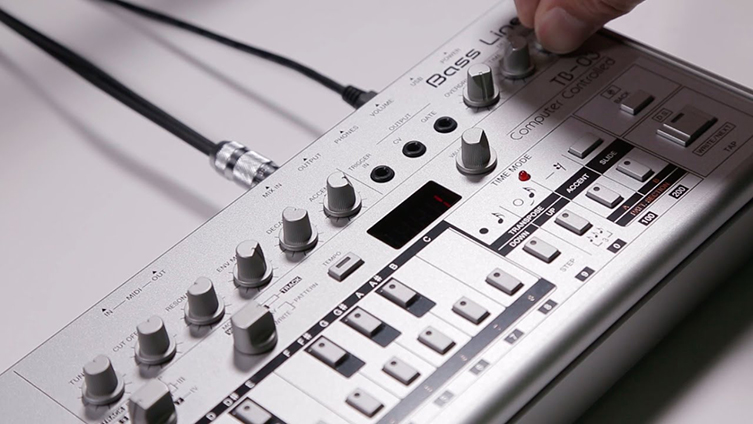
What this does have - and it’s clear from the first second - is one of the greater examples of a 303 riff ever. Simple, insistent, relentless and fantastic sounding, this is a riff that uses repetition brilliantly. Add some delay, and then add a second TB-303 line later on with increased cutoff for when things start getting intense.
In short, don’t go to a blood rave without your 303!
Incinerator - Author & Punisher
Tristan Shone is, in Author & Punisher, creating some insanely intense electronic doom metal, and presenting it in an utterly unique way. Using a collection of self-made machines that blend electronics and hydraulics with industrial design, he controls his synths and drums via weighted grips, pinions and other custom-made gear.
It’s a thrill to watch him do his thing live, and it’s an equal thrill to hear the crushing synths riffs and doom screams from this one-man chaos army. In terms of actual synths, I know him to be an Elektron fan, with the Octatrack and Analog Four being a big part of his assault, all routed through Ableton Live.
There’s More
Synthesizers are inherently good instruments to make riffs from. You can determine how a note begins, how it ends, and what it does in between those two factors. You can set it into a pulse or other combination of notes, and you can vary so many parts of its being, in order to satisfy your inspiration. As riff machines, you can freestyle or you can program; you can go light and airy or low and fuzzy. The sky is really the limit, and for the adventurous musician, synths only increase the palette of colours available.
I hope I touched on some of your own personal favourite synth riffs today? Maybe you’re inspired to check out some more synthtastic music, or - even better - you now want to switch on your own synth and make some noise! Whatever you do, have fun and thanks for reading my article. Click below to browse our current stock of synthesizers!
Click to Browse our Synthesizers