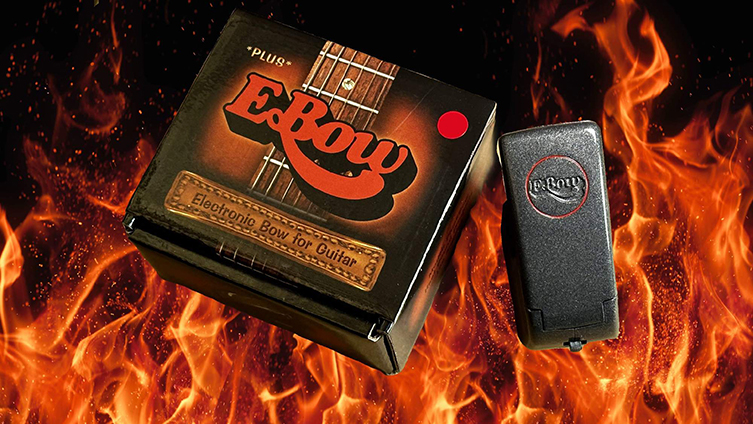
Have you tried an E-Bow before? You’ve definitely heard them, and seen them used by guitarists who want to evoke a mysterious, ethereal string-like sound with their guitar. They give a very unique and musical timbre to your guitar playing, and what they dictate in terms of limitations (they operate on one string at a time, and oblige you to play linearly up and down that string), they more than make up for an atmosphere and sheer sound.
It’s interesting to note how different players take to the E-Bow, because it’s quite like the wah and whammy pedals in that sense: everyone has their own approach.
That’s something I’d like to explore with you today, actually. Why? Because E-bows are great, and because this year marks their 50th ANNIVERSARY! I’ve gathered 11 examples from mostly quite popular music, and I’ll talk about the E-Bow use within each choice. From lead moments to supportive textures, you can learn loads about E-Bow technique just by copying these examples!
Are you ready?
What is an E-Bow?
Actually, before we begin, I should maybe take a second to explain what an E-Bow actually is. E-Bow, or E-bow, or Ebow, since I’ve seen it written in many ways!
An Ebow is a small device held in the guitarist’s picking hand. You hold the Ebow directly over the string you want to hear, with the device’s ‘feet’ resting on the adjacent strings. It uses an electromagnetic field generated by a couple of coils and a small inner amplifier to agitate the string and move it into life, creating a sustaining sound with no attack (so, like a bow) and it’ll last as long as you hold the E-bow over the string.
(Don’t Fear) The Reaper - Blue Öyster Cult
I love a song title with brackets, and old BÖC are one of the best at that! This is obviously their signature song, and it’s also one of the earliest examples of recorded E-Bow. This tune hails from 1976, the same year that the ‘Heet Sound E-Bow’ was introduced to the world.
So, where is the E-Bow bit? It’s the part that I always assumed was a keyboard: right as the last note of the guitar solo ends, the note transforms into a long, sustaining tone that lasts through the final verse. Yup, that’s Buck Dharma playing an E-Bow!
E-Bow the Letter - R.E.M.
The clue’s in the title here, which leads me to believe that the song may have been built entirely around Peter Buck’s bittersweet E-Bow part. Indeed, there’s hardly a moment on the track that doesn’t feature it, and its somewhat mournful sonority is a perfectly evocative match for Michael Stipe’s restless, inquisitive and melancholic vocal.
Unforgettable Fire - U2
1984’s Unforgettable Fire album saw The Edge expanding on his already-unusual approach to guitar sonics. Under the influence of musical boffin Brian Eno, Edge tried a range of unorthodox approaches for the record. The one we are interested in can be heard through the verses of the underrated title song. He’d later take the ‘infinite sustain’ approach in a different direction (see bottom of article) but for this record, it was E-bow for the win.
Sin in My Heart - Siouxsie and the Banshees
The Banshees were always a darker and more interesting proposition compared with the other bands who came from punk’s original 1976 explosion. 1981’s Juju album is perhaps their master statement, helped in no small part by the inventive guitar work of John McGeoch.
McGeoch was a master arranger, and also way ahead of the game when it came to effects, and their use in a song. Sin in My Heart is the appropriate choice for now, since he underscores the intro with a moody E-bow accompaniment, but it’s worth taking a deep listen to the entire record, for a masterclass in using unusual textures, notes and timings to build a very specific set of musical atmospheres.
Dreaming - Blondie
You can hear this great Blondie single 100 times and not hear the E-bow embedded throughout! It’s there as soon as the other guitars come in, offering a subtle drone that reminds me specifically of John Cale’s viola playing on the Velvet Underground’s Heroin.
Later melodic parts could be E-bow or synthesizer (by design, it’s difficult to tell) but those drones in the back are certainly Chris Stein’s E-bowed guitar, as is the Heroes-esque part at the song’s close..
The Drapery Falls - Opeth
Blackwater Park was a huge moment in the career of Swedish prog/death metallers Opeth. It showed the world just how complex and multi-faceted they could be, and how no genre conventions were going to be an easy fit for them from henceforth.
The album held space for more reflective moments, more progressive moments, and plenty of baroque, sinister mosh moments too. Encouraged to experiment by co-producer Steven Wilson, Opeth opted to use an E-bow for their song The Drapery Falls. Heard most clearly played with a slide, the E-bow adds an eerie, haunted sound and melody, whilst giving our ears a memorable hook to wrap around.
Soma - Smashing Pumpkins
An E-bow solo? Kind of! Fellow guitarist Billy Corgan gets the scene-stealing guitar solo later on in this Siamese Dream epic, but prior to that, second guitarist James Iha gets to be part of a real moment. Layering up literally dozens of tracks of E-bowed guitar, Iha and Corgan create what I can only call an ‘ambient guitar orchestra’ for a few short bars before the distortion kicks in.
The E-bow shows up fairly often in the Pumpkins’ music, but this example is a pretty unique thing in music. It’s roughly 3m 09 into the song if you want to go straight there.
The Storm - Big Country
What I’m getting from writing this article so far is that many of the top E-bow guitarists are hugely inventive but also very accessible. You’ll see this again with the rest of my choices, today. Stuart Adamson was such a musician: quietly innovative and actually quite unpredictable, his use of effects such as pitch-shifter is well known, as a means of approximating a set of bagpipes.
The Storm, from Big Country’s debut album The Crossing, is where he uses his E-bow to summon the sound of ancient Scotland, befitting a song that tackles the injustices of the Highland Clearances.
Heaven Beside You - Alice in Chains
Starting off with a bluesy Dobro riff and continuing in much the same vein, this track is somewhat unusual for grunge megastars Alice in Chains. Guitarist Jerry Cantrell seems to take more of a lead vocal on this song (he often sang co-leads with Layne Staley) and it’s during the choruses that you can hear subtle layers of E-bow supporting the grimey Dobro.
Nude - Radiohead
Prog rockers Radiohead are no strangers to unorthodox guitar approaches. Each of their three guitar players offers something, but it’s most often Ed O’Brien who is responsible for any effects-heavy guitar ‘treatments’.
On Nude, from the superlative In Rainbows record, the part we want to zoom in on is Ed’s performance from the 2nd verse onwards. Using an E-bow alongside delay and pitch-shifter effects, he’s able to almost mimic a string orchestra. Some of those layers even sound a little like time-stretched Thom Yorke vocals to me, but those E-bow layers hang in there like ghosts for sure.
Untitled 6 - Sigur Ros
Icelandic mood-creators Sigur Ros decided not to name their second album, nor any of the songs on it. Instead, it had a pair of brackets on the cover “( )” and that was it. Fans, then, began making up their own names for the songs, such as ‘Nothing Song’ for Untitled Track 4 since that was a working title for the song when it appeared in the movie Vanilla Sky.
Track 6 was given the unofficial term ‘E-Bow’, since it features prominently, but maybe not on the instrument you’d expect…Sigur Ros bassist uses the E-bow on his bass for the entirety of the tune. It’s actually very subtle, and you’d perhaps not even clock it at all unless somebody told you. So, here’s me telling you, and it’s an excellent piece of music to spend some time critically listening to.
That’s NOT An E-Bow!!!
Now for a couple of tunes that are so E-Bow-adjacent with their sounds, they fool most of us into thinking that they are! None of the following songs have an E-bow anywhere near them, at least in the official recordings…
Heroes - David Bowie
Robert Fripp’s genuinely iconic guitar part on Bowie’s immortal title track from Heroes is actually an amalgamation of three guitar parts…and no E-bow! Indeed, Fripp played his Gibson Les Paul Custom into a fuzz pedal and then directly into the mixing desk. The levels were increased until the studio monitors were feeding back. Fripp positioned himself within the room in order to catch the natural feedback loop that was occurring, and just played the notes.
Three passes of the song were recorded, and the resulting part is a combination of those three mixed up and down at producer Tony Visconti’s judgement. No E-bow!
She’s A Star - James
It’s one of James’ best-known songs, and is a glamorous, glittering indie rock ode to inner strength and beauty. A mainstay of their live sets to this day, the hit 1996 single saw guitarist Larry Gott using a slide and...nothing else to achieve that wonderful swooping melody line. No E-bow, just a sustaining sound that allowed the notes to flow into each other, thanks to deft use of the slide. I know, I know: I was SURE that was an E-bow!
With or Without You - U2
I’ve had The Edge on this list already today as a committed E-bow-er, so why is he here for this tune? When he plays it live, he’s often seen using an E-bow for it, right?
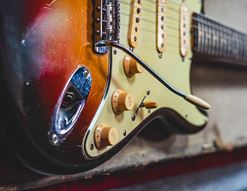
Yes, this is true, but not on the record! No, on 1987’s Joshua Tree album, Edge heard about the Infinite guitar from co-producer Brian Eno. This instrument was developed in collaboration with experimental guitarist/composer Michael Brook, and was basically a Fender Strat with a mod carried out by Brook on where an extra pickup was added to the bridge pickup. One sat on top of the other, which created a feedback loop that sustained forever. A further attempt on a Tokai Strat copy sealed the deal in terms of being a playable guitar.
Impressed, Edge asked Brook to do this to his 1965 Strat. This is what he used on the song, and ironically, it was created because Brook’s mail order for an E-bow was lost and he never received it. Being the legend that he is, he decided to make his own!
50 Years of the E-Bow
You’ve now heard 11 examples of E-bow, alongside 3 non-examples. They are all pretty different, aren’t they? Considering how specific the device is, and how relatively few approaches you can take, it’s amazing to listen to so many inspired artists using it in so many unique and exciting ways.
The E-bow has been around for 50 years now. When did you first come across it? Do you own one now? If not, why on earth not?