Have you ever stopped to consider the bracing inside your acoustic guitar?
I know, it’s an odd question. Maybe you’ve heard the term but never pondered further? It could even be that you don’t know what bracing is, and about how every acoustic guitar has some within their hollow bodies.
Well, today’s short, info-packed blog should at least put you on the right path towards knowledge! Bracing is a pretty significant part of how an acoustic guitar sounds in the final instance, so taking a slightly closer look at the subject may prove illuminating.
Interested? Step this way…
What is Bracing?
Firstly, let me define in rough terms what bracing actually is. Bracing is basically a set of wooden struts or ‘braces’ which are glued to the underside of a guitar’s top/soundboard in order to provide structural support. Before anything else, that’s what bracing offers. But more specifically, the arrangement of these supporting braces has an effect on the overall sound of the guitar.
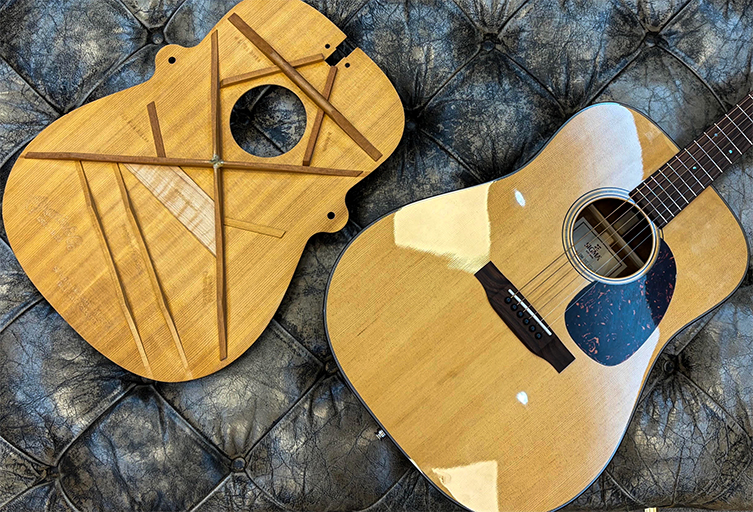
When you play a note, the sound from the string is turned into energy, which vibrates the top of the guitar, and then the rest of the body. The sound travels along the bracing, in whichever direction the bracing faces. The accumulated energy of all of that is what we hear through the soundhole of the guitar. Luthiers have evolved different patterns of bracing over the centuries, since they’ve learned that they can sculpt and ‘direct’ the guitar’s tone via the bracing.
When we consider guitar tone, the main factors are the tonewoods, the body size (and shape), and the internal bracing.
How Does Bracing Affect Guitar Tone?
Bracing affects how a guitar’s sound forms in a number of ways. I suppose the most crucial way is in how much it allows the guitar’s top to move and vibrate when notes are played. The positioning of the bracing will influence this movement in fairly direct terms.
For example, the less bracing there is towards the bottom of the guitar, the freer that large section will be to vibrate, which means there will be a greater bass response. If that area had bracing glued onto it, that area would become stiffer and so vibrate less, producing less bass response.
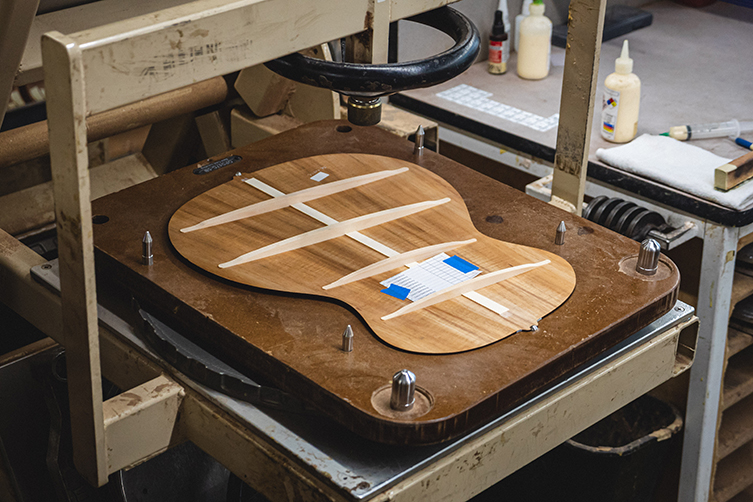
More bracing in general means more areas where the top is stiffer as a result, but it also means that those areas are being ‘zapped’ by the sound travelling down the bracing, if you get me?
The size and shape of the bracing itself also influences the sound. Thicker braces absorb certain amounts of frequency, which is useful when used in the correct place. Thinner braces absorb less.
Beyond that, the bracing ‘translates’ the inherent properties of whichever tonewood the guitar’s top is. It’s like a selective magnifying glass for the guitar’s overall sound, with its own influence helping to coral the frequencies and present a strong tone.
Fan Bracing
Our earlier examples of guitar bracing are with classical guitars, of course. Now, they needed no truss roads or the likes since string tension was, at that point, not a consideration. Indeed, even today, you’ll find that many classical nylon string guitars do not have truss rods.
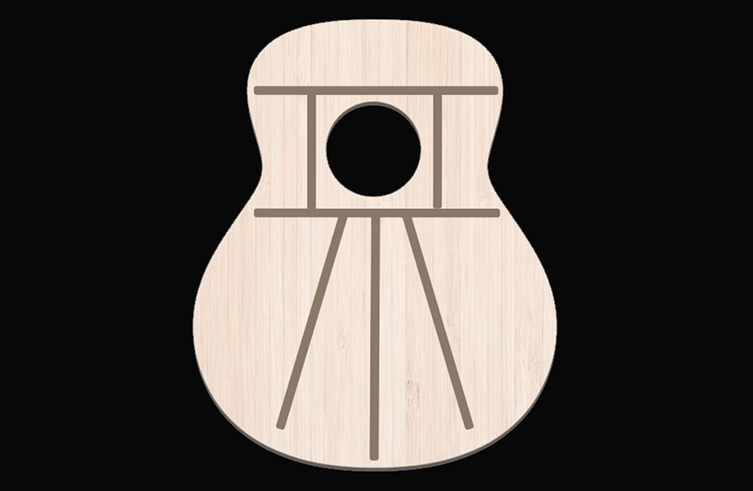
Anyway, since a balanced tone was required, many nylon string builders used what we call fan bracing. Fan bracing has the soundhole isolated via a ‘cage’ or ‘box’ of bracing, and then a number of long braces are laid out like a fan, covering the main area of the body. The response is even and balanced from string to string.
X-Bracing
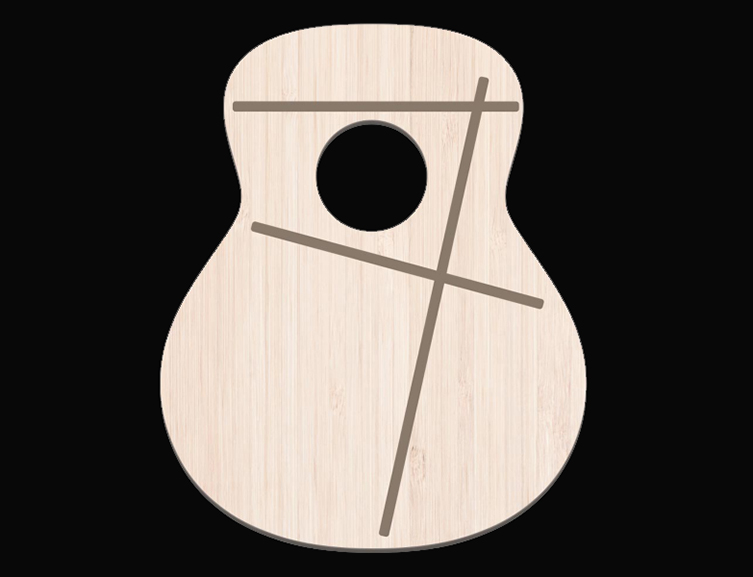
X-bracing is the most popular type of bracing today, and the one I’d presume you’ve already heard about. Created by Martin in the 1840s, X-Bracing is very much what the name suggests: a large X is formed across the inside of the top, with the points crossing beneath the soundhole. X bracing strengthens the top whilst allowing lots of movement and volume. It’s a responsive sound that works with most acoustic guitar bodies.
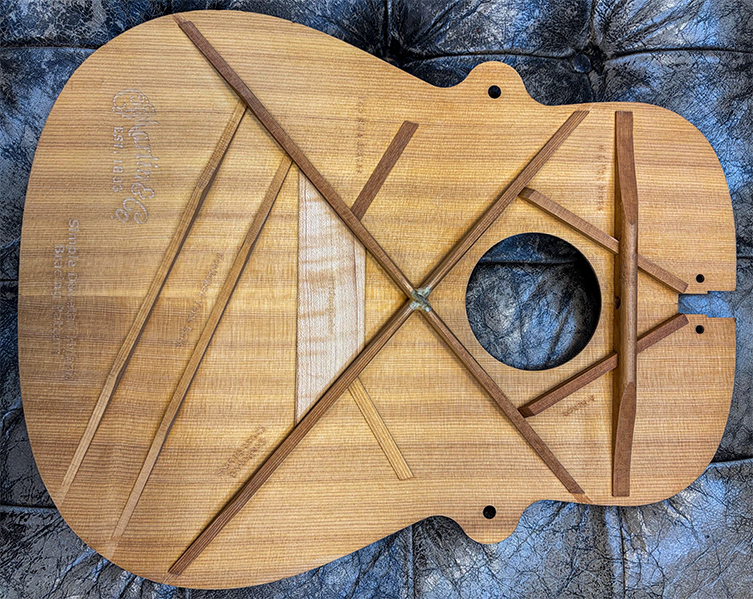
Forward-shifted X bracing is something you'll encounter too. This means that the center of the ‘X’ is closer to the soundhole than usual, and offers a louder sound with more warmth. There’s also rear-shifted X bracing too, which is a little quieter and more intimate, and favours a more trebly tone.
A-Bracing
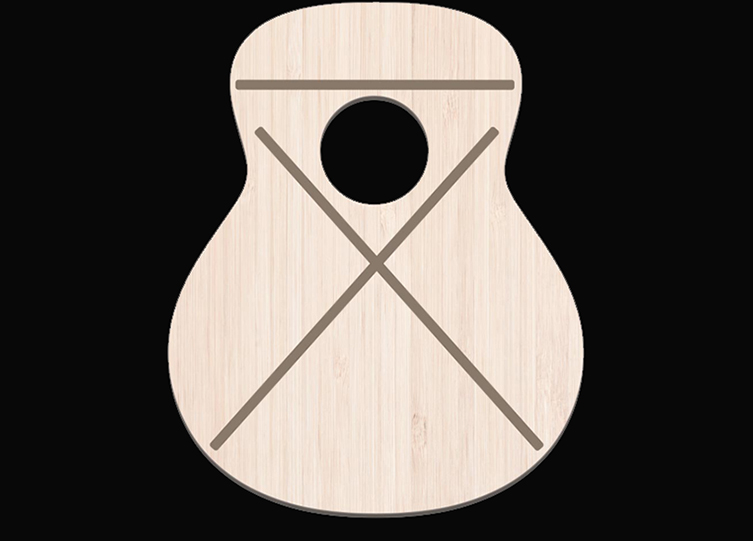
A-bracing is more complex than X-bracing. It gets its name from the diagonal braces that come down from the upper bout/neck joint area, and travel past either side of the soundhole like a capital ‘A’. This is a structural thing, created to strengthen the soundhole area and stop it from sinking in time. Most often, you’ll see A-bracing used alongside X-bracing inside guitars, or hybrid versions of both.
Lowden uses A bracing often, as well as adding ultra-thick scalloped braces into their patterns (what they call their ‘dolphin bracing’) to achieve their famous volumes levels and depth.

V Bracing
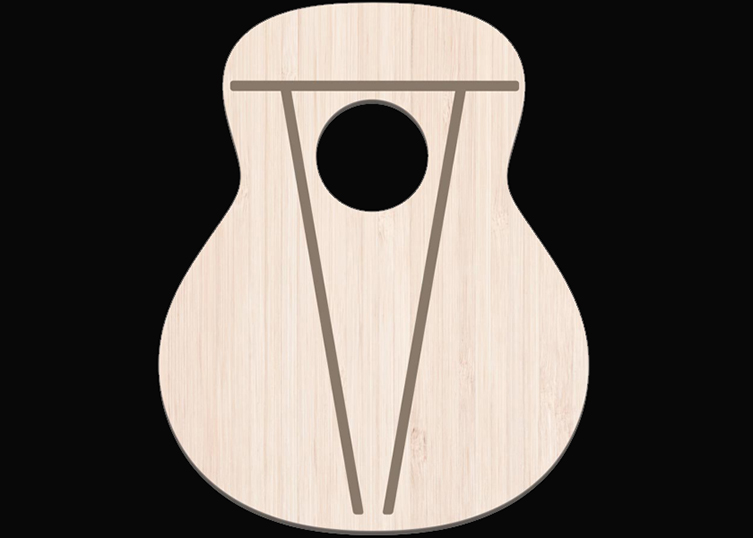
V - or V-Class - bracing is a relatively new style created by Taylor. V bracing sees a large ‘V’ made up of two long thin braces, travelling the entire length of the guitar’s underside. Other small braces are added, but this central ‘V’ is used to bring lots of stiffness to the centre of the guitar, and flexibility along its edges. The stiffness adds a new level of sustain, whilst the flexibility brings volume and projection.
What is perhaps most interesting here is that the V-Class bracing also helps out with the guitar’s intonation, believe it or not! Yes, the stiffness of the central area sorts out any clashing frequencies with its nice, orderly vibration. Everything sounds more harmonious!
C Bracing
Another Taylor innovation, C-Class bracing is pretty unique. The ‘C’ is short for ‘Cantilevered’, and refers to the fact that this bracing treats the treble side and bass side separately. It’s asymmetric for one thing, with the main long brace glued at a diagonal angle and supported by smaller side braces.
C-Class bracing was developed for smaller bodied acoustics, in order to give them strength and low-end response beyond the usual capabilities of their size.
Scalloped Bracing
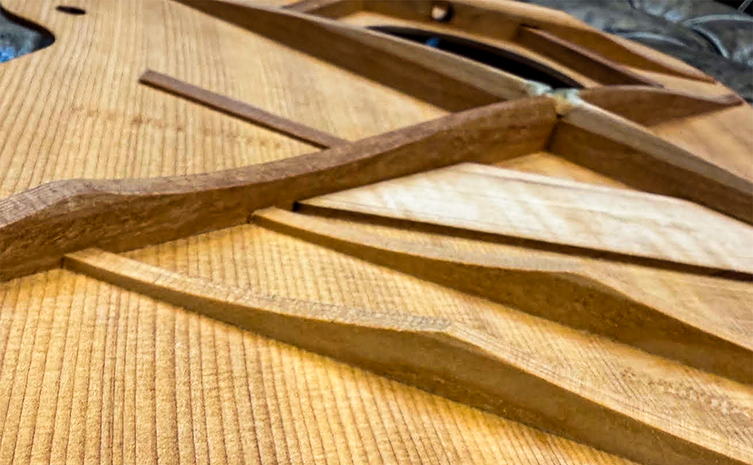
Scalloped bracing relates to the braces themselves, rather than the pattern they are arranged in. Scalloped braces are shaved down by the luthier in a sort of ‘bow’ shape, removing much of the timber itself. What this does is allow the top to breathe more freely, resulting in a richer, deeper tone.
Scalloped bracing is something we find on lots of Pre-War acoustics, those much-loved and copied instruments from the 1930s that represent something of a ‘holy grail’ for acoustic tone. It is mostly Martin that I’m referring to here, and they actually stopped scalloping their bracing in the mid 1940s. Going back to straight bracing, they ditched the concept altogether until 1977, when a reissue of the famous HD28 called for it. Duly rediscovered, the practice of scalloping binding resumed.
Bracing Matters
Bracing is one of those things you might not ever even experience in a direct way. Bracing hides within the guitar, and even though it’s always doing its thing, it’s not really an element of the instrument that you really interact with.
But without it, you are guaranteed to have a dull and lifeless sounding instrument, and who wants that? Understanding what different types of bracing does to the sound of a guitar can help inform you about what to expect from an instrument. By the same margin, knowing about bracing can help you understand why you like a particular guitar.
In short, bracing is a fascinating part of the art of guitar making. It’s undervalued, even, but now that you’ve breezed through this blog, you’ll have a greater appreciation for it.
Have fun playing!