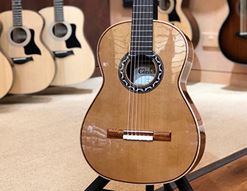
Would you like to know a little more about Bourgeois guitars? They are an interesting company for sure, and one whose reputation for building beautiful instruments is entirely justified. Based in Maine, there’s talk of ‘tap tuning’ amongst other techniques, which points towards a rustic and somewhat ‘olde worlde’ way of conducting business. This appeals to us as acoustic guitar players of course, because that’s just the sort of backstory we want for the guitars we choose to play.
On top of that, though, there’s also talk about sending wood to China to get guitars built and returned to the US for a set-up, which seems like an entirely different ethos and way of building guitars. Are these two sets of connotations at odds with each other? Does one story ring more true than the second?
These are things I hope to understand a little better, simply by paying closer attention to one of their guitars. As a writer for a guitar retailer, I am lucky enough to be able to sit down with a great assortment of instruments and actually assess them in my hands. It’s a perk of the job for sure, but it’s only of any value if I’m able to share that experience for interested parties like yourself.
That’s the aim here. A colleague purchased a Bourgeois guitar after being suitably impressed (which in itself says as much as this whole blog, really), and let me have a longer look at theirs. It’s a Bourgeois Touchstone Country Boy model, so that’s what today’s blog will refer to. If you want my honest thoughts on this guitar - without any requirement to deliver a particular message - then please read on with me!

Bourgeois Touchtone Series
So, to begin. If you are unfamiliar with Bourgeois as a brand, maybe I can direct you towards my ‘Bourgeois Guitars: An Introduction’ blog? That’ll get you up to speed!
Now, as I mentioned, I’ll be looking at the Bourgeois Touchstone Country Boy guitar. Let’s break that one down a little. First, the ‘Touchstone’ series name. This is the range of guitars that are not entirely built in the US, which is great because it lets me explain what happens.
So, the timbers are collected in North America, and the tops are ‘tap tuned’. I’ll explain that in just a second.
The parts are then sent across to China, to the Eastman factory, to be built. Now, if you’ve ever put your hands on an Eastman guitar, then I expect you’ll be pretty fine with the notion of them getting involved in this. To call a spade a spade, they make exceptionally good quality guitars at prices that American brands cannot match. So, by working directly with Bourgeois - and my understanding is that Eastman’s artisans are trained to the strict specifics demanded by Bourgeois - this collaborative effort allows some very high quality guitars to be made at a price that is certainly more attainable than if the guitar were fully USA-created.
They are still not cheap, by any means, but we are talking here about an instrument that can confidently compare with brands who charge double, to put it simply. If this sounds good to you, then I advise you to spend some time with a Touchstone Series guitar. If not, then Bourgeois absolutely still build lots of guitars completely in the US, but do remember that they are a small-run, boutique company of hand-builders. The demand is greater than their supply, so waiting times and costs are two pertinent extra factors.
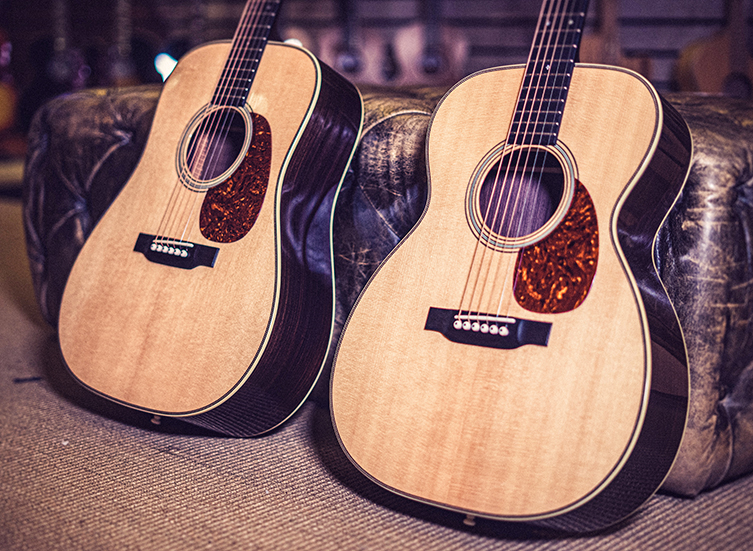
The Country Boy
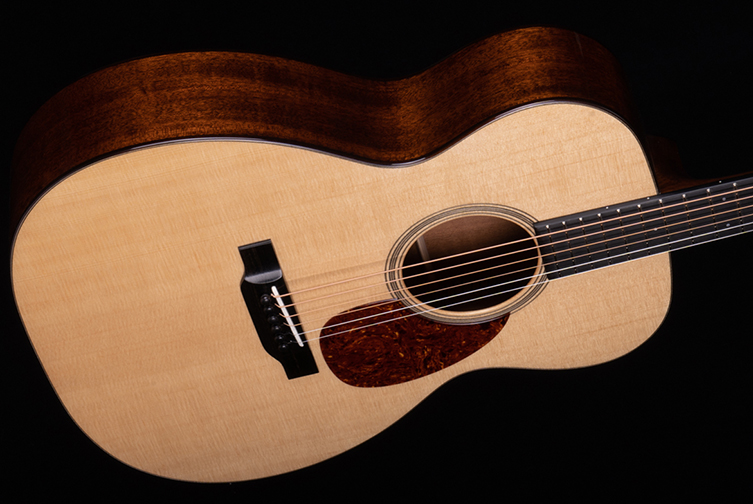
The other part of that title is ‘Country Boy’. Country Boy refers to a certain specification in both timber choice and decoration. Wood-wise, we are talking about Spruce and Mahogany. Decoration-wise, this is the ‘no frills’ option, which is a popular choice for such guitars.
There is an attraction towards guitars that are ‘everything you need, nothing you don’t’, when it comes to the perception of what’s going to be played on such guitars. Lots of country and folk players equate the stripped-down look with a more honest and earthy approach to their music and image. If that’s you, then look out for the Country Boy part of a Bourgeois guitar title, because you can have this level of decoration on a number of different body styles. Speaking of which…
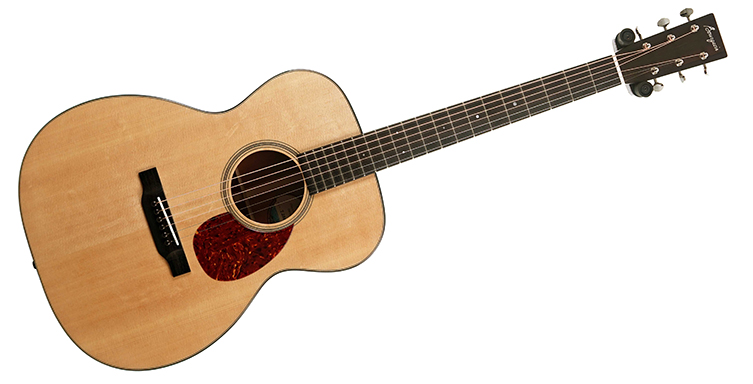
The OM Body
This particular Bourgeois Touchstone uses the OM body shape, so it’s a narrow-waisted body that comes in a little smaller than a dreadnought. Received wisdom on this shape is that you get less emphasis on boomy lows and therefore a more enjoyable fingerpicking sound. There may be less midrange and slightly less volume than with a dreadnought, but that’s all just my expectations based on previous experience with similar guitars. I’ll talk to you about what this guitar actually sounds like soon.
The Woods
I spoke about how the Country Boy moniker refers in part to the wood specification, and how we have spruce and mahogany here. This is true, but it’s worth stating the full facts: it’s Sitka spruce from Alaska, and Honduran mahogany, both of which are known to be amongst the planet’s best examples of such timbers. Acoustic guitar fans will have preferences about all of this, including their preferred species of spruce and timber, not to mention how this pair’s conjoined influence will have an effect on the sound of the guitar.
Sitka spruce is of course native to the Sitka region of Alaska and the other surrounding islands of the Alexander archipelago. The trees are also found around the nearby Tongass National Forest region, and can grow to 200 ft high. Sitka spruce is known to be a fast growing wood (good for the environment), a fast-maturing wood (good for tone) and very consistent, so builders can rely on it in terms of predicting tonal outcomes.
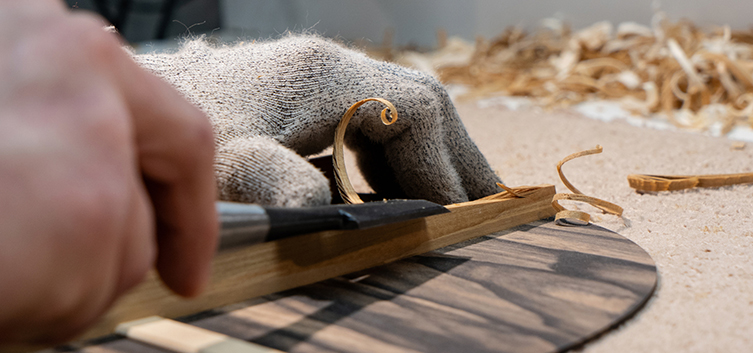
Spruce in general adds snap and clarity, and this isn’t any different here with this Bourgeois. Most of a guitar’s tone is determined by the top, and Sitka spruce is trusted to deliver a good balance of frequencies, along with a very agreeable level of stiffness-to-rigidity. As you know, the top has to vibrate in order to produce sound, but it also has to remain rigid for the integrity of the build to remain in order. It’s no good for the guitar to fall apart, after all! The strength and lightness of this spruce top transfers vibrations into frequencies excellently. People talk about old-growth Sitka spruce being as strong as steel. I don’t know about that, to be honest, but even using an analogy like that says plenty.
Then there’s the tap-tuning, which I’ll discuss separately.
The body is Honduran mahogany, another well respected species in guitar building. If a guitar’s top essentially creates the tone (alongside the bracing), then the body shapes that sound, or ‘EQs’ it, as I like to think about it. I’m sure you already know how much mahogany is used in the building of guitar necks, electric guitar bodies and other associated guitar parts, and it’s a popular acoustic body wood, too. It’s a stable, strong wood that delivers a warm tone, and everybody talks about that ‘midrange punch’. That, I’m guessing, is why it has been selected for use on this guitar: the smaller waist of the OM body is an indicator that the sound will actually be missing some midrange frequencies. Using mahogany will provide some warm depth, but also return those missing midrange frequencies.
Tap-Tuning
I’ve mentioned this term a few times already: tap tuning. So, what even is this? And why is Bourgeois founder Dana Bourgeois so committed to it?
To answer this, let me go back to the guitar’s top, or soundboard as some will call it. The top, as we’ve found out, is the part that takes those vibrations from the energy of the moving strings and turns that into sonic frequencies. Those are then shaped by the bracing (which is itself attached to the top) and the rest of the guitar body, to which the guitar top is joined.
So, before the top is even carved into a shape, experienced luthiers such as Dana Bourgeois are able to literally tap the timber with a finger and listen to the wood’s inherent resonant frequencies. If there is a strong dominant frequency, then that’s the thing to try to shape and accentuate via the bracing. The luthier will continue to tap the wood as the bracing is applied and shaped, and modify the braces to try to focus that sound.
Some luthiers report that a particularly good piece of tonewood will literally ring out like a wine glass when tapped, and these slices of wood are reserved for the finest builds. So, that’s tap-tuning, and that is something that is applied to Bourgeois guitars in order to bring out the best in each guitar.
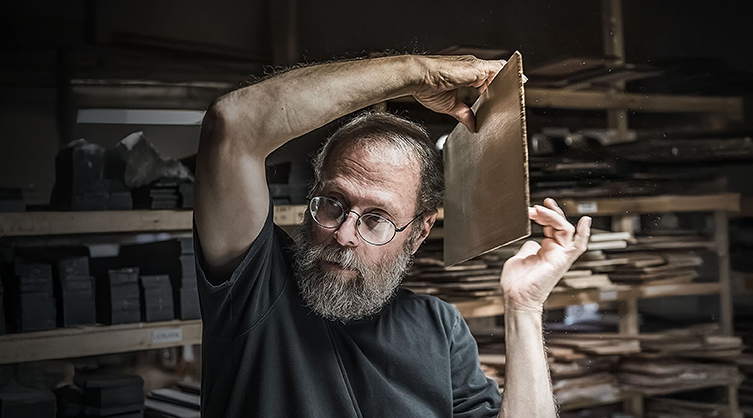
Bourgeois’ Neck Join
One more innovation that sets the brand apart is in their style of neck join. Bourgeois use a special bolted-on neck joint, developed by Dana in the early 80s. Superficially, the expected mortise and tenon shape is still there, but a bolt underneath the end of the fingerboard is what connects the guitar to the neck, not glue.
The idea behind this is mainly to allow for easy and quick neck resets. As James from Bourgeois has said, they want to make guitars that are ‘around for a heck of a long time’, which is good news! Older guitars just need their necks reset eventually, as string pressure pulls the neck up a degree or so, raising the action. Sanding the saddles is an option, but this robs you of tone, according to Bourgeois, and so being able to attack the issue easily from the neck end is preferable. They claim that an experienced tech can reset one of their guitars in about 20mins, and that’s without any gluing, steaming or invasive sawing.
Sounds like a good idea to me, and though I’ve obviously no direct experience of this, it’s definitely something to note in this deep dive.
The Play Test
Okay, that’s the background. Now time to sit with this thing and have a strum!
With the guitar on my lap, I instantly feel the comfort of the OM size. I’m actually a fan of jumbos, but there’s no denying how ‘moreish’ this shape is for fun solo practice. The neck has a pleasing width to it, which fingerpickers will no doubt enjoy. Later on I look up the spec and it is 1 23/32”, which means absolutely nothing to me until I convert it to decimals and get 43.65mm. This actually seems to be in between the likes of, say, Martin’s regular 42.8mm-ish nut and their wider 44.45mm nuts on some OM guitars. Perfect.
Strumming some notes, what I instantly hear is the low end! This is a surprise, and a pleasant one. Forget the physical size of this guitar: it’s a loud projector with a very solid bass response. Not what I expected, and proof that Bourgeois have really dialled in their build here. I’m impressed.
Further strums confirm that this is a very dynamic sounding guitar - certainly not one of those super-compressed acoustics that sometimes show up - and there is a lot of crisp detail there when you work for it. I say that because it doesn’t reveal itself at the beginning. Like any great guitar - and I’m beginning to suspect that that’s what this is - you get back what you give it. If you have the technique and the ears, there is a richness here that will delight you, I’m pretty sure! That bottom end though! It’s very impressive - though never too much - and I find myself enjoying very light strums, with the occasional ‘Pinball Wizard’ moment announcing itself from me, just to enjoy those lovely dynamics.

The top end is never sharp, and I suppose that might be the influence of the Honduran mahogany, but it’s also the mark of a guitar made by people who know their stuff and are capable of implementing that knowledge effectively.
Now, I’m no bluegrass fan I’m afraid, so I can’t comment on those types of runs, but I do love a fair bit of John Renbourn and Michael Hedges, so I put the Touchstone through its paces as much as I reasonably can on a guitar that is owned by somebody else, and I come away with the distinct impression that it is quite simply one hell of a guitar.
I can’t see this disappointing anybody. I really can’t.
What Did I Make of the Bourgeois Touchstone Country Boy?
Alright, I’ve given the guitar back now, but not before comparing it with a couple of other guitars we had in the guitarguitar office. One was a nice parlour priced at around a thousand quid - so very nice, basically - and another was a dreadnought that was far more expensive. I won’t name names, because that’s not the purpose of this subjective analysis, but I will say that the depth of tone and low end response was pretty amazing, before even factoring in the size of the body.
We think of OM guitars as ever-so-slightly smaller than normal, but pretty much normal, don’t we? Well, this thing sounds big: bigger and more expensive than the price tag. It’s a beautifully made guitar; it’s not ‘wow’-fancy to look at but the beauty here resides in that elegant simplicity (if you think Telecasters can be beautiful as I definitely do, then we’re on the same page here), and the performance beats that of significantly more expensive guitars.
If I were in the market for a quality acoustic, then I’d be eagerly beginning the hunt for my own perfect Bourgeois. I’m trying to be balanced with this, and I’m trying to find stuff to complain about, but all I can really say is that this is a pretty exceptional sounding guitar, and it’s a lovely thing to play. The fact of it being built partly in the US and partly in China is neither here nor there to my ears or hands, but it’s good news for the wallet, so I’m all for it.
But why take my word for it? We have some Bourgeois in stock, why not enjoy an hour in one of our stores finding your own one?
Click to View our Bourgeois Guitars