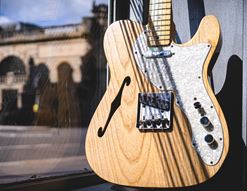
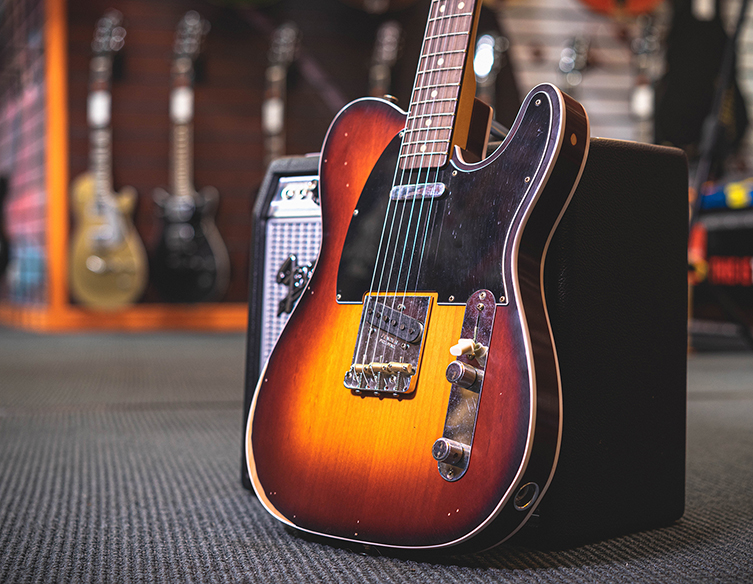
The mighty Fender Telecaster has been making musical history for three quarters of a century. And what a storied 75 years that has been! Remaining virtually unchanged since its release in 1951 (1950 if you count the Broadcaster), the Tele has played an enormous role in the shaping of modern music. It predates the birth of rock ‘n’ roll and has been a symbol for rebellion and artistic expression ever since.
This reputation is mainly due to the artists who’ve used the Tele to make history. From the 50s until right now, there hasn’t been a decade that didn’t see the Tele used in a myriad of different ways. From that esteemed lineage, I’ve pulled out a few examples today to serve as a timeless honouring of the Tele in modern music. Not everybody is on this list, but a lot of them are!
Enjoy!
Danny Gatton
Danny Gatton was one of those players that other guitar heroes looked up to. In his 49 years on earth, Danny Gatton completely rewrote the genre rulebooks for guitar music. He fused together the main American styles of jazz, country and blues, and landed on a style that was all of these, plus its own fresh sound. He was the type of guitarist you’d never want to follow on from in a live setting, particularly in country and rockabilly scenes.
An ardent Telecaster fan, his main 1953 model was modded with noiseless Joe Barden pickups, and put through his ‘Magic Dingus Box’ to control his effects. A true one-off.
Roy Buchanan
The beard, the flat cap and the Telecaster. It’s instant recognition for blues rock badass Roy Buchanan, whose musical passion was originally ignited in church revival group meetings. Buchanan is widely credited as pioneering the sonic potential of the Telecaster, and made particular use of hybrid pick and finger techniques to get more harmonic sounds. In the late 50s, he even taught The Band’s Robbie Robertson, back when he played with Ronnie Hawkins.
Legend has it that he turned down an invitation to join the Rolling Stones, which only adds to this guy’s reputation! His favourite Tele was a 1953 model that he named Nancy and added jumbo frets to.
Julien Baker
As innovative with her approach to guitar as she is honest in her approach to lyrics, Julien Baker’s art is original and very necessary. Her musical statements are often bold, but that doesn’t mean her delivery has to be. As a subtle artist of depth, Baker uses her Telecaster and pedalboard to create synthetic yet (somehow) rural landscapes for her bruised narratives to live upon. It’s a song-centric approach that allows for a unique sound, whether solo or with ‘alt-supergroup’ Boygenius.
Robert Quine
Robert Quine is one of those special players that you have to dig deep to find, and then cherish forever afterwards. The NYC guitarist came to prominence with Richard Hell in the Voidods, but it was arguably his playing on Lou Reed’s The Blue Mask and on Tom Waits’ Downtown Train that brought him the most attention.
Quine was a seriously gifted and unique player, with an ability to capture the emotional core of a song in his performance. Spiky, energetic but also deeply empathetic, he was a rare talent. Quine only switched to a Telecaster in the 90s, but when he did - when he said ‘I finally conquered it’ - he ascended to being a master of the instrument.
Muddy Waters
The king of the Chicago blues sound, Muddy Waters brought a large boot’s worth of attitude and authority to every note be played and sang. Armed with “The Hoss” - his 1958 Candy Apple Red Telecaster, Muddy Waters is the guy who turned blues licks into repetitive riffs, establishing a whole new ethos as he did. For many British music fans, attending his first UK tour in 1960 would be their first ever glimpse at a real Fender Telecaster.
Bill Frisell
Bill Frisell’s reputation amongst his peers is quite incredible. Known as “the guitarist who changed the sound of American Music”, Frisell works in musical areas that are jazz & jazz-adjacent, but ultimately very diverse. The Baltimore native came to prominence in the 80s NYC scene that also gave us saxophonist/bandleader/tastemaker John Zorn.
Frisell moves between traditional and avant-garde situations, and is known for using his beloved Telecasters, clean tones and highly developed ambient delays. Check out thie beautiful playing by Frisell on this Vic Chesnutt song...
Jimmy Page
He’s the primary 70s rock Les Paul wielder, but most of us know about Jimmy Page's early love for the Tele. Back in his session days, Page was gifted a late 50s vintage white Telecaster by friend and co-session ace Jeff Beck. This was Page’s main electric during the first two Led Zeppelin records. Initially decorated with reflective circles, this guitar was later painted by Page’s friend with a psychedelic dragon.
Let’s get real for a second: this is the guitar used to play Immigrant Song, people!
Anna Calvi
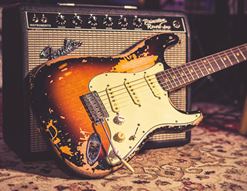
Anna Calvi is one of contemporary guitar’s most inspiring and expressive players. Armed with her beaten-up Sunburst US Tele, Calvi brings a cinematic, almost classical approach to her parts. A romantic songwriter who brings fire to her playing, she’s a great mix of old-school guitar hero and exotic experimentalist, as happy with blissed out clean tones as she is with gnarly fuzz.
Calvi has released three studio albums, written the soundtrack for TV show Peaky Blinders and found time to collaborate with David Byrne and Iggy Pop. When's the next record out, Anna?
Brad Paisley
The world’s greatest country shredder? It’s been an accepted term for a while now, and Paisley’s finesse and taste put him at the top of the technical country players, particularly since his context is in mainstream, arena-filling music.
He’s putting serious playing in front of the masses, and inspiring plenty of others to do the same. Brad Paisley’s signature Telecasters are also completely awesome, with great necks and sparkly finishes. Where’s my Stetson?
Brent Mason
Session legend Brent Mason has developed a reputation as being one of the world’s top country players. This Grammy winner has added tasteful Tele licks to records by Tim McGraw, Trisha Yearwood and literally hundreds more (actually over a thousand!), as part of the ‘New Nashville’ scene. In fact, he has won the Academy of Country Music (ACM) Guitarist of the Year award FOURTEEN TIMES!
Brent’s favourite guitar is a grey Tele, modded heavily to get the most versatile selection of tones possible. Fender have released a signature model that captures all of his favourite features, including Seymour Duncan pickups and a B-Bender system.
Jeff Buckley
What might we have had in terms of wondrous music if Jeff Buckley hadn’t tragically drowned in 1997? All we have is one studio album (Grace), one collection of demos and a few live recordings, but that’s all that’s been needed to confirm his status as a major, significant artist.
As well as an astonishing vocalist, Jeff Buckley was an incredible guitarist who studied at the Musician’s Institute in Los Angeles. His main guitar for his whole career was a borrowed 1983 blonde Telecaster, modded with a chrome pickguard and a Seymour Duncan Hot Stack bridge pickup.
James Burton
Louisiana native James Burton was there for the start of rock n roll, and he’s still going strong at 86 years young! Best known as the guitarist for a certain Elvis Aaron Presley - with whom he played for 8 years - Burton was one of the first visible users of the Telecaster. Hits like Dale Hawkins’ Suzie Q show Burton wielding his 50s Tele, and his trademark flame and Paisley signature Teles are amongst the most distinctive in the Fender catalogue.
Burton’s resume of collaborations is like a who-s who of country, rock ‘n’ roll and rockabilly greats: John Denver, Gram Parsons, Merle Haggard, Emmylou Harris, Roy Orbison, Vince Gill, Albert Lee, Brad Paisley, Johnny Cash and literally scores more. Living legend status: confirmed.
Keith Richards
A massively influential guitarist - and style icon - Keith Richards embodies much of what we perceive to be the ‘elegantly wasted’ English rock star. His lifestyle is as famous as his music, and his love for Telecasters eclipses even that!
Richards' main squeeze is Micawber, a 1954 ‘blackguard’ blonde Tele with a Gibson PAF pickup in the neck position. This was actually given to him by Eric Clapton back in 1971, and has been his main guitar ever since.
Hugh Cornwell
The former Stranglers frontman is a seriously underrated guitarist. His solo sections on hit songs like Golden Brown and Strange Little Girl display an advanced sense of harmonic and melodic invention, whilst his biting rhythms are a perfect match for his equally biting voice.
Hugh Cornwell is a Telecaster man of course, and his original 60s black model (fitted with a Dearmond pickup in the middle position) was stolen in New York in 1980. Since then, he has favoured a ‘74 model (also black, naturally) and a few more recent models.
John 5
Motley Crue guitarist John 5 is one of the mightiest shredders in rock. That said, most of his work has been playing riff-heavy rock and metal for Rob Zombie and Marilyn Manson, where he’s put his army of Teles to use alongside Marshall stacks and buckets of makeup!
A committed Tele guy, John 5 actually has a Telecaster from every year of production…ever! He’s also had a slew of signature Teles from Fender and Squier, some of which are now bona fide collector’s items.
Jonny Greenwood
The Radiohead lead guitarist is often acknowledged as one of the primary rock players of the 90s and beyond. His iconoclastic approach to typical lead guitar moments set him apart from other 90s rockers, particularly within the context of Radiohead’s jagged, bruised music.
Greenwood is as much a Hollywood movie composer now as he is a guitarist in a rock band, but his playing is as singular as ever, and his love for early 90s Tele Plus models (with hot Lace Sensor Red pickups arranged as a humbucker at the bridge) is undiminished.
Honourable Mentions
Of course, there will be a great number of wonderful musicians out there whose Tele-playing deserves to be on this list. Did your own Telecaster hero make the cut? If not, maybe they’ll be below in my honourable mentions list!
- PJ Harvey
- Jim Root
- Jason Isbell
- Bruce Springsteen
- Carrie Brownstein
- Wilco Johnson
- Chrissie Hynde
- Marc Ribot