Do you have a flanger pedal? Do you want to make that awesome whooshy sci-fi sound with your guitar? Are you maybe wondering what a flanger even is?
Well, you’re in luck, because I absolutely love the sound of flangers! Today in this brief guide, I’ll tell you what a flanger is, offer up some famous examples in songs, and then suggest some of the best flanger pedals you can buy and incorporate into your own set up.
How does that sound? Let’s take a trip together, to the outer reaches of spacey tone…
What is a Flanger?
A flanger is an effect that was designed to mimic an old trick called ‘tape flanging’. Let’s start there then! Tape flanging is a very old-school technique from the early 60s. Engineers and producers were always trying out different ideas in order to find new sounds for their artists, and ‘tape flanging’ was such an effect. It worked a bit like this:
After a piece of music was recorded onto tape, a duplicate tape of the recording would be made, and then the engineer would play both back simultaneously, and literally slow sections of the second tape down by touching it with their hand as it spooled. This kind of weird sonic displacement created an awesome ‘whoosh’ sound, though what you’re really hearing is phase cancellation. Here’s an example:
So, a flanger effect - such as a flanger pedal - seeks to recreate this electronically. The pedal duplicates the signal (just like the second tape recording) and delays it ever so slightly, then the second signal has an oscillator applied to it. The result is a more predictable and controllable form of that tape-flanging sound.
What Does a Flanger Sound Like?
We heard tape-flanging in the example above, but flangers can actually sound remarkably different, depending on how they are set. I’ll go through some famous flanger sounds with you soon, but I think listening to the intro to Van Halen’s Unchained is the easiest (and coolest) way to get the idea across to you:
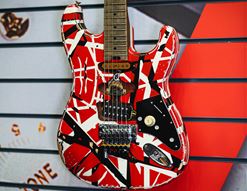
I’m sure you heard those low D notes sounding different from the rest, right? That was simply a case of guitarist Eddie Van Halen stomping on his MXR Flanger pedal for those particular notes, and then stomping on it again a few notes later to turn it off. It’s a fairly obvious and extreme flanger effect, but flangers can sound subtle, too. Keep reading, and I’ll bring up some quite varied examples…
Which Guitar Players Have Used Flangers?
Flangers have been used by a huge number of guitarists over the years. The effect can help to really transform their sound, and add a futuristic hue to their tone. Let me show you a few of my favourite ‘flanger moments’, so that you can see how different it can sound in certain contexts.
The Police - Walking on the Moon
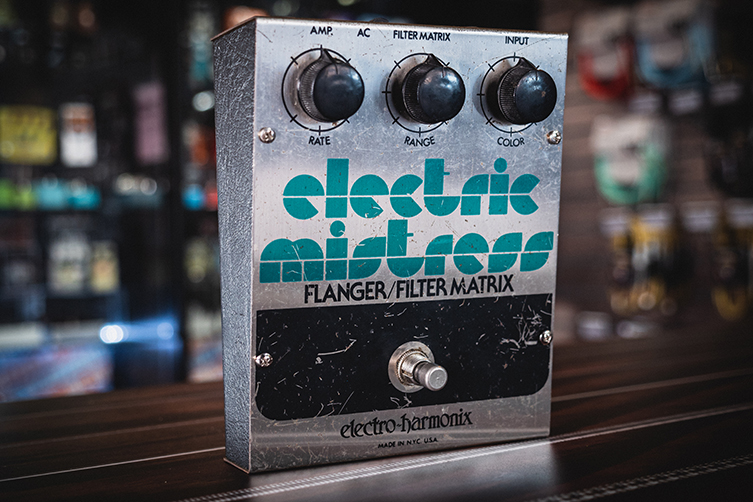
First up is The Police’s Andy Summers, who used his Electro-Harmonix Electric Mistress flanger to create a subtle shimmer which many guitar fans mistakenly attribute to being a chorus pedal. Technically, chorus is a similar effect to a flanger in terms of how it works, but I think it’s quite clear that the two effects are distinct. Here’s Walking on the Moon, in which you can hear Summers’ flanger sound mixed in with an Echoplex delay.
King Crimson - Elephant Talk
Adrian Belew is a pioneer of unorthodox effects use, and his startling sound on Elephant Talk is one of his best. Using nothing more than a compressor, a fuzz pedal (he’s using an Electro-Harmonix Graphic Fuzz, but any will do) and an Electric Mistress flanger, Belew summons a whole herd of angry elephants. It’s easy when you know how…
Siouxsie and the Banshees - Spellbound
This hit single from the Banshees’ 1981 album Juju shows off the late, great John McGeoch’s influential approach to the guitar. John was such a dedicated MXR 117 flanger fan, he actually had his mounted onto his mic stand (with an additional footpedal connected) in order to change the settings mid-song! Listen to the song Happy House for the same player using the same pedal in an entirely different way.
The Cure - Last Dance
Robert Smith has always been a touchstone when it comes to modulated, ethereal guitar tones. The 1989 record Disintegration is the one at the top of the list for me, and this deep cut towards the end of the album shows him at his layered, subtle best.
Smith almost entirely uses BOSS pedals, so it’s very likely that this is a BF-2, a precursor to the current BOSS BF-3 Flanger.
The Smashing Pumpkins - Love
Flangers often sound their best when used sparingly, as we first saw with Van Halen’s Unchained. The Smashing Pumpkins obviously weren’t paying attention at the back of the class, because their Mellon Collie and the Infinite Sadness track Love has a flanger on throughout the entire track! It’s a ‘BOSS Purple flanger’, according to the official sheet music, so I’m guessing a BF-2 again. It sounds incredible, and if you like extremely processed, OTT guitar sounds, hang around for the solo!
M41-A Pulse Rifle - Aliens
This last one is a bit of an indulgence, but one of the best examples of a flanger sound is the noise made by the pulse rifles in James Cameron’s 1986 movie Aliens. Although hardly ‘realistic’, it’s a pretty thrilling and memorable way to use the effect, alongside a phaser and a hefty dose of compression. Apparently, some cast members of the movie were annoyed that Cameron would hardly give them any personal direction for scenes, but spent 4 days in a recording studio tweaking the gun sounds. My man!
How Do I Use a Flanger Pedal?
If you want to use a flanger pedal in your set up, you have two basic options in terms of hooking them up. The first is to connect your flanger in your pedal sequence after the drive pedals and before the ambience pedals. This will get the most ‘whoosh’ from the sound. If you have an FX loop in your amp, fire it in there, particularly if you want to use the amp’s gain.
The other way is the Van Halen way. This means you want to use your amp for gain, but you connect your flanger in front of the amp’s input anyway: guitar - flanger - amp. It’s reverse logic, and generally sounds less immediate than having it after the preamp section, but it obviously worked pretty excellently for Eddie!
The Best Flanger Pedals
What are the Best Flanger Pedals?
There are lots of good flanger pedals available right now. Some are based on classic models and others are modern takes. Here are a few that I recommend:
- Electro-Harmonix Walking on the Moon: the title says it all! It’s a rethink of the Electric Mistress, built specifically to deliver that famous Andy Summers tone, and then some!
- MXR EVH117 Flanger: The MXR M117 flanger is a stone-cold classic. This fancy version is all of that, plus an ‘Unchained’ button which overrides the control knobs to deliver you Eddie’s personal settings! How cool? It’s also guaranteed to improve the look of your pedal board!
- BOSS BF-3 Flanger: a fantastic, feature-rich flanger that offers loads of creative bang-for-buck. The previous BF-2 version was good enough for Robert Smith and Billy Corgan, so this improved model (bass input! Stereo out!) is a sure-thing, I’d say.
- MXR M152 Micro Flanger: A cheaper, smaller alternative to the EVH Flanger, you’ll get the same great sound but a little less in the way of control over it.
- JHS 3 Series Flanger: fantastically priced for what is a boutique brand, USA-made pedal, this unit delivers a classic sound that will be perfect for most users.
You Could Use a Flanger
Now you know pretty much all you need to know about flangers. They can be subtle, and they can be overwhelming. It’s very much down to how you employ it within your music. If you’ve never used a flanger, then I recommend experimenting with one. You can really open your sound up, and transform pretty generic parts into exciting pieces of music.
Click to View our Flanger Pedal Selection