Lustmord Lombardo.
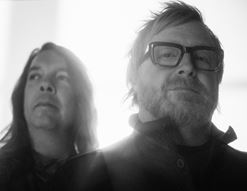
Brian ‘Lustmord’ Williams and Dave Lombardo.
One is a hugely influential maker of atmospheric musical environments with untold layers of depth, and the other is one of the most revered drummers and percussionists in modern heavy music. Lustmord rose from the scene around London’s late 70s/early 80s Industrial esoteric movement that held together disparate acts such as Throbbing Gristle, Coil, Psychic TV and Current 93. Otherwise known as Brian Williams, Lustmord has spent a career describing timeless, ancient depths of the universe’s soul through manipulated sonics, and has also ventured into the world of Hollywood film scoring. Lustmord has collaborated on albums with The Melvins, Tool’s Adam Jones and many more alternative rock artists, making music that’s by no means mainstream and in every way unforgettable.
Dave Lombardo of course is the definitive drummer for Slayer, which instantly puts him into ‘legend’ category. In addition, he has created with Mr Bungle, the Misfits and many others. Now, the stars have aligned for these two, and the resulting album of their collaboration The Pulse of Atoms - released under the name Lustmord Lombardo - is out now on Ipecac records.
I’ve wanted to talk with Lustmord for a number of years, so I was particularly hyped upon receiving word that he was up for a Zoom call with me. Connecting from the mountains above Los Angeles, Brian was incredibly pleasant to speak to, and happy to converse on a large number of subjects, including his live equipment, his sound manipulation techniques, and even venturing into communications he has had with NASA!
It’s all here, so take a load off and read this exclusive interview with a musician of a very singular calibre.
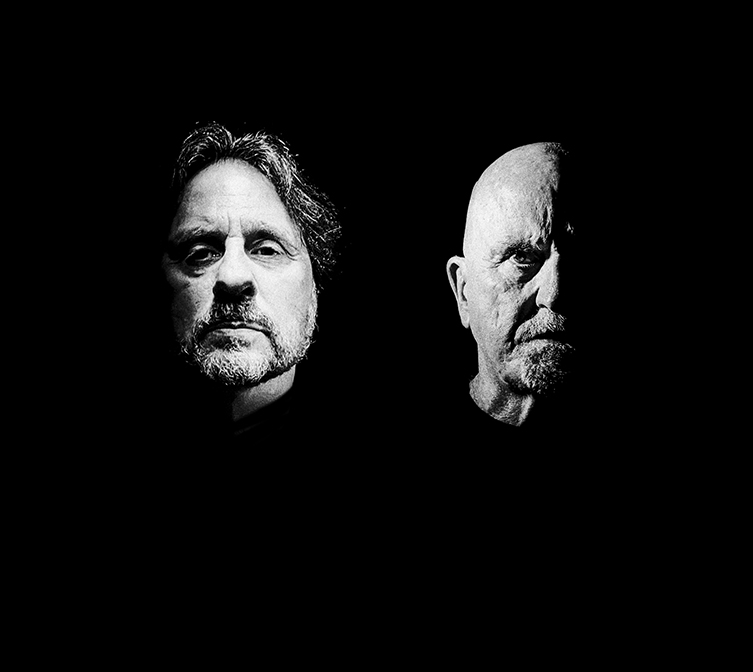
(Pic courtesy of Lustmord Lombardo)
Lustmord Interview
GG: So, this is a lovely opportunity to talk about your new collaborative album with Dave Lombardo. I’ve had a few long walks with it in my headphones already and I love it! I suppose the first thing I’d like to ask is how you and Dave interacted, creatively?
Lustmord: It was kinda much more long-winded than it should’ve been! From deciding to work together to actually working together was days, really. I sent Dave a bunch of stuff and within a few weeks he’d done a bunch of drumming on them. It sounded really good but he wasn’t very happy with it. He didn’t think it quite worked, so he went away for a year to get his head around what he had to do, and then came around to the conclusion that what he did at the start was the correct approach! (laughs) I was saying, ‘Well, yes Dave!’ You know, go with your instinct, don’t overthink it. Which is what he did, and then thought too hard about it.
So that was the first half. He sent that over and I was thinking: ‘How the fuck am I going to mix this stuff?’ I’ve never mixed drums before, and this is Dave Lombardo! He’s got a hell of a sound. He’s worked with a lot of people and he’s got a lot of experience and knows what good drums sound like. So I was going back and forth on that, and I was really busy too, and so I messed about for about a year trying to get it to sound right. In the end I just went ‘fuck it, I’ll make it sound how I want it to sound! I won’t care about how you’re supposed to mix drums’. I sent it to Dave and he really liked the sound of the drums.
So, the whole process was actually quick, but we spent a lot of time overthinking it! We should’ve both gone with our instincts, because that’s what we’re good at! (laughs)
GG: So did you present Dave with more-or-less finished pieces from your end, and he added what he felt he wanted to add?
LM: They weren’t finished, but they were more than sketches. The structure was all there, and most of the songs were there. Also, when he did his parts, I could also see which of my things were integrating with what he was doing, so there were some changes on my end afterwards, mostly taking things away and lowering the levels.
The difficulty with mixing something like this is: he has a really big sound. I have a really big sound, and we can both possess the same space. The sound has to give some space for both of us. The structure was mostly there, but it was also very fluid. That’s the thing with collaboration: when you work with somebody, you see what they bring in, and you adapt to that.
GG: And with the collaboration, I wonder: the drums can be quite sparse; sometimes there are minutes with no drums and then they explode into a big drum moment. Was that the joint decision of both of you?
LM: No, that was Dave. We were talking about it a few weeks ago, and I don’t know if this was a compliment - I think he meant it that way! - but he said it’s one of the hardest things he’s done. All the space around it, and when the drums come in: that’s all his call. He’s not used to just sitting there waiting for three or four minutes before he comes in, so I think there was some twitching going on!
Collaborations
GG: Yeah, I can imagine! But what an effect he has on the soundscapes that you’ve created! Which of course have their moments themselves. In terms of collaborating, you’ve worked with a number of people. Some of the most interesting ones from my point of view at least are the album you did with The Melvins and the collaboration with Adam Jones from Tool. How did those collaborations compare with how you worked with Dave?
LM: Well, they’re more fun, simply because you’re interacting with people. It’s weird when people refer to my music as dark, because I don’t consider it dark at all. I do enjoy doing what I do otherwise why would I do it? And a lot of the time I am having fun doing it, but it is more fun to work with people. People bring a certain attitude in, playfulness or whatever. But in terms of the process of making the sound, there’s no difference at all, it’s just the added enjoyment of actually having that interaction with people, and having that response in the moment.
I’m not a solo person by choice, it’s more by default. I just find it really hard to find people who really get what the hell I’m talking about! People who are on the same wavelength. Those people are out there, but invariably they have their own projects or the scheduling doesn’t match or they live in a different country. There’s a whole bunch of things. The handful of people who get it are often not available, so it’s a real joy when you get to be with somebody who gets it. I worked with other people early on in a supposedly collaborative way, but it ended up they were just waiting for me to tell them what to do, which is pointless really. There’s a great joy in having somebody coming along, you give them an idea, they take it and take it to a whole different level that you wouldn’t have thought of, making it better. Or, even taking your suggestion and going, ‘Oh, maybe we shouldn’t do that, you’ve done that already’. Somebody who brings something to the table and makes the process better.
The only albums I’ve worked on that I can listen to are the ones that are collaborations, because I can enjoy what the other people are doing. The really interesting part for me is the conceptual steps that I take when I’m figuring out what it’s going to be. I’ve got so many sounds, I pretty much know which sounds I’m gonna use over which others. In my head, I’m mapping it all out, and the concept behind it, and what kind of artwork. When I’m recording it - as enjoyable as it is - it’s also comparable to digging a trench: you’ve just gotta get on with it. Then you’ve got to mix it, master it, approve things…by the time it comes out, I’m done with it! I’m plotting the next one, you know?
So, I’m more interested in the next idea, but sometimes you go back, decades later, remastering something and go ‘Oh shit, this is interesting! Wow!’ I find myself thinking ‘oh, that’s going in an interesting decision!’ But I like collaborating, because it’s better to be honest with you. Personally, I enjoy the end results more.
Sounds
GG: You were touching on your sounds there, and that’s definitely worth investigating. I’ve listened to your music for a long time, but that doesn’t mean I understand how you make it.
LM: Well, neither do I, so that’s okay! (laughs)
GG: Haha! Okay, we’re on the same page! So, I read that you did a lot of field recording. Is that a major part of how you collect sounds?
LM: It was, really early on. The first three years or so. I also used a lot of early digital equipment which was actually camera equipment, because you could get digital Sony cameras but they had really big battery packs that were a pain in the ass - literally a pain in the ass - to move around. That was early on, but then with the advent of sampling and stuff, it became much easier to get stuff, you didn’t have to set up as much stuff. After a while, when you’ve done location stuff, you have tapes of stuff that you can go back to and use in a different way.
"What I try to create is an environment: a place that only exists when the music is playing. You're welcome to come in and explore"
Now, we have very powerful software. Because I’ve been doing this a long time, I’ve a really big collection of raw sounds: I don’t need to go location recording because it’s already on my shelf, as it were. And also there are things like convolution reverb which allows me to put my sound in any environment. I’ve made some of those myself. But for field recording, I don’t need to do that anymore, and I’m quite happy about that!
Lustmord’s Technique
GG: With some of your sounds - and I don’t want to reduce them by simply calling them ‘drones’, but the more drone-based stuff on the Pulse of Atoms record: some of them sound a little like strings, some are almost like choirs…is it as simple as you sometimes use plugins of synths?
LM: I very rarely use synthesizers. Most of it is samples that I create myself, and then layer. I use libraries as well, and manipulate the hell out of them. But what I do is quite simple: I take sounds and manipulate them, usually slowing them down and looping them and stuff. Then I’ll layer them and build them up in a certain way, working against each other or together. But the actual technique is really basic.
What’s interesting for me is how it’s more of an aesthetic thing. You mentioned drones, for example. Well, you don’t just choose a drone: there’s a certain kind of sound that you’re looking for; not just low bass, but a certain kind of warmth to it, or a certain kind of edginess to it. So it’s a matter of which sounds I choose to put together. It’s not just how I manipulate sounds, it's more which sounds I choose to manipulate, knowing what the results are gonna be. The people who copy what I do, they tend to just take a drone, take a noise and put it on, totally missing the point. Yeah, it’s just a noise: it’s just a drone.
So it’s mostly an aesthetic choice. There isn’t a lot of processing going on. I record things, really mundane things like, you know, the whooshing sound of the curtains opening. You take that and slow it down, then slow it down even more, and loop it or reverse it and loop it. Put some basic effects on it: EQ it, a bit of reverb and stuff, and then after you’ve played around with it for a while, you’ve got an interesting sound.
Then you find another sound that you can layer with it, and it becomes really interesting. You can pan it back and forth, and now you’ve got something. I’m using the example of the curtains as something that’s that mundane. You manipulate it, and it’s not science, it’s some really basic stuff, but in a way that makes it sound interesting.
‘Ambience’ and Engagement
GG: I know what you mean. One of the things that I think marks out your own particular brand of music from the people who copy you - and I think there’s a lot of people who copy you, haha! - is how engaging your music is to the listener. There’s the sounds and layers and juxtaposition of those, but also the timing: in some of your longer pieces, it’s when a given sound appears, when it vanishes, and so on. As a listener, I never switch off the way I might when listening to some so-called ‘homework music’ or whatever. Is that engagement down to a feel-based thing with the arrangements?
LM: Very much so. I’m not being corny here, but the track itself tells me. If it’s a 20 minute track, then that’s how long the track needed to be, I didn’t decide I was gonna make a 20 minute track. But I’d build it up, and go ‘now I’m gonna go here’...what I try to do is to put a sound there, have it for a while, take it away and bring it back. Sometimes that takes a few minutes, and sometimes it takes 15 minutes. Also when I’m doing it, I can sense that ‘Ok, something needs to come in now’ and I bring something else in or I change something.
It’s how I do the live shows, too. It’s very improvised in that way when I’m playing stuff, hoping it all goes right! But playing live is a more hyper version of what I do in the studio, because it’s happening over an hour as opposed to days of development. You build up sounds but then you need a big event, so it’s a feel thing.
By the way, I really appreciate that you said that you engage with the music, when you listen to it. Like I said earlier, people call my music dark, which I don’t agree with, but moreso they call it ambient, and it’s not fucking ambient! (laughs) When (Brian) Eno created that whole thing, that’s background music. I don’t create music for people to put on in the background when they’re doing the dishes or something, you’re meant to be immersed in it.
GG:Yes exactly.
LM: We’re in it together! Immersed in it, headphones on or on a good system, not messing about cutting the grass and shit like that! (laughs)
GG: Yes, grass-cutting music is not your agenda! ‘Immersion’ is a word that I scribble a big red circle around on my notes here. Would you subscribe to the idea that your music creates an interior space for the listener to have their own sort of internal experience, that you are shaping and guiding with the sound?
LM: That’s exactly the point of the music. Whether or not it succeeds is another thing! What I try to do is create - for want of a better word - an environment: a place that only exists when the music is playing. You’re welcome to come in and explore. And also, usually, the whole album is an arch. You play it in order, and a lot of the tracks crossfade because I want it to keep on going. It’s taking you here, and then it brings you back to the real world, as it were.
GG: It’s interesting that so many people think of it as dark music. We’re talking here about how you are making environments and atmospheres for people to have their own journeys. These people are having their own dark journeys then, aren’t they?
LM: This is like talking to myself, because this is what I say to people all the time! It’s where people’s heads are at. If people decide to go to a dark place, well I’m not making them go to a dark place!
GG: Exactly, you’re facilitating their own darkness!
LM: A big part of what I try to do is to make it really timeless, really old. Primal, like before the planet existed. I try and tap into that and I think people respond to it, and are quite uneasy going there. I’m quite comfortable with it.
"I don't create music for people to put on in the background when they're doing the dishes or something. You're meant to be immersed in it. We're in it together"
GG: That’s interesting. Is that timelessness helped along by mostly avoiding synthesizers? From what I know, there isn’t a moment in your music when some arpeggiator stutters into life, or some DX7 bell sounds start appearing.
LM: Yes, that is why I don’t use synthesizers. It doesn’t sound like it's from the 80s: it might be from the 80s, it might be from the 2010s. Some of it dates, but it might be the 17th century, and some of it goes way, way older than that. We’re talking millions of years ago, that kind of thing.
GG: Absolutely! So in terms of pitch changes, since you’re working with sampled audio, do you pick sounds that you like but are in the wrong pitch, then simply pitch change them to fit your idea?
LM: Oh yeah, there’s a lot of pitch changing going on. Pretty much everything is pitch changed. And it’s unusual for the pitch to go up, put it that way! (laughs)
Equipment and Live Work
GG: In terms of your equipment you use to capture your sounds - you said the field recordings were more a back-in-the-day thing, but what do you use to get the raw recordings?
LM: Well, for the last few years, I just use my iPhone. I don’t do it very often these days. I did film stuff for quite a while, so there was a lot of collecting sounds. Even orchestras: there would be an orchestral recording session for a movie, and whilst they were warming up, I’d record just the strings. Years later, I’d go back and have a listen to those, take those out and manipulate the hell out of them so they don’t sound like strings anymore.
So in that sense there would be some high-end gear, but most of the time - like a few weeks ago I recorded some coyotes when I was out on a walk - I’ll just get my phone out, with a microphone attached. With a good microphone, you can get very good results from a phone.
GG: Now, earlier, you mentioned live performances. You’re not just hitting ‘play’ on a laptop! I suppose my first question is: what equipment do you use for live performances?
LM: Well, I have a Mac laptop and I use Ableton Live. I have a MIDI keyboard and a MIDI controller with faders and stuff, so I can change things there. If it wasn’t for Ableton Live, I couldn’t do what I do live. It would be people watching me for three or four days creating a sound (laughs), it wouldn’t be very interesting! But with Ableton, I have a shitload of atmospheres, drones, hits and stuff, and I can bring things in on the fly as I build things up. I’ve taken stereo tracks of a sound off an album and bring that in alongside a sound from a different album, something totally different. Ableton allows me to bring things in and out on the fly, which is great. I can actually improvise on it.
GG: So, as an Ableton user myself, are you using the clip view mainly, or the arrangement view? Like, loading up loads of clips with your sounds?
LM: Yeah, I do, yeah. I have… a lot, yeah! Before I do a show - because I just do a show and go home, I don’t tour - I’ll spend a couple of weeks familiarising myself with the sounds so that when I bring it in, it’s doing what I want. And I also have a couple of samplers with things I can trigger, so it’s not just loops. I can have sounds and booms and things that I can trigger with MIDI.
"Invariably when I play live, all this shit will start falling down because the whole building is shaking! All this dust and bits of paint, bits of metal sometimes, it’ll all come crashing down."
That’s the only way I can imagine doing it: I’m not a musician who can play keyboards or anything like that, so I just manipulate sounds live.
GG: You seem to be quite specific about the venues you perform in. Do those acoustic spaces play a part in the overall decisions you make?
LM: No, it’s more like: is it an interesting venue? Like a church or an old power station, you know? It's about the vibe, because a lot of the time, the sound is really shitty in these places anyway so you’re fighting with bad acoustics and delays and things. And I have a lot of bass.
Going back to the ambient thing, unfortunately a lot of people don’t have great sound systems, so they listen to it or their...whatever! Which is fine! (laughs) I’m really anal about that, so I know that most people don’t get to head my stuff the way that I get to hear it. Playing live is great, because people come expecting ‘ambient’ and when I start playing, it’s fucking loud, you know? And there’s a LOT of bass! It literally hits you in the chest, the pressure of the bass. Invariably when I play, all this shit will start falling down because the whole building is shaking! All this dust and bits of paint, bits of metal sometimes, it’ll all come crashing down.
It’s loud, but it’s mostly bass. I do this for a living and take my hearing seriously, and I take the audience’s hearing seriously so we don’t have any of that high pitched stuff that will really mess up your ears. There’s none of that, but it is very loud.
GG: Obviously, live audience members are expecting to hear sounds that are similar to the ones you use in your recordings, but do you have to do anything further to the sounds in order for them to better exist in the live environment?
LM: Well, I don’t, because usually there’s decent sound people who know what they’re up to, so I leave it up to them. I do always try to have a chat with the sound engineer during the soundcheck. A lot of people, when they’re playing live, they like to push the levels up which just pisses off the sound guy because he’s trying to control it. I give them my highest level with just a bit of a limiter so I don’t go over a certain level. I tell them that I can’t do a good show without them, and to please make me sound as good as they can. Then I leave it up to them.
Lustmord and NASA’s Jet Propulsion Lab
GG: So, when doing my research, I came across a cool thing, but you can never really trust whether a story is true or not, just from reading it on the internet. I have an interest in reading about guys like Jack Parsons and so on…
LM: Oh shit, yeah! I used to live near JPL, yeah. (NASA’s Jet Propulsion Lab, a department founded by eccentric rocket scientist and occult magician Jack Parsons - Ray)
GG: Well this is the whole thing! You got hold of a bunch of tapes off that guys, right?
LM: Oh yeah! Yeah! That was weird. So we were in LA at the time, and this idea of doing an album entirely made of sounds from space was something that I had for years. And how the fuck do you get sound from space? Especially if you’re in a place like London, you know? But in LA, we were close to the Lockheed place and the JPL was still there. The Saturn V shuttles were being tested in the hills behind, and sometimes there was a weird sound, and one of our neighbours was a welder for the shuttle engine.
Anyway, I was talking to my wife over the kitchen table and said, ‘oh yeah, it would be great to do that space themed stuff!’ and she said, ‘well, JPL are only just down the road. They’re probably in the phone book!’ And sure enough, there they were in the book. So, I called them up and explained that I knew they had recordings from Voyager and stuff, and was calling to see how I could access some of those audio recordings. A lot of the stuff was recorded on laserdisc apparently, re-writable laserdisc so much of it had been written over. So a lot’s been lost because it’s been written over a number of times.
But yeah, they asked for my address and two or three days later a box arrived on my front door. What was really weird is that they were original tapes, they hadn’t made copies! There were about a dozen, maybe fourteen of these tapes and I thought: ‘now I can get started!’ At the time it was very surreal and a bit exciting!
GG: Oh yeah! But were they useful? The bits of audio themselves?
LM: Well, I think about 10% of it was useful. A lot of it was like when you’re turning through the radio and getting all that noise and stuff. But there were two levels. It was: does it sound interesting? And what was the sound of? Some of it sounded interesting on paper but when you listened to it, it was just a raw, nasty noise that didn’t matter what you did to it. But some things, like a pulsar, it’s a really interesting sound. A lot of it’s just going through it all and deciding what’s interesting conceptually as well as sonically, you know?
GG: Yeah, yeah. Cool story though! It obviously adds to your public perception as a dark individual of course, because of Jack Parson’s secret life. People will hear that in your music if they want to, even if it’s not there.
LM: (laughs) He was good friends with Anton LaVey and the Scientology guy too, wasn’t he? They lived in the same house for a while.
GG: Aye, they did. A couple of characters!
LM: And he blew himself up!
GG: It’s a hell of a story!
LM: Impressive! (laughs)
Brian and I then continued to speak about a certain sound of his that has enthralled me for years. I promised not to divulge its source since there is a LOT of online speculation regarding it, but afterwards, he had more interesting things to say before the end of our conversation.
LM: I like to keep my processing to a minimum. You don’t actually have to go crazy with the processing.
GG: I think it demonstrates the actual art in what you do though, when the sounds are just so inherently interesting and the use of them and juxtaposition of them means that you aren’t slamming people with effects, which of course would date your music.
LM: Yeah, good point. Well, it goes back to earlier with what I was saying about sound. It’s a matter of choosing the right sound. I compare it to ‘the funk’: either you’ve got it or you haven’t got it. It’s obvious to me what the right sound is. If I listen to twenty whooshes, there might be two or three good ones, and it’s just a matter of knowing that. You can’t teach that. I can show people exactly what I do with the sounds I choose, but I can’t teach them which sounds to choose, you know? If it’s not obvious to them, then…sorry! (laughs)
GG: Yeah, I totally get it. That’s why we’re listening to you and not the copycats. So, just one final thing. I noticed that you’re going to be playing the Shadowlands festival next year. I wondered whether you might have any plans to perform with Dave at all?
LM: Well we don’t have any plans, but he expressed an interest in doing that. In principle, we’re into the idea but we haven’t really talked about it. There’s no firm plans, but it's a question of how we make it interesting. I don’t know exactly what we’d do but we’re certainly not against the idea!
One thing I really like about this album is: it’s hard to think of the combination of me and Dave Lombardo, and of people replicating it. Lots of people copy my sound, but with this, it’s like ‘Okay, fuck you! Copy that then you fucker!’ (laughs)
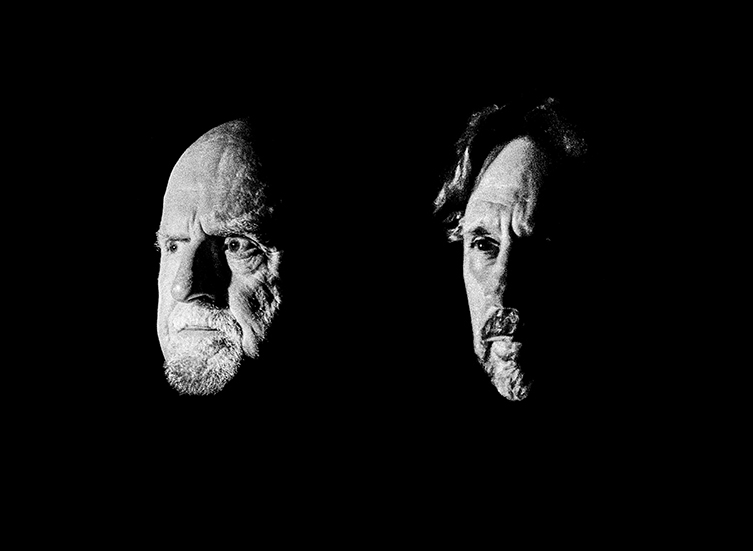
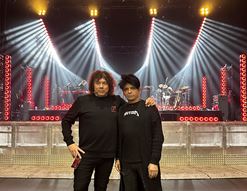
(Pic courtesy of Lustmord Lombardo)
Now that is a good quote to end the interview on! Brian was certainly generous in revealing the inner workings of his methodology, particularly considering how many online musicians copy his style and vibe. In the end, it’s as he says: the real art is in the selection of the sounds themselves: noticing what makes an interesting texture, capturing that, and then applying it in a context that makes it turn into music. Nobody does it like Lustmord, and for me, this was a very rare and worthwhile opportunity to explore that with him.
The Lustmord Lombardo record The Pulse of Atoms is out now wherever you get your music. Take an hour, find some great headphones, and sink into this sublime music.
My thanks to Brian for giving me a very enjoyable and stimulating conversation, and to Lauren and Rosie for putting me in touch with him. Find Lustmord online at his official website, and buy the album from Dave Lombardo’s bandcamp. Thank you for reading this exclusive interview: every click helps! For over 200 more original artist interviews, please head over to the guitarguitar Interviews Page. Thanks for your support.
Read More
-
GARY NUMAN's Steve Harris: Skirts, Lippy and Playing the Albert Hall with a £70 Guitar!
-
Blade Runner LIVE: Behind the Scenes of the Sci-Fi Event of the Year
-
"I need to do this, otherwise I’ll be really sad!" JONATHAN HULTÉN Returns!
-
HANS ZIMMER'S SYNTH: The Story Behind GIORGIO III!
-
DEVIN TOWNSEND: From METAL to OPERA with The MOTH!





![LAURA COX: Trouble is Coming! [Interview]](https://images.guitarguitar.co.uk/cdn/small/160/753_gg_lauracox_thumbnail.jpg?quality=80&w=247)
![Kai Hansen Talks Giants, Monsters and 40 Years of Helloween! [Interview]](https://images.guitarguitar.co.uk/cdn/small/160/753_gg_helloween25_thumbnail.jpg?quality=80&w=247)

![Nita Strauss UNLEASHES Her Secrets! [Guitar Tips]](https://images.guitarguitar.co.uk/cdn/small/160/news_753_Nita-Strauss-UNLEASHES-Her-Secrets_Thumb.jpg?quality=80&w=247)