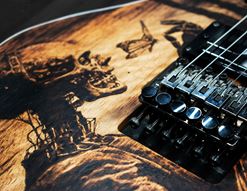
What happens when you get two legendary guitarists and put them in a room together to make music? Floods of notes? Endless show-off shreds? Egos clashing at the door and getting worse from there?
No, not if it’s ex-Genesis legend Steve Hackett and Marillion’s guitar wizard Steve Rothery! These prog masters are both renowned for their taste, tone and melodic nous, so it comes as no surprise that any body of work featuring them is full of melody, taste and atmosphere.
These two world-class talents are long time friends, and this new collaboration album is the culmination of years of sporadic working around each other’s busy schedules. The Roaring Waves is a guitar high point for 2026, and one well worth a deep dive into, if you’ll pardon the pun! The ocean in all of its breathtaking splendour and horror is the overarching theme throughout, and both Steves have approached that theme in their own inimitable way.
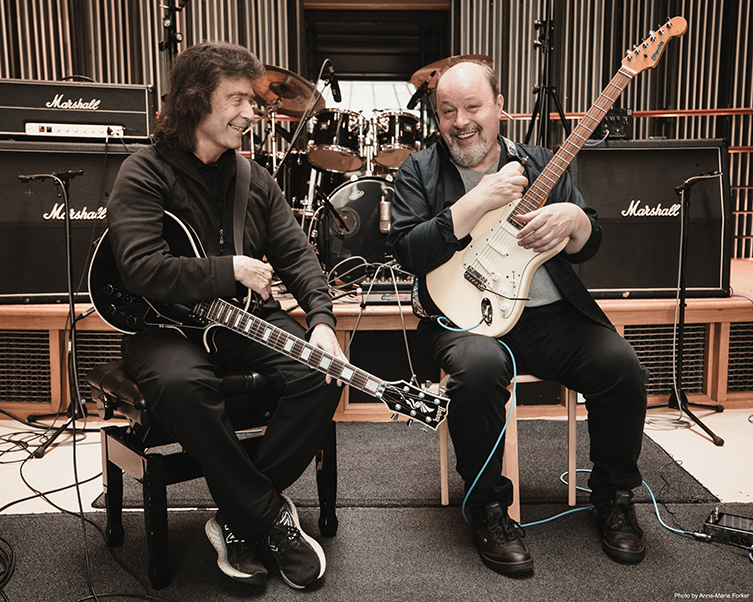
A word that features heavily in today’s interview is ‘conversation’, and that really is what you get here in The Roaring Waves. There are entwined melodies, subtle harmony and moments of counterpoint, with - significantly - a sense of space for these notes to breathe in and around. It’s a conversation between two master players, who both have plenty to say. The aquatic theme ebbs and flows, bringing drama and nostalgia to the album’s mysterious sound.
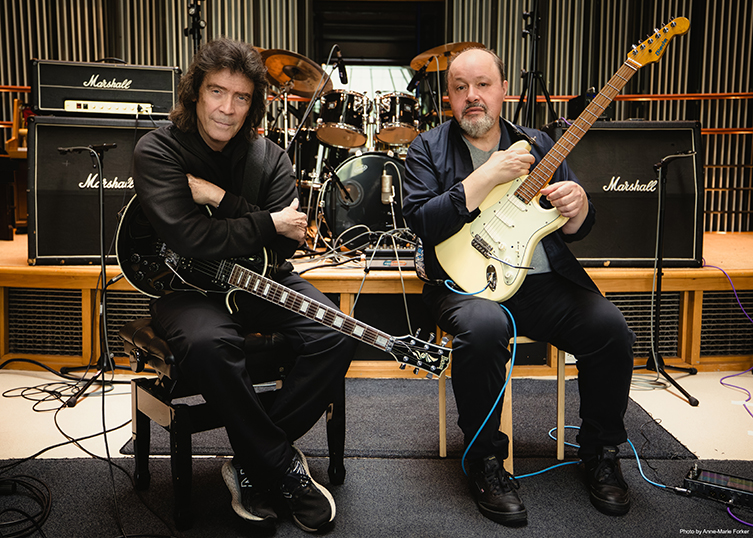
(Pic: Anne-Marie Forker)
As mentioned, Steves Hackett and Rothery are good friends, but they are also both good friends of guitarguitar! I’ve had the pleasure of interviewing both of them on a number of occasions, though this is the first time it’s been both of them for the same record! I decided early on that the most interesting way to present these interviews is together in one article, in the order in which the conversations happened. So, today you’ll find my talk with Steve Hackett first, followed by my time with Steve Rothery. I know both artists to be gentlemen and great articulators of their thoughts, and both proved to be on rare form when I caught up with them for this piece.
Here are both parts of the interview. Grab yourself a brew and a comfy seat. I hope you enjoy!
Steve Hackett
Steve chatted to me from his London home, and was generous both with his time and his anecdotes. Indeed, our conversation travelled into some highly interesting areas that I’ll save for a future article, since they fell outside the scope of The Roaring Seas. Something to look forward to!
Guitarguitar: As far as I understand, you and Steve Rothery have been friends for a long time prior to this, haven’t you?
Steve Hackett: Yeah, that’s right. We’ve been friends for decades actually! I’m sure it was one evening over eight years ago that we decided to do something. We were thinking: who should we involve? In the end, it just became simpler to have the two of us. There’s an awful lot of guitarists out there called Steve! (laughs) but there’s only two that I know with wives called Jo and that’s us so we have that in common! We have guitars in common. We started off as mates, and we’re still mates, having done this first album! Mr Rothery has suggested that we do another one as well, straight off!
GG: Excellent!
SH: Maybe that’ll happen, I don’t know! At the moment, it’s interesting to find out people’s response to the first one. The dictates of that will play their part. The video that we did for a track called The Black Sea seems to have produced an extraordinary amount of interest: I don’t know what the exact figure is, but it's over three hundred thousand hits on the video, which is damn good! If they all bought the record then hey, you know, that’d be good! (laughs)
GG: For sure! When you guys decided to create this record - The Roaring Waves - together, there’s of course this overarching metaphor of the ocean, which is a perfect thing to hang some atmospheric guitar playing on. Was that concept in place prior to you making the music?
SH: We had some other sea-faring titles which were very specific, but we decided not to bog it down with too much heroism or worthiness. Just the idea of the sea in its friendly - and unfriendly - capacity. K-129 was a Russian nuclear submarine that sank with a huge loss of life. The Roaring Waves title track was nothing specific, just something that was varied in terms of acoustic guitar to kick off and then the conversational approach where we swap phrases and sometimes play at the same time. Not necessarily playing the same melody, though we do from time to time, but it’s a musical conversation.
We started on it 8 years ago. The reason it took so long is that, yeah, it’s an epic length, but the truth is, we were very busy with our own bands and commitments, and also our commitments to others. I was working with ostensibly my own band but at the same time I was doing stuff with the South Americans, I was doing stuff with the Hungarians, a lot of other stuff, and a lot of different types of albums.
It was difficult to find a time when we were free to work together, but when we did, it proved very fruitful. And then a lot was done very much at the last minute! I’m pleased that it coalesced into an album, I was worried that we wouldn’t be able to finish on time for our record company!
"Never strive for originality: always strive for authenticity"
The Writing Process
SH: I had a blast doing this stuff with Steve. What tended to happen was, instead of somebody coming in with a complete tune, we’d come in with the idea of a pulse or a riff, to see if that engaged the significant other player. Does this fire you up? Yup, okay, yes we can do this!
Steve Rothery and I had lots of conversations about stuff that could probably be cinematic: music that could be for an imaginary film. This idea of films for the ear rather than the eye is something that came up many years ago with me, and then I noticed that having come up with what I thought was an original statement, Frank Zappa was virtually saying the same thing years ago! Never strive for originality: always strive for authenticity. That would be my advice to anybody, because very quickly you’ll find that it’s already been done. Sometimes I’ve been at the forefront of ideas, but other times you find out that Bach had already done it some 300 years ago, or whatever!
GG: It’s difficult to get past Bach sometimes!
Fernandes Sustainers
SH: It is, yes, that can be demeaning! But coming back to this record, I had great fun doing it. It was very nice to have those musical conversations and find out what we both really like about music, and each others’ playing.
Ever since I got involved with Fernandes guitars, it afforded the ability to play forwards in time but sound like you were playing backwards. In other words, hitting the string very lightly, letting it engage and build to a peak (Steve is referring to the Fernandes Sustainer system, an infinite sustain device that replaces the guitar’s neck pickup - Ray), which was something I used quite a bit on this album, particularly on The Black Sea.
GG: The Sustainer brings a unique voice, and of course I’ve seen you playing Fernandes guitars in the past, so I’ll ask you: does the Sustainer change your approach to melody when you’re not obliged to either repick a note or choose a new one? You can have something going as you want, and even control its harmonic complexity. Does that factor into your composition?
SH: Oh, absolutely! Plus, you’ve got the choice of using a tremolo arm. I started asking Fernandes if they would build me something with a tremolo arm. The sustainer and the arm mean you can get away from this idea of ‘percussion and decay’, and it’s what you do with the note in the middle. It happens to be brilliant for kind of vocal sounds, and little bits of police car noises and motorbikes revving: the stuff of heavy metal, all hugely unsubtle but exciting stuff that brings out the teenage hooligan in me!
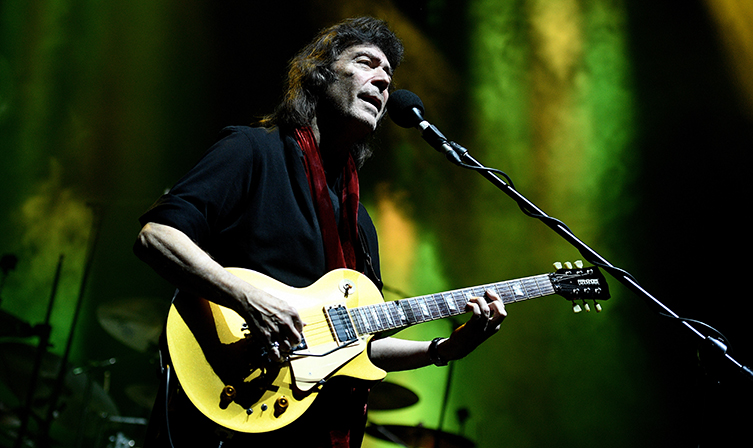
(Photo: Lee MIllward)
Red Special
They’re very good guitars. I’ve been using a lot of nylon guitar, but I’ve also got a guitar that Brian May designed. A friend of mine lent me one and I ended up swapping a Les Paul for it.
GG: Wow.
SH: I liked the pickup configuration very much. The three pickups that you can put in and out of phase with each other, gives you a very wide range of tones. The Fernandes is another extreme of our approach: you have another way of achieving the elusive upper harmonic.
But Brian’s playing, I noticed, was very much driven by the sound of the guitar. We worked together several years ago on a number of projects. You’d be hard-pushed to work out where on the fretboard he was playing, because you’ve got lots of harmonics available, plus you’ve got the ability to do false harmonics.
Plus the Fernandes, when you’ve got it in one position, it’ll default to a harmonic but over a slower transition. It’ll creep up, but without any tyranny of volume, and you don’t have to kill anybody to get the level of feedback you want! The downside used to be: I can’t get the sound I want without high volume. Now you can!
Amps, No Amps, and Pedals
Also, distortion units that do a very good impression of amps cranked up. Tube distortion.
I’ve also started using in recent times two Sansamps in series, whereas at one time, I’d be using two 50-watt Marshalls set on ‘stun’ and the idea would be: do not play a note until the engineer has left the room! (laughs) Now, I can comfortably hold a conversation over the top, and it can still give you that feeling.
"We wanted to respond to each other. It was very much an organic process: very little was written outside and brought in".
I’ve gone back to recording with amps, though, which might sound like a strange thing. For years, because of the constraints of volume and what have you, I was using what was in-the-box with computers. I moved into a new house with a big studio area downstairs again, and that means I can have my Engl amp cranked up fairly high! So yes, it’s moving some air, and as I say, I’m using two Sansamps in series, which makes it hiss like crazy but it does produce an interesting sound. I have used Pete Cornish treble boosters in my time, and I’ve used some of the Mike Piera stuff too: the (Analog Man) Beano Boost and that kind of stuff.
Very often I find that if I’ve got two Sansamps cranked up, I’m not necessarily needing to go to the stage of having a treble booster. Although, live I do. So there we go! The funny thing about live is that you can never really tell the kind of sound that you’re making. You’re standing in front of an amp, but it’s going through a PA - if you’re lucky - and you don’t know what sound the audience are hearing. It’s coloured by everything: the building, the speakers, everything.
The Age of the Guitar Hero
SH: In the 1960s, when guitar heroes began to appear on the streets in profusion, amps were onstage. You heard what the guitarist heard, and you would’ve been at the mercy of the acoustics as your sound ricocheted around the walls of a club. But interesting sounds were created from that, I think: guitarists playing so fast that you can’t discern the notes anymore; it became like a wall of treble or a wall of knives.
That was a great thrill for me when I was a kid, it was the equivalent of being on a rollercoaster when it was going a little bit too fast, a little bit too high, a little bit too low. All of that would produce the same smile as the guitarist when we went into his solo, and the drummer would get excited and start going to the ride cymbal because you couldn’t hear the snare, because nobody mic’d up snares in those days! Excuse my digression!
GG: Not at all! You raised a lot of interesting points there! One that I’d like to touch on with you, Steve, is that this is an album made by two very competent lead guitar players to say the least. What I’m not hearing is two players shredding and trying to out-pace each other. It’s not only very complementary, but it feels like restraint might have been a factor in the project?
SH: I think you’re absolutely right. To make a characterful album that has guitars involved, that’s really what we went for: something melodic. We wanted to respond to each other. It was very much an organic process: very little was written outside and brought in. There were lots of first takes of things, with not too much refining. To give ourselves that permission was important, and for the conversation to be a complimentary one rather than a contest of salvos.
I have noticed most of the time when you get guitar pairings, particularly with some very competent American guitarists, it becomes prowess-driven. Competence-driven music, as all jazz is, and that’s a turn-on for some people, a turn-off for others. Too many notes, Herr Mozart! (laughs) Whenever I’ve been working with American guitarists live, as I have in some jams and what-have-you, it’s very much the school of ‘I’m gonna blow you off the stage, man!’ (laughs) And once that starts - to be the fastest gun in the west - yeah, there’s times I admit I’ll lapse into that, it can be very exciting in short bursts, but over the course of an album, I would struggle with that. Over the course of a song, I would struggle with it! Over the course of a gig, I would definitely be worn down by hearing all of this virtuosic expertise.
GG: It loses its power, doesn’t it?
SH: It does lose its power, yeah. I think it’s somewhere to go. Let’s put it this way: if I’m doing (Genesis song) Supper’s Ready live, there’s the iconic phrases and then there’s nowhere to go but speed and prowess and all of that, to try to keep the surprises coming.
Form Versus Spirit
SH: I remember having a phone conversation with Robert Fripp, and he was talking about form versus spirit. He was talking about Emerson, Lake & Palmer, I think, and he said there was lots of form, but he was more interested in the spirit, which I took to mean improvisation, spontaneous combustion, all the rest.
I think that the contrast of the two was really what it was all about: the idea of music with surprises. You had this with Yes. There was a reverence for classical music. Chris Squire had been a choirboy. I got to work with him on several things, and you know, there would be a conversation about Hubert Parry and this kind of stuff. The lover of classical and choral music, and you would hear it all through Yes. I also share a reverence for all of those things, and of bands that use harmonies well.
GG: Interesting, because a lot of the great 60s bands were all about vocal harmonies, a lot of what I’d call the ‘Laurel Canyon scene’, and that brings me to the song that maybe surprised me a little on your album, Pacific Coast Highway. To me, that’s the most different track of the lot, and I don’t know if you’d agree but that sounds almost like Jim Morrison should be singing on it!
SH: (laughs) I'll tell you what I thought. I visited the Allman Brothers’ house, which is a museum, and I got to play the guitar that kicks off Layla when I was there. It struck me, listening to some Allman Brothers stuff, that we weren’t far off it with this.
We were also worried - and we still worry - that people would say ‘this isn’t progressive!’ it isn’t long, it isn’t driven by chords, it’s not driven by form: it’s everything that progressive is not. It is two guys having a jam, and allowing things to happen. This is the kind of thing where I’m always thinking ‘Oh, it would be great to be doing that with my own band!’ (laughs) This is pretty much what we can do in one go and so when I say it’s a musical conversation, that’s really it!
And we’re not trying to outplay each other. I don’t think there’s any clever playing on the whole album, apart from the slightly classical, slightly flamenco intro to the album. Even with that, I’m often trying to convey the idea of water rather than separate notes, so I tend to arpeggiate, and arpeggiate as fast as I can, using different techniques. I’m writing a lot of seafaring titles down right now, for an album that I’m working on right now, and another one that’s completely separate using the orchestra. Because orchestras can rock too, and how!
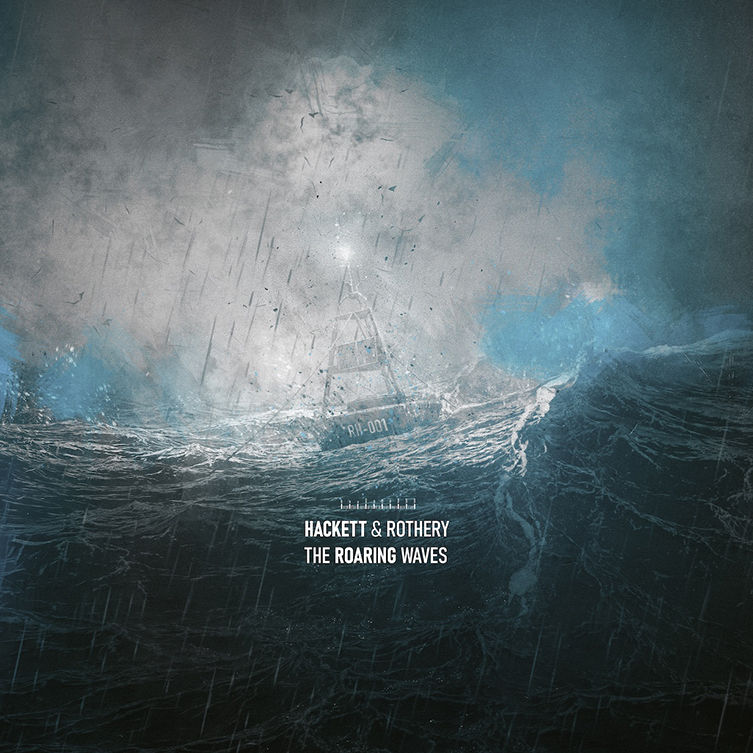
Steve Rothery
I caught up with Marillion guitarist Steve Rothery the following Monday. He was in his hotel room in Berlin, overlooking the venue he’d be playing in with Marillion the following night.
GG: I was talking to Mr Hackett on Friday there, and you and I have spoken before about how you have both been friends for some time. I take it that this collaboration has taken so long to happen is down to both of your schedules?
Steve Rothery: Absolutely yeah. We both never stop, really. He’s even busier than I am, which is saying something! He’s always touring, and he’s just finished another two albums! It’s incredible!
GG: Yeah, he’s a very energetic man! So, the album is called The Roaring Waves. Obviously there’s this overriding metaphor of the ocean. Now, you won’t remember but you and I had a conversation a few years ago about we’re both from small coastal towns. I wonder: what is it about the ocean that is so endlessly inspiring for artists?
SR: Well it’s just such a strong, always-there kind of reflection of the emotions of the world, or of the moment. There’s nothing like the sound of the sea during a storm, that primordial kind of energy that it has. And it can change just like that, especially in the North Sea. Not so much these days, but at the turn of the early 20th century, there were loads of shipwrecks and storms there.
So I think there’ s just something very powerful and poetic about having that as a constant influence - even if it’s subliminal - in your life, I think.
GG: It sort of runs parallel to human experience as well, so it’s easy to project music and art, as you say: it reflects back, doesn’t it?
SR: Yeah, and Whitby was a small port but occasionally you’d get very small cargo ships coming in. I used to have a Grundig Yachtboy radio that I got for one of my birthdays when I was about thirteen. You’d listen to the short wave radio broadcasts and hear all these transmissions from ships, and it gave you that sense of wonder, and of the interconnectedness of everything.
(Pic: Anne-Marie Forker)
And also the fact that once you leave a place and travel across the ocean, it’s like a whole new world, literally. That kind of perspective, growing up, and how magical that seemed. I hadn’t travelled much before I moved away at 19 to join Marillion. I’d been abroad hiking once when I was 15 but that was the only travelling I’d done outside of Yorkshire, really. So, to come from that and spend the last 47 years of my life travelling around the world, it’s been quite a contrast! (laughs)
GG: Haha, yeah I never really considered that: the travelling, the journey, the kind of interstitial status of never really being in place A or Place B. That’s a musician’s life and maybe that’s why the ocean speaks to you? It's kind of the same thing, isn’t it?
SR: It is really, yeah. That’s what anyone who had a career at sea would experience. The constant travel, the new horizons, and the kind of…not solitude, but maybe a slight disconnect from conventional life that it brings about.
GG: Yeah, which is just like a touring musician for sure. So, some of my questions will reflect my conversation with Steve Hackett, because I’ll put them together in the same article. He mentioned that not much of the material had been written in advance, and you had mostly developed it either directly playing against each other or were writing it on the spot. How much does that correspond with how you work with Marillion?
SR: It has some comparisons. One of the main early sessions we did was at the Racket Club (Marillion’s HQ and practice space - Ray) where all my equipment was anyway, and it was just the two of us. I’d call up some drum patterns on EZ Drummer on my laptop, and we just took a jam-based approach and played off of each other, which was very inspirational. Then Ricardo got involved, and stuff evolved from that point and it all took shape.
"There 's just something very powerful and poetic about having the ocean as a constant influence, even if it's subliminal"
We had a trip up to Whitby maybe five years ago, just after things opened up again after the pandemic, and we stayed in this funny little hotel in Whitby called La Rosa which is just chockfull of weird stuff: it looks like something from one of Steve’s album covers, actually! It’s got all of these Victorian objects everywhere. I showed him where I grew up, and where the 15-year-old me would be listening to Genesis Live, and being inspired by him as a player. And here we are, 40-odd years later, and he’s a great friend and we’ve made an album together!
GG: I know! What a journey!
SR: Totally!
Influences
GG: Here’s one thing I wondered about. You’re both well known for being innovative, melodic lead guitar players - and I’ll go back to that in a second - but one thing I wondered: did you learn anything about your own style and your own preferences through playing with Steve?
SR: Well, Steve’s a huge influence on me, but he’s only one of three influences. Dave Gilmour’s a really strong influence, Andy Latimer from Camel’s a really strong influence. Also, elements of Carlos Santana’s early work with the sustaining notes were a big influence on me. There’s all these different players I’ve taken aspects from, and combined them into what excites me about the guitar.
With Steve and I, we speak the same language, if that makes sense? When it comes to developing things, we have an instant rapport in that we can see what the other person’s trying to achieve which is a great time saver sometimes in the process! (laughs).
GG: Totally! That’s interesting about Santana: is that what influenced you to buy a Yamaha SG back in the early days?
SR: It was, yeah! Absolutely. It was the Moonflower live album, but I loved Abraxas, Caravanserai and all of that period. I was fascinated at how he could make the guitar sustain forever. Part of it, I think, was the Yamaha. I never 100% bonded with it, though. Growing up in Whitby, there was the other established guitarist of the time, a guy called Garry Trillo, the son of the guy who sold all of the ice creams in Whitby, a big wealthy family in Whitby at the time. He had a real Les Paul and a real Marshall, you know?
GG: Right!
SR: He played the school concerts, and he had the sound, he had that sound that you’d hear on the Thin Lizzy records, that only happens with a Les Paul and a Marshall. I had my Yamaha SG2000 and my Orange overdrive amp…and it just didn’t do that! It was always a source of perpetual frustration!
But then I got an Electro-Harmonix Big Muff and the guitar would sustain forever. I got into using pedals more and also, I was listening to people like Steve Hackett and Dave Gilmour, who used a more textural approach.
I remember listening to Shine On You Crazy Diamond on the beach at night in Whitby, under the stars on a portable cassette player, and thinking: ‘Yeah, that’s what I want to do with my life!’
GG: Yeah!
SR: Which is what I have done! (laughs)
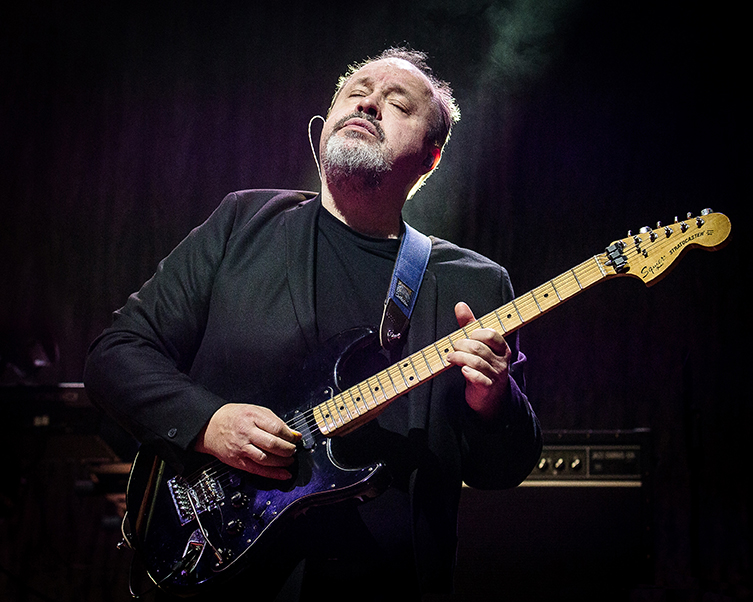
(Pic: Anne-Marie Forker)
Complimentary Voices: Rothery’s Gear
GG: Exactly, nice! And that brings it all back to the ocean too. So, with that in mind, the more textural approach: there are loads of lovely examples on the album. Did you both have any discussions about - for want of a better word - rules that you might adapt for a particular song? Like, about what you might want to do or not want to do?
SR: Not at all, no. The thing is, when it came to the overdub stage, Ricardo the keyboard player/engineer-producer was recording Steve’s guitar parts with him at his house studio. I recorded 99.9% of my parts in my studio at home, where I have too much equipment! That’s why I started this guitar podcast called Tonehenge! I have this ultimate selection of amps switching into one of the Fryette power stations, into a choice of speakers, into more pedals than you can count!
"I remember listening to Shine On You Crazy Diamond on the beach at night in Whitby, under the stars on a portable cassette player and thinking: 'Yeah, that's what I want to do with my life!'"
For me that was really important, to have that choice of texture. I wanted to have that whole range, that whole palette of colours that I could call on. Friedman, Matchless, all these different amps, depending on what I was looking at. A dozen different kinds of chorus pedals, for example, or reverb pedals, to find just the right sound for the part.
GG: That’s all ‘champagne equipment’, Matchless and Friedman. In the video, you play a lovely white Levinson Blade. I know you’ve had a few of those in the past, but was that white one one of the main tracking guitars for this album?
SR: I did use it actually on that track, the Black Sea. It’s got EMG SA pickups so it’s more like the Squiers that I use for the old Marillion stuff. But yeah, it’s a really nice guitar. It’s got the Vega trem, which I love! But I used Les Pauls quite a lot on this album, which is quite unusual for me. The next track that comes out, The Red Dragon, has got heavy guitars which were the Les Pauls into the Friedman for the chordal sound. There was a Yamaha John Scofield semi-acoustic from the early 80s that I used a fair amount.
There was a whole range of guitars, really. I just wanted to have the choice of all these different voices, and because every guitar makes you play slightly differently. They’re all great at certain things.
GG: That’s an interesting angle. Without boxing you in, I’d say that you’re a ‘Strat guy’: that’s my impression of Steve Rothery’s vibe.
SR: Yeah, absolutely.
GG: And I would say, conversely, that Mr Hackett is a Les Paul guy. So, rather than going for your extremes, you’ve actually decided to go closer with the Gibson. Was that simply a case of the sound you heard and required? Or was it the note choice thing?
SR: Well, the other guitar I used an awful lot was my Jack Dent Raven, which has two singles, a humbucker and a boost. It’s a very resonant guitar, so I used that an awful lot as well. But sometimes you want something that sustains without you having to overdrive it too much, which is why I like a Les Paul guitar, and indeed another Jack Dent guitar with P90s on it.
Again, just having that choice of guitars helps you. I've used Strats so much, and I can get most sounds I want out of one, especially the Blades with the mid-boost circuit, two singles and a humbucker. Sometimes you need some variety, you want to keep it fresh and interesting.
GG: Yes, little perspective shifts can be very important! Now, going back to melody. Playing the Les Paul with its humbuckers, smaller scale length and kind of pitched neck angle, promotes a different type of playing, with easier bends and so on. I wonder whether the melodic playing was suggesting that the Les Paul was the right tool for the job, as much as a sonic thing?
SR: Um, I don’t know really! I’ve always felt that the reason I haven’t used Les Pauls in the past so much - even though I love them - is that it always feels like cheating! It’s too easy! With a Strat, you have to force it into submission (laughs) to get it to do what you want it to do! You have to fight it, and there's something I quite enjoy about that. The struggle!
Strats have a timeless sound, and you can make them sound like a humbucker-type guitar, but yeah, it just varies from song to song, which picture I want to paint.
GG: Right, which paintbrush you want to use.
SR: Exactly.
GG: Any particular pedals that featured heavily?
SR: Well, the thing that I used a lot was the Eventide H90. I love it for the weird and wonderful ‘what is that?’ sound, you know? (laughs) Maybe in the past you’d use a synth to do it, so a lot of those unusual textures and sounds come from the guitar, not the synth. Riccardo is quite traditional in the choices of sounds that he used - piano, mellotron and organ - so a lot of the weird stuff is guitar.
Melody
GG: So, your commitment to melody. That’s something you share with Steve Hackett too, and I’d say it’s quite defining of your musicality and indeed your career. When you consider superficially the idea of two prog rock guitarists coming together, you might expect all kinds of shredding, but that’s the opposite of what we’re getting here. For the better, I’d say! Do you think, with the shredding, that a lot of guitarists haven’t learned restraint?
SR: Well I think there’s this whole new generation now of uber-technical players who are, you know, fantastic in a way, you know? The Tim Hensons of this world have incredible technique, but I don’t hear much music! And I think that’s the thing: music at its heart should move people. Every note should count in the same way that when Jeff Beck played, he could play such quite complex stuff at times but it was all about the emotion. I’d much rather listen to that, so that’s the sort of playing that I gravitate towards as a player.
It’s always been a thing - there’s always been shredders - and some of them can still be melodic players, but not many of them. It’s the sort of thing that impresses other young guitarists, really, who haven’t learned better! (laughs)
GG: Haha, yes, that’s a good way of putting it! I mean, it’s impressive, but what happens is, it gets you in the head, but not in the heart.
SR: It’s a technical exercise: you’re not gonna make anyone cry.
GG: Yes. And the goal is for tears, always!
SR: Yeah, absolutely! Music is one of those forces in life and in nature that has that ability to touch people deep in their hearts. Unless you’re doing that, you’re not doing your job!
GG: Exactly! Now, I don’t know if you even think this way in terms of a melodic approach, or indeed a guitar player’s approach since those are two different things, but did you find any particular scales of chords that suggested more of that oceanic vibe that you were looking for?
SR: It’s hard to say. Growing up at the sea, it’s part and parcel of who I am. There’s a folk influence there as well, and the Shine On You Crazy Diamond approach of painting with sound, so it’s maybe more an attitude, rather than a choice of scales. I think a lot of the most effective melodies are relatively simple, really. It’s just how much emotion you can put into each phrase and leaving the space: you’re playing the silence around the notes as much as you’re playing the notes.
"Music is one of those forces in life and in nature that has that ability to touch people deeply in their hearts. Unless you're doing that, you're not doing your job!"
So taking that philosophy into how I approach the melodies, the guitar should be like ripples in a pond: everything should have a reaction melodically and sonically. That’s the only way I can describe it.
GG: Yeah, because it’s like Steve kept saying: it’s a conversation between two people.
SR: It is, and he said that the lovely thing about doing this record is that it feels like an extension of our friendship. It wasn’t a competitive sport, it was about seeing what we could create together.
GG: One tune that was unusual for me in the context was the Pacific Coast Highway one…
SR: (laughs) Yeah, we’ll be having the Prog Police hammering on the door!
GG: Haha! It’s quite interesting for me because - I don’t know about you, but I got a real Laurel Canyon, late 60s vibe. I said to Steve that I could imagine Jim Morrison singing on it! And of course, the Pacific Coast Highway is the road that runs along the front of Los Angeles so it's still coastal! But what made you guys decide to go in that direction for that track?
SR: That was an idea I had because I’ve driven that road a few times and I love that area just below San Francisco down through Carmel, Monterrey. It’s so beautiful, it’s like Switzerland meets the ocean. My idea was to have something like a late 60s road movie, and I love that era and the guitar playing of Tommy Tedesco. So that was the theme, visualising Steve and I in an old VW camper, driving up the Pacific highway, being chased by a police car with ‘Prog Police’ down the side! I had an idea for the video but it would’ve cost us about 50 grand, I don’t think the record company would go for it! (laughs)
I love Steve’s blues harmonica playing on that track as well, he’s such a great player! Being able to highlight that in a track. It’s really fun.
GG: Definitely, and a palette cleanser at the end. Now, millions of years ago, we had a phone conversation and you spoke to me about a project called Revontulet that you were working on at the time.
SR: Ohhhh yes!
GG: (laughs) So, any updates?
SR: Yeah! It’s moving along. The thing is, I’ve had three projects going for the last 7 or 8 years: the album with Steve, the Bioscope album that I released with Thorsten Quaeschning from Tangerine Dream which came out last year, then Revontulet, which has been about ⅔ finished for the last 5 or 6 years. I’ve been so busy!
We released a Marillion album, toured the world, had Marillion weekends around the world, finished off those two albums, so next on my list is the space-themed album. I'm hoping to be able to finish it off by the end of this year and then I’d like to do another album with Steve at some point, when time permits! I’ve already got some cool themes to explore for that.
GG: Yes, that was something that he hinted at himself on Friday! So, there’s more gas in the tank of the VW camper for that project then?
SR: Totally, yeah! And we had such fun making this. We’re such good friends, and our wives are great friends as well. We share a lot of the same perspectives. I think it would be great to go out and play live together, but in a way, having a second album before we do that would make a lot more sense. We’ll maybe try to make it next year and play live in ‘28 maybe?
GG: That would be great. Better context for a setlist when you can pick and choose from more material too.
SR: Exactly!
I don’t know about you, but I would quite like to see a video of these two in a VW camper van, racing along the Pacific Coast Highway being chased by the Prog Police! Can we start a Go Fund Me for that?
I’m very grateful to both Steves for taking the time to chat to me about their fantastic new album. It really does take talking to both of them to get a full picture on the process. I hope you enjoyed coming along with me on this journey, and if you’re a fan of either of these players, then check out some more of my interviews with them below!
The Roaring Waves is released on August 28th on InsideOutMusic, so keep an eye out for it! Steve Hackett tours the UK this autumn, as are Marillion. Support live music, and see masterful players performing in the flesh!
Read More
-
The guitarguitar Interview: Steve Hackett (2018)
-
Marillion's Steve Rothery on Modded Pedals and Recording in a Castle
-
The guitarguitar Interview: Steve Hackett (July 2020)
-
Radical Romanticism: STEVE HACKETT Talks Classical Guitars!
-
Marillion: Tone, Touch and Inspiration [Interview]
-
"The subtext to music is to re-energise and to heal: it's very powerful medicine" Steve Hackett speaks EXCLUSIVELY to guitarguitar!





![LAURA COX: Trouble is Coming! [Interview]](https://images.guitarguitar.co.uk/cdn/small/160/753_gg_lauracox_thumbnail.jpg?quality=80&w=247)
![Kai Hansen Talks Giants, Monsters and 40 Years of Helloween! [Interview]](https://images.guitarguitar.co.uk/cdn/small/160/753_gg_helloween25_thumbnail.jpg?quality=80&w=247)

![Nita Strauss UNLEASHES Her Secrets! [Guitar Tips]](https://images.guitarguitar.co.uk/cdn/small/160/news_753_Nita-Strauss-UNLEASHES-Her-Secrets_Thumb.jpg?quality=80&w=247)