Do you want to know about the bass guitar? If so, then I’ve written this ultimate guide just for you. You’re going to learn everything you need to know about the instrument, what it does, what it’s made from, what makes them all so different, and innumerable other little questions that you maybe haven’t thought about.
This is your complete, in-depth guide to the bass guitar. I’m aiming mostly at beginners here, but experienced bassists might want to take a look too, for completion’s sake. There could be a eureka moment or two in here for you! So, bassists: come one, come all, and let us dive deeply into the world of the low end…
What is a Bass Guitar?
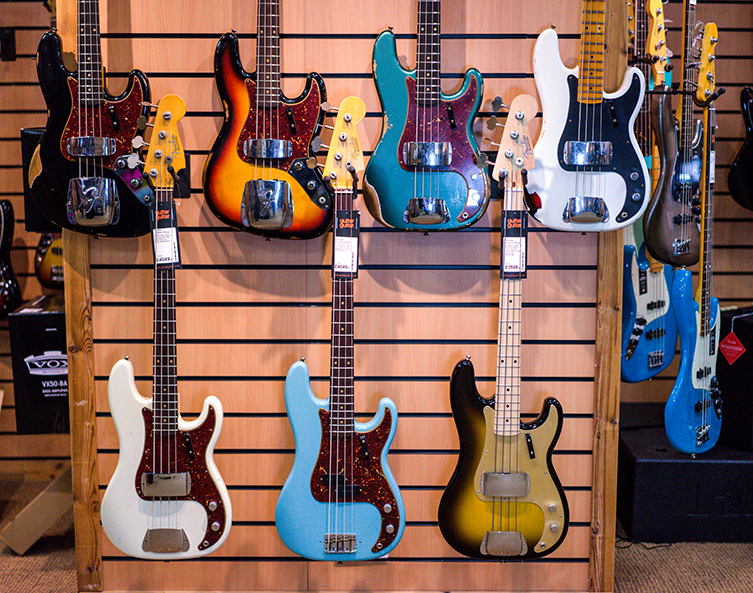
A bass guitar is a stringed instrument related to the guitar, with a longer neck and a lower range of notes. A bass guitar is designed to occupy the lower-pitched frequencies, below the likes of guitars and vocals.
A bass guitar is mostly used as a supportive musical instrument, defining a song or musical piece’s harmonic root, as opposed to a lead instrument, though exceptions do exist with certain artists. Bass guitars typically have 4 strings - two less than a guitar - but 5 and 6 string basses do exist, and I’ll mention then later in this guide.
How Many Types of Bass Guitar are There?
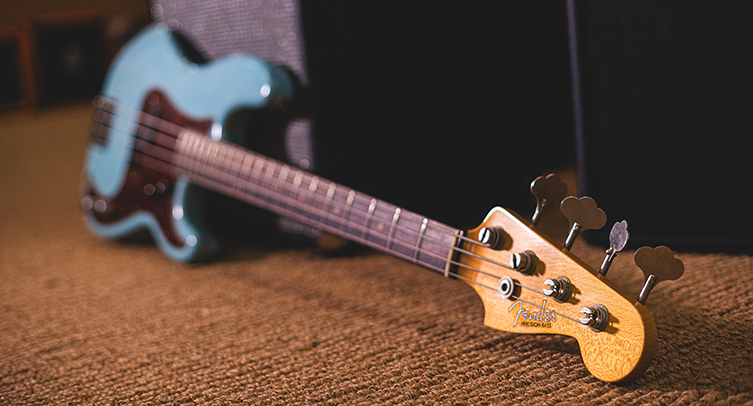
There are three main types of bass guitar: electric bass, acoustic bass and semi-acoustic bass. Having said that, there are lots of very important variations within those three categories, and I’ll be looking into just what they are today. Generally speaking, the vast majority of bass guitars are solid body electric basses. I would also say that Fender’s Jazz and Precision basses are the most popular ones worldwide, and the most influential designs to other bass brands.
What are the most Famous Electric Bass Guitar Models?
There are six electric bass guitar models that I believe are the most famous in the world. Some of these 6 are more widely used than others, but all of them are distinctly unique, and have all been copied many times since their inception. Here they are:
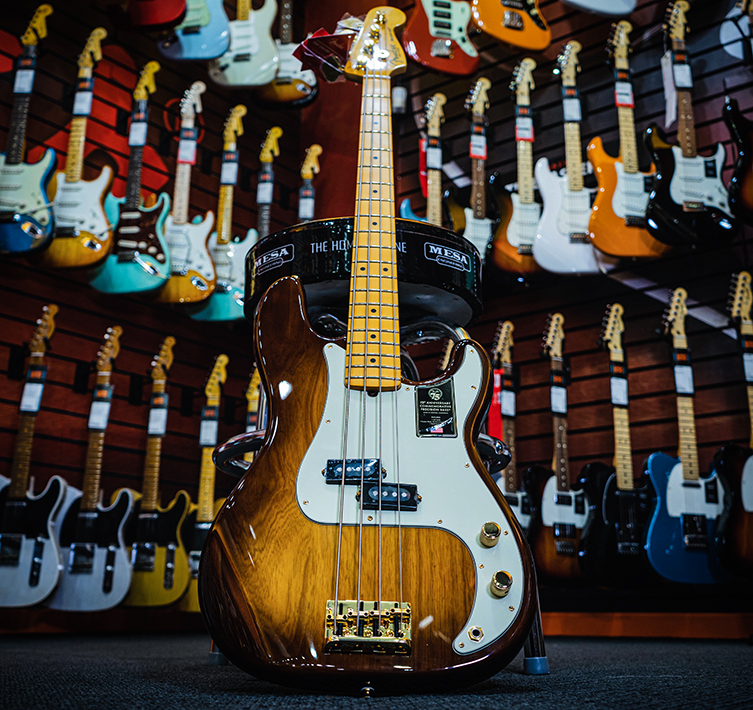
Fender Precision Bass: Also known as the P-Bass, this was the first mass-produced bass guitar in the world to gain mainstream popularity. Designed by Leo Fender and released in 1951, the Precision Bass is the most popular bass in the world. The P-bass has a powerful sound, thanks to its special ‘split-coil’ pickup, The is the original, from which all subsequent bass guitars have sprung.
The Precision bass style is so popular that maybe other makers build versions of it aside from Fender’s official models. We tend to refer to them all as P-Basses, or P-Bass style.
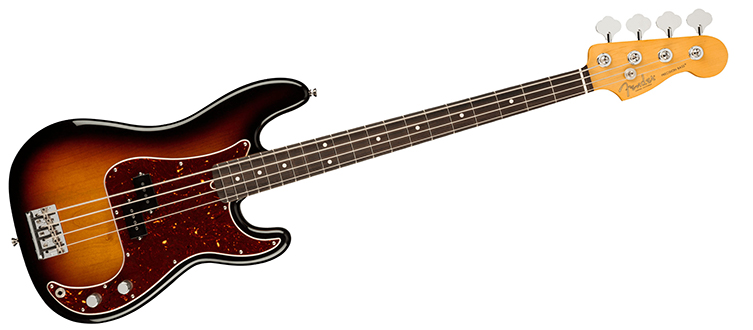
Fender Jazz Bass: Fender’s other most significant bass guitar design, the Jazz bass is similar to the P-bass, but has a more offset-shaped body, a set of two single coil pickups that can be blended together with the controls, and a slimmer neck. It produces a slightly toppier, snappier sound.
Much like the Precision bass, the Fender Jazz Bass is widely copied by other brands. The term for this style is J-Bass, or J-style bass.
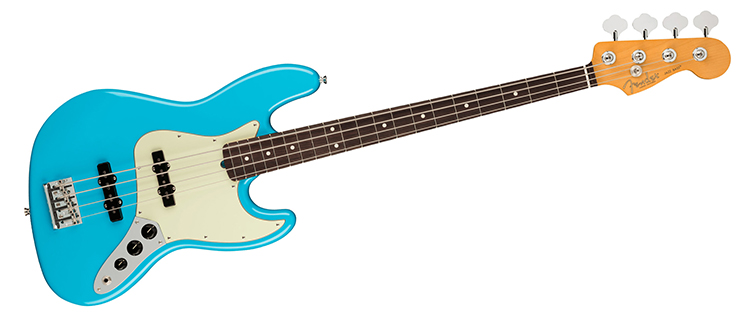
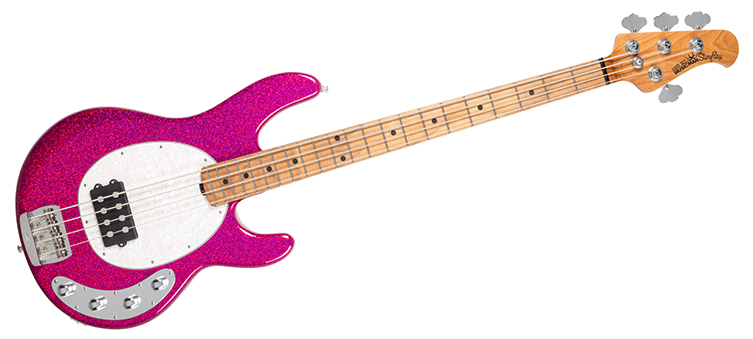
Music Man StingRay: Also designed by Leo Fender for one of his post-Fender companies, the StingRay is well known as a definitive ‘contemporary’ bass. The StingRay brought the world such pioneering developments such as active EQ circuits (see below) and a powerful humbucker pickup for an altogether different sound to the Fender basses.
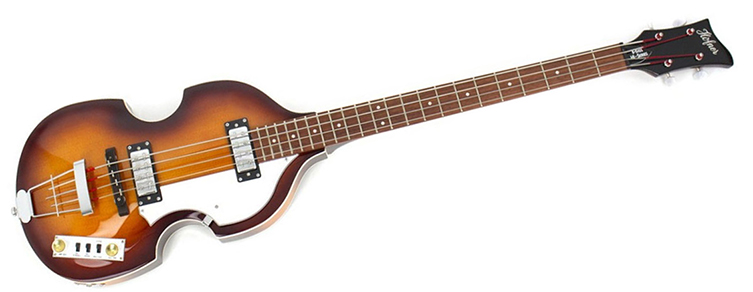
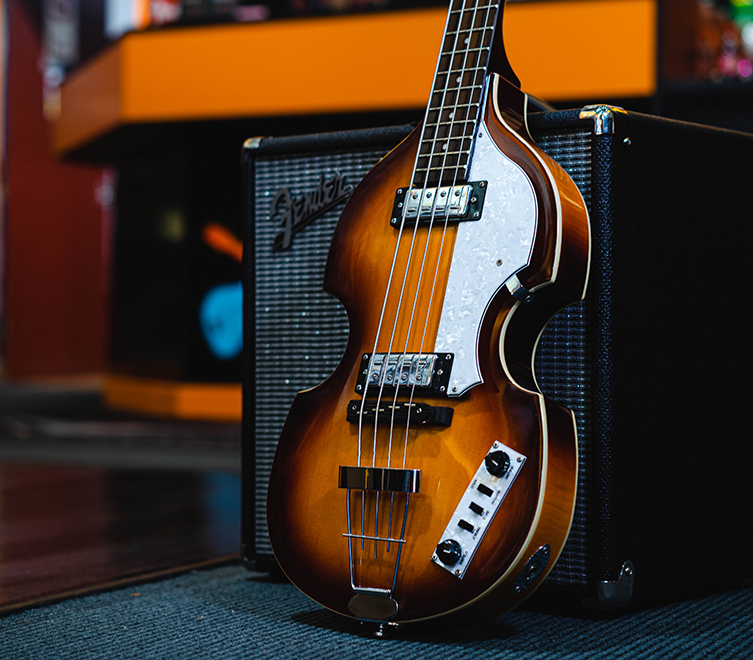
The Hofner Violin Bass: This is famous for one particular reason (or should I say, person?): Paul McCartney. This is the Beatles bass, frankly. A hollow design with a small body that does look more like a violin than anything else, the Hofner produces a distinctively resonant sound. It’s also a short scale bass (more on that later), so it feels particularly slinky in one’s hands.
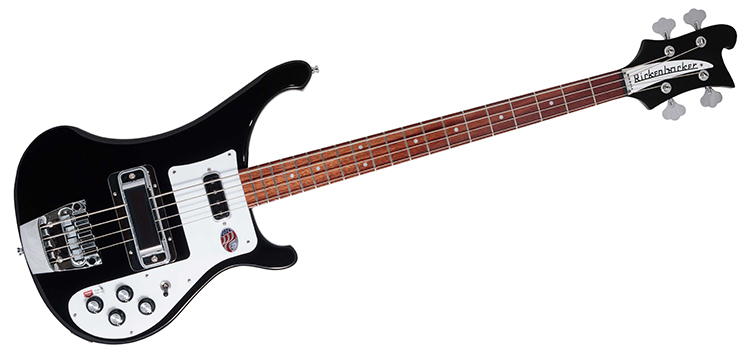
The Rickenbacker 4003: another highly distinctive, very influential bass guitar design. It’s big, idiosyncratic and has a look and sound all of its own. It’s a very ‘rock’ bass with a growling sound that makes it work particularly well with overdrive. I think it is fair to say that the Rickenbacker 4003 bass is as much an attitude as it is an instrument!
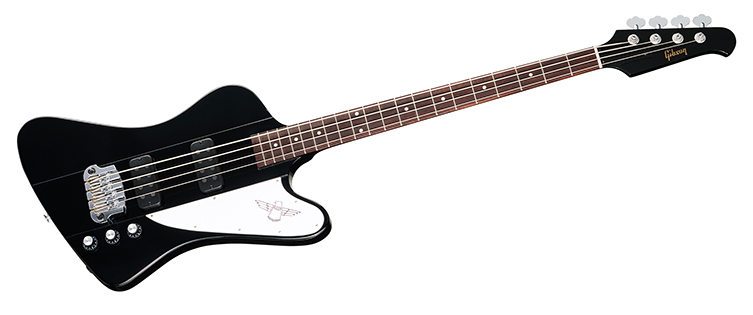
The Gibson Thunderbird defines a particular style of bass build. This is a large and sonically heavy bass, just like the Rickenbacker. Both basses feature a neck-through construction style (see below), though otherwise each bass is very distinct. The Thunderbird uses an offset ‘reverse’ body shape and in-line headstock and has a pair of hot humbucker pickups to bring a particularly powerful sound that is popular with hard rock groups.
Other Bass Styles
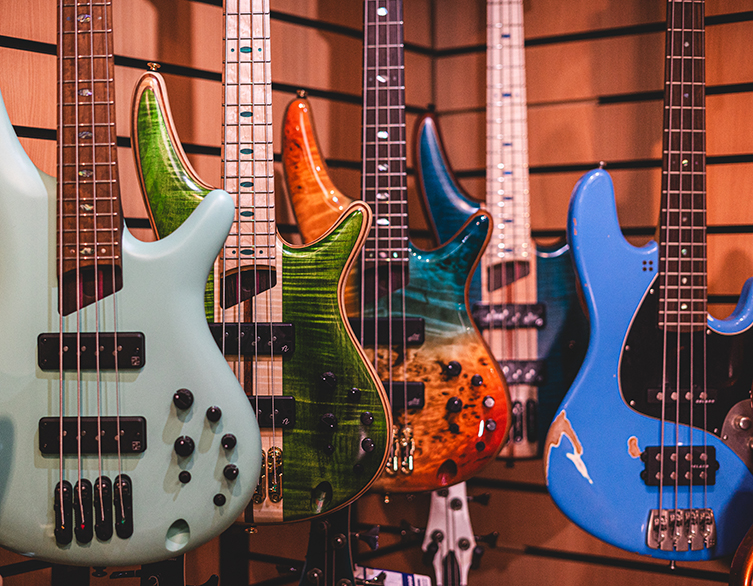
Those are the six most distinct bass models, as I see it. That doesn’t mean that all basses are copies of these six though. Far from it! Many basses exist that bear no real stylistic debt to these, it’s just that they are not as well known and ingrained in the history of the instrument. For example, brands like Ibanez and Yamaha make whole catalogues of interesting bass designs that appeal to the more modern player. They use original shapes, or styles derived from bass brands like Warwick and Wal. Their influence can be seen on countless other contemporary models.
Bass Guitar Bodies
Bass guitar bodies tend to be made from one of the following timber choices: alder, ash, basswood or mahogany. This stems back to the original days of the 1950s when Fender chose alder and ash for their initial Precision bass builds.
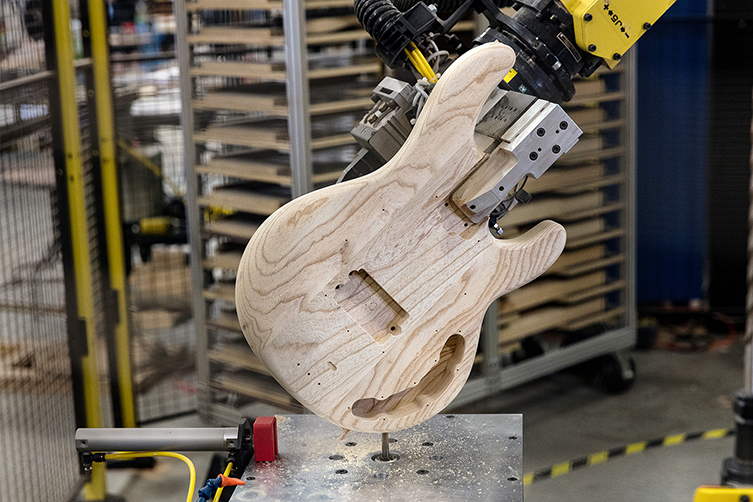
Different woods have different tonal properties, and these refer to things like sustain, ‘snap’, resonance and so on. To a certain degree, these things can overlap between timbers. Mahogany is known to sound ‘thick and warm’, ash is ‘resonant’ and basswood is very balanced, meaning it doesn’t overly influence the final sound in any particularly strong way. Bass bodies can be solid, semi-hollow (hollow cavities with a solid centre) or fully hollow. Semi-hollow and hollow bass bodies will normally have an ‘f-hole’ in the body where the hollow part is.
Bass Guitar Necks
There are the main ways in which Bass guitar necks are attached to bass bodies. typically either bolted-on to the body, glued in (also called a ‘set neck’) or as a ‘through-neck’, which means that the neck and middle of the body are the same piece of wood, with the rest of the body shape being created by gluing ‘wings’ to either side of the body.
Bolted-on necks are by far the most popular, which in part comes from so many brands using Fender basses as rough blueprints for their own models.
Bass Guitar Tuning
The standard tuning for a bass guitar follows the bottom four strings of a regular guitar, albeit an octave lower in pitch. That is, lowest to highest: E, A, D and G. The vast majority of guitar music (and, therefore, bass guitar music) will be in this tuning, and it is how your bass will have been tuned and ‘set up’ prior to you owning it, if you bought it new.
Other tunings do exist of course, and a popular one for rock music is ‘drop D tuning’. Drop D tuning is fairly simple: you retune the lowest string in pitch from E to D, and leave the rest as they are. This deepens the sound, lowers the pitch and makes the music sound agreeably heavier.
So that is for 4-string basses. 5 string basses add a lower B string to the existing 4, making the overall tuning B, E, A, D, G. On rare occasions, 5-string basses use a lighter 5th string at the ‘top’, instead of a heavier one at the bottom. It’s not generally how you’ll find them, but it does happen sometimes.
6 string basses change things up a bit. Generally speaking, a 6-string bass will have both a heavier AND a lighter string. The usual 4 bass strings will be in the middle, flanked by a low B string and a high C string. Overall, the tuning is B, E, A, D, G, C.
On even rarer occasions, a six string bass can be tuned like a guitar except an octave lower (so E, A, D, G, B, E), though you’ll most likely find this on hybrid/crossover instruments like the Bass VI. The Bass VI, made by Fender and Squier, is slightly different to a normal bass, and in fact is often seen as neither bass nor guitar, but as its own special thing. I talk more about 5 and 6 string basses under the chapter on Extended Range Basses.
Bass Guitar Electronics
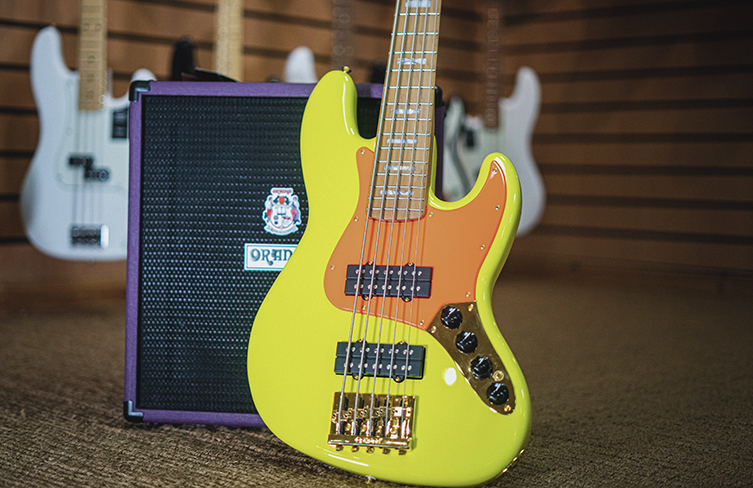
Bass guitar electronics refers to two things: the pickups and the preamp. These can be either active, passive or a mixture of both. What does this mean? I’ll start with the preamp.
Passive: the electronics function without the need for a battery or external power. Basses with passive pickups often do not have preamp circuits in them. They’ll have simple volume and tone controls.
Active: the electronics need a battery (usually a 9V PP3 style) in order to work, but generally offer more powerful tones and tone-shaping abilities. Active basses will most likely have preamps (see below) installed within them, and usually active pickups too.
Both: some active circuits can revert to passive operation in the event of a battery running dry, so that the bass can still make a sound. Also, basses with passive pickups can still also have active preamps. This effectively makes them ‘active basses’, but the application is different.
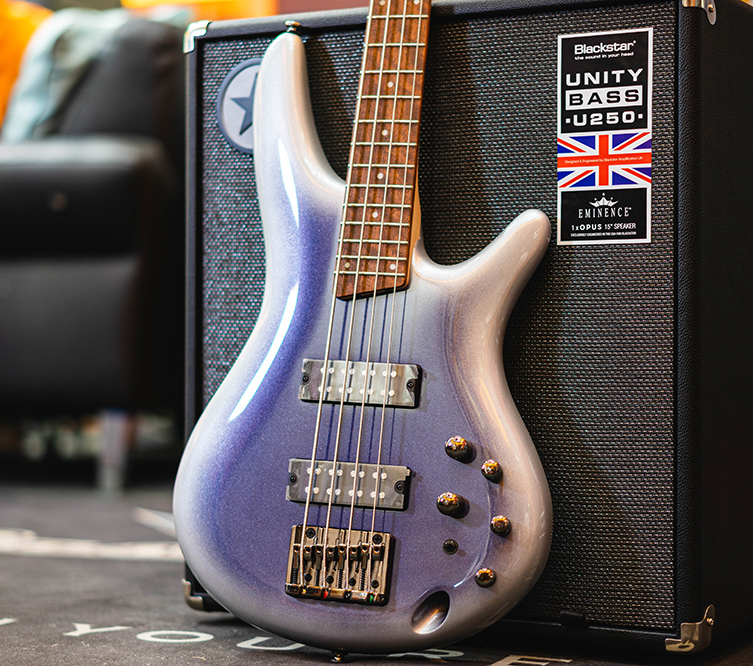
Bass Preamps: A bass preamp is typically active - so a battery is required - and is switched on as soon as the bass has an instrument cable connected to its input jack. This is worth remembering when you finish playing! Unplug the instrument cable from the bass or your battery will run down and need to be replaced.
We use preamps with bass guitars because of the power and control they give us as tone-shaping devices. For example, many bass preamps have ‘active EQ’ sections, where you can boost or cut specific frequencies rather than simply turning down the high end/treble as you’d do with a passive tone control. Active preamps allow you to carve out your sound, boost what you want more of and cut what you want to hear less of.
Bass Pickups
Bass pickups also boil down to three main varieties:
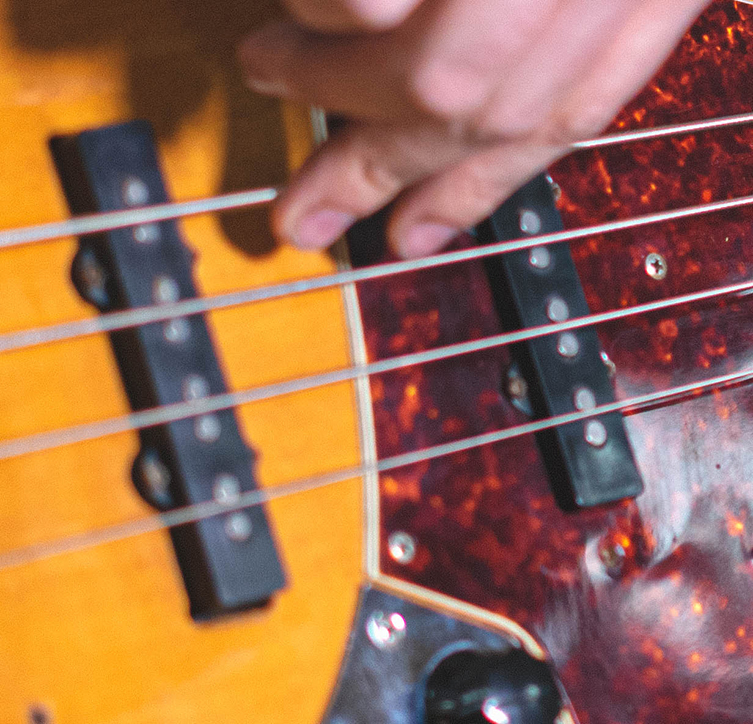
Single coil: found on the Fender Jazz bass, for example. More or less the same design idea as a single coil pickup found on a Stratocaster or Telecaster, though obviously sized and wound for a bass.
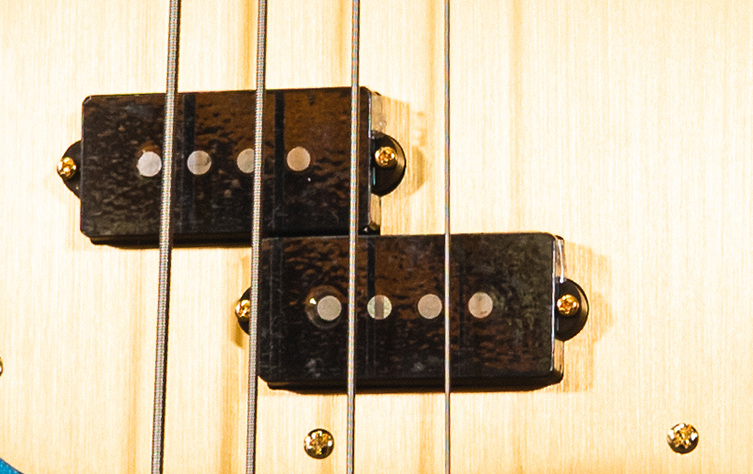
Split-coil: a distinctive looking pickup that is in two pieces, divided down the middle. Found on Fender Precision basses, this pickup was designed to lower the background hum that single coil pickups can suffer from.
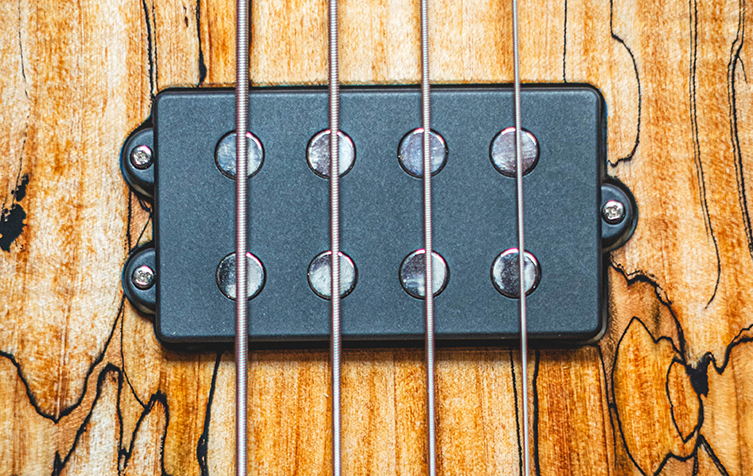
Humbucker: this is a powerful sounding pickup with more output than a single coil unit and less of the noise. It looks like two pickups pushed together, but that’s not exactly what it is.
Bass pickups can be active or passive, just like the preamps we looked at a second ago. Passive pickups need no extra power from any source (such as a battery), and produce a ‘vintage’ tone that is open and dynamic.
Active bass pickups are typically used alongside an active preamp, and both require extra power from a 9v battery. Active pickups are generally thought of as being ‘cleaner’ sounding with a lot more output and a lot more compression.
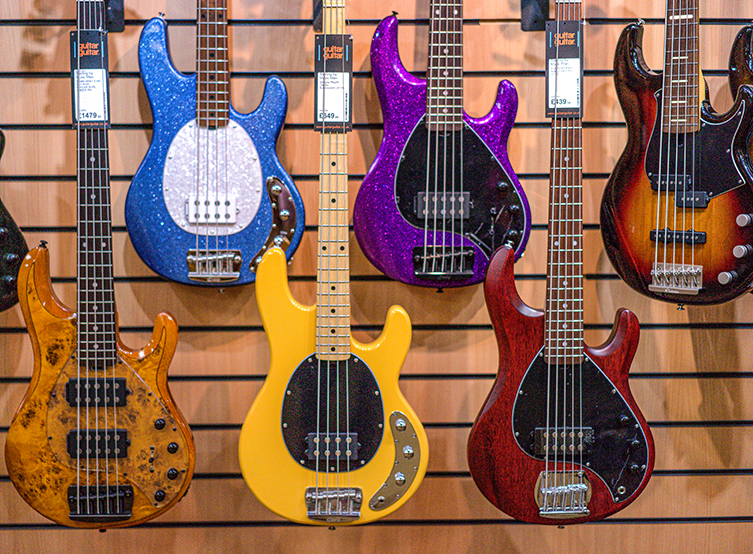
Many bass guitars use a configuration of different pickup types in order to enhance versatility. One such popular example is referred to as the ‘PJ pickup configuration’. This means that the instrument carries a Precision bass pickup and a jazz bass pickup together. There are many others (HH stands for two humbuckers, for example), as well as lots of basses with a single pickup, such as the Precision Bass itself and many Music Man StingRay basses.
Scale Length: Long Scale and Short Scale Basses
Scale length is a way to reference how long or short an instrument’s neck is. The scale length is the playable distance of a string from the bridge to the nut. I hesitate to use the term ‘regular’, but since Fender’s P-Bass was released in 1950, its 34” scale length has been the dominant measurement for other basses. 34” scale length instruments are often also referred to as ‘long scale’.
By comparison, short scale basses usually have a scale length of 30”, which significantly changes the feel. There are exceptions to these two values - there always are - but the vast majority of basses will conform to one or another of these values.
Which one you choose is entirely up to your preferences. Short scale basses are useful for those with smaller bodies or fingers, and for younger people, but it’s equally true that some musicians just prefer them for their specific feel.
Extended Range and Multiscale Basses
Extended range basses can be a number of things today. Mostly, it refers to basses with 5 or 6 strings. These extra strings (a low B on 5-strings, and a low B and high C on 6-string basses) extend the possible range of notes that are able to be played. Necks are wider to facilitate the extra strings, but scale lengths are not necessarily altered.
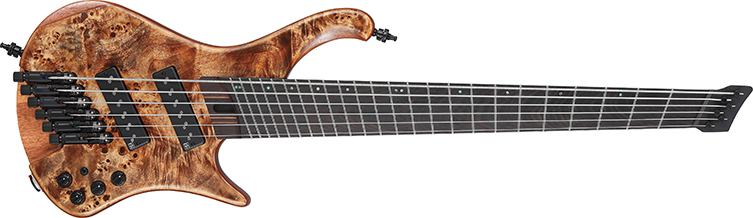
Multiscale basses, on the other hand, do change the scale length. Multiscale necks actually use two different scale length values: one measurement from the lightest string and another from the heaviest string. The heavy strings have a longer scale length than the lighter ones, in order to allow for better string tension and intonation (notes all sounding in tune across the fingerboard) when using lower tunings. This manifests as a set of specially slanted ‘fanned frets’ which are positioned to perfectly preserve the correct pitch of each note. Have a look at this Ibanez headless 6 string bass below to see what an extended range multiscale bass neck looks like.
Semi-Hollow Bass
A semi-hollow bass has hollow spaces within its body to allow for a more resonant sound. There will be a solid piece of wood in the centre of the bass’s body for tone, sustain and feedback reduction. Semi-hollow basses are good for players who might want less weight on their shoulders, as well as a more ‘retro’ tone that is more open and less compressed. The Epiphone Jack Casady bass is a good example of a popular semi-hollow bass.
Hollow Body Bass
Hollow body bass guitars - fully hollow, not semi-hollow like the example above - are relatively rare things. The famous Hofner Violin Bass - the Paul McCartney one - is actually a fully hollow bass model, but its lack of f-holes often fools people into thinking it’s something else.
Hollow body guitars have a large hollow cavity inside them and no central block of wood. They mostly have f-holes, but as we’ve seen with the Hofners, not always.
Hollow body basses are great for an even more open, soft, retro tone.
Bass Amplifiers
Bass guitars require specific bass amplifiers in order to sound correct. Regular guitar amps are just not designed to handle the low frequencies of the bass, so I wouldn’t recommend using one!
Bass amps come in all shapes and sizes, from small practice combos to towering stacks and everything in between. Bass amps tend to have different speaker types and features that are more relevant to basses. I’d note that there is also the use of ‘speakon’ cables - a special type of cable that locks into the amp head or cabinet - which you don’t tend to find outside the world of bass amps. The reason these are used is because, believe it or not, bass frequencies at high volumes can cause the cables to shake themselves loose and fall out of the amps!
Acoustic Bass
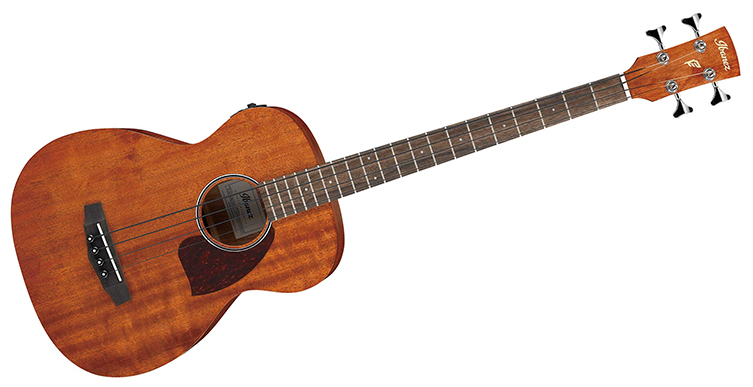
An acoustic bass is similar in many regards to an acoustic guitar. It has a large hollow body, which resonates and projects the notes just like an acoustic guitar. Naturally, it sounds an octave lower and has a longer neck (and longer scale length) but is played and used in the normal way.
An acoustic bass has a softer, less punchy but more percussive tone compared to an electric bass. Acoustic basses are good for ‘unplugged’ sessions, when they accompany other acoustic instruments. Small gatherings of musicians in general are good places to employ an acoustic bass, where their large but soft sound is able to work in a harmonious way with other elements.
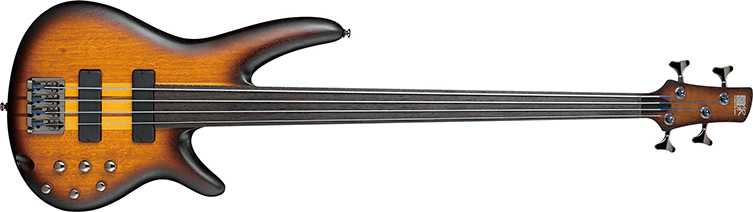
Fretless Bass
A fretless bass is literally a bass guitar with no frets on the fingerboard. This harks back to instruments like the double bass, which don’t have frets. Fretless basses allow the player to employ a range of techniques and sounds that are not possible with fretted instruments. The lack of frets does make fretless basses more difficult to play, and necessitates an alteration in technique in order to remain in tune when playing.
Fretless basses are very popular in jazz and jazz fusion music, where their extra level of expression and precision is acknowledged.
Playing a Bass Guitar
There are three main ways to play a bass guitar. Though there are always players who will innovate and introduce new concepts, almost all bassists play using a combination of the following three disciplines:
Fingerstyle: Strings are played using the right hand fingers. Some players use their first two fingers, some use them plus their thumb, and others use their thumb only. All versions are valid if they work for you!
Plectrum style: Using a plectrum/pick to play the bass gives you a sharper sound with more attack. Lots of rock and punk players use picks, but again, there are no rules!
Slap Bass/slap ‘n pop: this style comes in and out of fashion, but it’s fun to do and very distinctive. You use your thumb and (usually) one finger, either the first or second. With your thumb, you ‘slap’ a note by striking it on the top, rather than plucking it. Then you ‘pop’ another note by getting your finger underneath the string and pulling it up to sound the note sharply. You combine these two techniques with lots of palm muting (rest your right hand palm on the strings to quieten them) in various rhythmic ways. Here’s an example below.
Choosing a Bass
When it comes to actually choosing a bass guitar for yourself, there are a few things to consider.
Physical size: although generally larger than guitars, basses still come in all shapes and sizes. Some will be a better physical fit for you than others, so it’s worth getting your hands on a few.
Intended Use: all basses will be able to play all styles of music, but some models may be more suitable than others for the styles you want to focus on. For example, modern active basses from brands like Ibanez will be better at handling contemporary metal and prog than, say, an Epiphone SG bass.
Go for feel first: we all choose instruments with our eyes. We go for looks first, if we are being honest with ourselves, but I’d suggest you go with how an instrument feels above everything else. The feel of an instrument is a very personal thing, and nobody can really tell you what’s good or bad in this area. Choosing one that feels right will mean the difference between wanting to pick up the bass and have a noodle around, or not bothering. If you go for feel first, I don’t think you can go wrong! Looks and sound are important after this, of course!
Good Luck!
I believe that is all of the basic facts on the bass guitar that you’ll need. Have I left anything out? Let me know, and in the meantime, I hope this guide has clarified some of the questions you might have on the subject.
The main thing to do is to grab a bass guitar and play it! This is all just data for your brain, when you need to know something. Keep this guide handy, and refer to it again and again, when you’re not dominating the world with your bass playing! Good luck!