What is a semi-acoustic guitar? What does that term mean? Is a semi-acoustic guitar the same thing as an electro-acoustic guitar? What about semi-hollow?
These are all good questions, and frequently asked in our stores. These similar terms can all be a little confusing, but thankfully, there are pretty clear answers to them all. That’s what today’s short blog is written expressly for: to clear up the confusion and give it to you straight!
I’ll answer the main questions about semi-acoustics today, right here and right now! All you have to do is grab a seat and take it all in!
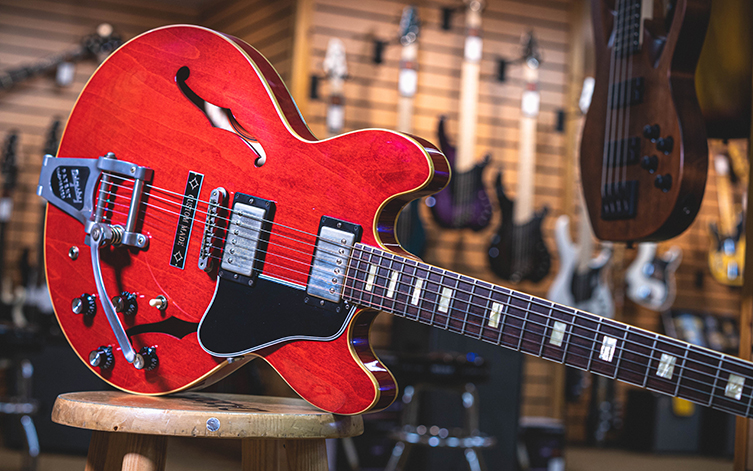
What is a Semi-Acoustic Guitar?
Let’s get the main question out of the way first. What is a semi-acoustic guitar? A semi-acoustic guitar is a fully electric guitar that has one or more hollow cavities built into its body. These cavities are visible because the guitars use f-hole designs (or similar) like those that you’d find on a violin or cello.
A semi-hollow guitar is the same thing as a semi-acoustic. The term most used is ‘semi-acoustic’, even though semi-hollow seems to make more sense! These are not acoustic guitars in the traditional sense: they are electric guitars - like a Fender Telecaster or Gibson Les Paul - just made to a design that includes those hollow cavities.
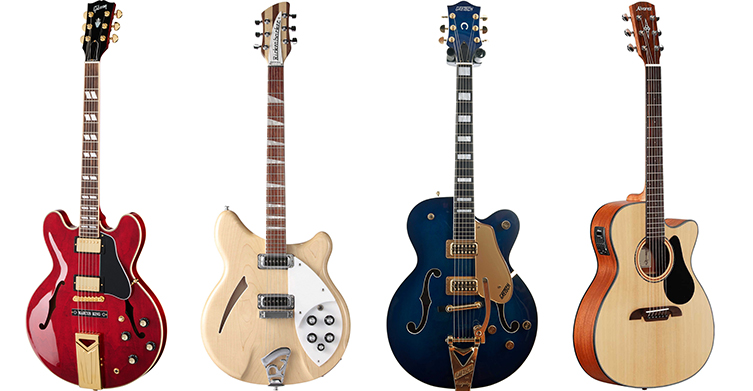
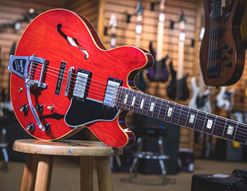
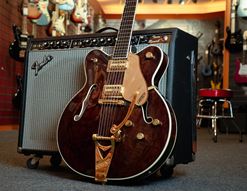
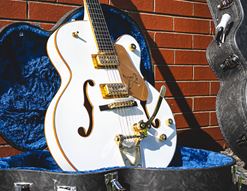
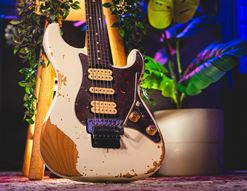
(From L-R: Gibson - semi hollow; Rickenbacker - semi hollow; Gretsch - fully hollow; Alvarez - electro-acoustic)
What is an Electro-Acoustic Guitar?
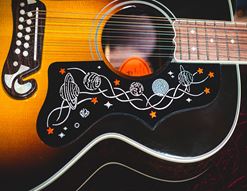
An electro-acoustic, however, is completely different. An electro-acoustic guitar is an acoustic guitar which has a pickup system fitted to it to allow it to be played live through PA speakers. An electro-acoustic looks, sounds and feels like a regular acoustic guitar (because it is), with the additional technology fitted to let it be used at gigs and on tours. Any time you see a musician playing an acoustic guitar on stage with a band, it’s an electro-acoustic because it wouldn’t be heard otherwise!
So, a semi-acoustic and an electro-acoustic guitar are actually pretty different things.
What are Examples of a Semi-Acoustic Guitar?
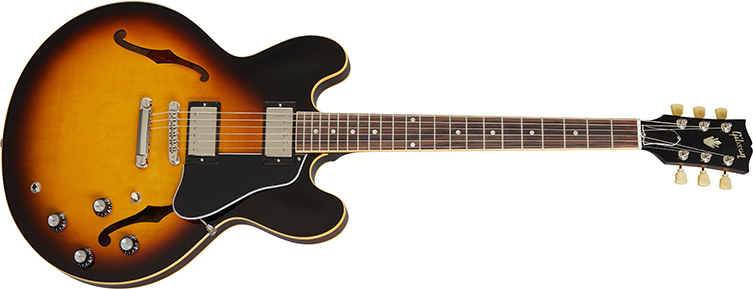
The most famous example of a semi-acoustic guitar is the Gibson ES-335. It was released in 1958 and has been a favourite choice for guitarists in many genres since. The ES-335 is made with a thin semi-hollow body which has a solid chunk of maple going through the middle of the inside. Either side of this are the hollow cavities, which you can see into via the f-holes.
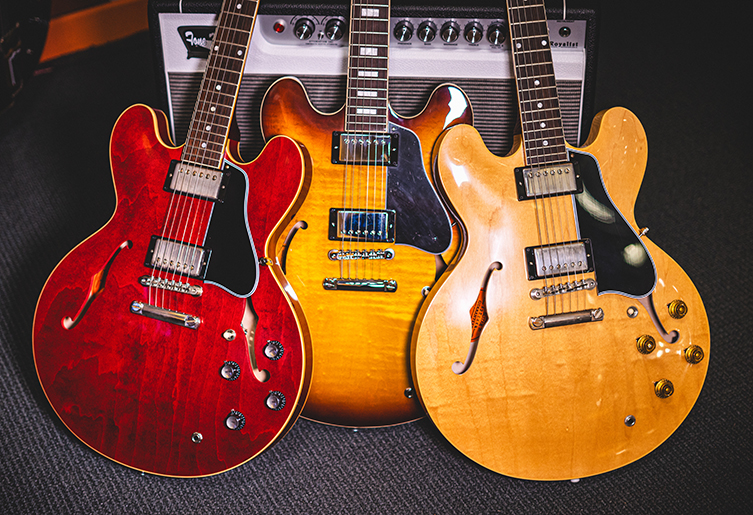
Gibson make lots of varieties of this style, including the ES-345 and ES-355.
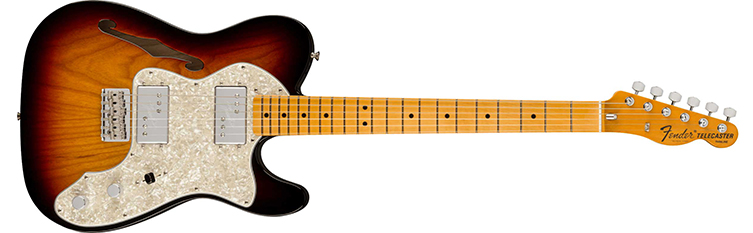
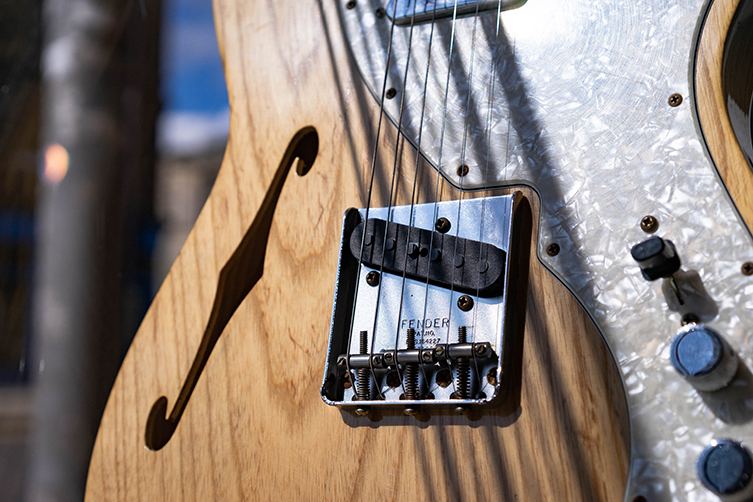
A different - but still very popular - example of a semi-acoustic would be Fender’s range of Thinline Telecasters. These are very similar to regular Teles apart from a single hollow section in the body, again identified by the f-hole.
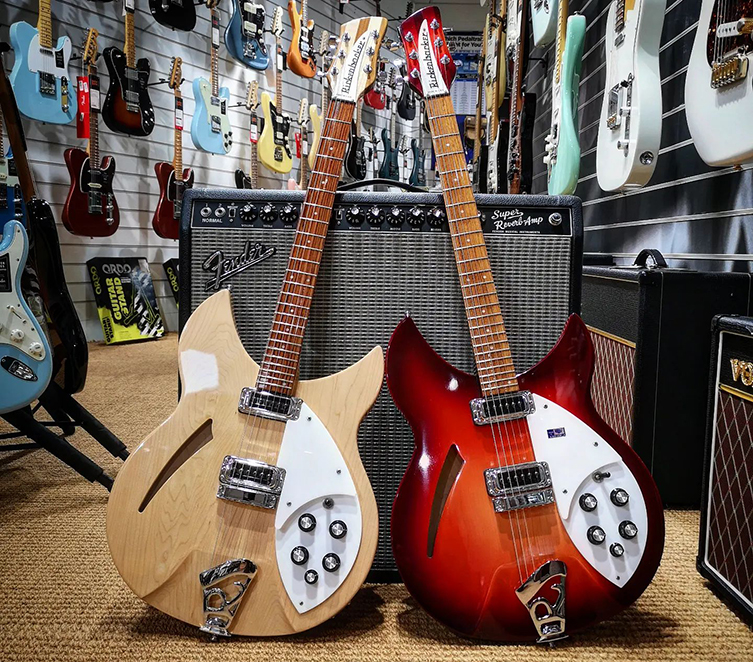
Rickenbacker make many semi-acoustic guitars. Their models are often made with Maple, which still makes them pretty heavy even though they have hollow sections in their bodies. Check out, say, a Rickenbacker 330 and you’ll spot their distinctive ‘cat’s eye’ soundhole, sometimes called a ‘slash’. That again is where the hollow area is.
What is a Hollow Body Guitar?
A hollow body guitar is slightly different to a semi-hollow or semi-acoustic guitar. Where semi-acoustic guitars have hollow cavities and a solid centre block, a hollow body guitar is fully hollow, with no centre block. Traditional archtop jazz guitars are like this, and so are their modern variants.
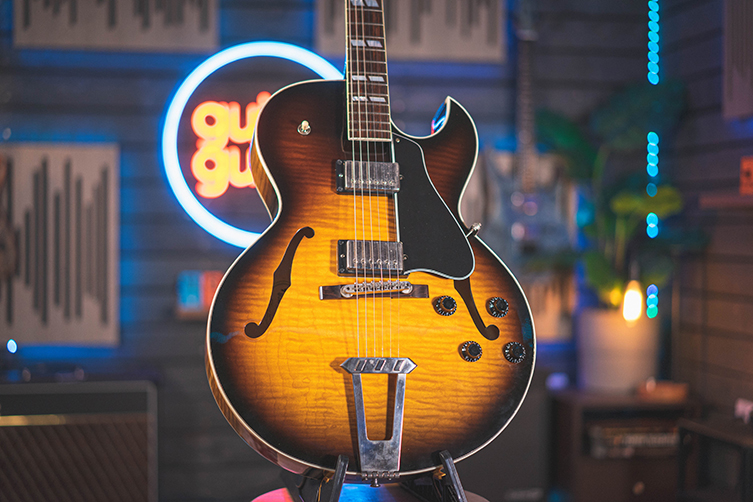
This wonderful Gibson ES-175 is a great example of an electric guitar with a fully hollow body.
The famous Epiphone Casino is like this too, even though it closely resembles a semi-acoustic ES-335.
Typically, deep/thick hollow body guitars have warm, jazzy tones, whilst thinner styles like the Casino are more percussive in their tone.
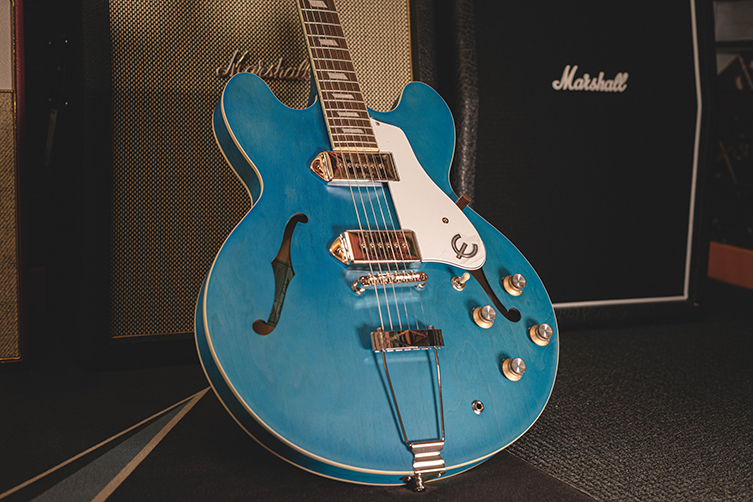
The Epiphone Casino is also fully hollow, but has a slim 'thinline' body unlike the deeper ES-175 (above)
What is the History of the Semi-Acoustic Guitar?
That’s a big question, but to summarise, electric guitars around 100 years ago were simply traditional archtop acoustic guitars with rudimentary pickups attached to them. This developed in the 1940s into what we’d call hollow body archtop electric guitars, from makers such as Gibson, Epiphone and D’Angelico.
The ‘thinline’ semi-acoustic guitars that we mainly think of in this area came about in the late 1950s. Gibson debuted their ‘Electric Spanish’ 335 (the number reflected the cost of the guitar in dollars) in 1958, and many other makers have since used that as their blueprint for similar instruments.
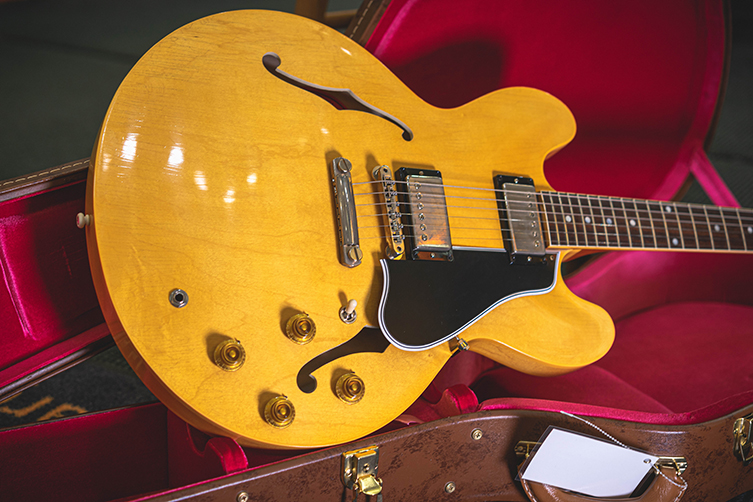
Gibson put a centre block of solid maple within the ES-335 and its cousins in order to thicken the tone (to make it sound a bit more like a Les Paul) and to reduce feedback, a problem with fully hollow guitars to this day. The main impetus in creating the 335 was to offer a Les Paul tone without the accompanying shoulder-killing weight. It was an instant success and has been in production ever since.
Gretsch are typically better known for guitars that are larger than an ES-335, and most models are fully hollow. That said, they have plenty of guitar styles that conform to what we refer to as a ‘semi-acoustic’ guitar.
Fender’s Thinline Telecaster (‘Thinline’ just means less thick in the body than something like a Gibson ES-175, which is not far off a dreadnought in size) debuted in the 60s and was revised in 1972. Both styles remain popular, and I’d say that the majority of thinline semi-acoustics available today share at least some DNA with the Gibson ES-335, the Gretsch models, and the Fender Thinline Telecasters.
What Do Semi-Acoustic Guitars Sound Like?
When plugged into an amplifier, semi-acoustic guitars still sound very much like other electric guitars. Players can still enjoy sustain and harmonic richness, and often report that the notes have a slightly less immediate attack: there is a ‘bloom’ to the notes that is considered to be beautiful.
Play them clean, play them with overdrive and fuzz: they are, after all, full-on electric guitars.
Can I Use a Semi-Acoustic Guitar Unplugged?
Unplugged, a semi-acoustic guitar is somewhat louder than the likes of an unplugged Stratocaster. You may notice more chime and resonance due to the hollow cavities, too.
So yes, you can use a semi-acoustic guitar unplugged - just as you can use any electric guitar unplugged - but that is not part of its function. It is not designed to be both an electric guitar and an acoustic guitar, so don’t expect a specifically ‘acoustic’ tone to come from a semi-acoustic. It will be a slightly louder sounding version of any other unplugged electric guitar.

What Musical Genres are Semi-Acoustic Guitars Used In?
Semi-acoustic guitars are used in pop, rock, blues, jazz, indie and all other genres. Jazz and blues were particularly well known genres to use a Gibson style semi-hollow guitar, but country and rockabilly use a lot of them too, particularly Gretsch models.
Are Semi-Acoustic Guitars Good?
Are they good? It’s a question that lots of people ask. Yes, they are good! Since the late 1950s, they’ve been continuously popular, and are played by many famous guitarists and top musicians. Epiphone models are enormously popular because they are affordable and are used by many professional players such as John Lee Hooker, Oasis, The Strokes and Gary Clark, Jr.
Guitarists who play lots of different styles often like to use a thinline semi-acoustic guitar of some description, because they offer a versatile range of sounds that can be as sweet or as dirty as you need them to be.
Who Makes the Most Popular Semi-Acoustic Guitars
As I mentioned in my brief history, most of today’s semi-acoustic guitars are based on a small handful of primary models or ranges. Here are a few examples that are available today…
Gibson ES-335
I’d call the Gibson ES-335 the definitive semi-acoustic guitar. It brought the worlds of traditional archtop guitars and solid body electrics like the Les Paul together in a very successful way. Constantly in production since 1958, the ES-335 is rightly seen as a classic guitar. Although colour choices really can’t change a guitar’s sound (the finish can, but not the colour), there is a definite trend towards jazz players choosing sunburst 335s and blues guitarists opting for the cherry red. Why? No idea, but it has been that way for decades!
Epiphone Inspired By Gibson ES-335
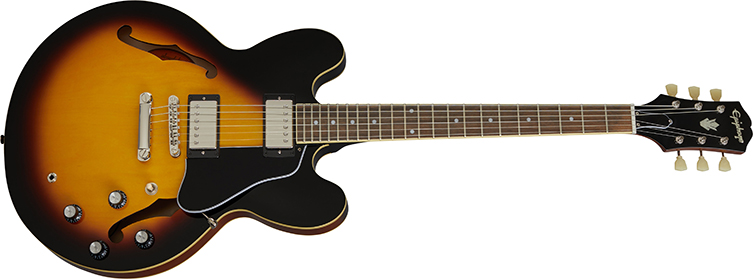
This is a licensed replica of the Gibson ES-335, made by Gibson’s sub brand Epiphone. Back in the 1930s, Epiphone were actually the top dog for American archtop guitars, but they were bought by Gibson in the 1960s.
Anyway, contemporary Epiphone guitars have been steadily getting better and better to the point that I can wholeheartedly say that this Epiphone Inspired by Gibson ES-335 will not disappoint you, particularly for the price. It performs well and has a feel that I’d almost call ‘authentic’. If you cannot stretch to the price of a USA-built ES-335, then this Epiphone is no consolation prize: it’s a proper contender.
Fender Vintera 60s Thinline Telecaster
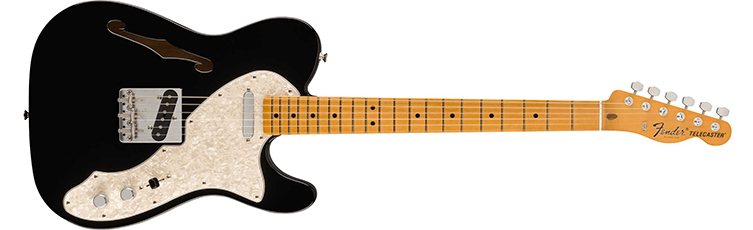
As mentioned, Fender’s own take on the ‘semi’ normally appears in two historic guises: a 60s and a 70s model. The main difference that isn’t cosmetic is in the pickups: the 60s model has single coil pickups, and the 70s should have Fender Wide Range humbuckers.
I’ve opted for the Fender Vintera 60s Thinline Tele, mainly to offer up an example that uses single coil pickups. This is a light weight guitar with perhaps a slightly softer tone than a typical Tele. The body cavity of course provides both of these differences, but it’s still characteristically a ‘Telecaster’ to both play and hear: it’s just a slightly different take.
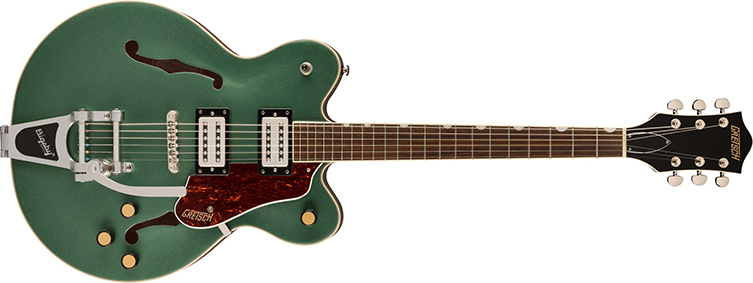
Gretsch G2622T Centre Block Streamliner
Gretsch guitars are typically three things: gorgeous, expensive and fully hollow. This G2622T Streamliner is the first one, but not the other two! The Streamliner range is the most affordable way to own some Gretsch coolness, but cheap in this instance does not imply nasty: it’s a nicely put together guitar that holds its own in a crowded market.
Also, it is rather more like an ES-335 than, say, a White Falcon, because it has a thinline double cut body and a centre block of maple. Add that to the fact that it has relatively high output ‘Broad’Tron’ pickups, and you have a Gretsch that is somewhat less ‘Gretsch’ sounding than purer examples, but maybe more useful as a result.
Semi-Acoustic Guitars Today
Did that help to clear up some of the mystery for you? I hope so! I’ve tried to break it down as much as possible, because I feel like the whole subject is needlessly confusing. In fact, let me summarize with some bullet points…
Semi-Acoustic Guitars In Brief
- Semi-acoustic guitars ARE semi-hollow guitars. Both are electric guitars.
- Both of these have solid central blocks of wood inside them. The pickups and bridge are attached to these.
- Both have hollow cavities in their bodies, and you can see them via violin-style f-holes.
- Fully hollow electric guitars are different. No central block. Just hollow space.
- Electro-acoustics are not the same. They are regular acoustic guitars that have pickups.
- Gretsch guitars can be either semi-hollow or fully hollow, and you can’t always tell just by looking at them.
- The Epiphone Casino is fully hollow. The Epiphone ES-335 is semi-hollow.
Does that cover it? Now that you know, you’ll be able to determine one from the other when you are checking out possible new guitars. We have a very wide selection of semi-acoustic and hollow body guitars here at guitarguitar, so bash the button below for the whole selection, and give us a shout if you have any questions. Happy hunting!