2026 is a big year for Telecaster fans across the country. You’re only 75 once, and this year marks the 75th birthday of this truly iconic electric guitar! The Telecaster was the one that started it all off: rock n’ roll, electric blues and country, right through to classic rock, prog, punk and beyond. Every generation has found the Telecaster on its own terms, and used it to make their own mark on the history of music.
Today, I’ll cast a broad net over the Telecaster’s story, and remind you of a few top models, players and highlights. I’ve written extensively about this guitar in other articles, so there will be frequent links to deep-dive into related areas as we progress.
Are you ready to celebrate the Telecaster? Grab your party hat and balloons, because it’s time for a special birthday!
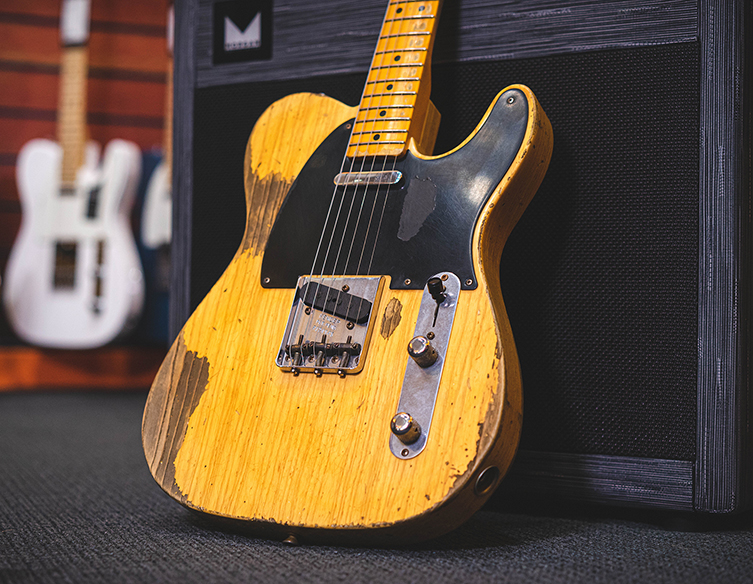
Classic Telecaster Guitar Models
In this section, I’ll take a brief skip through some of the more famous Teles from across the decades. Some are more different than others, as you’ll see, but all of them share the famous Telecaster outline and confer to the direct, effective, no-nonsense ethic of the original. For a more in-depth look at the Telecaster’s backstory, please hit the link below to go to my dedicated blog on the history of the Telecaster.
Click to Read The History of the Telecaster
The Fifties Butterscotch Blonde ‘Blackguard’ Tele
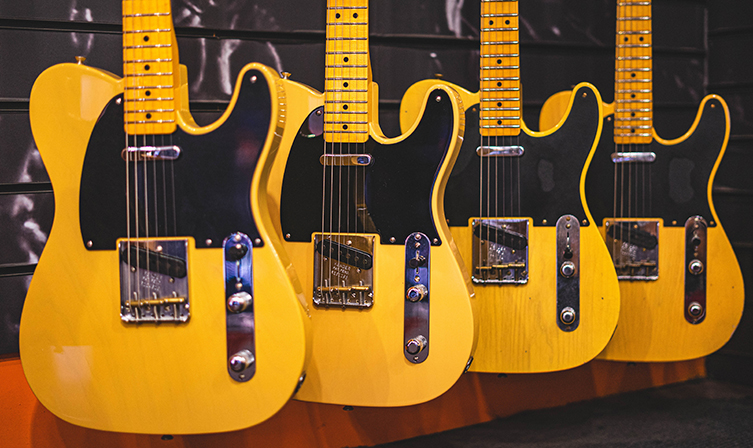
This fifties ‘Blackguard’ Tele is easily the most well known iteration of the model. It was the first one out of the stables in 1951, after of course losing its Broadcaster name to Gretsch (see the history, above). We often refer to this as the ‘52 Tele since that was the first full year of production under its final name, but Fender were calling their fist-born the Telecaster from autumn of 1951.
Anyway, the Blackguard Tele (this nickname refers to the bakelite pickguard found on all models) remains a potent icon of musical rebellion. If you want a blueprint for the Telecaster, then this is it: slab body, bolted-on neck, two pickups and simple controls. Everything you need, nothing you don’t, all wrapped up in a utilitarian style that is pure function but also somehow exquisitely beautiful.
It’s an unforgiving guitar, too. You can forget this if you haven’t been on one in a while, but there’s nowhere to hide with a Tele: no beefed up tone, no slinky short scale length, and not even any contours built into the body for comfort. It approaches you as an equal, and it gives back what you give it. It’ll highlight whatever you have to give, and that means your shortcomings too! But if you can play it on a Tele, then to quote Billy Gibbons, you can “flat out play it”.
Take a closer journey into this era with two blogs of mine, linked below…
Read The Legend of the Blackguard: the Early Story of the Telecaster
Click to Read more on Fender Butterscotch Blonde Telecasters: It’s Finest Players
The 60s Tele Custom
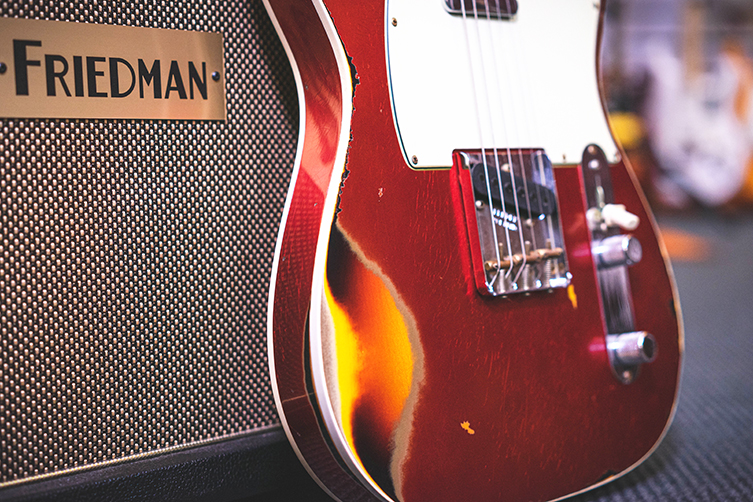
Measure for measure, this could be the coolest Tele of them all. Do you agree? I love this 60s version of the Tele Custom because it doesn’t lose any of the guitar’s unique qualities, it merely adds to them. You get a rosewood fingerboard, you get super-cool binding on the front and back of the body, and hotter sounding pickups. It looks just that little bit more special to my eyes, and I always appreciate a little bit of extra heat from single coils. Afterall, you can always roll the volume down ever-so-slightly and take that heat out!
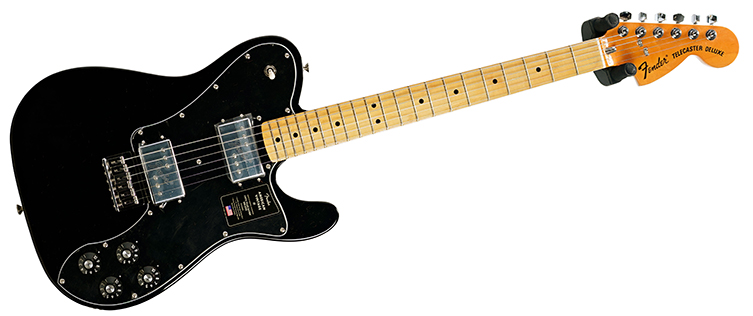
The 70s Tele Deluxe
The 70s brought a more significantly different set of changes to the Tele. Whilst standard models were of course produced, models like the Custom and Deluxe bore the evidence of Fender competing against Gibson for a thicker sound.
I’m looking at the Tele Deluxe here, because it’s more overtly Gibson-influenced than any Tele before it. Not only did it have two Wide Range humbuckers (which are NOT the same as PAF pickups!), a totally revised control layout that was very Les Paul/SG, and also a flatter fingerboard radius, again in line with Gibson’s style.
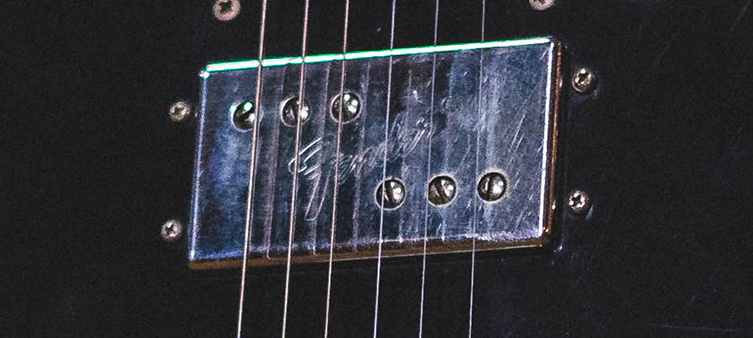
They are Teles in shape only, but that doesn’t stop them from being pretty excellent guitars! They saw a resurgence of popularity in the early 2000s, and that has continued in some degree to today.
For more detail on these and other era-specific Teles, please have a gander at the blog below!
Click to read The Fender Telecaster 50s, 60s & 70s: What’s the Difference?
1990s Telecaster Plus
I’ve skipped ahead to the early 90s now, for a Tele that has become a rare jewel for collectors, thanks mainly to the efforts of one chap…
The Fender Telecaster Plus looks fairly traditional from a distance, but closer inspection will reveal a most uncommon (for this guitar) pickup configuration. It has three Lace Sensor pickups - two arranged together as a splittable bridge humbucker - which deliver a sound that actually isn’t much like a Tele! I’d call them higher output for sure, probably more compressed sounding and very quiet in terms of hum and noise. Modern, in other words!
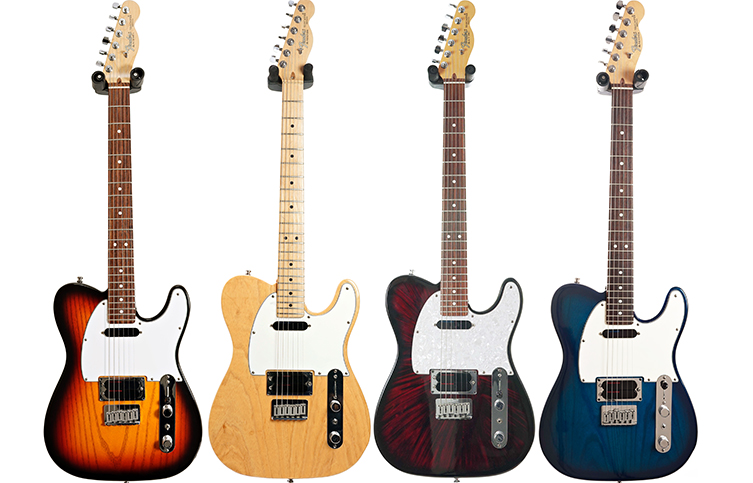
It was of course Radiohead’s Jonny Greenwood who made these guitars so rare and overpriced in the vintage market today. I’ll speak more on him later, but the Telecaster Plus is a very cool example of how the classic Tele recipe expanded and bent around the changing musical climate of the 90s.
Fender Ultra Telecaster
I’ve now teleported us into the here and now, in 2026. If you are a Tele fan - and you are, otherwise you’d not have made it this far! - then you’ll know that there’s more choice than ever. You can get multiple reissues of all of those historical Teles I just showed you, plus a myriad of more contemporary takes on the theme. It’s great news to have such choice, but it may also cause you to wonder what’s so different about today’s Teles?
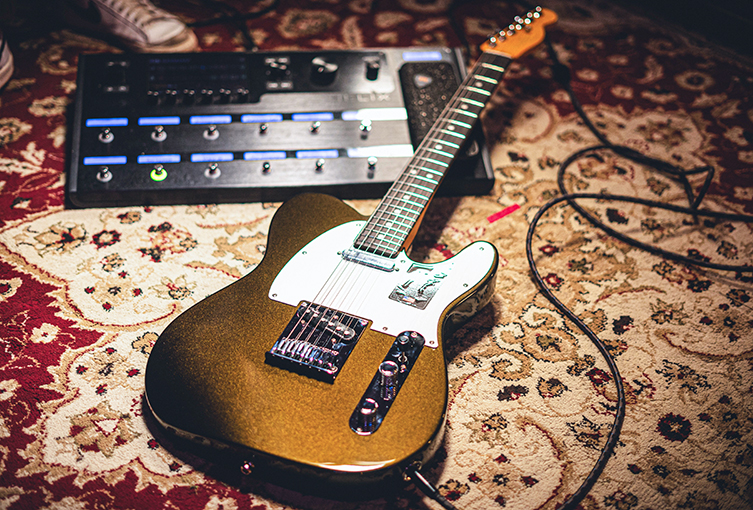
I’d present the Fender American Ultra Telecaster as supporting proof of how much you can advance a theme whilst still remaining true to its essence. Firstly, there’s a whole palette of awesome metallic finishes to choose from, including ‘Solar Flare’ which I highly recommend checking out in person to fully appreciate!
The things that make this guitar Ultra all relate to the user’s experience. It’s a thoroughly modern guitar, with a slim D profile neck, a compound radius (it starts at 10” and flattens to 14”) ebony fingerboard with nice big frets on it, and Luminlay side dots to find your position on dark stages. It has the latest generation of noiseless pickups (Ultra II Noiseless) which use a stacked coil design to eliminate unwanted noise, and have alnico V magnets for a bright, authentically ‘Tele’ tone.
So, you can have a Telecaster made pretty much how it was in 1951, and you can have one that has a number of modern innovations built in. Both are equals; it’s more a question of what you love about Teles!
Top Tele Players
Any guitar is just an object until somebody picks it up and makes music with it. Only then does it take on the qualities we all see in it, and love. So it is with the Telecaster of course, and there are now 75 years’ worth of legends to look towards.
Click the link below for an article on Tele artists: one for the Best Telecaster Players Ever, and head back up earlier in the blog for another focussing on those who played the Butterscotch Blonde model. But here, in this blog, let me celebrate a few class acts from then till now…
Click to Check out the 16 Best Telecaster Players Ever
Danny Gatton
Danny Gatton’s going first here because although dedicated Tele fans love him, many guitarists have never checked him out! Take this as your excuse to immerse yourself in one of the greatest practitioners of the Telecaster in history. The details of his life are sad, but the music he left was pretty spellbinding, with a depth, taste, invention and pure joy in every note.
Bruce Springsteen
Bruce is the best long-term advert for the Tele, isn’t he? He just doesn’t mess around with anything else, and it never lets him down. For over 50 years, The Boss has relied on his Tele/Esquire hybrid, to the extent that he’s had it ‘waterproofed’ for touring. Nobody actually wants to see Springsteen with anything other than a Tele, to be quite honest.
Read more in my blog Bruce Springsteen Gear Guide: How to Sound Like The Boss.
Keith Richards
Keef has shown off an enviable guitar collection over the years, but I think it’s safe to say that his main squeeze is the Tele. He may or may not have accidentally invented the concept of the ‘relic guitar’, but there’s no mistaking him as one of the most visible Tele-lovers in rock. Micawber, his illustrious 1959 Tele - which sports a PAF humbucker in the neck - was given to him by Eric Clapton for his 27th birthday.
When was Keith Richards ever 27?
Joe Strummer
Nobody exemplified the no-messin’ approach to guitar like Joe Strummer. The Tele was his perfect tool to spread The Clash’s message of questioning authority. Less a guitarist than a crazed missionary using punk to spread his gospel of inclusion and fairness, Strummer saw his battered 70s Tele as much as a tool or totem of defiance as an object of expression. Still, how many people expressed themselves so directly or effectively?
Jeff Buckley
The tragic 90s troubadour’s favourite guitar was one he borrowed from a friend and never gave back whilst alive. Jeff’s Telecaster was a 1983 model from the range put together by Dan Smith, who was brought in to revitalise the models. The one played by Buckley was more white than blonde (I know, it doesn’t look like that in pictures), and had a ‘top loader’ bridge that meant the strings didn’t pass through the body.
Jeff’s singing and guitar playing were stupifying, and the world certainly lost an immense and singular talent that fateful day down by Wolf River Harbour, Memphis.
Jonny Greenwood
Radiohead’s mercurial lead guitarist pops up a lot on our Telecaster blogs but that’s because he’s one of the most unique - and successful - players of the last few decades. Unorthodox in almost every note, Greenwood’s approach is to simply see the guitar as a device with which to make noise. Pulling strings off the fretboard? No problem. Combining whammy pedal swoops with kill-switch stutters? Fine. His creativity sits first and foremost, and his guitar skills exist to execute those plans.
Anna Calvi
Highly revered and underappreciated at the same time, Londoner Anna Calvi is a player of exciting and romantic intensity. From the first note of her first track on her first album (see below), Calvi laid out her intention to reclaim the guitar as a lyrical, poetic and expressive voice in music. Her battered 90s Sunburst Tele is her main squeeze, and exotic chord voicings and circular strumming patterns are fresh sounding and beautiful.
Did Someone Say ‘Telebration’?
So, the Tele is 75 years young this year. This brief blog is hopefully a little taster menu for you, to whet your appetite for further morsels of Tele-tastic entertainment this year. I’ll be writing more about Fender’s first child as 2026 progresses, and as you can see, there’s already lots of articles for you, all linked here!
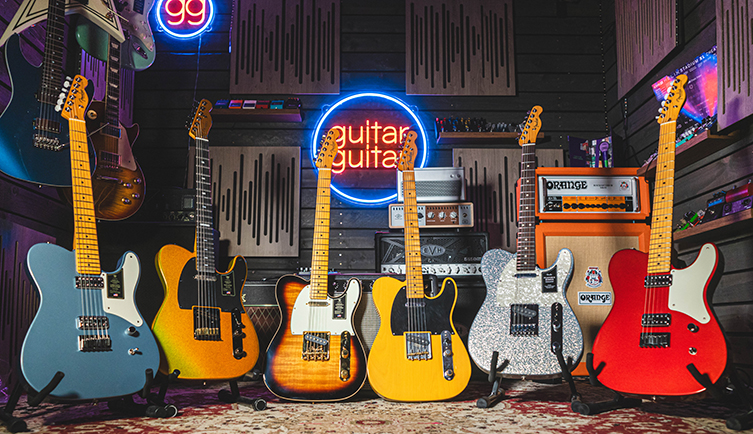
Fender are celebrating in style too, with a whole stage full of new 75th Anniversary models to check out and buy. I’ll write about them in more detail very soon, but in the meantime, here’s a video from my colleague Keiran on the whole range!
Telecaster lovers, you’ll be hearing more from me soon! In the meantime, enjoy the 75th anniversary of the Fender Telecaster!