Are you a Radiohead fan? As far as massive bands go, Radiohead are one of the few who continually reinvent their approach, pushing ahead into new musical terrain and generally keeping us fans on our toes. They are a famously contrary band, at least from first impressions: after their era-defining guitar album OK Computer, they promptly ditched their instruments and began working with synths, machines and programming for the follow-up album Kid A.
This is all old-history, though. The Radiohead of today are a multifaceted and multicoloured band who draw from several disparate styles, ranges and approaches in order to make their contemporary music. They’re back touring after an 8 year absence, and their long-running collaboration with artist Stanley Donwood is currently being celebrated via a retrospective exhibition at the Ashmolean Museum.
It’s very much Radiohead time right now!
I feel like it’s time to delve into the sounds made by the band’s guitarists. Today, I’ll dive into the equipment used by each of them and consider how that gear informs and inspires their musical approach. Now, Radiohead are massive gearheads, and as I mentioned, they routinely change up what they do and use, so there is no reasonable way to be comprehensive about this! I’ll check out what the band members are using right now and add in important items from the band’s legacy to paint a fair picture of their approach.
Radiohead have three guitarists including vocalist Thom Yorke, so each will have his own section in the blog, as will bassist Colin Greenwood.
Get yourself a hot beverage and stick on your preferred Radiohead record, because we are diving into this Moon Shaped Pool of gear, and I don’t want you to get The Bends!
Sorry.
Jonny Greenwood’s Guitars
I’ll start with lead guitarist Jonny Greenwood, because he tends to be the player that most fellow guitarists focus on. His highly unorthodox playing style and use of effects has put him on a pedestal for those who love alternative playing styles.
Greenwood maintains that all electric guitars sound the same, and that he isn’t attached to his instruments, but he’s also really particular about what he uses, and has stuck with certain guitars for decades, so I think he’s more attached than he admits!
Fender Telecaster Plus
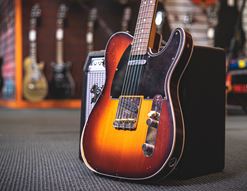
Greenwood’s number one guitar is undoubtedly his 1990-92 Fender Telecaster plus. It’s been by his side throughout his career, taking a break only for his other project, Smile. The Tele Plus is a Telecaster in many ways, but not sonically! This model has three Lace Sensor pickups arranged in an HS configuration, so it’s a modern sound with what is effectively a humbucker in the bridge position. Greenwood modded it with a kill switch on the control panel, which isn’t used to often on Radiohead recordings but has all over his live performances throughout the 90s.
Fender Starcaster
For a while, the semi-hollow Starcaster enjoyed a resurgence of popularity with iconoclastic guitarists. It’s Fender’s best known semi, with an offset shape and a set of Wide Range humbuckers. Greenwood was amongst the first to adopt this relatively obscure model before others found theirs.
Jonny’s Amps
Jonny has used a number of Fender amps throughout his career, from solid state 85 combos to valve units such as vintage Deluxe Reverbs. He seems to run multiple amps together, splitting one for clean tones and the other for distortion, though it also seems that he uses pedals for that almost exclusively.
The Vox AC30 is another main choice for Greenwood and indeed all of Radiohead. Certainly, it’s almost always on stage with him these days, and he seems to prefer combos over head and cabinet combinations.
Jonny’s Main Pedals
Greenwood clearly makes use of a wide range of effects with his guitar. Like lots of players, he changes up his pedal board from time to time, so what I’ll do is highlight some of his more obviously notable effects here, and put together a list below which collects his most often-used devices.
- Marshall Shredmaster: this is Jonny’s main distortion sound since the beginning of the band. Marshall have recently released the Shredmaster, so you no longer have to pay horrifying online prices for old units.
- Electro-Harmonix Small Stone Phaser: you can hear this on lots of Radiohead songs, from Planet Telex to Paranoid Android and Subterranean Homesick Alien. It’s a regular phaser, but it has a distinctly different sound to a Phase 90, in my opinion.
- Digitech Whammy: Check out the main riff to My Iron Lung (unison octave up mode), Just (octave up and two octave up for that note near the end!) & Subterranean Homesick Alien (the lead swoops during the verses).
- Tremolo: Jonny has used at least two different tremolo pedals. On a song like Bones, you can hear a George Dennis tremolo pedal, which uses a treadle style design to allow the player to change the speed of the effect. Notice how the tremolo slows down? That’s done by foot. You can also hear tremolo used to great effect on Lucky, from OK Computer. Nowadays, Greenwood prefers a Demeter Tremulator, which I gather he still manipulates with his foot to change the speed!
- Mutronics Mutator: you hear this vintage pedal being used a lot on Paranoid Android, and I believe he does not use one live, instead approximating the sound with his phaser and DOD Envelope Filter.
Additional Gear
- Laptop with Max MSP software: Jonny built his own virtual modular effects on the software platform Max MSP. Ableton users will know this as Max for Live, as it’s effectively the same thing. Perhaps the most dramatic example of this is during the song Go To Sleep (particularly live versions), where the patch he has created in the software makes his guitar randomly glitch, retrigger and generally malfunction.
- Korg Kaoss Pad: Jonny has long made good use of this underutilised device, for effects control and more.
- Violin bow: used on his Telecaster for certain songs such as Like Spinning Plates.
- Synths: including a Sequential Prophet ‘08, a Nord Grand, and Fender Rhodes and more.
Jonny Greenwood’s General Guitar Rig
- 2 x Fender Telecaster Plus (one in Antique Burst and another in Charcoal Frost)
- Fender Starcaster (Sunburst, 1970s)
- 10-46 gauge strings
- Dunlop Nylon Standard 0.60mm picks
- MXR Distortion +
- Marshall Shredmaster
- Digitech Whammy
- Electro-Harmonix Small Stone Phaser
- Tremolo pedal (previously a George Dennis model, more recently a Demeter Tremulator)
- BOSS RE-20 Space Echo
- Akai Headrush E2
- DOD 440 Envelope Filter
- BOSS SD-1 Super Overdrive
- Various volume pedals, line selectors, send/return and other utility devices
Ed O’Brien’s Guitars
Ed O’Brien is as obsessed with sonic manipulation as Jonny Greenwood. He’s more of a textural player, creating atmosphere and parts to compliment the other players. Greenwood perhaps steals the limelight due to his attention-grabbing style, but Radiohead’s sonic identity is as much a product of O’Brien’s sensibilities and approach as anyone’s in the band.
Fender EOB Signature Stratocaster
The Fender EOB was Ed’s signature Stratocaster. Based upon his Eric Clapton Signature Strat (see below), the EOB was in production up until a few months ago, when the collapse of Fernandes (who built the Sustainer pickup) prevented the guitar being made.
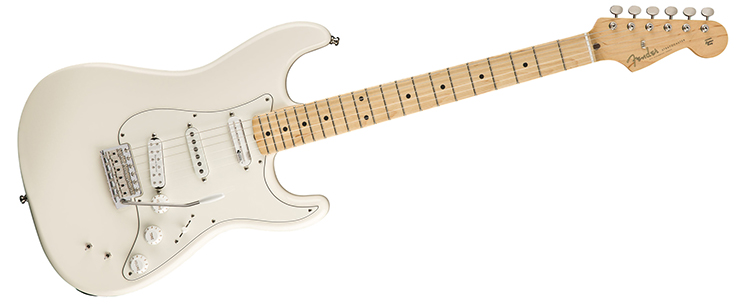
The Fender EOB Strat (Ed’s name is not included anywhere on the instrument itself) included a trio of special pickups: a Seymour Duncan JB Jr, a Fender Texas Special and a Fernandes Sustainer, which also had its own dedicated controls. Additionally, the output jack was moved off the face of the guitar and onto the side.
Modified Fender Eric Clapton Stratocaster
When Fender created Ed’s signature EOB Strat, they based it largely on his modded Eric Clapton Strat. This was bought by Ed to replace his beloved Squier Strat, and he changed out the white pickguard and Lace Sensor pickups for a black pickguard with a bridge humbucker and a Fernandes Sustainer system.
O’Brien also uses a number of other Fender Stratocasters: mostly two white ones (one with a maple neck, the other with rosewood) with other models appearing in the past. I’d say that Ed mainly goes between a Strat of some description and a Rickenbacker, which I’ll mention now…
Rickenbackers (several)
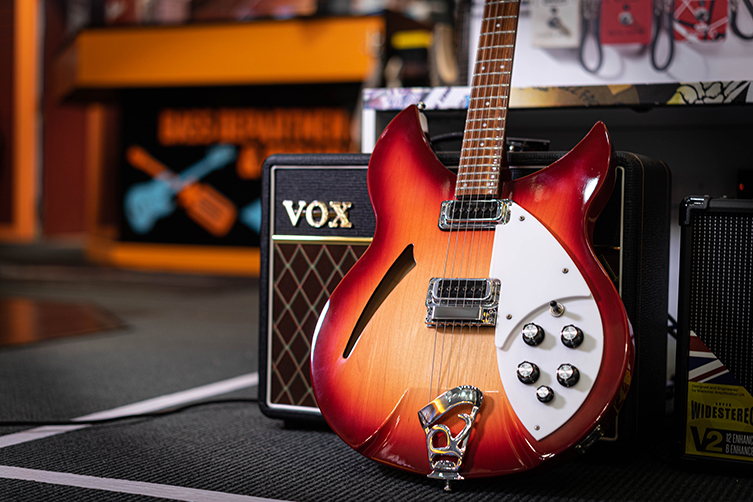
Ed is definitely a Ricky guy. I’m not exactly sure when he began using Rickenbackers, but I certainly remember seeing them in Radiohead’s Live at the Astoria video from way back in 1994! As far as I can see, he currently uses a number of Rickenbacker 330 models in Fireglo and a 12 string version in Mapleglo. Certainly, in live terms, he tends to use these guitars for songs from The Bends and OK Computer, though that doesn’t mean they correlate to what was used in the studio.
Epiphone Casino
This won’t be the last time you see an Epiphone Casino in this article! Ed uses a vintage 1964 model occasionally, particularly around the In Rainbows period. Some sources say that Thom bought this one off Ed!
Gibson ES-335
O’Brien actually uses at least two Gibson ES-335 models, which appear to my eyes to be unmodified. There’s a black one and an old 1960s model in Cherry Red.
Whilst less frequently used than the Rickenbackers and Strats, they have still appeared with him consistently.
Ed’s Amps
Early times saw Ed using a combination of MESA/Boogie and Vox amps. These days, things are a little different. His main amps seem to be a Hiwatt Custom 50 head and a Lazy J 20 watt tweed combo. In other words, it’s two strong flavours of clean tone, with different levels of headroom. The Hiwatt has a normal channel and a bright channel, and I believe the Ed uses the normal channel.
Ed O’Brien Pedalboard
Remember what I said about Jonny, and how he uses so many effects - and changes them so often - that it’s almost a Sisyphean task to document them? It’s even more the case with Ed, whose armada of pedals is so vast that we are talking about three boards, each with two tiers!
So, what I’ll do again is highlight some of the more noticeable pedals that he has used, and include a bigger list below with roughly what he’s using just now.
- Electro-Harmonix Deluxe Memory Man - Ed’s main delay (alongside a Line 6 DL4 & several BOSS DD units), which forms a large part of his sound. Listen to tracks like Airbag, Let Down and The Tourist for evidence of his delay techniques.
- Digitech Whammy: On his board for years, it seems that Ed now uses an Electro-Harmonix Pitch Fork+ and a Digitech Ricochet for his pitch-shifting needs.
- Blended overdrives: Ed has used tons of overdrive pedals over the years, from BOSS units to JHS and Kingsley units nowadays. A favourite for him in the late 90s was the Crowther Hot Cake.
- E-Bow: This doesn’t belong on his pedalboard of course, but one of Ed’s best techniques is to simulate the sound of an entire string section with his guitar and an E-Bow.
Ed O’Brien’s General Guitar Rig
- Fender Eric Clapton Stratocaster
- Fender EOB Signature Stratocaster
- Gauge 10-46 strings
- Hiwatt Custom 50 head and cab
- Lazy J Tweed amp
- Xotic XW-1 wah
- Crowther Hot Cake
- JHS NOTAKLON
- Gamechanger PLUS
- Electro-Harmonix Pitch Fork +
- Digitech Ricochet
- Electro-Harmonix Deluxe Memory Man
- BOSS DD-5
- BOSS DD-3
- Line 6 DL-4
- E-Bow
- 2 x BOSS FV-500h volume pedals
Thom Yorke’s Guitar Gear
Radiohead vocalist Thom Yorke wears many musical hats, inside and outside of Radiohead. I’m focusing only on his main job here, but still, with Radiohead he is the lead singer, rhythm guitarist, keyboard player, sample manipulator and more!
He’s obviously as into the equipment side of things as Ed and Jonny: in fact, his gear list is maybe even more esoteric! I’ll try to consolidate it into manageable chunks today though. First up, here are his guitars…
- Epiphone Casino: Thom has two vintage Epiphone Casinos which he is well-associated with playing. He has a sunburst one and a tan model, and both are early 60s USA-made examples. He is often seen using these in performance videos and they seem to be a recurring favourite.
- Fender Jazzmaster: a vintage 1963 model, used on Airbag and other songs.
- Gibson SG: Thom has at least two, a 1964 Cherry Red model and a slightly earlier Ebony one.
- Fender Telecaster Deluxe: black, with an Apple logo sticker, from the OK Computer days.
- Martin 00-18 and 000-18: Tom's main acoustics these days, with a black Alvarez-Yairi model used in the past.
Thom’s Pedals: Guitar Pedalboard
- BOSS TU-3 Tuner
- Earthquaker Devices Plumes
- Death By Audio Interstellar Overdriver
- Origin Effects Cali76
- Death By Audio Echo Dream 2
- Electro-Harmonix Holy Grail
- Fairfield Shallow Water
- Strymon Timeline
Thom Yorke’s Vocal Effects
- BOSS RE-20 Space Echo delay & reverb
- Akai Headrush E2
- BOSS FV volume pedal
Colin Greenwood’s Bass Gear
Colin Greenwood has been a P-Bass man for a very long stay, but he used to also indulge in occasional Music Man StingRay and Sterling models. It’s probably fair to say that, as a bassist, Colin is naturally less deep into the rabbit hole of pedals and gear than the other three, but he does like a fuzz and has plenty of outstanding basslines to his name. He also has that rare talent of understanding when not to play, which is an enormous power to wield!
Here’s a list of his current equipment, with some older bits in for good measure…
Colin Greenwood Bass Rig
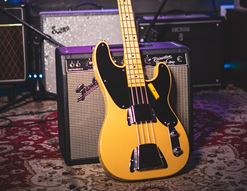
- 2 x Fender Precision Bass (a white 1973 model and a Sunburst 1963)
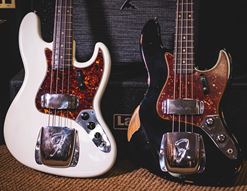
- Fender Jazz Bass
- Music Man Sterling
- Elites 45-105 strings
- Fender Super Bassman head and cab
- Ampeg SVT Classic
- Ampeg SVT-810E Cabinet
- Tech 21 Sansamp Bass Driver
- Novation Bass Station synth
- BOSS TU-2
- Origin Effects Cali76
- Lovetone Big Cheese Fuzz
- Shin-ei FY-2 Fuzz
- Electro-Harmonix Microsynth
- Dunlop Tortex 0.88mm picks
Hail To The Tone
So, Radiohead basically carry around a museum’s worth of incredible gear to every show they do. I mean, why not? They have the means, the will and the inclination, so they may as well have as much fun with their music gear as possible!
As I mentioned a few times, what they use live isn’t strictly adhering to what went on in the studio. Also, bits of gear inevitably get changed in and out as things become old, broken, replaced or just tired. So, in my research I decided to be as representative as I could, instead of slavish. I’ve not included DI pedals and FX loops, for example, because I don’t believe that’s all that interesting for you unless you are copying their exact rigs and why would you do that? The whole fun about it is being inspired by these great artists, not to copycat them. Check out what they’ve used and considered how that could apply to what you do. Take from it what you need to make the sounds inside your imagination come alive.