Are you excited by the forthcoming Rush reunion? The Canadian masters of prog rock will be touring again this year, with new drummer Anika Nilles, for their first round of shows in around 11 years! Many said that the band would never play again after the passing of original mega-drummer Neil Peart in 2020, but it seems that the call of the music is just too great!
It’s awesome news for everyone who loves ambitious, technical (yet accessible) rock music, and to celebrate this moment, I wanted to take a dive into the gear, sound and playing techniques of Alex Lifeson. He’s a beloved and yet sometimes underrated player; an innovative guitarist and also a real team player. He’s a melodic musician who can be flashy, but is never less than a tasteful ensemble player too. In short, he’s an important creative element in one of rock music’s most beloved bands.
In this blog, I’ll look at some of his favourite guitars, amps and effects, and then I’ll break down little bits of his playing technique. He has a unique approach to rock guitar, and I’ll hopefully pass some tips along that’ll help you play more like him. Of course, much of Rush’s sound is down to Geddy Lee, whose dextrous bass playing, evocative synth lines and highly distinctive voice are all signature constituents. Maybe the subject of a future blog? In the meantime, let’s dive into the world of Alex Lifeson…
Alex Lifeson’s Guitars
Most players of Alex Lifeson’s calibre and status play a whole rack of different guitars, particularly so given the length of Rush’s career. Lifeson is no different, and is clearly a real gear nerd too! That said, there are a few guitars that stand out as being notable favourites, so let's have a look at those…
Gibson Les Pauls
Lifeson is definitely into the Gibson Les Paul, and has used a variety over the years. This includes classic Goldtop models, ES Les Pauls (semi hollow with f-holes) and, more recently, Custom Shop Axcess models, complete with Floyd Rose tremolo systems. This gives Alex everything he needs for a big, thick sound and also that wide, synth-like vibrato that he enjoys employing.
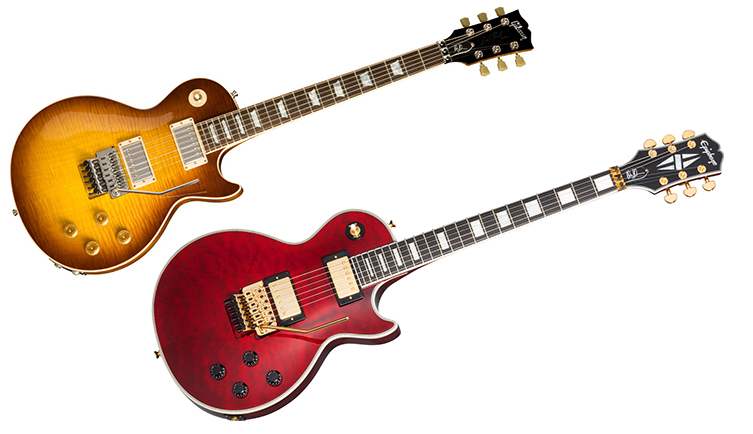
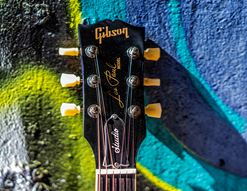
This has led, in recent years, to signature Alex Lifeson Les Pauls with both Gibson and Epiphone. Both of these feature carved maple tops, deep ‘axcess’ heel contouring (for easier axcess (sorry) to upper frets) and the locking tremolos. Now, having a Floyd on a Les Paul is by no means unheard of, but they are still few-and-far-between. Alex’s are great though: classy and very responsive.
Some Lifeson Les Pauls are equipped with piezo pickups for acoustic-like tones as well. Such models have a ‘Life-o-Sound’ output jack for taking the piezo signal straight to a separate output, alongside a blended ‘regular’ output for both standard humbuckers and piezo sounds.
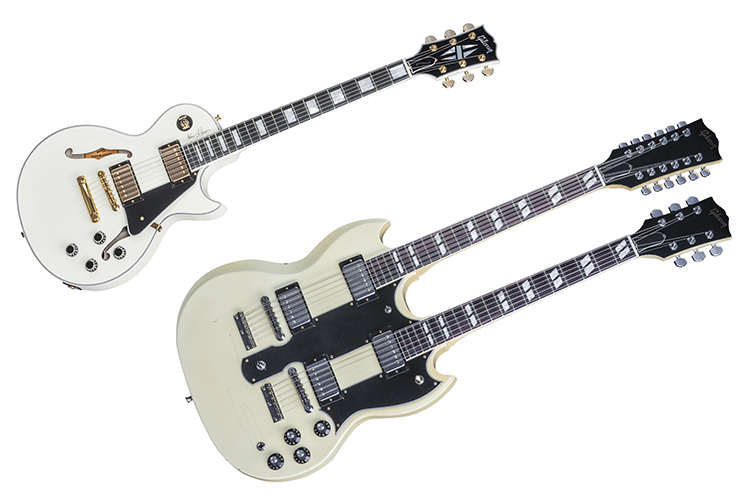
Lifeson is also not afriad of a little double-neck action! He has often used a Gibson EDS-1275 model (in white, to match his ES-355 of course) and it gets a cheer from the audience whenever he pulls it out to play live! Gibson honoured him with a signature model of this one, too.
Gibson ES-355 and ES-335
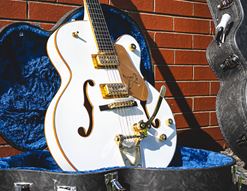
Lifeson was actually a 335 fan before he was a Les Paul user. A famous guitar of his is of course the beautiful white Gibson ES-355. I believe it’s a 1976 model, and was fitted with a Maestro tremolo system. This guitar has reportedly appeared on every Rush album in one form or another, making it perhaps his most significant instrument.
Gibson Custom Shop issued a very limited edition of this guitar a few years ago, and I do hear whispers about something else that might be in the works (you didn’t hear that from me!), but if you can’t find one of those Gibsons out in the wild, I’d say that the current Epiphone Inspired by GIbson Custom 1959 ES-355 in Classic White is a pretty great stand-in!
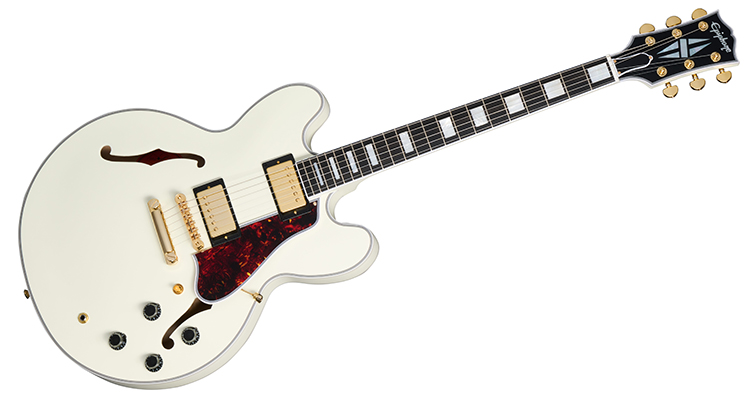
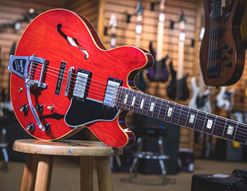
Lifeson is also partial to an ES-335, and has played a number of them over the years. In a clip from Gibson TV, Lifeson says “There was something that was sort of unique about that guitar in a rock context. It didn’t seem like a rock guitar, like a Les Paul or an SG was.” He also fell in love with the 335’s distinctive feel: “I just couldn’t stop playing it. I couldn’t believe how easy it was to play…the neck felt so much smoother, the action was so much lighter and easier”.
PRS Guitars
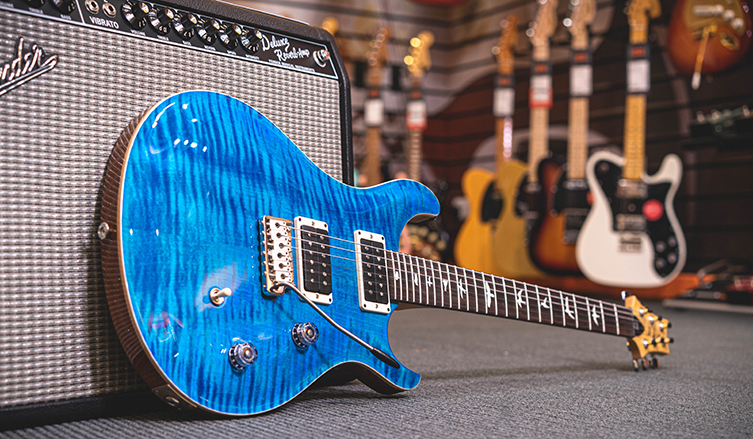
Alex is a fan of PRS guitars too, which isn’t a huge surprise given how many prog guitarists use the brand. I remember seeing him in PRS ads back in the guitar magazine days, and during the 1990s he used a number of CE24 models. Several of these were modified to include piezo pickups for quasi-acoustic tones, and he later on collaborated with PRS on a signature acoustic guitar.
PRS do offer the CE24 as both USA-made Core models and more affordable SE guitars, though none are available with a piezo pickup. For that, you’d want to look towards the PRS Custom 24 Piezo or the Hollowbody II Piezo models.
Alex Lifeson’s Favourite Amplifiers
Our man has used a good number of amplifiers over the years. He clearly understands that they are a hugely significant factor in the construction of one’s tone, maybe THE most significant thing outwith the guitar and the player themselves.
As the only guitarist in the band, Lifeson has the task of filling up a lot of sound (around Geddy’s bass and synth, at least), and so it’s no surprise that he prefers relatively hot valve heads. Mostly, I could distill it to ‘lots of Marshalls, a selection of MESA/Boogie amps and Hughes & Kettner amps later on’, but let’s be more specific! For the classic 70s stuff, it is indeed Marshall heads, alongside a Hiwatt Custom 100. This gave him the best of crunch (Marshall) and clarity (Hiwatt) so that he could be punchy in tone as well as saturated and ‘rock’ sounding. In the 80s, he made use of then-new JCM800 heads and Roland Jazz Chorus combos.
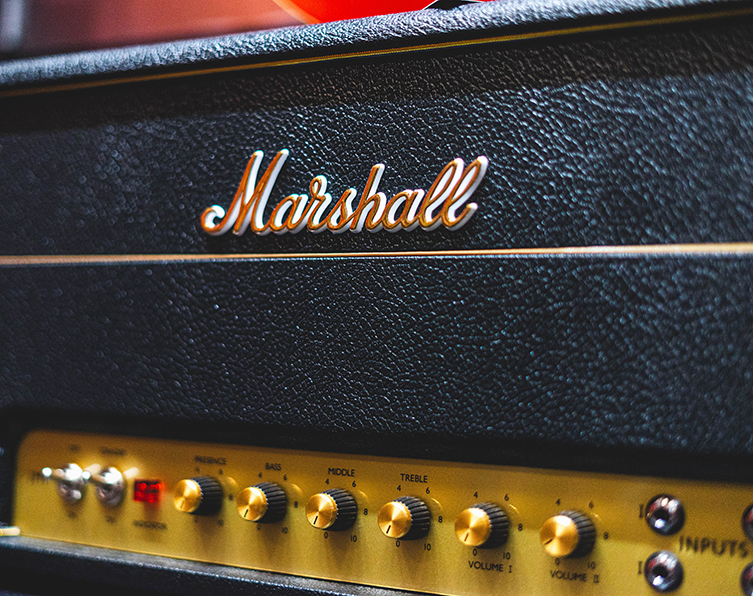
The Boogie Mark V has been cited as another amp, as have various Hughes & Kettner models. These are all clearly more ‘modern high gain’ in their operation, delivering thick distorted tones with perhaps a greater level of dynamic control and sonic tightness. Indeed, semi-recent touring revealed that Lifeson liked to run two of the H&K Triamp models (his own signature versions, of course) at once, with one staying ‘dry’ for channel switching and the other receiving all of the ‘wet’ effects. This is a great idea, since it adds clarity, depth and size to his sound, and can be used in either mono or stereo, allowing him an even wider sound.
Here’s a list of Alex’s amps…
- Marshall JMP1987
- Marshall JCM800
- Marshall Silver Jubilee
- Marshall JCM900
- Roland JC120 Jazz Chorus
- MESA/Boogie Mark V
- Hughes & Kettner Coreblade
- Hughes & Kettner Switchblade
- Hughes & Kettner Triamp (Alex Lifeson model)
- Marshall 4x12 cabinets
- Hughes & Kettner 4x12 cabinets
- LERXST mega 4x12 cabinets (developed with Mojotone)
Effects Pedals and Racks
Lifeson is great at changing texture and tone throughout a song in order to break up the sections and add interest and expression to some pretty long tunes! As much as he often just uses a nice thick distorted tone (from his amps, see above), he’s adept in effects use, on both his clean sounds and some attention-grabbing distorted sounds.
As a player who dominated in the 70s and 80s, you’d maybe expect him to be a rack guy, and you’d be right! TC Electronics rack systems feature a lot in Rush’s music, particularly the G-Force unit, of which he is known to employ FOUR at once!
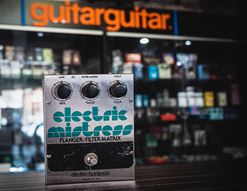
Prior to the rack days, Lifeson employed devices such as the Electro-Harmonix Big Muff and the Maestro PS-1A Phase Shifter. Recent years have seen more of a MIDI controller setup, as his 2011 Time Machine tour rig testifies. Check that out in the box below, but just before we get there
One other significant part of his pedal board is completely distinct to his guitar rig. It’s a set of bass pedals arranged like a Moog Taurus (think of organ footpedals and you’re getting close) which allow Alex to supply some low end bass parts whilst his bandmate’s bass drops out in favour of synth playing. It’s a very cool thing to be able to do, and speaks to his abilities as both a musician and a co-operative band member.
Here’s that list of what was in his 2011 signal path…
Alex Lifeson’s Time Machine Signal Chain
- Gibson Custom Shop Alex Lifeson Axcess Les Paul with Floyd Rose tremolo and piezo pickup
- Volume pedal
- Morley Wah
- Switch for piezo pickup on guitar
- Amp switch - 6 button switch but only 3 used: ‘clean, dirty and super-saturated’
- Moog Taurus Bass Pedals (actually Korg pedals arranged as a Taurus, for Alex to take over ‘bass’ duties when Geddy is playing synth)
- TC-Electronic G Force rack FX: FOUR of these - two for different delays, one for pitch-shifting and phasing etc, and another dedicated to flanger
- TC 1210 SPatial Expander: used for chorus
- Hughes & Kettner Triamp Alex Lifeson Signature model: two of these, one dry (for channel switching) and another for the effects
How to Play Like Alex Lifeson
Okay, that was the gear. Now onto the actual facets of his playing that are notable and worth checking out.
Arpeggios
Arpeggios are a good way of adding movement and size of a piece of music. Broken up chords that are played in constant patterns of single notes, arpeggios are something that many guitarists use in songwriting. Alex Lifeson uses arpeggios throughout Rush’s catalogue of music, and often uses shared notes through his chord progressions to add a sort of ‘through line’ to his parts. The ‘No One at the Bridge’ section of the epic The Fountain of Lamneth is an example of this, where an open G sounds throughout. This adds mystery to the piece. You can also hear this in 2112 and many other Rush classics!
The Rush Chord
I expect you already do this sometimes, but Alex does it a lot! Play a barre chord with the root note on the low E string, and simply lift your fingers off the high E and B strings so that the open strings sound. Voila! The ‘Rush chord’! You need the root, the 5th, the octave and the third, and then those two open strings. Some positions sound better than others for sure, but that’s what he does a lot! He often mixes this with arpeggio playing, so you’ve got two Lifeson techniques in one here! Here it below in their huge hit Limelight…
Wild Time Signatures that You Don’t Really Notice
It’s a proud prog rock staple to undermine any standard groove with a mad time signature. All the great prog bands do it, and Rush are no exception. What is interesting though, is how crafty they can be about sneaking those time signatures in. The verses of Camera Eye, for example, break down to being in a combination of 6/4 and 5/4, and whilst you do notice it, it doesn’t detract from the song’s momentum.
Light and Shade in Riffs
Lifeson uses a simple technique to maximise the sonic size of his guitar in the band’s overall mix. Check out Red Barchetta for a good example. What I’m talking about is combining high and low notes in a riff, like having low bass notes and then higher treble string notes too. It’s almost like thinking of the guitar fingerboard as being divided along the middle, and then hopping back and forth from treble to bass within the space of a riff.
Unusual, Exotic Scales
It’s always fun and exciting to hear the results of players looking beyond the limits of the major, minor or blues scales for their solos. Rush’s famously epic ‘wig out’ YYZ is a great example of this. When it’s time for Alex Lifeson to step forward into the spotlight, he lets rip with a kinetic labyrinth of a solo, using the B Phrygian Dominant Scale (also known as the B Spanish Gypsy Scale). No, I didn’t recognise that by ear, I had to Google it! It fits the song brilliantly though,and turns the listener’s head a little bit too, so it’s mission accomplished here!
Space
One thing that Alex Lifeson is great at is explaining space through sound. He uses lots of expansive ambient effects throughout the band’s career, but he also does something else that you might want to pay attention to. He often just stops playing, and just lets his chords ring out. Listen to their big hit Tom Sawyer and you’ll see what I mean. He knows when to underscore a synth part, when to take the front seat, and when to back off entirely.
I genuinely think that his ability to hold space in a song is why so many people love his playing, just like Pink Floyd’s David Gilmour. Both are great soloists, and both know when to play and when to listen.
Alex Lifeson: A Class Act
Hopefully this little journey through Alex Lifeson’s approach to guitar playing and equipment has helped answer a question or two for you, or just inspired you to return to the music of Rush! Theirs is a very open and inspiring sound, and an especially rich ground for guitarists to find themselves on. Lifeson can do it all, and he does so with a positive attitude, and commitment to the magic of rock music. Its prog, its pop, its all rock and its all great.
Click to View our Rush Guitar and Bass Gear
Read More
-
Steven Wilson Interview EXCLUSIVE
-
Marillion Interview: Steve Rothery talks Tone, Touch and Inspiration
-
"The subtext to music is to re-energise and to heal: it's very powerful medicine" Steve Hackett speaks EXCLUSIVELY to guitarguitar!
-
STEVE VAI Interview! Vai on Satch, Finding Your Guitar Voice & "The Sea of Emotions"
-
Tony Levin is the World's Greatest Bassist
-
YES: Steve Howe Talks Guitarscape in our EXCLUSIVE Video Interview!