Queen’s Brian May is almost beyond iconic. From the hair to the clogs to the home made guitar to the second job as an astronomer, he’s a one-off who also happens to be an astonishing musician. His appeal is worldwide, too: everybody can hum along to something he has played, and most of your extended family will have been found at get-togethers wildly air-guitaring to some of his riffs and leads after a shandy too many. In short, he’s the people’s rock star: a significant part of both rock history and British culture.
You want to play more like him and get closer to his sound.
I can help.
It’s always worth studying great musicians to see if any of their genius will flutter off and land somehow inside your own talents. There’s even a thrill involved in achieving some of their more famous parts, or copping a little of their tone. That’s what today is all about, really: assessing May’s approach and seeing if we can’t add some of his spice to our guitar gumbo, if you will.
He certainly has a unique sound, so let’s begin with that and move to the techniques later. Sound good?
Brian May’s Guitar Gear
Now, let me first make the usual disclaimer before we go any further: owning similar gear to Brian May does not, and will not ever guarantee that you’ll instantly sound or play like him. If that sounds like a bit of an obvious remark, I say this because of a memory from the shop floor when a disappointed customer handed me back the Ibanez JEM he was demoing, with the immortal comment: “It doesn’t sound like Steve Vai”.
No, sir. No, it does not.
So on that note, I’d share that owning this equipment will definitely get you as close as you can get to Brian’s inimitable sound, but unless you happen to have his hands and brain, you’re still gonna sound mostly like you, okay? If you are an experienced player, you’ll achieve some impressive results by taking heed of this blog, but do manage your expectations, particularly if you are a beginner.But I’ll take you as close as you can get!
Red Special
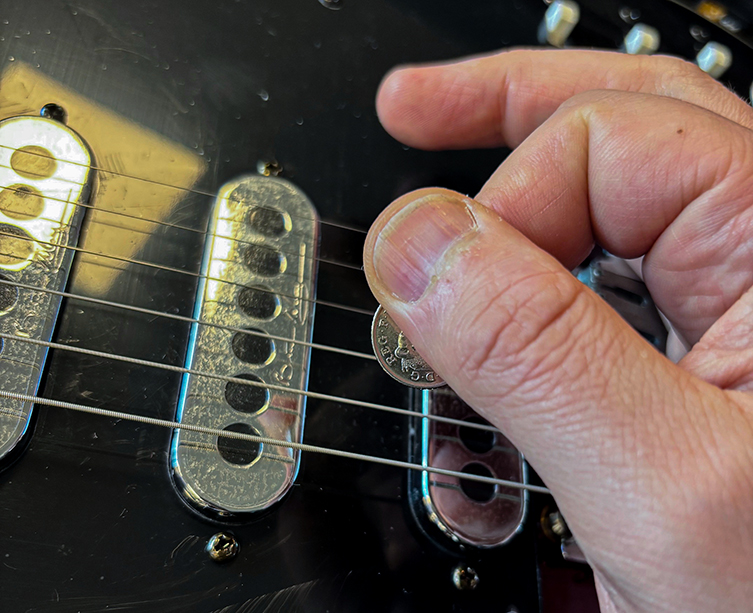
If there’s one thing that you’ll already know about Brian May, it’s that… he plays with an old English sixpence coin instead of a plectrum. Haha, okay, but if there are two things you already know, the other would be that his trademark Red Special guitar was made at home by Brian and his dad. From an old fireplace!
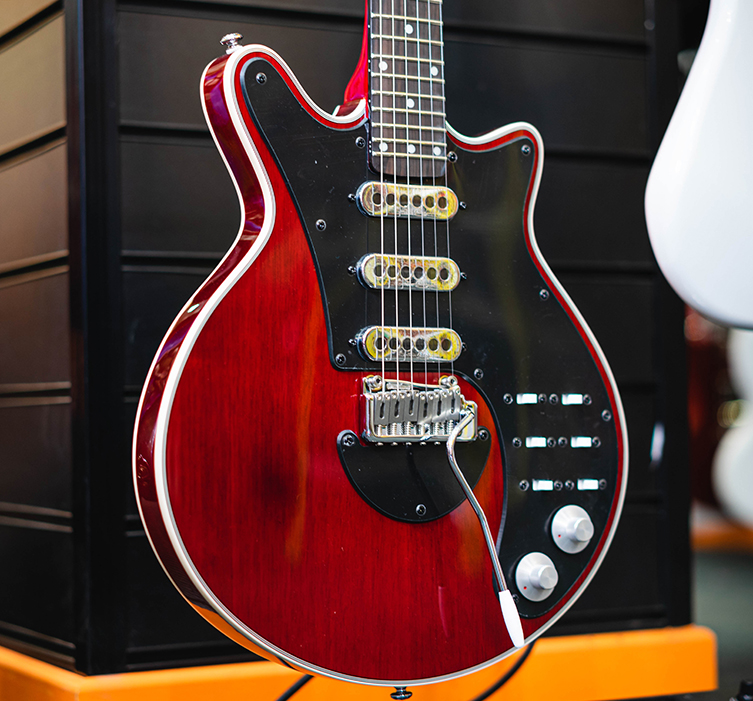
Yes indeed, we do all know this, so I’ll skip the story apart from adding details such as the use of some Burns TriSonic pickups, the fact that the neck has a 24” scale length, a 7.25” radius, and that it has a fair bit of extra switching involved to get loads from those pickups.
The wood from the fireplace was blockboard (strips of cheap wood such as pine sandwiched side by side in between outer plywood veneers), and the neck actually had wormholes in it, which Bri stuffed matchsticks into!
Here’s a little list of the original Red Special’s eccentricities…
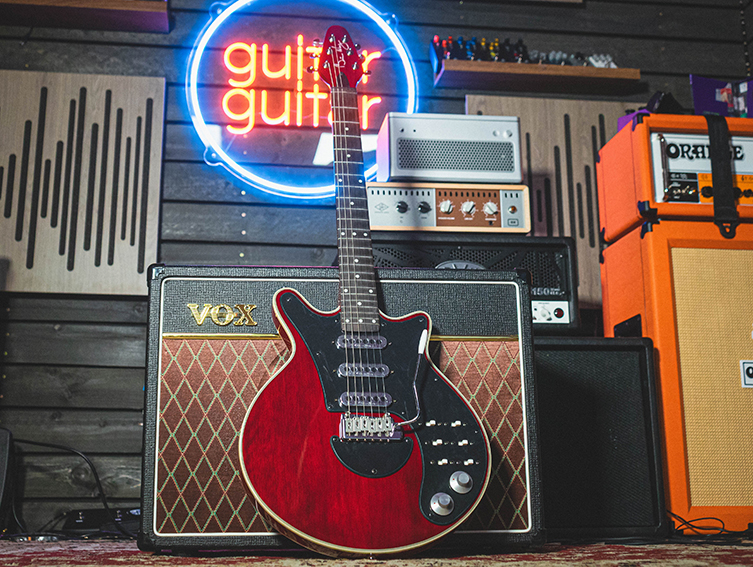
- Semi-solid body made from blockboard with pieces of oak
- Mahogany neck from a Victorian fireplace, bolted on to body under the fingerboard
- 24 frets oak fingerboard (painted black), with fret markers sculpted from a pearl button
- 24” scale length
- 7.25” radius
- 46mm nut width (really wide for a 6-string guitar!)
- Zero fret with an additional string guide made from Bakelite
- Original design bridge with motorbike springs.
- Tremolo arm made from a bicycle saddlebag holder with a knitting needle plastic tip.
- Onboard controls: master volume, master tone, on/off slider for each pickup, in/out of phase slider for each pickup. Bridge and middle pickups set to ‘on’ and ‘in phase’ results in a humbucking sound, which is Brian’s favourite setting.
- An onboard distortion circuit was originally incorporated, but later removed as May preferred the sound of his Voxes.
Brian May Guitars Red Special Replica
Your quickest and easiest route to get to Brian’s guitar is to simply buy one of his own replica Brain May Red Special guitars. This is his own company, and he has directly approved the reissues, which I’d say are very affordable and a good close likeness to the original.
So, has anything been changed? Well, of course, because this is a modern production line guitar, not a father-and-son weekend hobby that went unusually well! Here’s what I can find that is a little bit different about them, and bear in mind, a lot of these changes actually improve the playing experience…
- Chambered mahogany body
- Polyurethane finish
- Set neck
- Ebony fingerboard
- Brain May branded TriSonic pickups (very close but not identical)
- Wilkinson special design bridge
- Locking tuners
So, it still has the 24” scale, the zero fret, the TriSonic pickups and in fact some fancier features like a set neck and locking tuners! These guitars are made by a company from the Czech Republic called New Bohemia Electric. Far from being a step down for value, this is actually a pretty high spec instrument, with all of the sounds and switching that Brian himself would use. What are you waiting for?
Other Guitars Played by Brian
I’ll keep this part brief, because in all honesty, I know that you all just want to know about the Red Special, or The Old Lady, or The Fireplace or whatever name you ascribe to Brian’s DIY triumph. Anyway, on certain occasions, our Bri has used non Red Special guitars, so here’s a little rundown on those:
Fender Telecaster (usually for Crazy Little Thing Called Love)
Washburn RR-V (check out the Princes of the Universe video)
Gibson Flying V (excellently, as a backup to the Red Special)
Godin A12 12-string (for the Freddie Mercury Tribute gig)
Gibson Chet Atkins CE (acoustic used in the 1986 tour)
Collings OM acoustic (1998 solo tour)
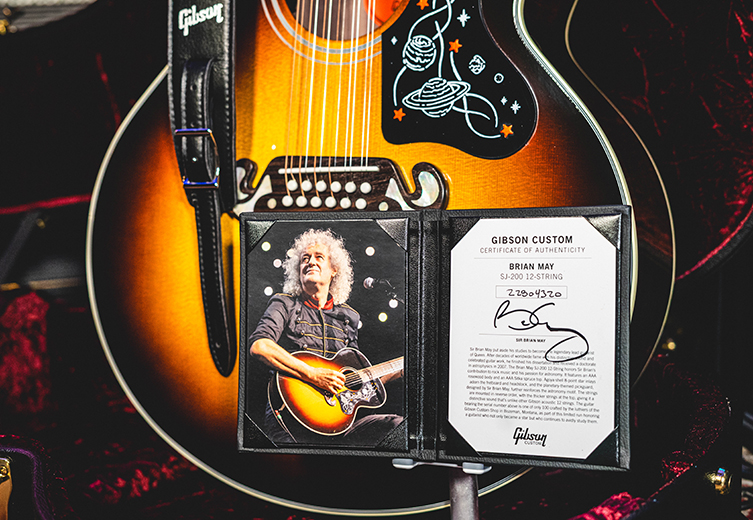
Gibson J-200
Various Burns guitars
Brian’s Amp: Vox AC30
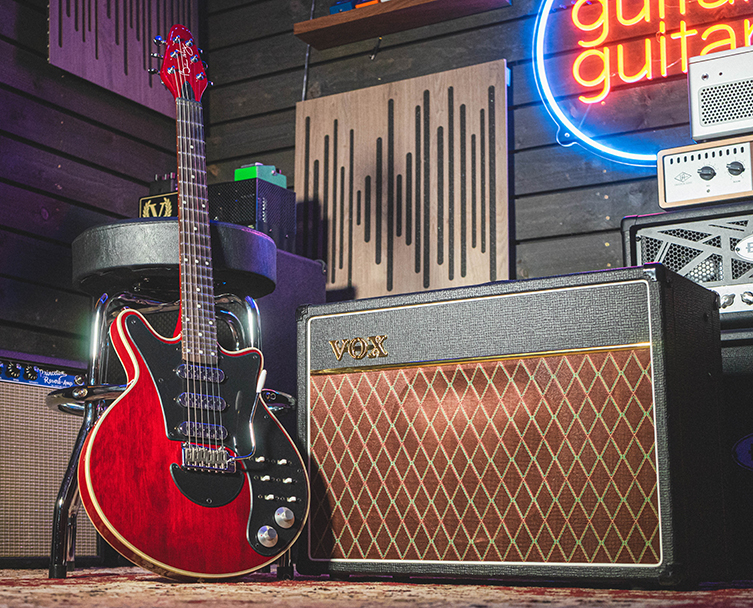
Again, there is really only one choice for amps for Brian May. He’s been a Vox AC30 guy since forever, and you’ll usually see NINE of them onstage at a typical Queen gig. Only three tend to be running though, and May has them in a wet/dry/wet setup, with‘wet’ meaning his tone with effects added, and ‘dry’ for his amp sound sans effects. This particularly pertains to his delay sounds, which I’ll talk about soon.
Brian’s Voxes have changed over the years, with him using different production models from different years. Some were modded by Greg Fryer (more on him soon), and there was even a Brian May signature AC30.
For you, that means you should be for whichever Vox AC30 model suits your means. I’d try to stick to valve models though, so you might want to try the Vox AC30 C2 for a well-priced and effective version. The Vox Handwired AC30 is a classier affair and is worth investigating if you can afford it. It seems to have a quicker attack and a more dynamic sound thanks to the more efficient circuit board.
Brian’s amps use Celestion alnico ‘blue’ speakers, so that’s something you can upgrade if you want extra authenticity. I’d strongly recommend that too: lots of guitarists discount how important the speaker actually is in tone creation!
Simply put though, any decent AC30 will get you in the ballpark!
Deacy
Have you heard of the ‘Deacy’? The little amp was built/modded/saved by Queen bassist John Deacon from an old circuit board he found in a skip. It’s a small amp (it has a 6.5” speaker, for example) and is battery powered. Brian May has used it loads on Queen records for sounds that need a tightly compressed, distorted tone. You can hear it on A WInter’s Tale, Love of My Life and loads of other Queen deep cuts.
The thing is, I believe you don’t ever hear it on its own. It’s always mixed in with May’s Vox sound, which is being pushed by his treble booster pedal. So, how the Deacy sounds on its own is a bit of a mystery, though plenty of fans have built their own versions and posted videos on YouTube, and I expect most of these efforts are pretty close to Brian’s.
Brian May Guitar Effects
Brian is a big user of effects to help add colour to his palette. He’s famous for certain sounds, but if we’re landing on three general areas, it would be a treble booster, modulation and delay. Let’s take each of these in turn.
Treble Booster
Treble Boosters are a particular type of gain effect in that they do somewhat belong in the past these days. It’s just much easier to get the levels of gain, drive and sustain we want from amps themselves these days, or from overdrive pedals that are perhaps more subtle.
Still, the sound of the treble booster is important when nailing the Brian May tone! Treble boosters push amps into overdrive, they add compression (therefore sustain) and they do take away a little of the bottom end of your sound. Back when amps had little or no breakup (unless you dimed the volume and ruined your hearing), these were perfect for rockers like Brian and also Tony Iommi, Rory Gallagher and countless other players on a quest for more.
Brian has used a number of Treble boosters throughout his career:
Dallas Rangemaster treble booster (the classic)
Pete Cornish treble booster
Greg Fryer treble booster (remember him from earlier? He has restored the original Red Special, built replica AC30 and Deacy amps, but has mostly retired from those pursuits. He still makes pedals tough!
BMG Brian May treble booster: Brian’s own branded treble booster.
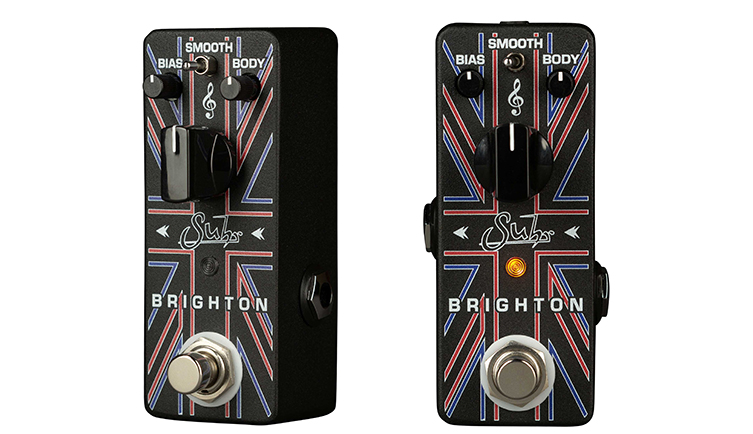
He doesn't use this, but try a Suhr Brighton pedal for a very convincing take on this classic circuit!
Modulation
Brian has used modulation a lot over the years to add colour and movement to his sound. Usually, the sounds are supportive rather than domineering, and he seems to favour phase and chorus sounds mostly. For phase, he was big on the Foxx Foot Phase, a pretty unique sounding pedal that is actually nothing like a Phase 90. The Foxx used 10 stages where the MXR has 4, and the result is fairly clear to the ear.
Now, Foxx haven’t been a brand for decades, but there are plenty of wise souls in pedal land, and so lots of clones exist. How to put it? You want a swirl instead of a sweep. Does that make sense?
For chorus, May used the classic BOSS CE-1. Well, the Roland CE-1 actually, since it pre-dated BOSS. Since then, there have been additional BOSS chorus effects, a Rocktron Replifex and then TC Electronic rack units for adding that subtle but important movement to the sound.
BOSS chorus pedals are pretty easy to get, so I doubt you’ll need much help here, but for extra fun, check out an old 80s BOSS pedal called the MZ-2 Digital Metalizer. It looks like a typical BOSS compact pedal, and it contains an analog high gain distortion and a digital chorus and delay. It’s not directly related to Brian May’s sound as far as I can tell, but it does get mentioned a lot in tandem with his tone, so fans might want to know more about this rare stompbox.
Delay
Delay is a big one for Bri. Now, this goes back to that three-amp set up from before. Brian has two delay effects: one for each ‘wet’ signal, with the middle dry signal of course just being the amp. Crucially, Brian sets each delay for a different, yet connected, delay time. One popular example is for Brighton Rock. One delay is set to 800ms and the other for 1600ms, which of course is double the time. Because these delays are going down different paths, they sit alongside each other better and build up in a complementary way, rather than becoming a mushy sound of noise.
What what gear does Brian employ here? Well, it’s been different things over the years. Initial delays were a pair of Maestro Echoplex delay units (go for the Dunlop EP103 Echoplex Delay for a modern recreation), before moving onto digital delays in the 80s. Rack mounted TC Electronic G Major units seem to have been a major hit with him.
Thankfully, there are absolutely hundreds of capable delay pedals that will give you a great Brian May-style delay. I have two recommendations for you, and encourage you to experiment with more…
Strymon Timeline: the best digital delay currently available, in my opinion. It’s objectively excellent, and I reckon you can achieve a Brian May delay by selecting the Dual Delay ‘machine’ and using it in parallel mode. That’s if you have two amps, of course!
Eventide Pitch Factor: not an obvious choice here, but this pedal is an absolute powerhouse and can do up to 2 seconds dual delays, so I have a strong feeling you’ll be able to achieve exactly what you want with this, as well as having an entire universe of other sounds to play with too!
Brian May’s Guitar Accessories
Okay, we’re back to the most famous thing: the sixpence coin. Have you ever tried playing guitar with a coin? I’m still not convinced it’s the way to go generally, but Brian obviously does, so why not experiment?
I do not think you have to source a genuine old sixpence. I don’t. Just try a selection of coins, and go easy on the attack, those things will be tough on your strings!
Talking about strings, Brian likes them on the light side, despite his guitar having a short 24” scale. He currently endorses a set of gold (they are gold coloured, yes) strings by Optima, in a 9-42 gauge. In the past, he’s been known to use Rotosound 8-38 gauge strings too. If you want to try a set of 8s on a 24” scale guitar then that is your business but I’m not recommending it if you want to stay in tune!
Okay, those are the main bits of info on Brian’s gear. Next, I’ll share some insights I’ve picked up from studying his playing. Hopefully some of these will be useful!
How to Play Like Brian May
So, this section intends to give you some pointers for tips and approaches on how to get some of Brian’s vibe into yours. I’m not going to be telling you any note-for-note licks or riffs, because that doesn’t achieve our aim here. Nobody creates in a vacuum, so hopefully you’;ll pick up little bits by applying what’s here to your own music.
A Light Touch
Brian doesn’t have a heavy touch, either with his fretting hand or his picking hand. The reasons are obvious: he uses light gauge strings on a guitar with a short scale-length, and he plays with a metal coin instead of a plectrum. All of these elements require a light touch to avoid pulling notes sharp, breaking strings and basically failing at the task of playing guitar.
Now, even if you don’t opt for the light strings or the sixpence, I would recommend experimenting with a lighter touch anyway, because it does affect how you interact with the guitar, and thus what you ultimately play.
Wide, Constant Vibrato
It may be another byproduct of using light strings with a short-scale guitar neck, but May uses a lovely wide vibrato to add movement to his notes. It is applied often and I think adds a really distinctive sound to his playing. You can easily adopt this, and you don’t have to have gauge 8 strings, either! Just go for a wide up-and-down vibrato, and keep the movement consistent: don’t stray too much into slow or fast, keep it constant!
3 Part Harmonies
This is a pretty obvious trademark of May’s, but building up symphonic sounding guitar harmonies is one of his most glorious tricks. On records, he mostly just records three guitar parts that are all in harmony. Simple enough, if you know your music theory and have good timing. But live, he can’t exactly clone himself twice and then agree on who’s doing what, so his workaround is to approximate it with his famous delay sound.
This is what you should try too!
I touched on this earlier during the gear section, but to recap slightly, use two separate delays that are spaced out in a rhythmically sensible way, like 800ms and 1600ms, for example. By playing harmonically related notes (keeping to a given scale, for example) and playing in time with the delay repeats, you will automatically start building a 3-part harmony within your playing.
And you don’t need two outputs for Brian’s wet-dry-wet set up, either. A decent delay into a mono amp is definitely enough to get some sound-on-sound May vibes happening.
A Solo is a Story
I have two points to make here. Firstly, I get the strong impression that most of Brian’s solos are written in advance. They are composed and he pays attention to his intro, outro, and how one part gets to the next. This is why his solos are so melodic, memorable and hummable: he rarely just improvises some flash noodling, despite being hugely capable. He tells a story with his solos.
This brings me to my next part: he will sometimes even change the music for a song to accommodate his solo parts, making them almost like little songs within songs. Take the Bohemian Rhapsody solo, for example. Yes, you’re humming it already, aren’t you? Well, have a listen to the chord progression under Brian’s lead guitar. That chord sequence was developed specifically for the solo, he’s not just playing over a verse measure or whatever. It has its own built-up, crescendo and dramatic finish, before the ‘Scaramouche’ section takes over.
How often do you hear this happening in rock music? Almost never, and it’s genius.
Look Beyond the Pentatonic
It doesn’t have to be flashy, but adding more notes than your usual minor pentatonic is going to allow you more melody and more flavour in your parts. Brian makes use of harmonic minor and similar exotic modes from time to time, but even just getting intimate with the full major and minor scales is important. If you want to make the most of those 3-part harmonies, then I suggest getting those scales into your brain and under your fingertips.
‘Cry Bends’
Brian’s ‘cry bends’ are basically string bends that are performed slightly slower than a typical bend, released a little and then sometimes bent up again. You hold onto the original note slightly longer, before bending it up. That’s it. He places these within his solos for a dramatic, human-like cry and they are super effective. So, it’s bend-release slightly- bend, and it’s in tons of his solos. Consciously practice this and add it now and again to your own soloing for a very cool effect.
Check Out Brian’s Influences
May has always been a humble superstar, and is quick to champion other players who’ve inspired him. He seems particularly taken by Nuno Bettencourt (understandably), frequently talking of how much he loves Nuno’s playing. On top of that, May has repeatedly namechecked Jeff Beck, Eric Clapton, Eddie Van Halen, Steve Vai and Jimi Hendrix. I expect you'll be pretty familiar with those people, but maybe there’s an artist there that needs further listening time from you? Well, Brian is recommending them, so get to it!
Discover Your Own Inner Rock God
Brian May is the real deal, and a total one-off. He is a unique player who has chased his own uniqueness and championed it. He has his influences, but he took that inspiration and turned it inward, until his own sound became a unique personal expression of him as a human being.
That's the real lesson today, if you really want to know. Practise his parts, take some ideas about his approach and try out some of his equipment to see how it works for you. All of that will take you to new places in your own guitar journey, and that’s very important (not to mention fun!). But if you really wanted to make Brian smile, it would be if you took all of this and poured it into music of your own creation. Follow in his footsteps, and use his approaches to make music that’s all yours. After all, that’s what he did!
Click to Browse our Brian May Guitar Gear