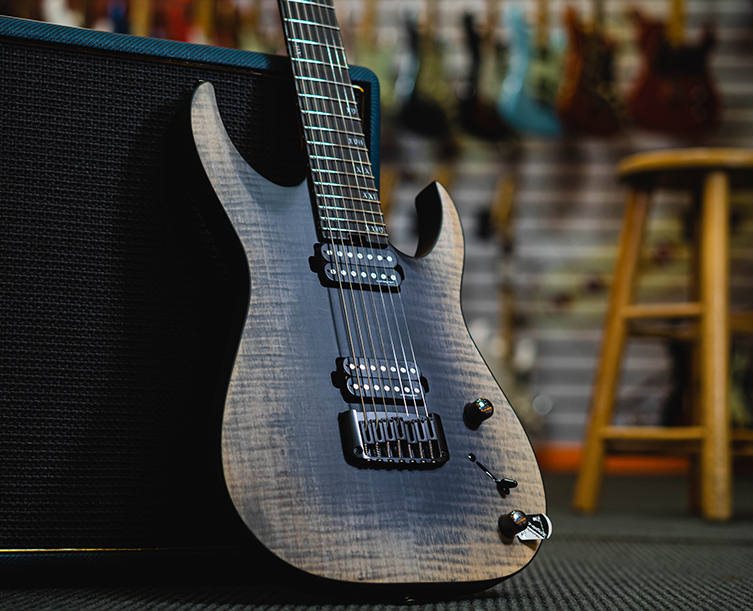
Are you a fan of 7-string guitars? If you’re a fan of modern metal music, I expect you will be, since they’ve become an integral element of that sound. But there’s more to the story of the 7-string than just low-end riffing.
I’m a fan myself, and I happen to have chatted to some of the 7-string’s most significant innovators over my years here at guitarguitar. It’s made me take an interest in where the notion for a 7-string even came from originally, because the answer goes back further than you might expect!
Today, I’ll flesh out some of the details for you and maybe put some perspective on where it all started versus where it is now.
Come along with me, why don’t you? If nothing else, you’ll get some good music on the way!
Why 7? Why 6?!
Before I jump onto the subject of 7-string guitars, it seems important to ask the question: why is 6 strings normal? I mean, people build these instruments, so decisions had to be made about that at some point, right? Okay, we’re going back in time…
Guitar-type instruments have been around for a very long time. I’ll keep things simple today, and say that in 15th century Europe, guitars were largely in existence, and had 4 courses of gut string. So we’re on the same page, a ‘course’ of strings here refers to a pair of strings played together as one. A 12-string guitar, for example, has 6 courses of dual strings. Make sense?
Okay, so a few hundred years later, this became 5 courses, and interestingly, they were routinely tuned out of ascending or descending order, in patterns that suited the music.
Up until 1800-ish, instruments were strung with gut strings (literally that - sheep guts - so don’t think about it too much), but the early 1800s brought the advent of widely available metal strings. Metal strings were significantly louder, and so allowed luthiers to experiment with single-course strings. Double courses were not needed fo the extra volume any more.
In time, 6 strings became the accepted norm, though this was by no means the only choice. 7 string instruments certainly existed at this point, and whilst they weren’t as popular in Europe, they were (and are) huge in Russia, with large bodies of work written in folk and classical repertoire for 7-string guitar. Much of this uses the open G tuning, which is DGBDGBD, low to high.
So it continued until the 20th century, more or less.
Early Electric 7 String Guitars
So, 7-string guitars have been around pretty much as long as 6 string guitars. Surprised? I was, and that wasn’t my only revelation. I won’t get ahead of myself though. In the age of the electric guitar, the formative developers of the instrument looked to existing acoustic and classical guitars for their blueprint, which is how we’ve ended up mostly using 6 strings. But, this is not the whole truth…
Step forward jazz pioneer George Van Eps and none other than Epiphone! You may know Epiphone’s past as the main jazz-guitar rival to Gibson back in the 20s and 30s, but here’s a good factoid for you. Epiphone built Van Eps a special custom-made 7-string semi-hollow electric guitar, potentially the first one ever!
Later on in the 60s, he moved across to Gretsch, who made him a signature 7-string guitar, which I believe is the first ever commercially available 7-string electric guitar! Not only that, but Van Eps was obviously a closet metalhead because his preferred 7-string tuning included a low A string! Talk about an unsung hero? Check out his record My Guitar from 1966 to hear a 7-string guitar played in an entirely different context.
Van Eps inspired quite a few jazzers to adopt an extra string, with players such as Lenny Breau following suit but adding their extra string to the top instead. Their additional high A string extended the range in terms of extra melodic potential, as opposed to low-end ‘bass’ accompaniment.
Uli Jon Roth and his Sky Guitars
Here’s an interesting thing: that jazz artist Lenny Breau, whom I mentioned briefly at the end of the last chapter? He actually had a signature 7-string solid body guitar which debuted at the 1983 NAMM show! His had a shorter scale length in order to stop the high A string breaking so much. As I understand it, this guitar never made it to production, and so another famous artist’s guitar became the world’s first mass-produced 7-string solid body electric guitar. You know what it is and I’ll get to it in a second, but before we reach that point, there is a somewhat unsung hero of the 7-string guitar to include.
The Scorpions’ lead guitarist Uli Jon Roth was already feeling frustrated by the limitations of his Stratocaster in the late 70s, when his band were riding high in the charts of their native Germany. A fan of both Hendrix and classical composers, Roth likened his guitar to a paintbrush, and by the early 80s, felt like he needed more colours on his palette.

(Pic courtesy of Uli Jon Roth)
I spoke with Uli a couple of years ago and he told me how his natural desire for a greater level of expression brought him to the idea of a 7-string guitar: “I knew I wanted a guitar that could do everything a Strat does, but I also wanted a guitar that can sound like a Les Paul, and a Strat can’t. So that was quite an unachievable thing to start with, for many different reasons. The initial phase was that I came up with the shape for the Sky guitar and he built the first Sky guitar. That was in 1983, precisely forty years ago now. I never went back, you know? We built five prototypes over the years, including two 7 strings, and those were the first 7 strings in rock.”
Roth tends to get forgotten in the conversation of early 7-string guitars because he made the deliberate decision not to bring them to market, as he says here:
“We didn’t build for twenty years. I always played Mighty Wing - the fourth Sky guitar, the 7 string - which was a unique instrument, it’s still unique. And then eventually, several people came up with the idea to put the guitar on the market. I heavily resisted that, because I didn’t want the guitar commercialised. I thought, no, this is too personal for me.”
Another guitarist, Alex Gregory (who seems to refer to himself as The Maestro) was also apparently working with Fender to produce a 7-string Stratocaster, again with a high A string. Pictures of a prototype can be found online, but this instrument never made it to market for whatever reason.
So, there are actually a few 7-strings which precede the one we all know as the pioneering one, which is interesting! Uli Jon Roth owned and played his own self-designed 7-string guitars as early as 1983. But anyway, it’s time now for the famous one…
Steve Vai and the Ibanez Universe UV7
In the late 80s, Steve Vai was the face of forward-thinking heavy guitar music. He’d served his time with Frank Zappa and Whitesnake, whilst also managing to effectively replace Eddie Van Halen as David Lee Roth’s lead guitarist for his solo career. He was already an influential character, and Passion and Warfare hadn’t even been released!
There’s a lot of story in how Steve got involved with Ibanez to build his JEM series of guitars, and I was lucky to get the whole tale, direct from the source! Click through to The Definitive Story of The Ibanez JEM, as Told By Steve Vai for that exclusive conversation. The JEM wasn’t a 7-string, but Steve’s creative and restless nature did mean that he experimented with options for extending the range of the guitar.
(Photo courtesy of Steve Vai)
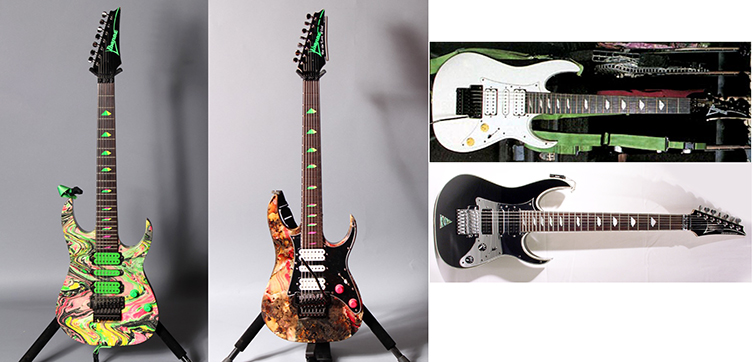
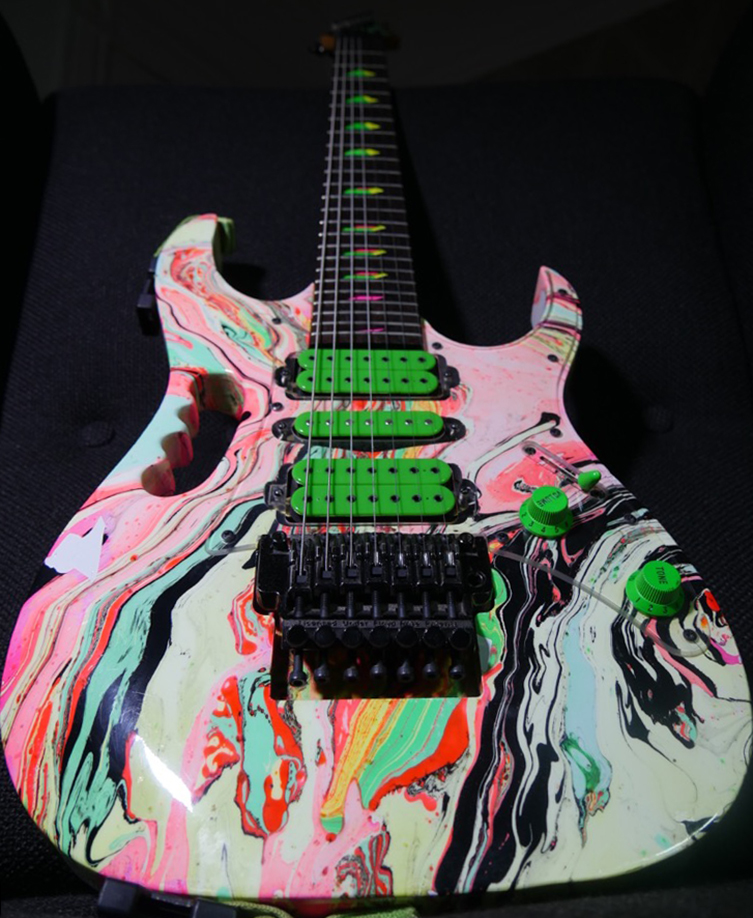
The result was the Ibanez UV7 Universe, the world’s first mass-produced solid body 7-string guitar. The Universe debuted in 1990, three years after the JEM, and actually slightly less eccentric looking. The sharp superstrat body remained (the JEM spawned the famous RG series, not the other way around) but the Universe ditched the monkey grip handle (mostly) and the tree of life inlays. With a low B string and a sound that shook the earth, it was already quite outside the mainstream.
Vai chose a swirl-finished Universe for the front cover of his landmark Passion & Warfare album and used it on Whitesnake’s Slip of the Tongue album and tour. The 7-string was now officially a ‘thing’. Here's Steve's direct take on how the idea manifested itself for him:
"And that was another game changer: very innocent at the time, just like the JEM. I didn't know these things! I kinda had a feeling: I was just about to do the Whitesnake record and I wanted something that set it apart from every other guitarist that may have played on it, or that has ever played, or was playing at the time and making those kinds of records. You know, you're allowed to think that way! (laughs) And I love thinking that way. What can I add? What's different? And I just thought, ‘I got it. I want a seventh string for that entire Whitesnake record. It's going to reshape the whole sound of Whitesnake!"
(Photo courtesy of Steve Vai)
Korn Redefine the 7-String
Well, it was a ‘thing’ for a couple of years, but it didn’t bite the way both Vai and Ibanez had hoped. It was expensive and it was a niche instrument, so the numbers selling began to dwindle. The shred brigade had run out of ideas, and gone back to their 6 string guitars. It took a pair of pretty unorthodox guitarists to lead the way for both the Ibanez Universe and 7-string guitars in general.
Here’s What Steve told me about it:
“And then there's the use in jazz. I remember walking into a club and I just saw this guy playing a Universe and he's just throwing jazz shapes, walking bass lines that you can't do with six strings, chord voicings…and I've even seen people play it classically, you know. But it's the metal guys that really brought it home, because the sales were waning to the point where Ibanez came to me and said, 'look, we're gonna discontinue this because it's only selling a couple a year’ or something.
Normally I'd say ‘okay, we had a run, it was nice’. But something in me said ‘even if you're only selling a few a year, keep it going because it's not done yet’. I don't know why, but I was correct, (laughs), because then I remember - as the story goes - I was driving down the street and I heard this intense music on the radio, this metal that I had never heard and I knew: that's a seven string! It's because I could hear it, it's not like they're just tuned down six strings. I know that's a seven. Who the hell is this? And it was Korn. Once Korn blew up, they really ushered in that heavy sound of the seven string.”
I do sometimes wonder if Head and Munky from Korn understood how innovative they were being, when the band’s debut was released in 1994. The Bakersfield quintet fused songs of intense existential angst and social issues to a brace of slowed down, drop-tuned, lethally heavy guitar riffs. Nobody had heard anything like this, particularly the combo of the riffs with an overt hip hop sensibility to the rhythm section.
Long story short, they inadvertently invented the entire nu metal genre. Suddenly, rock and metal bands all over the USA and beyond required a 7-string guitar to keep up with this colossal new noise, and the guitar companies were only too happy to oblige. The nu metal scene prospered, and bands wearing baseball caps and shorts were all seen playing Ibanez, Schecter and other brands of 7-string guitar. Downtuned metal riffs were all over the radio and MTV, which is actually a really bizarre concept to consider these days.
This lasted until the early 00s, when the fashion for such music calmed down somewhat. Guitar music went in a retro NYC indie-rock direction for a while, in mainstream circles at least. Over in the fringes though, 7-strings were still being utilised by bands like Meshuggah, Deftones, Slayer and Behemoth.
Djent, Prog and Today’s 7-String Climate
Since the early post-millennial years, a curious thing has happened to music genres. MP3s and then streaming culture has gradually eroded the notion of a central defining genre, in favour of increasingly specific subgenres. The playing field is more open than ever, but less bands are making as large a dent on culture, since everything has its own niche.
This is where I’ve noticed an interesting thing happen with 7-string guitars. They are becoming more readily used in a number of subgenres, mostly in the heavier worlds of music of course! But 7 and indeed 8 string guitars are filling arenas all over the world, as bands like Spiritbox and Sleep Token find huge audiences that love the sound made with 7 string guitars without necessarily being metalheads at all.
The contemporary version of prog metal is all about extended range guitars (with bands such as Tesseract and Devin Townsend leading the way), and the much-malgined Djent movement (the word is onomatopoeic for the sound of the guitar riffs) has built itself specifically around downtuned 7 string guitars.
Today, the 7-string is an accepted, and indeed expected part of modern metal. It never existed as a cultural thing in the 60s or 70s, so retro-leaning classic rock bands will not be uncasing their Mayones Hydras anytime soon, but for all contemporary and future-forward bands, those low frequencies are as essential as vocals and drum beats.
Long may it continue and evolve!
Click to View our Selection of 7 String Guitars