Aloha! So, you’re thinking of trying the ukulele? Good idea! Ukuleles are fun, easy to learn and probably amongst the most portable instruments out there. Playing the ‘uke’ is something that has become ever more popular over the years, and my guide today will hopefully give you all of the info you need to make a good decision about what to choose when buying and playing a ukulele!
Types of Ukulele
The ukulele is a traditional instrument from Hawaii. Images of palm trees, hula girls and Elvis ‘acting’ all come to mind when discussing the uke. Always possessing kitsch charm, it’s now a very popular tool for songwriters and social media starlets. More popular than ever before, the ukulele is a great instrument in its own right and a good ‘gateway’ instrument to get you on the road to learning other instruments.
The Ukulele comes in four different types (five if you include bass ukulele, which we are going to leave out today since it’s a lot less common), and they are known as the following:
You may recognise these terms from the Classical music world, where they are used to define certain pitches and styles of vocals. Whilst this isn’t the case here, the terms do reflect similar relative terms. The soprano ukulele, for example, is the smallest and highest pitched (just as soprano is the highest female vocal pitch), whilst the baritone ukulele gives the deepest, lowest sound, similarly to how a baritone vocalist is low-pitched, just about a ‘bass’ voice.
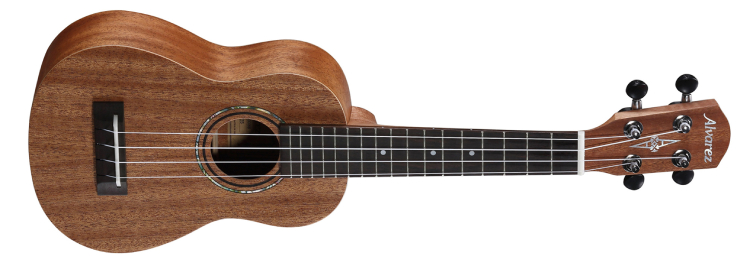
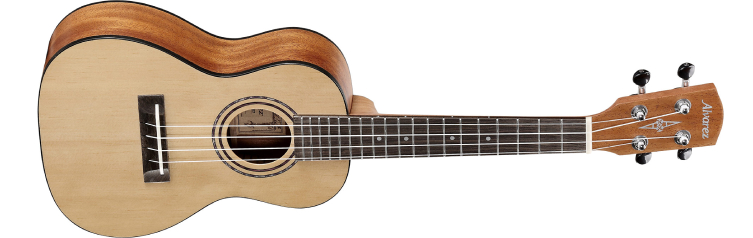
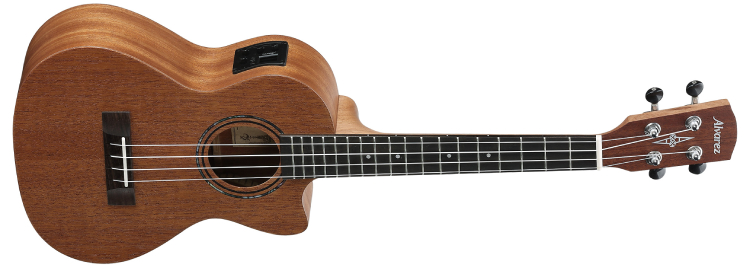
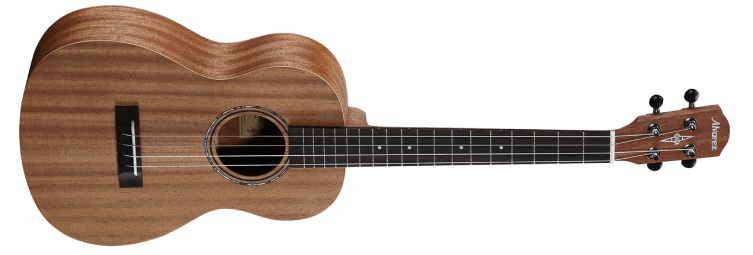
Anyway, here’s a quick lowdown on each type (pics are not to scale, but compare the soundhole to get a sense of relative size!):
1. Soprano Ukuleles
The soprano ukulele is the smallest and most common type of ukulele, the soprano is most likely the one you’ve seen before. The soprano uke gives you the most recognisable sound, one I’d maybe describe as ‘plinky’ and percussive. This is because of the small, shallow body, which won’t resonate as much as bigger G-C-E-A, low to high.
2. Concert Ukuleles
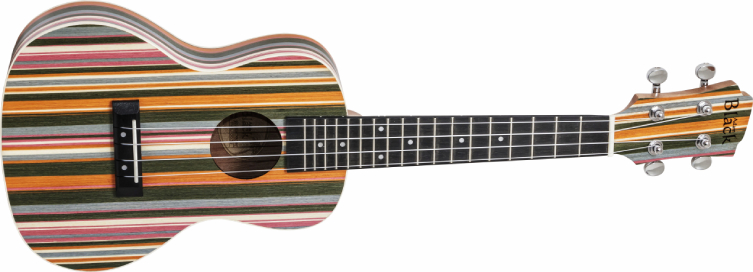
The concert ukulele is the next size up from the soprano. Slightly bigger (both in length and depth), the concert uke is therefore a little louder on average, as well as being that bit easier for adults to play. This is helped also by a longer scale length (the length of string available to play on), so the neck is a little longer, wider and the frets are spaced out slightly more.
The concert ukulele is also tuned to G-C-E-A, low to high, just like the soprano style. This means the pitches will be the same, but the sound will be deeper and louder.
3. Tenor Ukuleles
The tenor ukulele is next up, which follows the pattern we’ve established here by being larger, wider and louder once again. At this point, there is a vague comparison to a nylon string acoustic guitar forming, though a tenor uke is still notably smaller. The longer, wider neck allows for more intricate, complex playing, which may free up players who want to play melodies and lead lines. The tenor uke is also tuned to G-C-E-A.
4. Baritone Ukuleles
The baritone ukulele is the biggest standard uke out there, and is perhaps the most similar of all to a guitar. Indeed, guitarists transitioning to the Ukulele may find the baritone style to be the one to aim for: the bigger body and neck will feel the most familiar, and even the tuning - D-G-B-E - is the same as the top four strings of a guitar.
The baritone ukulele gives the biggest and loudest sound of all four styles.
Ukulele Sizes
Ukuleles differ from guitars when it comes to their sizing. With guitars, a ¾ or ½ sized guitar can be thought of as a down-sized, slightly shrunken version of a full-sized guitar. For ukes, each size difference corresponds to a different type of uke.
In other words, a soprano ukulele is thought of as its own type of ukulele, rather than a smaller version of, say, a concert ukulele. Each size (and therefore, type) of uke has its own distinctive sound. Generally speaking, the smaller the model, the more characteristically ‘plinky’ they sound. As noted earlier, here is each ukulele in ascending size, from small to large:
- Soprano
- Concert
- Tenor
- Baritone
As for choosing a size, I’d recommend you try each size out if you can. We always keep a diverse selection of ukuleles in stock at every guitarguitar store, so please feel welcome to try them out with us, where our staff can help you.
I’d also say that, if you want a low-risk purchase (i.e. not too expensive), then a soprano ukulele can be had for very little cash, and will also give you the most characteristic ukulele sound.
Ukulele Tuning
I looked at this a little earlier, but let’s go over it again, for good measure. Most ukuleles are typically tuned to the following notes, from low to high:
G-C-E-A
This tuning applies to soprano, concert and tenor ukes. The baritone ukulele is typically tuned to D-G-B-E, which happens to be the same as the four lightest strings of a guitar.
Now, these are the tunings that most players stick with - and are the ones used in ukulele chord books etc - but as with most instruments, it is ultimately up to you how you tune your instrument. Other ukulele tunings do exist, though for simplicity’s sake (and for ease of joining in with other players), I’d recommend sticking with the tunings that I’ve outlined here. Ukuleles can be fragile instruments, so don’t over-tighten any of the strings! The ‘standard’ tunings shown above will give you the results you’re looking for.
Is a Ukulele a Guitar? What are the Differences?
A ukulele is not a guitar. A ukulele looks similar to a downsized acoustic guitar, and it is played in a roughly similar manner, but they are not the same. The closest guitar-relative to the uke is the classical guitar, since both use nylon strings and neither have truss rods in the neck to help with the tension of heavy steel strings (the nylon strings mean they don’t need them).
Ukuleles are much smaller, they only have four strings and typically have far fewer frets. Generally, ukuleles are tuned to higher pitches than guitars, so playing a ‘D’ chord on a ukulele will have a higher register sound than a guitar, and it’ll utilise a different hand shape to form the chord on the neck.
What is the Best Ukulele for Beginners?
I feel that the best ukulele for beginners is a soprano ukulele. They can be had for a low cost, they are extremely portable, and they give the most characteristic ukulele sound.
Due to their small size, some prospective players may have initial trouble with the small neck, so those people might want to go up in size to the concert ukulele.
What is the Best Ukulele for Guitarists?
For guitar players, I generally think that any of the ukulele types will be an equal task: it’s a matter of learning new chord shapes more than anything else. That said, if you wanted the most similar, most familiar feel to the likes of a classical guitar, then I’d recommend you try a baritone ukulele. It’s the biggest, and has the longest & widest neck, so it’ll feel less ‘other’, compared with a soprano uke. Also, the baritone tuning of D-G-B-E will make a lot of sense to a guitar player, since it’s the same as the top four guitar strings!
Play a Ukulele Today!
Ukuleles are fun, musical and quick to learn. Why not try one today, and surprise yourself with just how quickly you can add another instrument to your repertoire! You won’t regret it!