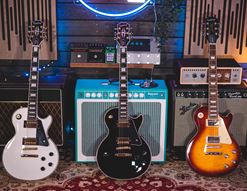
Are you a Gibson Les Paul owner? Are you looking to get the best out of your instrument? Do you want a better selection of sounds, more tone and to basically use the guitar itself as the primary source for your sound?
If so, then I have some thoughts and suggestions for you today. These are some nuggets of info, insights and practices that I’ve come across on my travels as a gigging guitarist who primarily uses Les Paul guitars on stage and in the studio.
I’ve worked with loads of Les Pauls over the years, I own a couple and I’ve sold hundreds back in my days as a salesman. I’ve also had the privilege of interviewing some of the world’s greatest guitar players for this very website, so I hope that qualifies me in your eyes as somebody you can trust on the subject.
Today, I’ll talk about classic Les Paul sounds, and simple ways of achieving those sounds. This is mostly about the guitar itself, so that you’ll hopefully be able to apply this stuff to your own music, whatever styles you might play.
Okay! Let’s talk Les Pauls!
The Holistic Approach
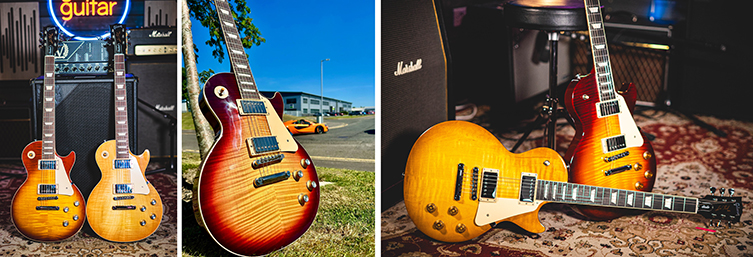
Here’s a grand statement right off the bat: there is no one element that’s more significant than the other when it comes to tone creation. In terms of equipment, good tone is a matter of looking at the overall picture, and realising that the end result comes from an accumulation of several individual parts. These parts are, in no particular order: the body & neck, pickups, electronics, the nut, the bridge and the amplifier.
So, how do each of these affect the sound you get?
Body & Neck Construction
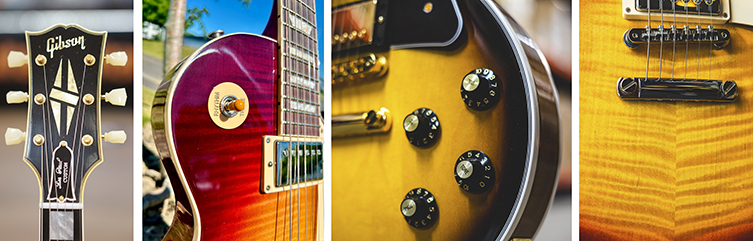
You’ll already know that the solid mahogany body, thick maple cap and glued in neck all play an influence in the sound of a Les Paul, right? Mahogany carries sound really well, with a thick, cello-like sustain. Maple is a hard and dense wood, and this translates to more top end vibrations, or treble in your tone.
The glued neck is important, but so is the length of unseen mahogany we call the tenon. The tenon often travels as far as going underneath the neck pickup, and this extra timber creates more of a connection with the body.
The thickness of a Les Paul’s body is significant, too. A direct comparison between a pretty typical Les Paul and a pretty typical SG will highlight this: the SG’s thinner body and different neck connection result in a sound that’s thinner with more treble. Both sound really good; it’s simply a matter of what you want.
Pickups
Most classic Les Paul tones make use of PAF pickups, humbuckers with relatively low output. The less copper windings a pickup has, the more open it’ll sound, with more top-end. Combine that with the thick response of the mahogany, and you’re onto a winner for that wonderful, velvety, ‘vocal’ Les Paul lead tone.
Pickups with more windings become hotter in output, but also more compressed sounding with more midrange. Again, not better or worse, but not what I’d choose for classic Les Paul tones.
One extra point to make about Les Pauls with P90s. Good P90 pickups should sound very similar to good PAF pickups, despite the change in design. PAF pickups shouldn’t be more than about 7 or 8 Kohm in resistance, and since historical examples were not wax potted, they should be equally ‘humming’ when overdrive is used!
The Nut
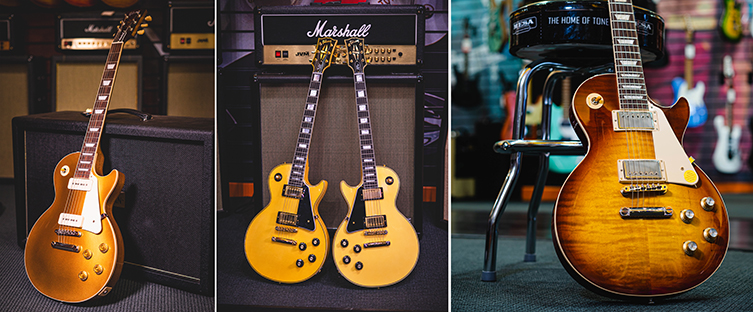
The nut has a part to play in the overall sound, but I suppose that’s mainly with open strings. The nut was to be cut correctly of course, but the material is important too. Nylon is ubiquitous and fine up to a point, but it lacks the chiming top end of bone and graphite, so it may be worth considering a nut replacement if yours is nylon.
The Bridge
Any part of the guitar which comes into contact with the strings will have some effect on how that string behaves, ultimately altering the sound. Now, almost all traditional ABR-1 bridges are made from aluminium alloy, but those alloys are not all equal in their metal mixes. In this case, it seems that more modern bridges are clearer and brighter, whereas old vintage ones give less brightness and more warmth.
Which is better? Neither, really, but it's worth knowing that you'll get different results with bridges which superficially seem pretty identical.
Controls: Pickup Selector, Volume and Tone Knobs
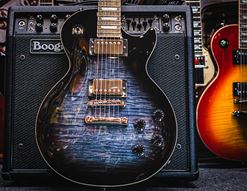
A standard Les Paul design will have two pickups controlled by a three-way selector. It’ll have four control knobs, which are a volume and tone control for each pickup.
Big improvements in tone can be achieved by simply having great quality potentiometers in the circuit. Different resistance values allow for different amounts of ‘filter’ on the high end of your sound: for example, a 500k volume pot allows more treble to leave the circuit than a 250k volume pot, which in turn gives you more treble to play with. Lesser value pots sound darker, basically,
The Amplifier
It won’t be the first time I’ve said this, but the amp is possibly the biggest influencal factor in how your sound will end up. More than any other component, the amplifier takes your plucked note signal and sculpts that into an actual guitar sound via its circuit and speaker. The speaker makes a huge difference, but that’s another story.
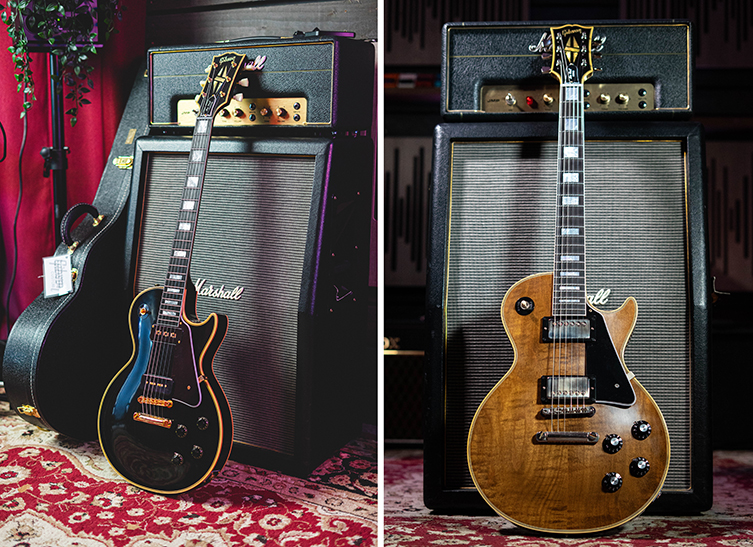
Put simply, pairing your Les Paul with the correct amp for your needs is key. A Les Paul through a Fender Twin is a lovely thing, but not if you want a British Invasion sound. By that same token, a ‘good Les Paul into a good Marshall’ is a thing to behold for rock music. I put that in quotes because it was The Cult’s Billy Duffy who said that to me, and he knows a thing or two about great guitar tone!
Approaches to Tone
Here are a few ways to make the most of the guitar’s 3-way selector and control knobs. I mentioned these a second ago, so now it’s time to actually talk about how to use them!
Clapton ‘Woman Tone’
I am no way going to defend that out-of-date nickname for ol’ Eric’s famous lead guitar sound, but the sound itself is a good one, so let’s discuss it.
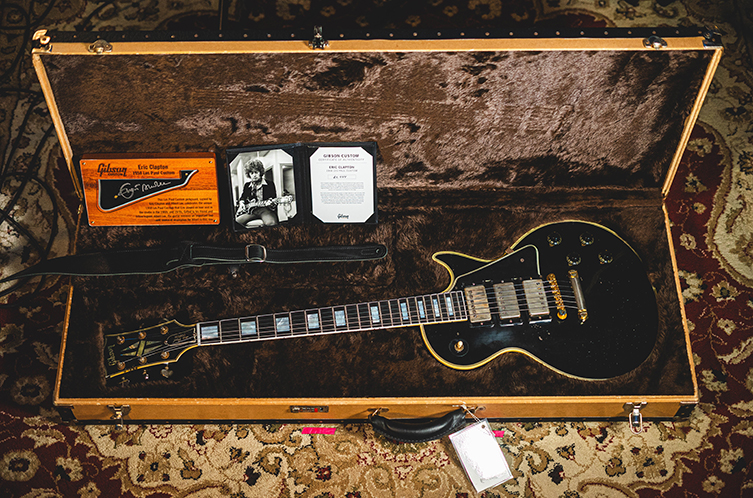
The ‘woman tone’ is from Clapton earlier times in both John Mayall’s Bluesbreakers and in Cream. It’s pretty simple. Adjust your amplifier so that it’s loud and trebly. Select the neck pickup of the Les Paul, and turn the neck pickup tone control all the way off. Done!
‘Onboard Channel Switcher’
Get the equivalent of a clean and overdriven tone directly from your Les Paul. Here’s what you do: dial up your filthiest distortion sound on your amp, using the guitar’s bridge pickup. Next, flip to the neck pickup and turn the volume to zero. Finally, bring that volume dial up just enough to catch the sound, and it’ll be beautifully clean. Simply flip between the neck and bridge pickups to go from clean to overdriven.
‘No Pedals Overdrive’
Similar to the previous tip, but without the pickup switching. Dial up your amp for your biggest sound, and then simply dial back the volume to clean it up. This all applies to using one pickup, and it’s quite a revelation when you realise how much you can modify your sound simply by manipulating your appropriate volume control.
Here’s a couple of tips for you…
Dial your tone with your neck pickup: get your neck pickup sound sorted out first in terms of amplifier knob-twiddling, and the corresponding sound on the bridge pickup will ALWAYS sound ace. Start with the bridge pickup and your neck sound may end up muddy and underwhelming.
Dial your sound with your guitar volume at 7: try this one out, because once you have your sound cooking with the guitar volume set to (roughly) 7, you’ll enjoy an extra ‘nitro boost’ of thickness and saturation when you go to ten. It’s not tons, but it definitely helps you hone your tone, as it were.
Some Great Les Paul Sounds, Why and How
Time for some examples of really good Les Paul tones. I’ve been focussing on classic sounds for most of this article, for two reasons: data tells me that’s what you love reading about, and; the points raised are fundamentally useful, and can be adapted to other genres and tones. But, in this section, I’ll talk about a wider range of players, though they are still largely ‘rock’ guitarists.
Steve Jones’ Sex Pistols Tone
Whether you’re into the Sex Pistols or not, I don’t expect you’ll have much of a problem with Steve Jones’ immense guitar sound. I’d have bet a million quid it was a Marshall sound, so I’m glad nobody took that bet: it’s a Fender Twin!
Yep, one of two Les Paul Customs into a Fender Twin fitted with Gauss speakers, which were rated for 400 watts (!!!). Those speakers reputedly added a bunch of midrange, but he still must’ve played that at beyond-obnoxious volume levels in order to get such a roar from the one amp in the world renowned for its clean headroom!
Marc Bolan’s 20th Century Boy Tone
Everybody knows this sound, right? It’s a loose, filthy, crunchy glam rock tone, and it just screams ‘Les Paul’. Listen closer and you’ll notice that it’s not overly distorted. Sometimes that actually sounds heavier, which of course AC/DC knew a thing or two about! Bolan often used solid state HH amps (not sure if those are what we hear here!) and a Dallas Rangemaster treble boost. Yes, the Black Sabbath one!
Paul Kossoff’s Tone in All Right Now
It’s the most famous riff that everyone plays wrong, and it’s another great Les Paul tone. Gain down and volume up for this one again, because that is delicious power amp distortion we are hearing in this track, with Kossoff’s wonderful command of sustain allowing his solo to sing like a soprano.
The choppiness of the main riff displays something that’s been apparent to me ever since I chatted to guitarist Duane Denison: he spoke about the importance of how a guitar finishes a note, as much as how it begins one. Now that is an interesting topic, and I’d say part of the reason I love Les Pauls so much is because they are excellent at stopping notes when I want them to!
Back to Kossoff, you can learn lots about vibrato from studying just this one song.
Mick Ronson’s Ziggy Stardust Tone
Take the fantastic Les Paul Custom & cranked Marshall stack combo, and add one crucial feature to capture Mick Ronson’s immortal sound: a ‘parked’ wah pedal. By that, I mean switch it on and move the treadle half-way, so it’s neither fully ‘toe’ nor fully ‘heel’. There’s a point where a certain resonant frequency just makes the guitar ‘honk’, and that is where you want to be!
David Bowie had pretty much the best taste in guitarists ever (Stevie Ray Vaughan, Robert Fripp, Nile Rodgers, Page Hamilton, Reeves Gabrels, Adrian Belew…) and it started with Hull’s own legend, Mick Ronson. What a sound!
Adam Jones’ Vicarious Tone
Tool’s Adam Jones is not afraid of distortion. Indeed, his thick, chewy high gain sound is rightly praised for being one of the best ever, and he is pretty specific about what he needs for it. His late 70s Les Paul Customs have SIlverburst finishes (he reckons the paint plays a part in the tone; you decide for yourself) and Seymour Duncan Distortion bridge pickups. These are high output ceramic humbuckers, so nothing like PAFs!
Amp-wise, he uses an interesting combination of a MESA/Boogie Dual Rectifier head, a Diezel VH4 head and an old Marshall Super Bass head. Yes, a bass amp! Worth a shot, right? These are fed into a mixture of regular 4x12 guitar cabs and 2x15 bass cabinets.
Do not be a roadie for Tool!
Mark Knopfler’s Brothers in Arms Tone
Now, is this the greatest Les Paul sound ever? Possibly, particularly if you love expressive and haunting leads. Mark’s playing is the main reason that this track sounds so awesome, but the vintage ‘59 Les Paul Standard doesn’t hurt! This is a sound that any guitarist would love to hear coming out of their amp. Here are a few further steps you can take to get close to this sound:
- Low to medium gain from a ‘British’ valve amp
- Fingerstyle for dynamics: clean tone to pushed overdrive, purely from fingers
- Neck pickup only
- Tone control dialled back a little
- Volume pedal for the ‘violin’ notes with a bowed-style attack (used sparingly)
- Natural phasing from studio mic placement (don’t add a modulation pedal)
It’s Not a Les Paul! Great Les Paul Guitar Sounds That Aren’t
Just for a bit of fun at the end, here’s a few classic Les Paul sounds from great Les Paul players…only they ain’t even using Les Pauls!!!
- Dire Straits - Money For Nothing: he may be using his ‘Brothers in Arms’ ‘59 LP Standard in the video, but that absolutely excellent guitar sound is coming from a Les Paul Junior with P90s, and there is NO WAH PEDAL on this, okay?
- ZZ Top - Gimme All Your Lovin’: Billy Gibbons may have the incredible Pearly Gates ‘50 Les Paul, but you aren’t hearing it on this tune or any of the other tunes on Eliminator! So what IS he using to get that amazing Les Paul tone? It’s a Dean Z with DiMarzio Super Distortion pickups! Not only that, but it’s into a Legend 50 watt solid state amp! Go Billy!
- Led Zeppelin - Communication Breakdown: Jimmy Page may also have a rather stunning ‘59 Les Paul Standard (is a pattern emerging here?) but those early Led Zep records do not contain any LP tones. Instead, he used his famed Fender ‘Dragon Telecaster’, so-called because a friend painted a red and green mess all over the guitar’s body as a surprise for Page. Friends, eh? Not that it matters, but almost all of the live recordings you hear of Zep will be of Page wielding his LP into a stack of Marshalls like a champion, and those are his greatest moments anyway, in my opinion!
Gibson Les Paul: a Never-ending Tone Machine
We’ve reached the end of my casual cruise through the various ways we can approach guitar tone with a Les Paul. There’s always more to say about this, but I do need to draw a line under things at some point or I’ll just keep going...
It always mystifies me when I hear people talking about the Les Paul as a ‘one sound guitar’, when in fact it’s as versatile and manageable as any of the other main contenders. What it does have - and this might be the real point worth making - is a signature footprint. There are certain sounds that you can really only get from a Les Paul. I love Strats, but a Strat is just never going to sound like a Les Paul, and that’s a beautiful thing for everybody.
I hope I’ve helped you figure out some of that today, along with some tactics to approach how to handle a Les Paul. Leave all of the controls on ten all the time if you want, but I believe you’re missing out on some cool stuff if you do. Those control knobs are all there for a reason, why not get experimental with it all?
I sincerely think that all guitarists should own a Les Paul, because I think there are certain sounds and performances (the shape etc all plays a part in how you handle it) that can only be had from a Les Paul, and I believe you deserve to have all of that greatness to hand when you need it.
Browse Our Extensive Selection of Gibson Les Paul Guitars
Read More
-
Bursts: 2026 Guide to Les Paul Standard Sunburst Finishes
-
Epiphone vs Gibson: What Is The Difference? (Updated for May 2026)
-
Gibson Artist Signature Guitars: Your 2026 Guide
-
The Best BRITISH Rock GUITARISTS!
-
The Gibson Les Paul Studio: The Expert Guide
-
Fender & Gibson: Which is Right For Me?
-
Ultimate Guide to BIGSBY Vibratos: Which One Is Best For You