“The principle here is: establish the possible and more gradually towards the impossible.”
How much do you know about Robert Fripp’s Guitar Circle? Fripp is an intriguing musician. A great thinker and a particularly ‘out of the box’ guitarist, Fripp has spent his professional life resolutely not acting like a typical rock star.
What do I mean by that?
The aim of today’s piece is to discuss a hardcover book that he has written based on his own unique philosophical guide to personal development. That in itself is quite atypical of your average rock guitarist, but there’s more.
Fripp always sits down to play, eschewing cliched rock stances. He has invented his own guitar tuning (New Standard Tuning, which is C-G-D-A-E-G and needs custom string gauges, be warned) and also created a whole new concept of playing with his Frippertronics system, effectively preceding looping.
He’s an enormously influential musician, not just with King Crimson but through his collaborative work with artists such as David Bowie, Brian Eno, Peter Gabriel and many more. His is the simple-yet-uncopyable guitar part in Bowie’s Heroes. He is able to say that Jimi Hendrix himself was a big fan of Fripp’s music.
So, there is a lot to Fripp’s career and art that put him quite resolutely outside the typical guitar hero connotations. These energies are all arguably captured and put into context in his book, The Guitar Circle.
What is the Guitar Circle?
So, what is the Guitar Circle? The Guitar Circle is a number of things. In 1985, Fripp called an end to the Discipline-era of his band King Crimson. He then founded Guitar Craft, a sort of philosophical workshop/seminar/awareness group who learned about personal development through Fripp’s unique approach to music and the guitar.
The big thing about Guitar Craft was that it didn’t focus on scales, licks, riffs or rhythms. This wasn’t about learning King Crimson riffs at all. There was no talk of music theory. The sessions were more about how a player would mentally arrive at their instrument, and then how they’d physically engage with it. Subjects like intention, expectations, the influence of your own physicality/pose and your perception of silence were all major inclusions. It was fairly revolutionary stuff.
There was playing, after a fashion, and participants were encouraged to use Ovation acoustics due to their ergonomic bowl back construction. The emphasis was on the ‘whys’ of music, and in seeking answers to that through Fripp’s mentored practice. Presumably, everyone would arrive at their own inner destination, by applying similar practices.
The Book
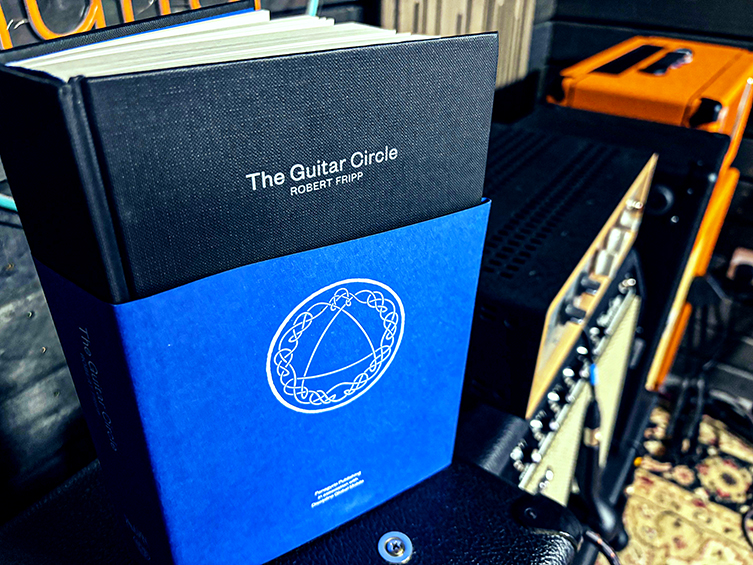
Much of the thinking and practice of the Guitar Circle and its breakaway groups has been distilled by Fripp in a luxurious 500+ page hardback book also entitled The Guitar Circle.
As a longtime follower of Fripp’s music and musings, I bought myself a copy a few years ago. I’ve never been a part of those Guitar Circle groups or anything approaching such events, so I was coming at this relatively ‘cold’, if you like. I was intrigued about what the book could offer me, basically.
As it is my job to write about guitars/guitar culture, I thought it was time to explore The Guitar Circle book, talk about what I found and how those findings might apply to players like yourself.
So, this is my personal response to the book, based on how I’ve chosen to both approach it and use it. Mr Fripp has not asked me to write this, nor has he been involved, though he has expressed encouragement. This is my own work, and I hope you find something useful within!
My Personal Approach to the Book
So, briefly: why am I interested in this book? How did I arrive at it? Why indeed am I now writing about it?
As mentioned earlier, I’ve been a fan of Fripp’s music in a number of contexts, from King Crimson to Bowie and then Eno. That aside, I’ve always looked for a way to get ‘outside’ my own playing limitations, one way or another. I’ve often found that the musical ideas I receive when I’m away from the guitar itself are often far more interesting than the music that comes out when I’m back at the guitar, idly strumming and picking. We are all victims to our own learned patterns and habits, right?
This realisation led my thoughts down a path towards people like Fripp, whom I already knew to have created the Guitar Craft events in the past. I’ve read plenty of interviews and online diaries from him, so there was a vague sense of expectation there.
I felt that by understanding where the musician was coming from in a more conceptual headspace (if that’s the term), then I’d be able to use that knowledge to walk my own path more.
In short, a desire to maximise my own unique voice as a guitar player was key.
This realisation kept Fripp in mind for me in a number of creative ways, and when the book was released, I couldn’t have hit the ‘Buy’ button quickly enough.
What was I missing in my own approach to the instrument? Was it simply a lack of theoretical knowledge and practice? Or were there some other factors involved that I hadn’t anticipated?
Reading The Guitar Circle has put a large degree of context and focus to those thoughts. If you are like me in this regard - and I expect you must be, since I don’t believe I’m particularly unique in my thinking process - then perhaps some of the teachings, methods and suggestions that I’ve come across could be useful to you too.
What is The Guitar Circle Book?
So, this book is a collection of writings from Robert Fripp. It contains his curated thoughts on self-development through the focus of music. The book is, I understand, strongly linked to his previous Guitar Craft and Guitar Circle courses, but is a distinct entity that can be taken on its own merits.
The Guitar Circle offers a way of approaching a musical life, through a series of Core Principles, awareness training and other concepts that relate to our overall approach. I’m getting ahead of myself here, but I’ve found the book to be useful to my life quite outside the realms of being a musician, and that is something I believe to be intentional.
But I’ll come back to that.
What the Book Isn’t
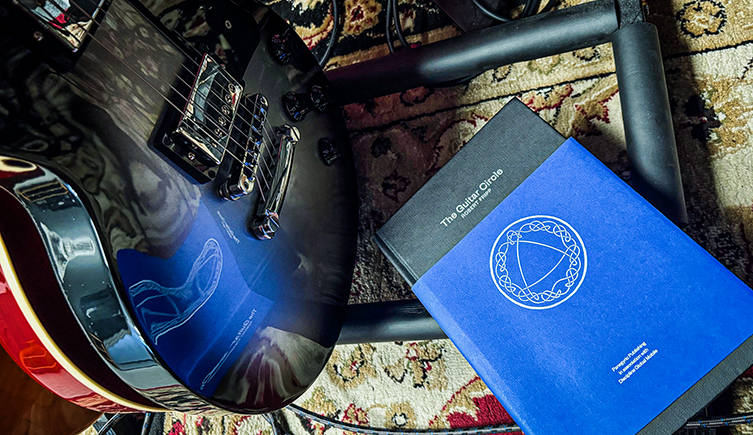
What’s useful to know is that it seems that you do not need to read the book sequentially from page one onwards. This book is not a linear narrative as I see it. It is laid out in such a way that you can certainly read it from first page to last if you want, but I also feel that it has a lot of potential as one that you’d repeatedly refer to, dipping in and out at various points.
You can absolutely crack it open at any given point and see what’s there for you.
You can read a collection of aphorisms at the end of the book, where they are collected alphabetically.
You can approach the book in the manner that seems right to you.
It IS about practice and it IS about Discipline, but the book doesn’t necessarily act as a didactic ‘How To’ manual in any particular way.
It’s also not a guide book about how to play the guitar like Robert Fripp, which I presume is the opposite of what Robert actually wants you to get from the work. Self-discovery is the key here, not mastery of another’s unique skillset, impressive as those skills may be.
So, The Guitar Circle isn’t a technical book filled with transcribed exercises or tabs. This book is about the space before the notes, the space in between the notes, and the space after the notes.
The Guitar Circle’s Core Principles
The Guitar Circle concept (first the philosophy, then the classes, now the book) is based on a set of core principles. I’ll briefly mention a little about each, as I understand them, since they compose the backbone of the book’s substance.
The Three Capacities of the Excellent Player
These are the jobs within playing music that Fripp believes are necessary to master and put into practice:
- To solo
- To accompany
- To be silent
Did you notice that none of that was directly about technique? Not to say that it isn’t important. Indeed, it is expected as part of one’s personal discipline. Fripp sees an equality between engaging your technical ability, your emotional responses and your intellectual self, so that a balanced and authentic expression is achieved. He refers to this as Head, Hand and Heart.
- Head - Intellect/Intention
- Hand - Ability, technique
- Heart - Emotion, empathy.
Four Pillars of Ethical Conduct
These salient points refer to one’s movements within the industry, and as a musician playing music.
- Honesty - basically being straightforward and transparent in your behaviour.
- Responsibility - realising that you are accountable for all of your own behaviours, and acting accordingly.
- Equity - acting in a fair manner throughout all dealings, from behavioural to musical to fiscal.
- Goodwill - this boils down to recognising a need for decency, and I also believe it works for a person’s musical attitude too.
Discipline
Discipline is a term strongly associated with Fripp, not least thanks to the KC album of the same name. However, Fripp sees the term as playing more of a supportive role in a person’s musical life.
Discipline comes to the surface when other angles such as motivation and energy seem unavailable to us.
Discipline is there as a device to get through the wall/barrier/block that may have appeared to face us.
Part of the idea of discipline here is to be able to hold a presence within the chaos of life: having an inner stillness that allows us to respond rather than react; to keep our own counsel, consciously. This of course extends into our everyday lives, quite outside the act of playing music.
That’s as brief a summary as I can put together without robbing the philosophy of its own meaning and agency. There’s far more depth available to those who seek it, of course. After all, the book is over 550 pages!
My Process
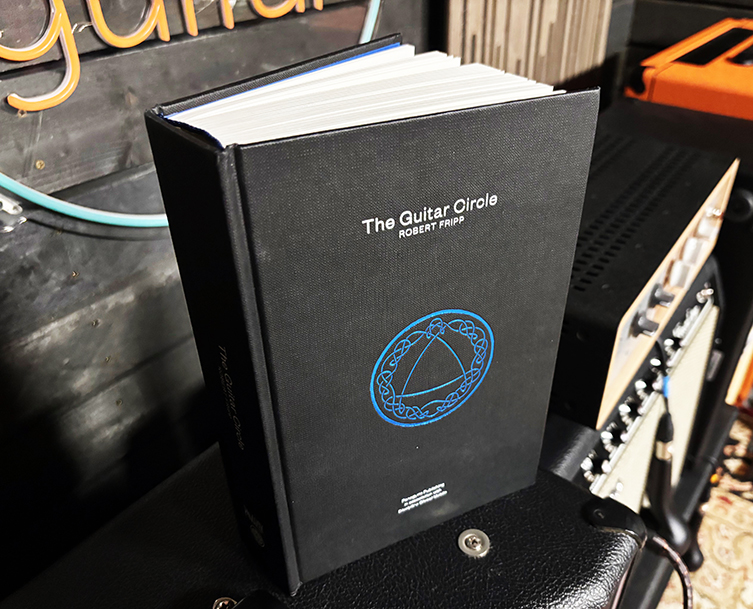
My approach through the book has been to open it and read what I find. It could be a page of aphorisms, or a diary entry. It could be a dialogue between Fripp and a Guitar Craft attendee/member. It could be a detailed description of the operation of the right hand and arm.
Ideas are expressed in a number of ways, but similar themes appear again and again, leading to a sort of circular re-emphasising of the central tenets discussed earlier. I have re-read several sections a number of times, and, depending on my own circumstances when I read, I seem to take the message on the page in different ways. That tells me that it’s me who is transforming, or at least seeing from a different perspective.
My Favourite Fripp Aphorisms
In this section, I’ve grabbed a selection of my favourite aphorisms from the book. I think the usefulness of these statements stand out quite apart from any particular context, and so I’ve put a number of them here for you to read and consider: to be enjoyed on quite their own terms.
“Discipline is not an end in itself, only a means to an end.”
“Any fool can change the world, but it takes a hero to make their bed and clean the toilet.”
“All that we properly have in life is the quality of our attention.”
“Like and dislike are cheap.”
“Music explains itself. We use words.”
“Never be afraid to let go of a good thing.”
“The greater the seeming imperfection, the greater the possible transformation.”
“Silence: Love that has not yet spoken.”
“A common aim is closer than blood.”
“Life is often desperate, but never hopeless.”
“Money gives us options. Better to judge a person on how they exercise their options; whether having money, or not.”
“Listening is how we eat music. Hearing is how we digest it.”
“Never react: respond.”
“A measure of the person: being in tune, in tone, and in time.”
“Make better mistakes.”
“Nothing worthwhile is achieved suddenly.”
“Loving is an intentional act.”
“Music creates the musician.”
“Music is a language through which we express our struggle to be human.”
“Q: Where does music come from?
A: Where was the world before it was made? Find that place and you will find Music.”
And perhaps my favourite aphorism of Fripp’s:
“In strange and uncertain times, such as we are living through, on occasion a reasonable person might despair. But Hope is unreasonable, and Love is greater even than this.”
What I’ve Taken With Me
So, at this point in the journey, what have I personally taken from Fripp’s teachings? I believe the main one is a recognition, in very real terms, of potential in every moment.
Potential for transformation, but also for surprise.
Potential in staying silent, and forming an inner response before settling on an opinion.
The potential that exists energetically in the moment itself.
The potential of those around us.
I suppose you could boil it down to simple ‘Mindfulness’, but that doesn’t speak to me the way Fripp’s aphorisms do. I can apply those aphorisms in any situation in my life: from how I approach a blank canvas as an artist, to how I enter into an improvisation with a fellow musician.
More pointedly, I’ve found the teachings helpful as a listener, not so much with recorded music but as a participant in conversations. I’ve found that the self discipline I’ve found has helped me to become a more eloquent and patient conversational partner, and one less invested in impressing others with my performance, if that makes sense.
In short, I don’t even know if I’m a better guitarist or musician from having taken this book on board. I’ve found that it actually isn’t the point at all. The Guitar Circle - as I’ve received the teachings at any rate - is a discipline, yes, but also an attitude. That attitude takes in co-operation, efficiency, equality, realising that everyone is unique and phenomenal, and that we all have a part to play in the “greater destiny of the community”.
These are lessons and teachings to sit with, digest, consider and hopefully process in a meaningful way. The outcomes may be subtle or huge, but if you read the book, I doubt you’ll remain unaffected by the end.
Crucially, your takeaways and outcomes may differ significantly from mine. That may be the best part of how this work manifests: as a sort of individual awakening within each of us; a realisation of the electrifying, living moment itself, and of us within that moment. How we then behave is what makes us ‘us’, and this book teaches us that we have a certain agency over that.
Do I take every word and accept it automatically? No, I’d say I do not, but I consider them all before arriving at a conclusion and that in itself is a fair demonstration of at least some of the book’s principle teachings, so the accumulated message is, I think, sinking in. The construction of an inner discipline - an “interior architecture” - seems to be underway thanks to simply deciding to give my full attention to the lessons, and by returning to those pages again and again.
I don’t see these teachings as lofty abstractions. It’s big ideas that translate into small changes. But small changes accumulate and reverberate. You and I practice music already as a way of life. Fripp’s Guitar Circle seems to acknowledge that, breathe some extra meaning into the moment, and demand that we are mindful of what is happening. At the end, we have the Discipline to fall back on when we need it, and that in itself is reason enough to engage with the practices.
Music is communication and conversation. I’ve found that this book has helped, challenged and suggested ways in which those essential forms can increase in a positive way. If this sounds useful to you, I encourage you to sit with the book and see how it works its message on you.
Head over to the official Robert Fripp website for more info on the book and associated aphorism cards. Also, click through to the official website of Guitar Craft. My deep thanks to Mr Fripp for allowing me to quote extensively from his book, The Guitar Circle.
If you choose to embark on it, I wish you a fulfilling and illuminating journey!