What is the most famous electric guitar shape in the world?
The Fender Stratocaster?
I’m not so sure…I feel like it could be the Gibson Flying V. Debuting a mere 4 years after the Strat, Gibson’s instantly iconic V has since become shorthand for ‘rock guitar’: it’s known across the world, and the vague outline drawn against even a stick man is enough to convey the point. The Flying V is simply as ‘electric guitar’ as it gets.
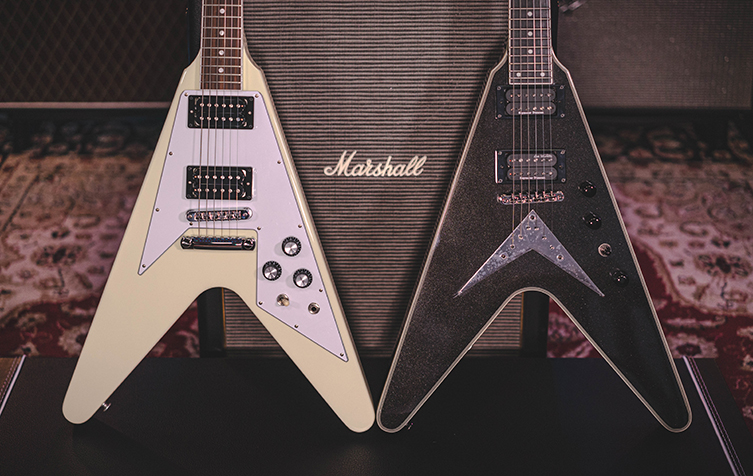
Today, I’m going to gather together some of the most famous Flying V players of all time, in one place. Now, there are of course all manner of V-shaped instruments from other manufacturers such as Jackson and ESP, so I’ll be clear and draw the line at the original Gibson Flying V. There’s more than enough legends who’ve sported those anyway!
Jimi Hendrix
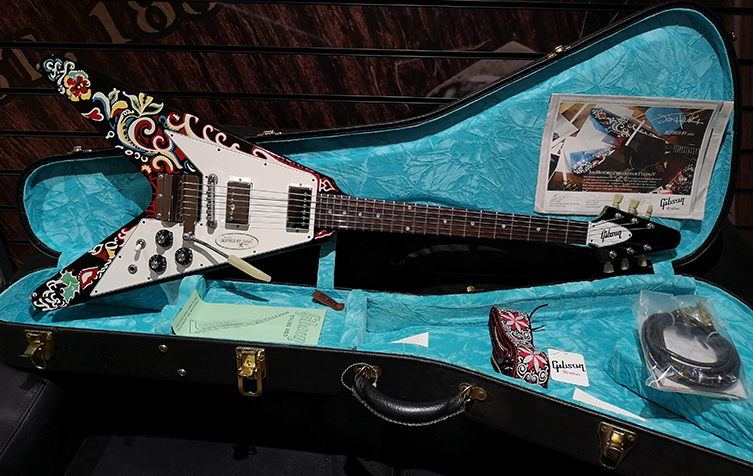
Okay, Jimi was most definitely a pioneer of the Stratocaster, but who could forget his incredible, hand-painted ‘Love Drops’ Flying V? Jimi applied the art to the top of the finish using nail varnish, and used the V on songs such as Red House. Both Gibson Custom and Epiphone have made impressive tribute instruments to this, so you can absolutely indulge your psychedelic side!
Albert King
Nobody has a ‘cut’ to their sound like Albert King! As one of the Three Kings of the Blues (alongside Freddie and B.B.), Albert King played a left-handed Flying V with total authority. His early V was a 1958 Korina right-handed example flipped upside down, before success brought him an array of custom Vees.
An instantly recognisable player with a singing voice that contrasts his sharp guitar tones with its ‘velvet bulldozer’ tone, Albert King was a true giant of the blues.
Lenny Kravitz
I don’t think anybody will disagree when I say that you can’t out-cool Lenny Kravitz. The epitome of rock star style and swagger, he’s like a mix of Hendrix and Prince, with a little bit of Sly Stone mixed in there too. Kravitz often performs all of the instruments on his songs himself (drums too) and is well known as a Flying V aficionado. In terms of gear, Kravitz is something of a minimalist, opting to fire his Gibson straight into a Fender Deluxe amp and stick everything on ten.
Michael Schenker
Every hard rocker’s Flying V hero is Michael Schenker. The teutonic axeman is of course known for his time in The Scorpions, UFO and the MSG, which stands for monosodium glutamate. I mean, the Michael Schenker Group! Michael’s famous Flying V is black and white, split in colour down the centre, with the opposite shades on the pickguard.
Andy Powell
Wishbone Ash seem to be one of those bands who were pretty big back in the day but don’t get as much love these days as they perhaps deserve. Albums like Argus are forgotten gems, and guitarist Andy Powell’s melodic and tasteful melody lines belie the fact that he’s a fiend for the Gibson Flying V! Although Powell now uses a custom Tatalias guitar, he made his mark with a ‘67 style Gibson Flying V.
Kirk Hammett
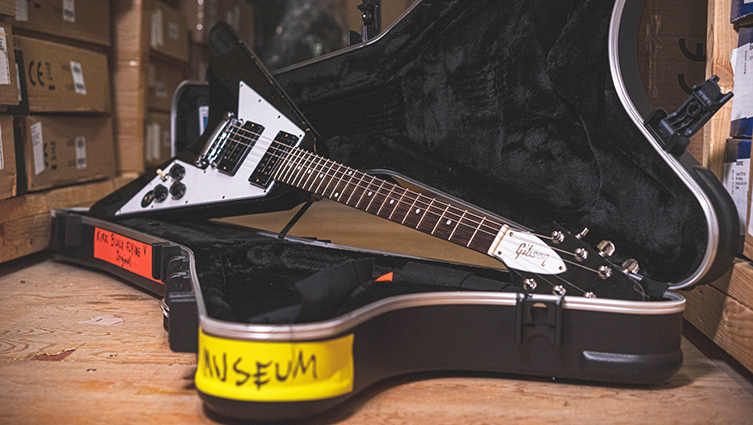
Now, James Hetfield’s famous white Flying V is of course NOT a real Gibson but an Electra copy, so he gets disqualified from this article! His guitar partner-in-crime, Kirk Hammett, though, sports a real deal Gibbo model often, so his place in this pantheon is secured!
Both Metallica players are highly associated with ESP, but both are also big Gibson players. Hammett owns Greeny of course, but since this is about Vees, let’s give a little love to his cool black and white 1979 Gibson Flying V that ended up being held together with black gaffer tape! Gibson recreated this with its proper T-type humbuckers, and Epiphone paid tribute with a cool purple one too.
Brent Hinds
The late Brent Hinds was an off-the-scale guitarist who also had his own sound and approach to the instrument. Mastodon had three lead singers (of which he was one) but only one lead guitarist, and Hinds’ epic playing will remain inspirational for generations to come.
Hinds loved an SG and he really loved a Flying V, championing Silverburst Customs mostly. Epiphone released a signature model many moons ago, and it’s well worth hunting down if you can find one in the wild.
K.K. Downing
Given that Judas Priest are one of the most revered heavy metal institutions ever, is it even fair of me to call K.K. Downing underrated?
I think so! The band are beloved, but K.K. rarely gets his dues, given how pyrotechnic and kinetic his lead work is. As with most top metal players, he’s been seen with a number of abstractly-shaped guitars, but in the early years of the Priest, it was almost always a 1964 Gibson Flying V.
Dave Davies
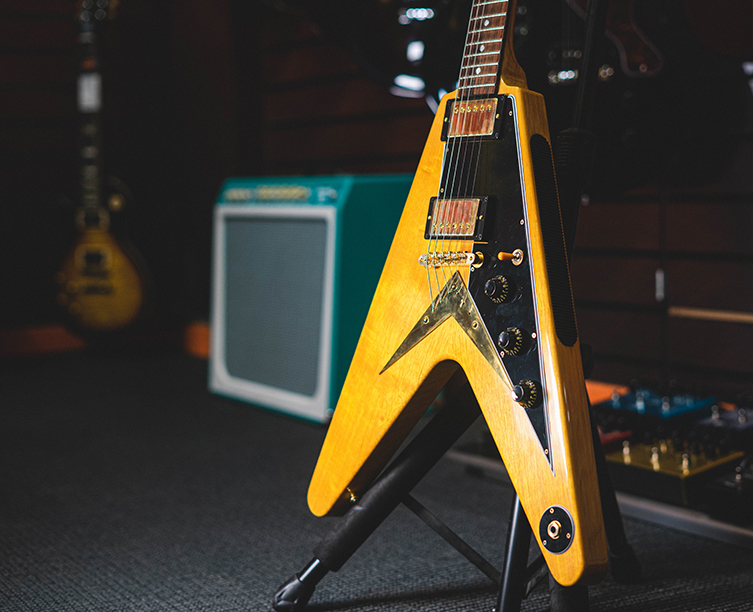
It’s not all denim ‘n’ leather with Flying V players, though. Even 60s poppers like The Kinks had their fun with the iconic arrow-shaped guitar. Guitarist Dave Davies was one of the first players to slash his amp’s speaker cone in order to get a rougher, more distorted tone, and he gets extra points for his commitment to the ‘58-style Korina Flying V, too.
Marc Bolan
The short-lived T-Rex mainman loved his Gibson Les Paul Standards so much that he actually wrote two songs about them. I don’t know if any tunes from his repertoire are dedicated to his Flying V, but he played it as much as those Les Pauls, and was a very public and glamorous posterboy for rock stardom in the 70s, so his influence is significant. After all, what’s more glam than a Flying V?
Underrated
Yes, you CAN sit down to play a Flying V. They also balance perfectly on the floor when you sit them down, they sound basically the same as a Gibson SG and you DO feel at least 20% more incredible and Valhalla-like when you have one strapped around your shoulder and slung low. The Gibson Flying V is just a ridiculously cool guitar, and if you can pull off the look, it’ll be a friend for life.
Despite being as ‘rock’ as it gets, you’ll have noticed today that it’s not just metalheads that love it. I mean, there are lots of metalheads in this article, but the Flying V - or any guitar for that matter - is what you make of it. It’s really all about you and your audience if you have one. Do they deserve to see you rocking a Flying V at your next show? I reckon they do.
Click to View our Gibson Flying V Guitars