Guitar fans, which types of guitar have you not yet experienced in your own playing life? What types of guitar have you looked at online, seen other people playing, thought about, but never quite pulled the trigger on?
I’m not talking about brands here. We’ve all got 6-string acoustic and electric guitars, and of those we all have our favourites. Many of us will have a nylon string classical or a bass, too. But what about the other types of guitar that exist? There’s a good few of them, and that’s what today’s blog is about. I want to talk to you about the instruments that you don’t even know you need yet! From extra strings to longer necks and all points in between, here are the essential colours currently missing from your musical palette.
Read on, and discover what you’ve been missing…
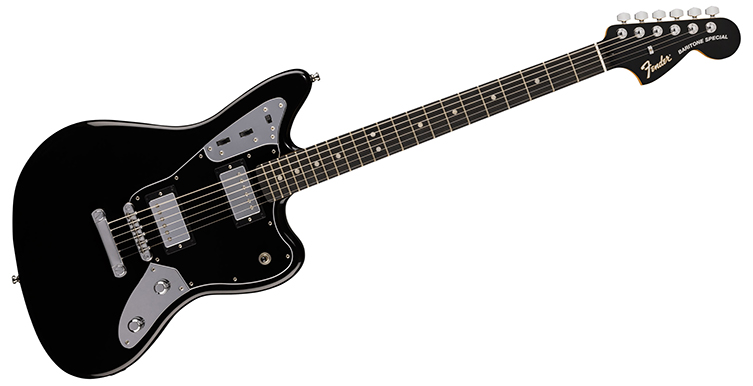
Baritone Guitar
From Duane Eddy to Twin Peaks to Sleep Token, there has always been an appetite amongst guitarists to go lower in pitch. Baritone guitars have a longer scale length (which varies from brand to brand but is often around 26.5”-27”) and utilise thicker strings to get a strong, twangy sound. Baritones are normally tuned from B to B, so significantly lower than a regular electric guitar.
Yes, baritones are tuned to the same bottom note as a typical 7-string guitar (more on those soon!) but they are pretty significantly different in my opinion. The combination of long neck and thick 12-68 strings (sometimes 13-27 gauge) means that you play a baritone completely differently from how you’d approach a normal guitar or a 7-string. Single note melodies, lots of twang and lots of space seem to be how most players react to a baritone. For riffs, they are pretty mighty: just ask Boris, Gojira and the rest. So yes, you can ‘do heavy’ with them for sure, but I feel like that’s only a small part of their appeal.
Layering up your music with a baritone guitar adds depth like you wouldn’t believe, and that goes for country and indie as much as for stoner doom metal. Sometimes they stand-out noticeably in a mix, and other times that blend just sits back in the atmosphere, but either way, remove it and you’ll experience a lack in the song!
Baritones are superbly useful, and very inspiring instruments.
Extended Range Guitars: 7 & 8 Strings
Have you experimented with a 7 string or 8 string guitar yet? They mostly seem to belong in the realm of heavy music, which makes a lot of obvious sense, but there’s more to them than that. Experimental and avant-garde musicians of any stylistic calling can take advantage of the extra notes on offer, without having to compromise with downtuning or using heavier string gauges.
It’s true that there is an adjustment period required for most players: the necks are naturally wider on these guitars, and your fingers will reach for chords that have moved a bit, but I can tell you from first-hand experience that a little perseverance goes a long way!
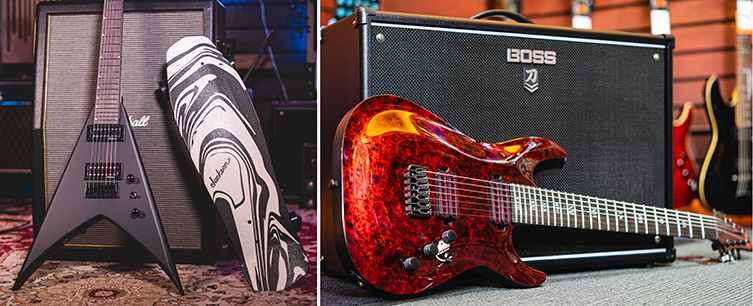
The best way to approach an extended range guitar is to use them as new idea creators, rather than trying to run through your usual favourite song covers on them. Approach them with your own agenda and you can extend any scale, open up new chord voicings, add extra drones to chordal and modal playing, and lots more. They are so much more than just ‘djent machines’, and nowadays you can get them at extremely affordable prices from top brands such as Jackson and Ibanez, so investigating this world has never been easier!
Multiscale Guitars
Multiscale guitars are a recent phenomenon in terms of mainstream guitar building, but the roots of the idea do go back a few decades. Multiscale guitars have two scale lengths, which is the length of playable string between the nut and the bridge.
Here’s a simple way for me to explain this: a Fender Strat - which of course is not a multiscale instrument - has a scale length of 25.5”, as do a great many other guitars. Every string on the guitar shares this same scale length, and it’s a matter of a ‘best-compromise’ ideal for having low strings that are tight enough, and high strings that are loose enough to bend. This is normal, basically.
With a multiscale, things are different. The highest string conforms to one scale length - and it’s usually 25.5” or thereabouts - whilst the lowest string has a longer scale length, perhaps an inch or more longer. The strings in between these two extremes lie somewhere between the two scale lengths. This is achieved by ‘fanning the frets’: they are no longer perpendicular to the strings themselves, but arranged in a specific fan-style formation which accounts for these two differing scale lengths.
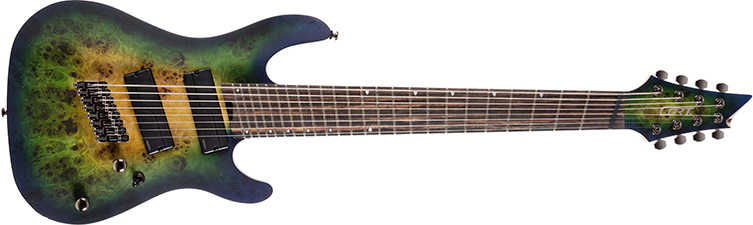
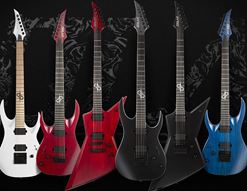
Fine, but why? Well, it’s all about string tension. Whilst multiscale guitars do exist as 6-string instruments (and you’ll find them made by Cort, Solar, ESP and others), you’re far more likely to see them as 7 or 8 string guitars, because they benefit the most. With these extended ranges, standard scale lengths feel too small for the low B and F# strings, and so can’t properly cope with the required tension. Long scales won’t feel great on the higher strings, plus that goes into the zone of baritones, which we now know to be a specifically different thing at all, with their own feel and approach.
So, by using a longer scale on the bottom strings, and graduating into a normal scale length for the top strings, you get to enjoy the ‘correct’ string tension (and intonation) for all of the strings, across the entire fingerboard. Each string has its own ideal tension.
When recording, you’ll be amazed at what a difference this can make for the tightness and tuning of your guitar parts. In practice, it doesn’t take long at all to get used to the fanned frets, and you may actually wonder why all guitars are not like this!
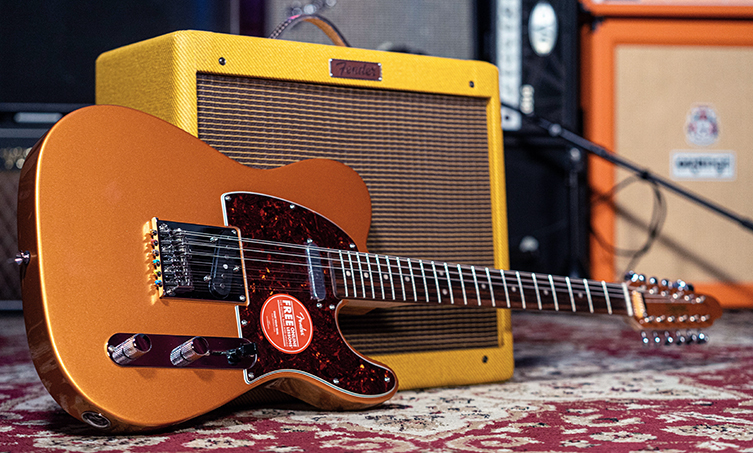
12-String Guitar
The sound of a 12-string guitar is something we probably all recognise from jangly pop songs of the 60s and 80s. It adds an unmistakable sheen to your songs, and is a beautiful sound to have access to in general. Producers love to add them into recordings for extra sparkle and texture, and they do make quite a magisterial sound when you hear them being strummed in person!
So why don’t more people use them? Well, some players have been put off by dodgy cheap 12-strings in the past - particularly acoustic 12-strings - and just never went back to them later in life. Others find their relatively stiff strings (there are twice as many, after all, so the tension is considerably more than a 6-string) to be a significant compromise to their regular playing style.
I get all of this, but feel like that is somewhat missing the point. 12-string guitars, be they acoustic or electric, are supposed to influence how you play. Your entire approach to the instrument does change, and I’d argue that this is precisely why you should have one in your arsenal.
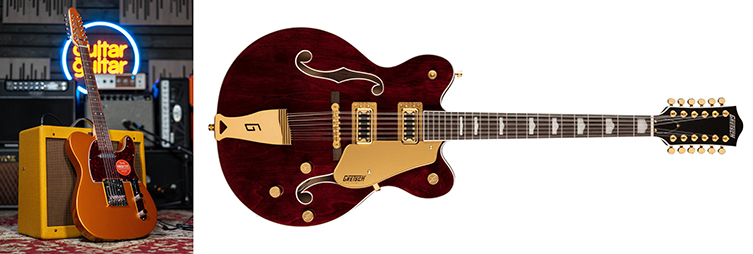
With a 12-string on your lap, you’re far less likely to noodle around with the same blues licks that automatically come out of your hands, because that bag of tricks simply doesn't work with a 12-string. Instead, the instrument obliges you to think in terms of chords and arpeggios, and that, if we’re being honest with ourselves, is where the songs come from.
A 12-string guitar can add a unique and lovely dimension to your recordings, for sure. But I think the real gold is in how it breaks so many lazy playing habits, and guides you towards the music.
Headless Guitars
Have you tried a headless guitar? They are divisive for sure. Some see them as a weird throwback to the 80s, along with skinny ties and pastel suit jackets with the sleeves rolled up. Others see them as the next natural step in the evolution of the electric guitar.
They are both, of course, but the headless guitars of 2026 as a quantum leap ahead of their 80s siblings.
For those who’ve yet to drive into this world, the benefits of the headless guitar are actually numerous. There’s obvious stuff, like how portable they are due to the smaller, lighter size: most headless guitars are likely to fit into an aircraft’s overhead compartment, for example. Ergonomics is another thing: brands like Strandberg have really championed the idea of building the instrument around player comfort, particularly during long playing sessions. This can be seen in the overall balance and weight distribution of the guitar, and of course other innovations like the patented Endurneck, which is definitely not something you see on every guitar!
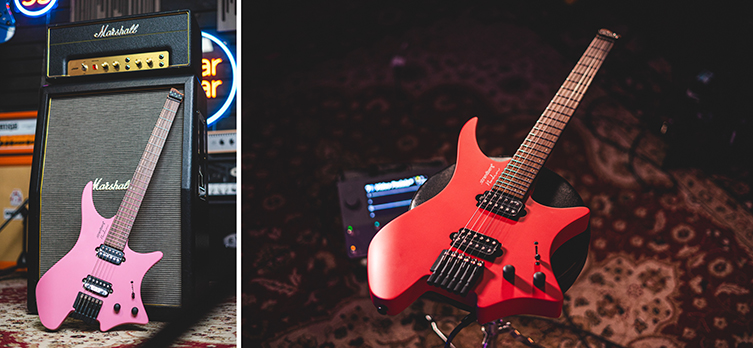
Finally, there’s the precision aspect. Removing the headstock allows the designer to have more scope around how the string’s break angle is achieved, which then has an effect on the instrument’s intonation. That’s one element, but there’s also the notion of multiscales (see above!), which are not exclusive to headless guitars by any means, but still show up on many.
Hardware for headless guitars is often developed in tandem with the guitar itself, since it can’t make use of typical bridges and tuning machineheads. So, a large degree of fresh ideas are poured into any given headless guitar in a way that just won’t occur with, say, a boutique brand who build S and T-types. This makes them endlessly futuristic, and it also means there’s a constant level of refinement going on, which translates as ever-better guitars for you and I.
If you want cutting edge guitar design, and an instrument that simply didn’t exist 40 years ago, then today’s headless guitars are where you need to be looking.
Evertune
Have you seen Evertune bridges yet? Those metal squares that take the place of a traditional bridge on certain contemporary guitars? They’ve been around for a while so I’d hardly call them ‘new technology’, but they are still a fairly niche consideration for most of us. You see them on custom guitars and also lots of production models from brands like Ibanez and ESP.
So, what does it do? And why should you want a guitar with an Evertune?
The Evertune is a mechanical device that uses springs and the tension from guitar strings to keep your guitar perfectly in tune, no matter the circumstances. There’s no mad robot tech in here, or dodgy autotune sampling. It’s all done with physics and engineering, with each string having its own spring and lever that supplies a sort of ‘negative pull’ to your guitar string so that the pitch is fully locked in place.
And it works. It does! It’s something of a mission to get it fully set up, if I’m being honest with you, but once it’s done, that’s it. You are good to go, and no amount of drops, heatwaves, temper tantrums or misplaced limbs striking the tuning keys will do anything to your tuning. The constant tension involved means that where you set the strings up is where they will remain.
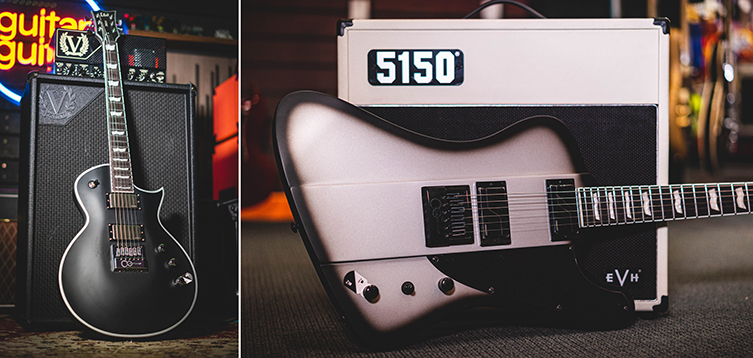
If you want to never go out of tune - and why wouldn’t you want that? - then this is the device you need to become acquainted with. I feel like the best way to get onboard with the Evertune is to use a guitar that has one already installed, rather than buy the bridge on its own and retro fit it to one of your guitars. Click the guitars in the carousel below to check them out, because they all have Evertune bridges and they all come recommended by me!
The Guitars You Didn’t Know You Needed
There is so much to the world of electric guitars that extends before the familiar boundaries of the Les Paul, the Tele and the Strat. I decided not to approach guitar synthesis on this occasion, because I feel that it is perhaps more about the extra hardware than the guitar itself, but it’s another valid and deep ocean to dive into.
What the guitar has always represented to me is potential. Possibility. I love Les Pauls and Strats as much as you, don’t get me wrong, but there is a vast and varied vista out there for musicians who want to look that far. Why not try some of the instruments I’ve discussed with you today, not as replacements for the guitars you already love, but precisely because they aren’t those old familiar pals. It’s time to make some new friends! Good luck and enjoy!