Heavy metal, and its adjacent genres, are in many ways the very lifeblood of guitar music. No other genre relies so heavily on layers of guitars, and no other genre is as demanding on the instrument. It’s a rare guitarist who doesn’t get along with at least a few heavier bands, especially given how numerous they are, not to mention diverse.
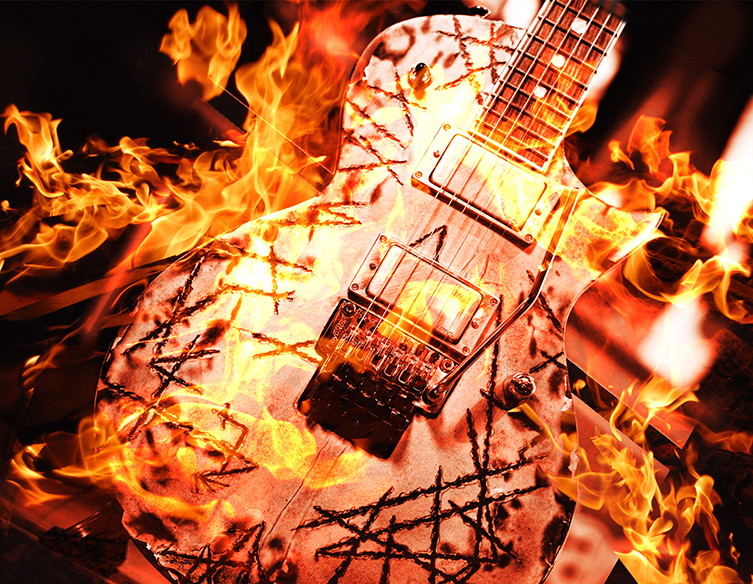
From bands who look to the hard rock of the 1970s for their cues, to those who have composed symphonic nightmarish epics, the world of metal is a varied and colourful one. Today, we pick out the 15 metal bands whom we feel are the biggest, best and most influential of all time. How many do you agree with?
Contents
Black Sabbath
Where would heavy music be without Black Sabbath? Ozzy’s mad crew of dark lords are one of the most influential bands in existence, and in heavy music circles, perhaps the most significant band of them all. Black Sabbath were the first band to slow down the riffs, detune the guitars and pointedly sing about dark, occult themes.
At the time, Sabbath seemed like a genuinely dangerous, otherworldly proposition, with their crucifixes, doomy sonics and intense vocals. This was in the days before reality TV shows made Ozzy a household name and simultaneously reduced the mythmaking, of course! Paranoid, their biggest hit, is about the 23rd best Black Sabbath song at best, so if that’s all you know, you’re in for a treat.
Iron Maiden
A band so iconic sounding that other bands don’t even bother trying to rip them off, Iron Maiden are an entire microcosmic universe of metal. From their iconic artwork inwards, Bruce Dickinson and the boys embody a rich world of anthemic metal that’s chock full of mythology, history, horror and galloping riffs; a world that is as intense and appealing now as it was in the early 80s.
Iron Maiden are one of those bands who just flat-out own their sound. Even their smallest songs dwarf the biggest tunes of their competitors, as you’d expect from a lineup that includes three full-on lead guitarists and a vocalist who is frequently referred to as the ‘human air raid siren’. Do a lot of their songs sound the same? Sure, but the point is, nobody else sounds like them.
Staying on top for over 40 years is a supremely difficult task to face, but Iron Maiden make it look easy, all whilst leaping around massive stages filled with sets, monsters and pyro. Looking for a jumping in point as a listener? We’d recommend either Powerslave, which features the frankly hair-raising Aces High, or Seventh Son of a Seventh Son, a dark concept album with more hooks than a fishing boat. Legendary.
Metallica
Metallica are the biggest metal band on the planet. The reason for this is because they are also one of the very best. They have the anthems, they have the anger and, musically, they almost re-wrote how bands could approach heaviness, with an angular, European sensibility of chromaticism and note choice. Who can outclass James Hetfield for riff writing and timing? Nobody, frankly. Metallica’s songs have melodies, they have mosh moments, and they have deeply satisfying grooves, something that is intrinsic to the genre but rarely commented upon.
Metallica’s first 5 albums are rightfully held up as an unstoppable body of work, and even though their latter period output has been hit-or-miss, they’ve never taken an easy route, preferring to explore collaborations (Lulu with Lou Reed), symphony orchestras (S&M I and II) and genre experiments in Alternative and Contemporary Metal (Load and St Anger respectively).
But yeah, those first five albums are kinda still what it’s all about.
Slayer
In the 80s, the music media put together the term ‘Big Four’ for thrash metal’s biggest and most hard-hitting bands, in order to somewhat take ownership of a scene that was already doing its thing without the requirement of a neat label. Anyway, the Big Four were Metallica, Megadeth, Anthrax and these guys, who were perhaps the most notorious of all.
Now, it has been a hot minute since the late 80s, but some people are still unsure when it comes to Slayer. Their art and song/album titles were strongly satanic, which, in the middle of the 1980s 'Satanic Panic’ was either pretty subversive or just flat-out baiting. Also, there were references to Nazis in both song content (Angel of Death is about Josef Mengele) and in guitarist Jeff Hanneman’s attire & guitar decorations. This is despite lead singer, lyricist and bassist Tom Araya being a liberal Christian.
As you can see, Slayer pushed a lot of buttons, but at heart, a lot of those decisions were seemingly more about theatricality and shock value than any particular agenda. To a degree, it seems that they were messing around. Musically, however, they were a ferocious proposition, with a far rawer and wilder sound than the other members of the Big Four. Slayer fans are famously passionate about their favourite band, and the back catalogue is as impressive as it is nihilistic and intense.
Pantera
As the late 80s became the 90s, a pessimism and internal angst took over heavy guitar music. Grunge was becoming a thing of course, but even in metal, things were becoming less about devils & goblins, and more about depression, anxiety and social issues.
Pantera obviously felt this, because they undertook one of metal’s most famous rebranding exercises ever. Out was the glam metal of their (often hushed and denied) early records; out was the name ‘Diamond’ Darrell and in was ‘Dimebag’ Darrell, whose band dropped their glam affectations and went straight for the audience’s collective jugular.
Pantera are, like Metallica, one of those bands who caused a watershed in the genre at large. Just as you can tell the bands who were influenced by Deep Purple and Led Zep by their riffing style, so is the case with metal fans who grew up on Metallica and Pantera before starting their own bands. The sound is just from a different playbook altogether.
Pantera brought a heavy groove and sense of southern American culture to their brutal and confrontational music. And in Dimebag Darrell, they had one of the most original and inspiring guitarists of any generation.
Rammstein
Rammstein must be the ultimate ‘don’t go onstage after them’ band. Berlin’s finest have certainly done things their way, over a career that has seen their enormous sounding music becoming some of the most popular that metal has ever witnessed, without ever showing signs of pandering to a quote-unquote ‘Western audience’.
It’s not exactly obvious radio-friendly fare, either, is it? Blending Ministry’s best riffs with Depeche Mode’s best keyboards, covering those with an operatic sense of drama and adding a show-stopping German baritone voice, Rammstein created a sound that was fresh, original and distinctly European. Not only that, it was an extremely accessible sound - no matter how gargantuanly heavy it could become - perhaps due to the deliberately repetitive, techno-like rhythms and an uncluttered, highly focused sound.
On top of that, you have subject matter that is…subversive, to say the least (non German speakers may miss a lot of the context of Rammstein’s music and that may very well be for the best…), and riffs that come at you like literal jackhammers. Their name does translate to ‘battering ram’ after all!
Almost thirty years later, Rammstein may not sound quite as dangerous as in the early days, but they still bring their A-game to enormous stadium shows complete with pyro, projectiles and flame throwers. And that’s just in the first tune!
Mayhem
Mayhem are here more for historical and cultural reasons than pure popularity or songsmithery. They typified, in many ways, the distinctly frosty flavour of metal from Scandinavia known as Black Metal. Scratchy yet grandiose sounds, intensely dark vibes and lyrics that - as per usual - focused on the usual satanic tropes all helped give Nordic Black Metal its signature sound. The uniform of denim, leather, studs and ‘corpse paint’ is now something that’s instantly recognisable throughout the world, too.
None of this was invented by Mayhem, but when their founding member Euronymous was brutally murdered by fellow musician Count Grishnak in the early 90s, the scene became world famous. This was after another musician in the scene (nicknamed ‘Dead’, grimly) had already committed suicide with a shotgun. This was also after numerous reports had made their way around the world about churches in Norway being literally burnt to the ground by these bands, supposedly in an act of allegiance to the devil.
You couldn’t make it up, frankly, and there was a soundtrack to all of this too, courtesy of Mayhem and other Black Metal bands like Burzum, Dark Throne and Bathory. The scene was very closed off and critical of any fans who weren’t deemed ‘Trve Metal’ enough, which is something that some metal scenes have continued with. That said, for a piece of cultural history, Mayhem’s output is a potent document of the sounds, art and attitudes of some very unusual and uncompromising young people.
Meshuggah
Meshuggah are one of those bands who inspire almost religious fanaticism in their most ardent fans. The Swedish metal pioneers were so far ahead of the game in the mid 90s (when they’d already had numerous records out) that the world collectively took about a decade to catch up.
Meshuggah’s music is almost a sonic equivalent of HR Giger’s artwork: dark, hostile, uncompromising and unfathomably alien, but also technically astounding, inventive, game-changing and definitive. It’s hard to describe Meshuggah to those who haven’t heard them, and it’s equally hard to overestimate how influential they have been - and continue to be - on forward thinking music, metal or otherwise. When everyone started playing 7 string guitars, Meshuggah were already onto 8 strings. Guitarists still have to begin practice regimes to build up their speed and precision in order to tackle a song like Bleed, whilst drummers who listen to the same song simply shake their heads in denial and walk away.
Importantly, for the band themselves, it’s always just been about expressing themselves and creating the sounds they want. It’s not about technical ability at all: it’s simply the fact that you have to be technically exceptional in order to play these quite extraordinary pieces of music.
Korn
Talking of 7 string guitars, California’s Korn probably got more of these sold around the late 90s than at any time since. So new was their sound, so unique was the application of sonics and pitch, that the guitar world instantly took full notice. Korn were heavy, sure, but it was a different kind of heavy altogether: a low, sludgy, scrappy sound more akin to something from a serial killer movie than from an American metal band.
And the riffs! From the moment Blind kicked into its low groove, you knew you were hearing something that nobody else was doing. Of course, six months later, everyone else was following suit, but Korn had made their mark on history. Detuned 7 strings, played along to almost hip-hop rhythms, with a decidedly non-standard approach to note choice, was their raison d’ettre, and they've ploughed that singular field to great effect ever since. Yes, they inadvertently invented Nu Metal, but that wasn’t their fault!
Machine Head
Rob Flynn’s crew have been keeping the metal flag flying high ever since 1994’s superlative Burn My Eyes record put them firmly into the metal firmament. Blending a traditional metal approach and aesthetic but including contemporary influences (sometimes too many, but we’ll ignore the regrettable rap metal phase) into their ever evolving sound, Machine Head are a metal band for Trve Believers and mosh-happy party goers alike. There’s depth if you want it, but there’s also a treasure trove of riffage and righteous anger there too, perfect to rouse the rabble. Machinehead are almost like a ‘best of metal’ all gathered together in one original band.
Behemoth
Blackened Death Metal is what Nergal calls his band’s music, and who are we to argue? Taking a cue from what was happening over in Norway and adding their own Polish energy and darkness, Behemoth have, for the last decade at least, been the gold standard for acceptably unacceptable extreme metal.
Nergal (real name Adam Darski) is a legitimate Satanist and has been involved in many battles with Polish authorities - both religious and governmental - over freedom of speech. His band are a difficult one to ignore, and it’s not just due to the blasting, molten fury that erupts from them, either: Nergal has proven himself an intelligent, astute and capable leader, too. A man with a message, and a controversial one at that! We’ve chatted to him twice, so click through to the second Behemoth Interview to catch some great insights from the man himself.
Opeth
Sweden’s Opeth started out as a hard-hitting Death metal band at the tail end of the 80s. Their career has been a very interesting one, as they’ve twisted, turned and leapt through their fanbase’s expectations to land in a place that’s still defiantly ‘metal’ but is also quite classically ‘prog’, too.
Opeth are known for their darkly beautiful sonic vistas, their propulsively dynamic music and an atmosphere that’s grand and yet unremittingly sombre. Great players one and all, Opeth are proof that technical ability and great songwriting aren’t mutually exclusive terms. For more, read our exclusive interview with Opeth.
Slipknot
It all seemed like a big joke at the time: 9 anonymous musicians with matching boiler suits and horror masks, playing brutal metal. How very arch. They even had a guy with a clown mask banging on some garbage cans, as if that was meant to impress us.
The thing was, nobody counted on their tunes being excellent, nor did anyone expect the sheer longevity of Slipknot to be a thing worth considering. Arriving slap-bang in the middle of Nu Metal, Slipknot instantly sounded like something darker, more intense, more bruised and - unbelievably - something with integrity.
We didn’t see that coming. Since then, the nine members have become anything but anonymous, but the masks remain, as does a commitment to playing supersonically heavy metal music with enough hooks to please Hellraiser. Corey, Jim, Mick and the rest have, in a rather unlikely manner, become one of the biggest metal bands on the planet. Limp who?
Arch Enemy
Melodic death metal (which means they have choruses you can sing along with, basically) from Sweden, Arch Enemy actually have quite a pedigree. Founding member Michael Amott was previously in pioneering extreme metal band Carcass, and both he and original vocalist Johan Liiva were previously in Carnage. Other band members have previously been in Mercyful Fate, Nevermore and a host of other significant ‘scene’ bands. Arch Enemy, therefore, is like a fine blended whisky with a taste that’s been worked on for decades to create just the right effect.
Arch Enemy are one of those bands who have quietly become massive just by doing their thing (there’s nothing quiet about their music, let’s be clear) and to their fans, they are full-on superstars.
Ghost
Metal, as we've seen already, likes a good bit of theatre. Slipknot’s masks, Iron Maiden’s monster mascot, Mayhem’s well…mayhem: of all the musical genres out there, metal is the place where you really can’t be too over-the-top.
That’s a good thing for Ghost since they are simultaneously the most fun and most preposterous act currently selling out arenas. The brainchild of songwriter Tobias Forge, Ghost are a mostly anonymous group of ‘Ghouls’ who provide a backing band to Cardinal Copia, or Father Emeritus, or whichever alias Forge has chosen to match his elaborate costumes and prosthetics.
Looking at Ghost’s excellent visual aesthetic, you’d expect them to sound like Behemoth at least, so it’s a surprise to many when they start playing and they are almost more like a heavy Abba! But hey, Abba hardly ever brought us anything less than greatness, and Ghost do bring the heavy, albeit in a manageable and mostly classic way. Still, there’s no arguing with amazing songs, and Ghost have plenty.
Anthrax
Did you see Anthrax’s set at the Black Sabbath Back to the Beginning show? They killed it! Anthrax were always one of the Big Four thrash bands, so expectations were understandably high, but that performance really reminded the world of what a vital proposition they remain.
The lineup has changed over the years, but the commitment to melodic metal - and the power of The Riff - has been a constant. And let me be frank: Scott Ian is one of metal’s most valuable and underrated players.
Turnstile
Current flavour of the month post-hardcore metallers Turnstile have actually been a big deal for ages now. Arguments prevail about whether the Baltimore five piece are metal, rock or alternative (they started out as a hardcore punk band, actually) but what’s not in doubt is their significance. Since 2021’s Glow On record, they’ve ridden a tsunami of success that has seen them become festival headliners.
They’ve also released their own Converse shoes, so there’s no stopping them now!
Megadeth
Where would metal be without Megadeth? Dave Mustaine’s four-decade-long response to being kicked out of Metallica is actually one of the strongest back catalogues in metal, with melodic songwriting blending in with the pioneering thrash. Mustaine himself is a powerful, unique player, but nobody in the Megadeth camp could hold a candle to 90s guitarist Marty Friedman, who is easily one of the most original and exotic voices on the electric guitar.
Megadeth have just released their final ever album, so make sure you see them when their years-long last tour passes your city!
Sepultura
Iconic Brazilian thrash with generous helpings of doom and one of the best drummers in the genre. That’s how I’d sum up the enormously influential Sepultura, whose best years were certainly those with Max Cavalera on vocals and riff writing duty. Records such as Chaos A.D. and Roots not only sound fresh today, but are more thematically relevant than ever.
Sepultura have called it a day, but Max and brother Iggor (the aforementioned drummer) continue playing the catalogue as Cavalera.
Mastodon
Atlanta' s best ever metal band sadly lost founding member and massive talent Brent Hinds last year. One third of their vocal assault as well as lead guitarist, Hinds was a wild one-off of a man, and he’ll be massively missed.
Thankfully for fans of the band, he has left behind a stupidly good body of work that rewards careful repeat listens. Labyrinthine, oblique, visionary and of course rocking ridiculously hard, Mastodon have easily earned their place at the top table.
Prog-metal concept albums about Moby Dick? And Rasputin? Of course, yes!
Testament
Guitar fans are always going to revere Testament, thanks to the next-level playing of Alex Skolnick. Coming through in the Bay area’s late 80s ‘second wave of thrash’ scene, Testament have always been ‘nearly giants’ who never quite ascended to Metallica levels of fame, but they are still a touchstone for those who appreciate expertly crafted metal with talent and technique to spare.
Orbit Culture
If your head doesn’t mosh itself off your shoulders 37 seconds into the song The Tales of War, then you, my friend, are not a metalhead.
Orbit Culture have been around long enough to have a few albums out, but they are still something of a breakthrough act. Something tells me that they won’t be on early afternoon festival slots for much longer, on the strength of the current output. It’s massive, monstrous metal that’s old-school in character but modern in production. It’s big, evil and immensely satisfying.
Gojira
France’s Gojira are having their moment now, after years and years of working up through the ranks. It’s actually slightly preposterous that it took so long for their brand of epic eco-metal to find the large audience it deserves, but they’re now firmly a household name for rockers.
Yes, they played on the side of a building at the Paris Olympics.
Yes, they have songs about Flying Whales. Yes, they are immensely satisfying to listen to, and no, we can’t play drums like that either.
Deftones
For over 30 years, the Deftones have been meshing 80s post-punk influences like Joy Division and The Cure with breeze blocks of 7 and 8 string cyber metal. The result has always been exciting and effective, and now a new generation have embraced the band and elevated them to arena status.
Deftones tow that difficult line between moving ahead and staying the same, inching into new musical territories but always bringing gigantic dollops of metal to the recipe. Instantly recognisable, their sound is now rightly acknowledged as iconic.
Tool
Mercurial metallers Tool sit at the point where hard rock, metal and 70s-style prog intersect. Tool combine all of that and also inject their own brand of claustrophobic metaphysics into the mix, resulting in a sound that is highly influential and often copied.
The band take their time to release music, with only 5 full album releases in over 35 years, but each release is a landmark event in the metal music calendar. Guitar fans love Adam Jones’ super-chewy tone, bassists love how Justin Chancellor is more of a ‘lead’ player than Jones, and everyone agrees that Danny Carey must be some sort of 8-armed alien to be able to pull off such legendary drum performances.
Lamb of God
Lamb of God are one of the pioneers of the New Wave of American Heavy Metal that arose around the turn of the century. On the go since 1994 - and previously known as Burn the Priest - Richmond VA natives Lamb of God blend thrash riffs with breakdowns and classic metal moments to create an exciting sound that celebrates most corners of heavy music. Records like Wrath and Sacrament are genre classics, and guitarist Mark Morton now has a brand new signature Gibson Les Paul model, so check it out if you’re a fan!
Limp Bizkit
Are Limp Bizkit metal? Yeah, of course they are! Some Trve Metal gatekeepers will still turn their noses up at Durst and co, but for those who are open to it, there’s a lot of fun to be had!
Not least Wes Borland’s endlessly creative spirit which manifests itself in his whammy bar riffs, effected breakdowns and fantastically ‘out there’ appearance.
In the late 90s, they defined the mainstream rock and metal scene so much that they quickly became a parody/joke, but now, 25 years later as they continue filling arenas, the joke’s on the haters. Keep on rollin’, baby!
White Zombie
White Zombie deserve to be remembered for the gargantuan - and deeply influential - sound they made up to and including 1995’s Astro Creep 2000 album. Their riffs were like galvanised rockets, blasting off in between party-rhythms and whacked-out horror movie raps from Rob Zombie. If Nu Metal were a little bit more Black Sabbath, then White Zombie would rightly be seen as the genre forebears.
As it is, the sound became progressively safer and more sanitised when Rob went solo, but all you have to do is stick on the early stuff to understand why they were so enormous in the US Midwest of the 90s.
Strapping Young Lad
About as heavy as it’s possible to be whilst still including (mostly) melodic vocals, Canada’s Strapping Young Lad were an unstoppable force of aimed aggression. We know that nothing on earth can defeat frontman Devin Townsend’s vocals, but when you add those to his most ferocious ever guitar playing, and then mix in Gene Hoglan’s apocalyptic drums, then you have a band who basically redefine the term ‘heavy’.
Some of SYL’s music is like concentrated chaos, the type of music that only superb musicians can even contemplate attacking, far less blasting every night of a tour. We’ve still got Dev’s incredible solo career to enjoy, but yeah: everybody misses Strapping Young Lad!
Dillinger Escape Plan
Were Dillinger Escape Plan one of the greatest live bands ever? They were a hugely intense proposition, combustible and unpredictable, but always keeping an enviable edge of finesse to their manic madness.
The same applies to their recorded work, which could conceivably be described as being ‘jazz-adjacent’, if only the term didn’t so completely fail to take in how hard they rocked. Math rock can be a lot of things to a lot of people, but I expect everyone would agree that Miss Machine and Calculating Infinity are benchmarks of the genre.
Endless Metal
Metal is an elemental genre: as infinite as the sky and endless as the tides. As long as there are guitars, there will be true warriors of the faith ready and able to unleash triumphant riffs and planet-smashing solos. These above choices are by no means the beginning and end of ‘good metal’, since that’s an impossible notion to even consider. Think of today’s list as a salute to the titans of the metal world.
Who knows? In the future, you could be joining the ranks of metal titans here!