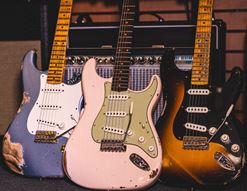
Do you love the guitars of the 1980s? That semi-mythical era of spandex, neon and Aquanet hairspray? For those who don’t remember it firsthand, it sometimes feels like a made-up time that never existed. Everything was larger-than-life, fun and loud, with an emphasis on partying. MTV had kicked off, Sunset Strip was where it was all happening, and there was no time for misery.
If your favourite band wasn’t Motley Crue or Warrant, it was Ratt, Bon Jovi, Def Leppard or Poison. Inside your guitar case you kept spare strings and picks alongside eyeliner and foundation. Cowboy boots were what you wore - with spurs - even though you’d never been anywhere near a horse in your life.
The 80s sounded pretty awesome. That flamboyant attitude carried across to the guitars, of course, and whilst fashions come and go, the loud guitars of the 80s weren’t away for too long. After grunge killed off the hair metal scene, there was maybe a decade where the dayglo, graphic-printed Superstrats of the 80s felt very out of date.
And then…
They came back and never went away! We live in a sort of post-genre world now, or at least one in which there’s room for everything to exist. That leads me to today’s blog. I’m looking at reissue guitars from different decades, and there are few decades that are as strongly present for the guitar community than the 80s! So this blog will focus on that.
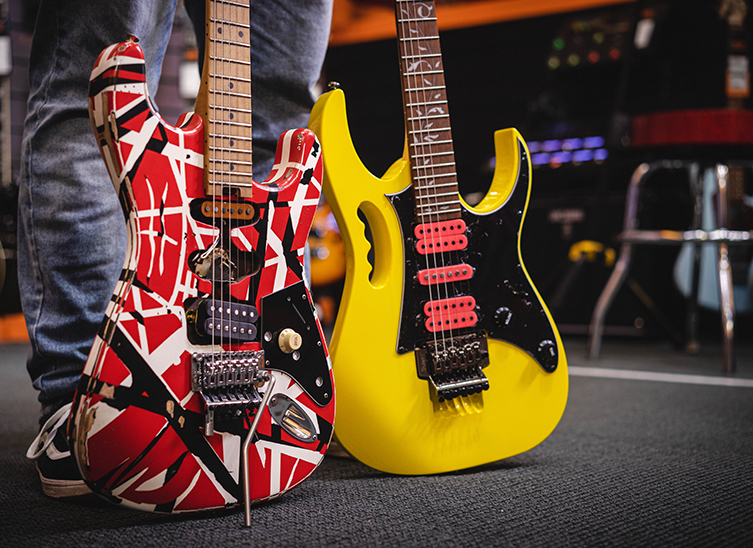
I’ll check out what NEW guitars exist on the market today that either directly recreate those seminal 80s vibes, or at least display the decade’s tropes of a speed neck, a locking whammy and a set of super-hot pickups. The 80s are alive, and they live at guitarguitar! This will be a mix of brands and artists, so you’re sure to find plenty of hard-rockin’ inspiration here!
What are you waiting for? Rummage through your sock drawer for that bandana headband, and dig out your spandex, because we are heading back to the 80s!
Charvel
I won’t try to be too chronological with today’s brands, but it feels right to begin with Charvel. Nowadays they are owned by Fender (a name that will crop up quite a lot here) but back in the late 70s, Charvel were the first brand to modify existing guitars with hotter pickups, the first brand to offer full instruments made up from custom parts, and basically the first boutique shop who sold parts.
Wayne Charvel started it all in California, and without his pioneering vision, I don’t think the scene would’ve developed in the same way. Charvel put humbuckers into Strats; they refretted with jumbo frets and they planed back necks to make them skinny. When Floyd Rose tremolos came around, they were amongst the first to fit them to their guitars. In short, they invented the Superstrat.
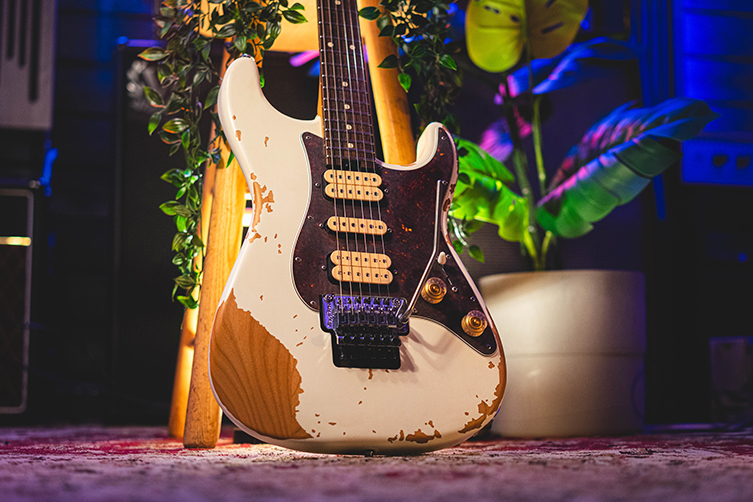
Today’s Charvel models are quite evenly split between beautiful retro guitars and modern redrawn takes on those with fresh body shapes and perhaps less overtly ‘80s shred’ specs. When shopping for Charvel guitars, the key is that ‘San Dimas’ and ‘SoCal’ refer to specs, not models. A San Dimas, for example, has no pickguard and (usually) a set of Seymour Duncan pickups. This means that a Charvel San Dimas can be Strat-shaped or Tele-shaped. DK24 models are the less overtly 'Sunset Strip' in style, but inmany ways are still very 80s-influenced.
Motley Crue
Rock’s 80s bad boys were almost better known for their backstage behaviour then their songs, but they still had a few bangers! The Crue are a deliberately sleazy, good-time pop metal band who are still touring today with wonder-guitarist John 5 stepping in for Mick Mars.
Whilst John holds it all down with his trademark Teles, Mick Mars was a superstrat guy through and through. Latter periods saw him using Fender Custom Shop Strats, which were contemporary takes on his prized ‘Isabella’, a significantly modified mid-60s Strat with H-S-H pickups and a Floyd Rose trem.
Eddie Van Halen & EVH Striped Guitars
As much as Wayne Charvel and co were the original builders of Superstrats, one guy did more to put them on the map than anybody else. You already know it’s Eddie Van Halen, and whilst his band wasn’t specifically thought of as ‘hair metal’ (they predated all of that happening), his influence ran right through the decade, on literally every lead guitarist who emerged.

That gigantic influence wasn’t just about his playing, either. His constant DIY-tinkering of his gear resulted in a huge fashion trend for single pickup Superstrats and modified Marshall heads. Everybody wanted his sound, and everybody wanted to chase the gear he played in order to get it. His ‘Frankenstein’ partscaster is about as iconic as electric guitars get, and it set the tone for the 80s: hot sounding Strat-types with wild finishes and divebomb-friendly wiggle sticks.
Today, you can buy a range of excellent replicas from the EVH brand. EVH are another Fender sub-brand, and are looking after the Van Halen legacy since Eddie’s passing. Check out their Striped Series guitars, where you can buy box-fresh recreations of Frankie, plus the Bumblebee (black & yellow) and black & white striped guitars, the latter of which is historically the same guitar as the famous red, black and white Frankenstein. You can also get an authentically pre-bashed version of Frankie, which comes complete with a fake neck pickup and broken pickguard, just like the original!
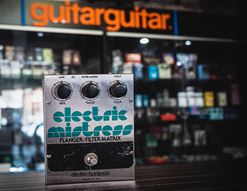
It’s also worth mentioning that EVH have collaborated with MXR to recreate several of Eddie’s favourite effects pedals. You’ll recognise them thanks to their awesome striped paintjobs of course, and you can have perfect recreations of Ed’s Phase 90 and M117 Flanger: just the things for nailing those Ain’t Talkin’ ‘Bout Love and Unchained moments!
Jackson
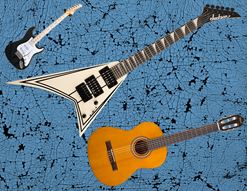
Jackson were a huge brand in the 80s, with thrash metallers as well as hair metal shredders. The brand itself actually came out of Charvel, whose employee Grover Jackson bought the company when Wayne Charvel hit money troubles. Jackson kept the Charvel name on the guitars, but used his own surname when he built Ozzy Osbourne guitarist Randy Rhoads a custom V-shaped guitar. Initially called the Concorde, Jackson revised the shape and then named it the Randy Rhoads, or RR for short. Yes, the spiky sharkfin one that you’ve always secretly wanted to buy!

Jackson are as equally well known for their Superstrat models - the through-neck Soloist and the bolt-on necked Dinky. What set Jackson apart visually was the pointed headstock (before everyone did it) and the triangular ‘sharkfin’ fretboard inlays. These existed alongside the more modded-Strat videos of the Charvel guitars, and catered to a slightly more extreme vibe.
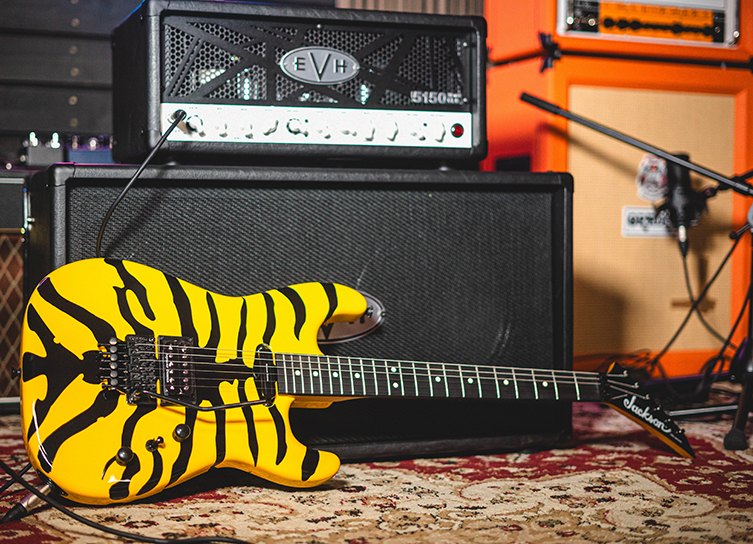
Today, Jackson are going strong under (once again) Fender’s stewardship. Guitar models are available at every price point from £200 to £2000 and beyond, built in China, Indonesia, Mexico and the US. Jackson are great at putting out reissues of classic shredders, including this incredible Jackson Pro Origins 1985 San Dimas in Yellow Bengal! It’s brand new and I don’t think there is a more ‘80s’ guitar available anywhere!
80s Hard Rockers and Shredders
The 80s weren’t entirely about hair metal, but it is quite a focal point for us guitarists. The age of the gunslinger brought us many showstopping soloists, from Dokken’s George Lynch (who has had tons of cool ESP signature guitars) to Ratt’s Warren DeMartini, who rocked a collection of Charvels, and has had recent signature models too. Ozzy’s great guitarist Jake E Lee is another notable Charvel player.
Away from the strip, lots of hard rock guitarists from the late 70s were finding their stride. Def Leppard became enormous thanks to their hard rock sound that was actually pop music with hefty production. Leppard co-guitarist Phil Collen was and is a huge Jackson fan, and his PC-1 signature guitar has been available in many iterations over the years.

Winger - who were named after their excellently named frontman Kip Winger - were a huge hair metal band who sold bucketloads of records but somehow found themselves hated by both Metallica and Beavis and Butthead. Still, they were big players in the melodic hard rock world of the late 80s, and their lead guitarist Reb Beach continues to innovate on the guitar.
Back then, Beach was an Ibanez endorsee (more on that soon…), and nowadays plays a signature Suhr. Suhr of course lie outwith our 80s focus today (unless you count the previous Pensa-Suhrs played by Mark Knopfler), but their Suhr Modern model is a great example of an 80s-adjacent guitar that leans on those halcyon days, whilst still being a contemporary instrument.
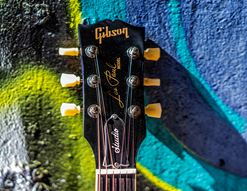
Gibson Les Paul Custom
It’s not pointy, nor is it neon, and it doesn’t (often) have a locking tremolo, but the Gibson Les Paul Custom was a big presence in the 80s rock scene. Slash might’ve preferred his Sunburst Standard replica, but for hard rockers such as Def Leppard’s Steve Clark and Blue Murder’s John Sykes, the Les Paul Custom was the boy to beat.
Randy Rhoads’ most famous non-pointy guitar was a cream 70s LP Custom, and The Cult’s Billy Duffy - whose main squeeze is undoubtedly the Gretsch White Falcon - also slung a choice selection of Les Paul Customs, too.
Of course, it's not a hard thing to find a Les Paul Custom today. Gibson make several, as do Epiphone, and all of them are perfect vehicles for low-slung, thick sounding riffs. That said, I think the recent Gibson Les Paul Custom 70s model is the one you should aim your 80s-fixated gaze upon. After all, most players in the 80s were using older Les Pauls anyway, and Randy’s awesome cream LP was a 70s one.

Those 70s reissues sound great, have volutes behind the neck/head joint (making it stronger) and are available in three supremely cool finishes, from timeless Ebony to Randy-ish Buttercream. Add a studded strap and for goodness sake wear it low.
Ibanez: The House of Shred
When your guitar brand has signature models with Steve Vai, Joe Satriani, Paul Gilbert, John Petrucci and a bunch of other monster shredders, you know you’re winning the game. Ibanez really made the 80s their own by chasing the right artists, and impressing them with guitars that simply delivered more of what those artists wanted.
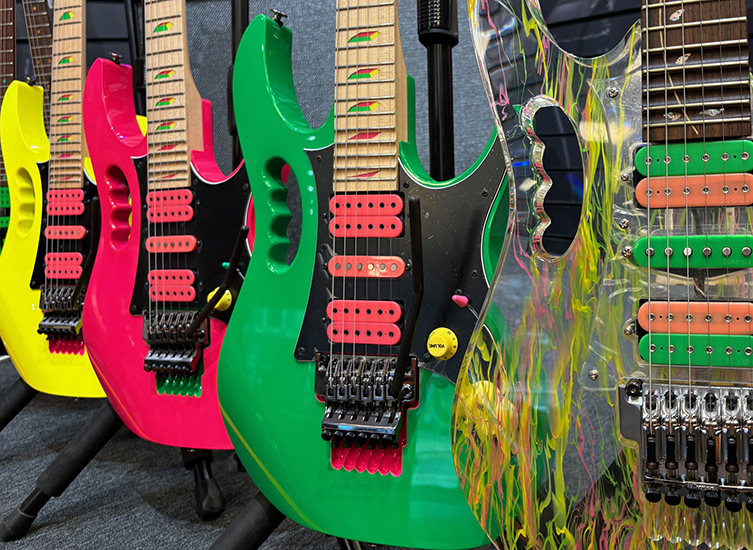
Joe Satriani was the hot ticket, thanks to his hit album Surfing With the Alien. Once he came on board with Ibanez to produce his JS series guitars, it paved the way for his friend Steve Vai to speculate on his own dream axe. Ibanez delivered the JEM, a resolutely idiosyncratic axe that has remained firmly in production now for nearly 40 years. I spoke to Steve about this directly, so click through to the Definitive Story of the Ibanez JEM to read it all, straight from Vai himself!
The JEM of course became the RG, and both are still available today in a myriad of models and price points. Joe’s JS guitars are still popular too, and whilst further generations of shredder have come onto the scene, they all owe a debt of inspiration to these two titans.
Extreme and Nuno
Extreme are only just an 80s band as they arrived at the end of the decade, but their sound is certainly reflective of that glorious era. As soon as they released their debut in 1989, guitarist Nuno Bettencourt landed on the map as a special talent.
Play With Me, from the first album, showed up in the movie Bill & Ted’s Excellent Adventure AND much more recently in season 4 of Stranger Things, further enshrining the band in the legacy of the 80s. It was 1990’s Pornograffitti that brought them their huge moment, though, and sealed Bettencourt’s fame through frankly outrageous playing on songs like Get the Funk Out.
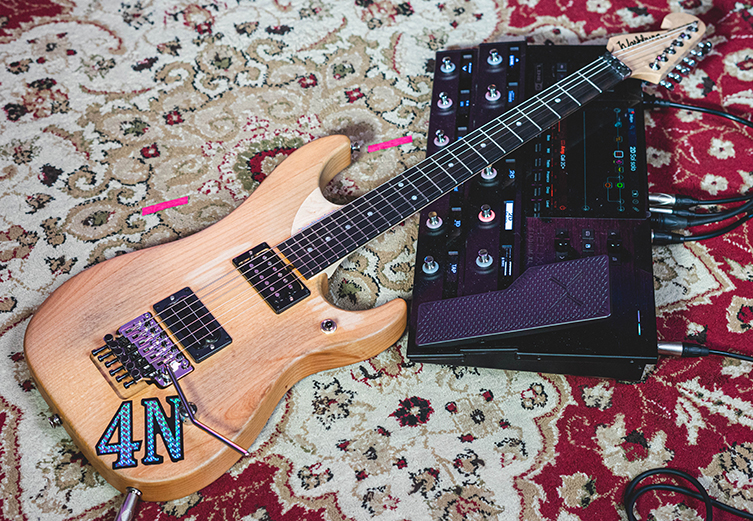
From his early career onwards, Nuno collaborated with Washburn on a signature range of guitars called the N Series. Unpainted superstrats with a reversed headstock and an extremely (‘scuse the pun) deep heel cutaway, the Washburn 4N is a strongly 80s-accented shred machine if ever there was one! These highly regarded guitars are, at time of writing, still available. Yes, you probably need one.
80s Tone: Amps and Effects
So I’ve covered a bunch of guitar reissues, but what about the rest of the picture? Well, thanks to the influence of Ed, the most coveted amps of the 80s were Marshall heads that had been somehow secretly ‘modded’ to get more juice out of them. There’s a lot of talk about what these mods were - and weren’t - but it’s a fact that the sounds of that era have informed the guitar sounds we use today. We all love the Marshall sound anyway, and when they’ve been zapped for a bit more gain and saturation, well…it’s kind of perfect.
If Marshalls were the focus - and that goes from modded Plexi heads to the JCM800 models of the time - then the people modding them became the actual makers of amps later. I’d hesitate to call Friedman a brand of reissues per se, but he’s a guy from back then who is building Marshall-refencing amps that are out of this world.
Mesa/Boogie were a connoisseur's choice back then for those who could afford them. The brand remains strong today (owned now by GIbson) and have several models available that harken back to their 80s amps, including a full-on reissue of their famous Mark IIC+.
One sound that is defiantly 80s is the Rockman. For those who don’t know, the Rockman was a headphone amp designed in 1982 by Boston guitarist Tom Scholz, and was primarily intended as a private practice tool. The Rockman has a very particular sound, and one which resonated with a great many players in the 80s, and so it frequently featured in recordings. You can hear it all over Def Leppard’s seminal Hysteria record, and ZZ Top’s Afterburner album. Also, Joe Satriani used it for many of the lead tones of Surfing With the Alien, so its credentials as a significant piece of 80s gear is clear.
Rockmans (Rockmen?) exist today in both a revised headphone amp form and as an MXR stompbox reimagining of the Rockman X100. The headphone amp style is available in 3 flavours - Guitar Ace, Metal Ace and Bass Ace - but in all honesty, my money is on the MXR Rockman. It’s a far closer version of the famous Rockman sound, and its pedal form makes it far easier to integrate into your regular setup
The 80s Never Died
I suppose I’m being quite selective in my version of the 80s, aren’t I? I’m missing out all of the technicolour pop of Duran Duran & Madonna, and the indie of The Smiths and R.E.M. but maybe that’s because lots of that stuff transcended the decade? Or perhaps were not so strongly coloured in the accoutrements of the time?
I don’t know, but as a guitar fan, I’m sure you understand why my gaze settled on the flamboyant guitar heroes of the Los Angeles scene. The amount of reissued guitars and amps from that era is proof enough of how the gunslinger years have resonated with us. We still love the songs, we love the glamour and fun, and we love the crazy-ass guitar solos. We love the guitars that those solos were played on, and in 2026, we can go out and find those guitars on the walls of guitarguitar. It’s a good time to be a guitar fan.