If you’re a fan of Taylor guitars, you’ll know that they have a reputation for innovation. The restless energy of both Bob Taylor himself and current CEO Andy Powers has resulted in genuine forward motion in the art of acoustic guitar building. From body shapes to preamps, wood use to computer use, Taylor has never settled for ‘good’, when they could strive for great.
One of the areas that they’ve addressed again and again is bracing. Bracing - the inner struts of wood that are shaped and glued in specific patterns to the underside of the guitar’s top - is a significant element in a guitar’s final acoustic tone.
I’ve actually written a blog on this overall subject, so please click through to my Guitar Bracing Guide for a deep dive, but today, I’d like to draw attention to Taylor’s V-Class bracing in particular. Read on for your short, sharp guide!

What is V-Class Bracing?
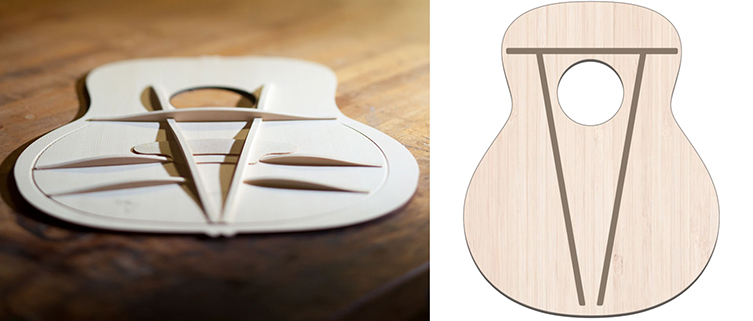
So, firstly: what even is V-Class bracing? Most bracing - and I’m being quite general here - but most bracing inside acoustic guitars is arranged as ‘X-bracing’. Have a look at the picture below and you’ll see what this looks like…
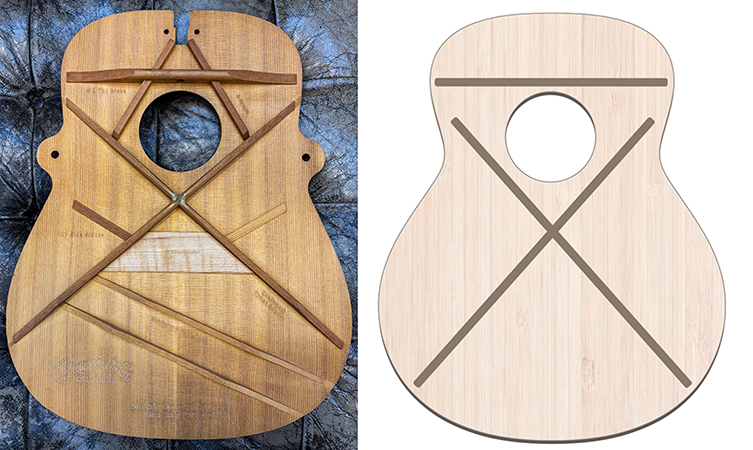
This X-bracing formation gives a good balance of volume and sustain, but it has drawbacks. Guitar tops are where most of the tone is created, and there needs to be vibration and there needs to be stiffness, otherwise sound won’t happen. With X-bracing, if you increase one of these, you suffer losing from the other. Getting that balance right is the key, really, and V-Class bracing approaches this in a new way.
V-Class bracing takes advantage of the guitar’s length. Have a look at the image below and you’ll see how the ‘V’ is long and relatively narrow. This does a few things:
- It makes the top divide mostly into two equally sized parts.
- It creates a stiff ‘pivot’ point along the top.
- It achieves a level of stiffness across the length of the top.
- It removes a lot of the ‘chaos’ of the soundwaves that can ping around and oscillate, making the guitar sound a little out of tune otherwise (more on this below).
Louder Notes
Volume is created when the guitar’s top is allowed to vibrate. Because the V-Class bracing focuses most of its stiffness along the centre of the body, the two ‘wings’ (the top timber at either side of the bracing) are allowed to vibrate more freely than they might otherwise, resulting in plenty of volume. It’s an efficient way to approach volume, since you are allowing the top to do what it wants to do, which is vibrate and move air.
Longer Sustain
Rigidity is what helps with the sustain. The centre length of the top, where the main V of the bracing lives, is what allows this rigidity to occur. This area not only organises the vibrations in an orderly, non-chaotic way (see below), but it also stops the soundboard from absorbing too much of the vibrational energy provided by the played strings.
Having this stiff ‘backbone’ right underneath the strings means that their movement - when plucked or strummed - isn’t entirely ‘soaked up’ by the vibrating top. Again, it’s that balance of stiffness and vibration that allows the guitar to have both volume and sustain. The sides of the top are indeed free to vibrate and raise volume, but the centre is controlled by these stiff braces, and that’s how extra sustain is created.
More in Tune
Yes, bracing affects the tuning, and I don’t mean in terms of strings being in or out of tune. It’s about the vibrations and how they move around the soundboard when you play a note. With X-bracing, those vibrations travel in multiple directions because they are sent to the four corners of the top by the X brace itself. These frequencies oscillate when they inevitably meet each other, and create slightly out of pitch or out of phase sounds in addition to the fundamental note that you played in the first place..
You probably just accept these little frequencies when you hear them, but the V-Class bracing actually gets rid of them. It causes the soundboard to move in a more ordered manner, thanks to how the energy is directed by the V-Bracing. Think about a see-saw rocking back and forth, and that’s slightly closer to what we have here, with the central V of the bracing acting as a big long pivot. The controlled back and forth from side to side is more synchronised and so does away with those little tuning imperfections. You’ll notice it higher up the fretboard, too.
Which Taylor Guitars Have V-Class Bracing?
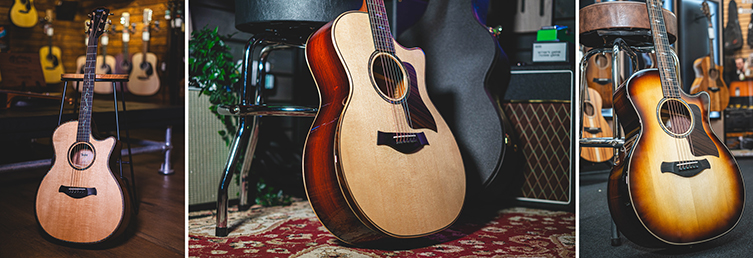
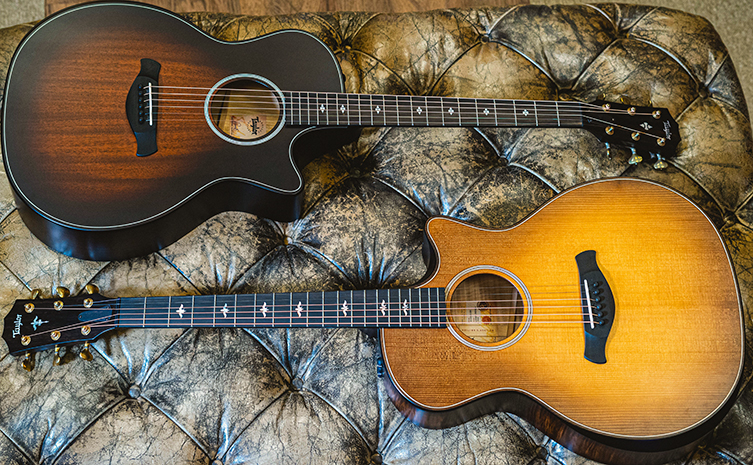
Okay, so you like the idea of V-Class bracing and want to try it for yourself. Without looking through the spec sheet of every Taylor, how can you tell which guitars have the bracing built in?
Well, one way is to look at the spec sheets of course, but there’s an easier way. All Taylor guitars (apart from Custom builds of course) with V-Class bracing have a special black graphite nut, and also a soundhole label that looks like the one below.

Small Steps, Giant Leaps
All of this innovation happens under the hood of the guitar, so to speak. It’s not something that’s visually obvious since you can’t see bracing from the outside. But bracing is an important part of how every acoustic guitar makes its sound, gets its volume and basically, how it performs sonically. Body shape and timber choice play equally important parts, but every element adds to the whole.
With V-Class bracing, Taylor has made a genuine step forward in the art of guitar building. There seem to be no drawbacks to the design, either: you get more volume, more sustain and better intonation, without sacrificing anything. There’s nothing to lose! It’s just a more effective, efficient way to get the air moving and turning into tone.
Try a Taylor with V-Class bracing at your nearest guitarguitar and hear the difference for yourself.