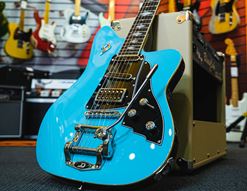
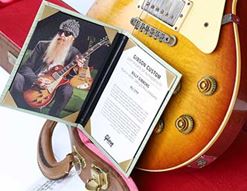
The V is one of the most radical electric guitar shapes in existence. Even now, some 60+ years after its invention, it still has the aesthetic of something futuristic and edgy. For some guitarists, it’s the only shape they’ll use; for others, it’s beyond their confidence to ‘pull it off’ live. For everybody, it’s a universal sign of rock music as much as the devil horn hand gesture.
So, today I’ll take you through the story of the V guitar, from the original Gibson Flying V to the many sharp and deadly variants that exist in today’s market. Some V’s will appeal to classic rockers whilst others will be more predominantly ‘metal’, but if you’re reading this, I get the feeling that you’ll be into them all!
Ok, grab a coffee, don your most inappropriate rock clothes, and let’s V!
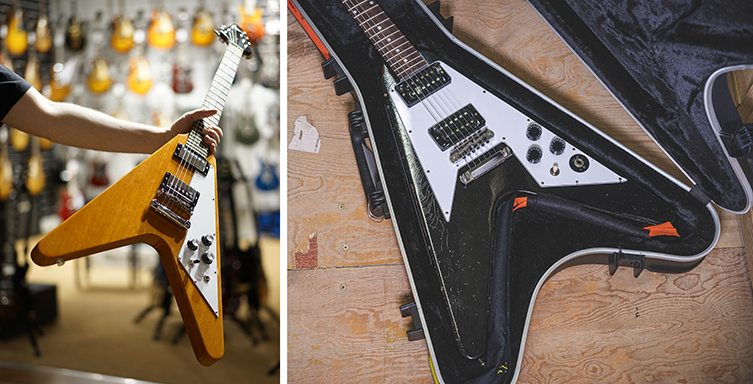
The Original: The Gibson Flying V
It’s strange to think that the Flying V is from the 1950s, years before the Beatles were even a thing, and long before Jimi Hendrix set his guitar aflame. It pre-dates rock music, but then I suppose it was from its own special era: the age of the Cadillac coupe with its big fins, and of the Drive-In cinema. To be more specific, it was from the era of the Fender Stratocaster, the guitar that had Gibson’s bosses more worried than any other instrument out there.
To say that the Strat took off in popularity would be an understatement. It’s reasonable to say that it actually changed the face of modern music, and sealed the deal for Fender as being the world’s premier electric guitar company. With its sleekly contoured solid body, the Strat had an heir of the ‘space age’ about it, which of course it was right in the middle of, in terms of history. Even the name reflected that: it was a cultural zeitgeist object as much as anything else, and Gibson was feeling left behind.
Their undeniably beautiful looking guitars were comparatively conservative and traditional looking compared to these new Fenders, particularly in the eyes of a new generation of rock ‘n’ rollers like Buddy Holly. They needed a suitably bold response.
Gibson’s president Ted McCarty is credited with designing a range of guitars under the Modernistic range banner. This included three initial designs: the Flying V, the Futura and the Moderne. The last of these actually only existed on paper until the early 80s, when it was finally made in very small numbers, promptly to be forgotten about again not long after.
The Futura was renamed the Explorer, which you certainly do know, and the Flying V was the 1958 model that remains today.
Seth Lover - who of course invented the PAF pickup amongst other things - had a hand in the Flying V’s design. Initial models were made using mahogany, which was deemed to be too heavy. Instead, Gibson began using a mysterious timber called Korina, which in fact was a term completely invented by Gibson. Why? Apparently ‘White Limba’ didn’t sound futuristic enough for the launch of these new Modernistic guitars. Korina was agreed to sound more exotic, and it would also be an exclusive: nobody else could offer a guitar made from Korina! Limba gave a similar tone to mahogany, but weighed significantly less, which suited the larger solid bodies of the V and the Futura.
The 1958 Flying V had several distinctive features, including a very cool through-body metal V-shaped tailpiece. The headstock was like an arrow and the jack connector was down at the bottom of one of the guitar’s ‘legs’. It was a bold design, to say the least.
In the end, the Flying V was not a huge success. Roughly 98 V’s were built between 1958 and 1959, before Gibson called it a day and discontinued the model. Compare that to the 600+ guitars the company makes every day now in 2026, and that whole original run of Vs represents maybe one hour of production in today’s terms.
The Futura lasted slightly longer - as the Explorer of course - but still got the axe in 1963. It was made in even smaller numbers (only 22 made between 1958-60, and less in the following years!), which is why these original Korina V’s and Explorers are some of the most valuable vintage instruments in the world these days. There’s nothing like scarcity to drive up the price!
The Renaissance
Gibson in general had a rough time in the early 60s. They’d retired the Les Paul in 1961, replacing it with what would become the SG. They’d failed to find a market for their Flying V and Explorer guitars, which were designed specifically to take people away from their Stratocasters. That evidently didn’t happen. In short, they’d lost to Fender, who were dominating the world with their twangy sound.
In the mid-60s, though, things seemed to change a little. Even before the British Invasion reminded the world about how amazing a cranked Les Paul could sound, artists were finding Gibson electrics and using them. In particular, the outlandish looks of the Flying V were finding fans in showmen who wanted to make a statement onstage. Albert King used a Korina Flying V upside down (it was the one guitar whose shape didn’t interfere with lefties) and Lonnie Mack was famous for his use, too.
The Kinks’ Dave Davies discovered the Flying V when looking for a guitar that was visually striking, light in weight but heavy in tone. Then somebody else got their hands on a V, a guitarist who is undoubtedly more associated with the Strat, but who is still a defining Flying V player: Jimi Hendrix.
Yes, Jimi was very fond of the Flying V and owned a number of them throughout his professional life. Another lefty, he no doubt found the shape appealing to his extrovert stage persona, as well as the practical benefit for his fretting hand.
One of Jimi’s V’s was hand painted by him with nail polish, and was known as the ‘Lovedrops’ V. Both Gibson and Epiphone have reissued that one, complete with detailed recreations of his art. His final Flying V was actually a 1969 custom order, which isn’t something that was as widely done back then as it is today. Hendrix went for a proper left-handed model, and specified Native American arrowhead inlays on the fingerboard.
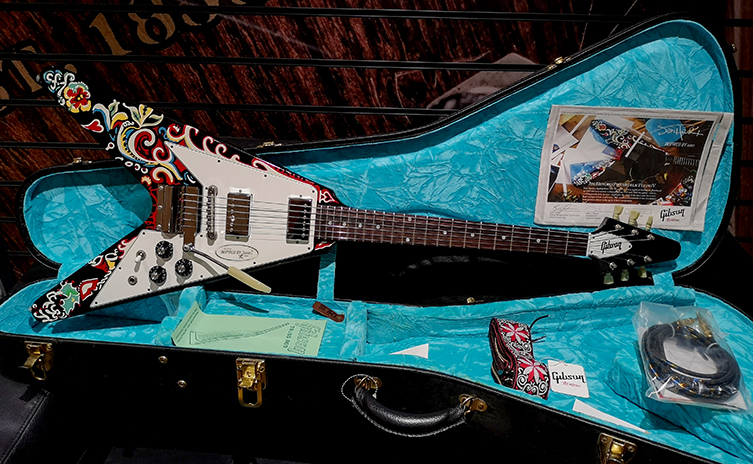
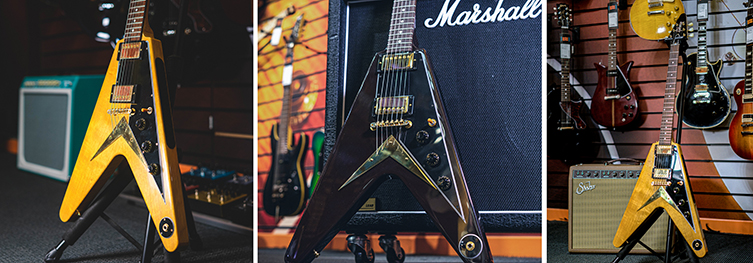
So by the late 60s, the Flying V was becoming the iconic instrument it now is. It was reissued by Gibson in 1967, after a rare few being built from old parts in the early 60s. This ‘67 version had a much larger pickguard and a regular tune-o-matic bridge and stop tailpiece.
The 70s: Rockstars and Copycats
By the late 70s, the Flying V was accepted as a classic. Marc Bolan played one, Michael Schenker played one, and Wishbone Ash’s Andy Powell played one, too. They were accepted as awesome ‘statement pieces’ for guitarists to strut their stuff with on stage.
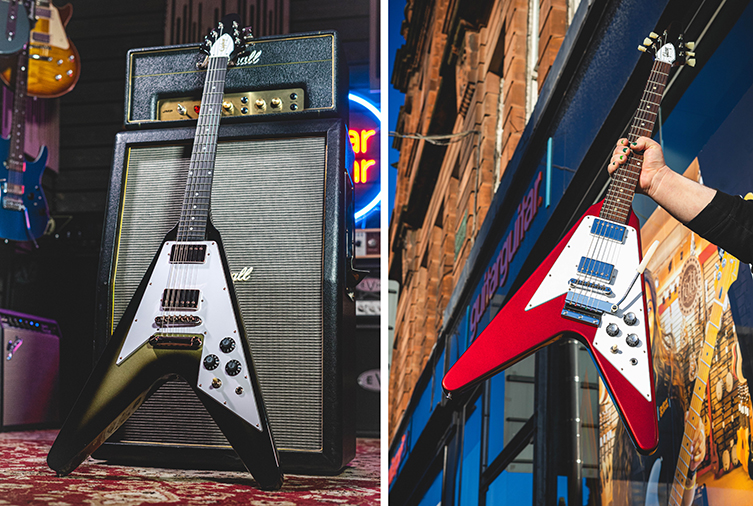
This renewed success brought with it an inevitability: the copycat brands.
Yes, the 70s were rife with Japanese brands and even American brands who’d use Japanese factories to build cheap approximations of famous guitars. In truth, some of them were pretty exceptional in terms of quality: brands like Ibanez, Greco, Aria, Fernandes and Burny put out V-shaped guitars that were impressive. They absolutely impinged on Gibson’s trademarks - and eventually had to alter their designs - but they were popular and affordable nonetheless.
In addition, cheaper guitars with bolted on necks and ‘pancake bodies’ (made with various chunks of timber sandwiched together) appeared from brands like Holly Kawaii, Arbiter and Electra. In fact, one famous V-guitar fan by the name of James Hetfield toured and recorded with a white Electra Flying V, before moving onto Gibson and ESP.
In retrospect, guitarists and collectors alike are going back to these ‘lawsuit era’ instruments with a new appreciation. Some were built in the famed Matsumoko factory, which is seen as a badge of quality for those who know what they’re looking at.
The Flying V ruled the 70s, but developments from another company came to define the 80s version of this famous guitar…
Jackson and Randy Rhoads
A few factors come together into the story now. The 80s brought a new breed of flashy guitarist into focus, who were inspired by the fretboard athletics of Eddie Van Halen. The era of the gunslinger was in full effect, and they wanted to play ‘Superstrats’: souped up S-type guitars with humbuckers and locking tremolos. These were largely provided by boutique custom guitar builders Charvel, a brand whose employee Grover Jackson came to eventually own, after buying from Wayne Charvel..
Whilst building Charvel Superstrats for the shredders of Sunset Strip, Grover was approached by a young hotshot guitarist called Randy Rhoads. Burning bright as the new sideman of Ozzy Osbourne, Rhoads wanted to make a statement with his guitars,and came to Jackson with an idea of what he wanted.
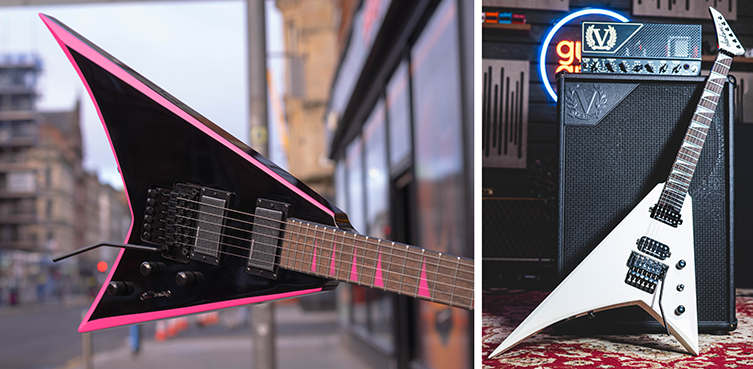
What he wanted was a pretty idiosyncratic looking V-shaped guitar with offset fins and a selector switch on the side of the body.
Since Charvel were known for their S-types, Grover didn’t necessarily want to start adding odd new shapes to the catalogue. He readily agreed to build the guitar for Rhoads, but on the condition that it be released under his own name. This, then, was the beginning of Jackson guitars, one of the biggest brands in the world.
Randy’s initial design was built and named the ‘Concorde’ after the revolutionary aeroplane. This design was quickly revised by Grover though, thinned out and sharpened at its edges. The resulting guitar is what we know today as the Jackson RR, and it has remained in production ever since.
Jackson followed this model with a number of new designs. Whilst outside the scope of this article, guitars such as the Kelly and the Warrior have become design classics in their own right, and given Jackson a reputation as one of the great ‘shape’ brands. One design, however, is very much relative to what I’m talking about today.
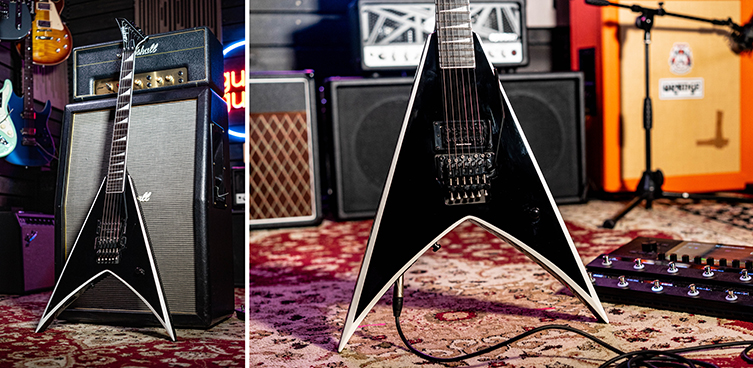
The Jackson King V is a fairly straight up ‘metallising’ of the classic Flying V design. It’s sharper, more tapered and sports Jackson’s famous pointed headstock. It has those amazing sharkfin inlays too, and you’d see metal titans like Anthrax’s Scott Ian and Megadeth’s Dave Mustaine playing them in the 80s and 80s. Nowadays, Limp Bizkit’s Wes Borland is a very visible King V player, whose most notable model was a custom shop left-handed model that he spied, took a liking to, and took away to modify for his own use. The Jackson Wes Borland Flying V is a laudably close to Wes’ DIY original, even down to the reverse logo on the headstock!
Modern V Guitars
As I mentioned earlier, V-shaped guitars seem to appeal to the metal brigade more than in other genres. It makes sense: the shape itself is aggressive looking (particularly the ‘sharper’ models) and the visually bold statement of a V suits the bigger, louder music.
So, it stands to follow that lots of brands have their own special take on the style. Most of them offer a slightly redrawn take on the symmetrical V, whether adding an offset edge to the shape, squaring off certain edges or sharpening others.
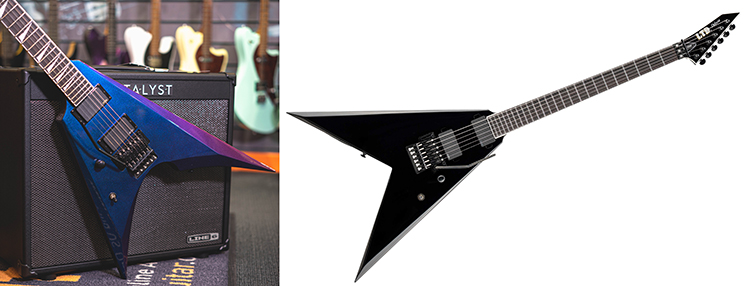
ESP offer a few, including an Alexi Laiho signature that is as much a tribute to Randy Rhoads as anything, and a James Hetfield signature ‘Vulture’ that adds a stylish chunky look to the classic V.
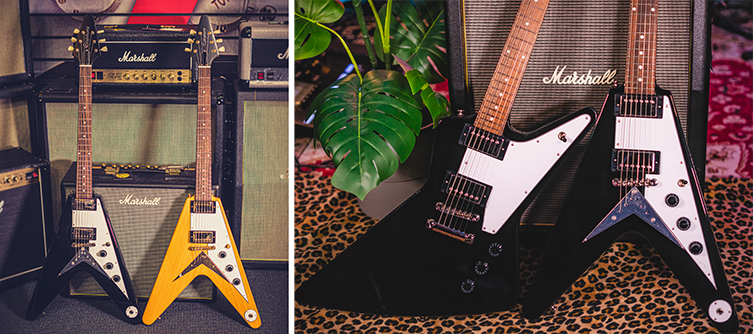
Epiphone’s new Prophecy series includes a very cool Flying V that takes its inspiration from the Gibson Flying V Custom, and adds plenty of monochromatic detail to produce a classy new metal axe.
Schecter also produces a wide range of gorgeous V guitars that add some chunk factor to their designs, as well as offering a host of hardware and finish options, as you’d expect from the brand. They also made a ‘trident’ for Ministry’s Al Jourgensen, which was basically a V with an extra third spike.
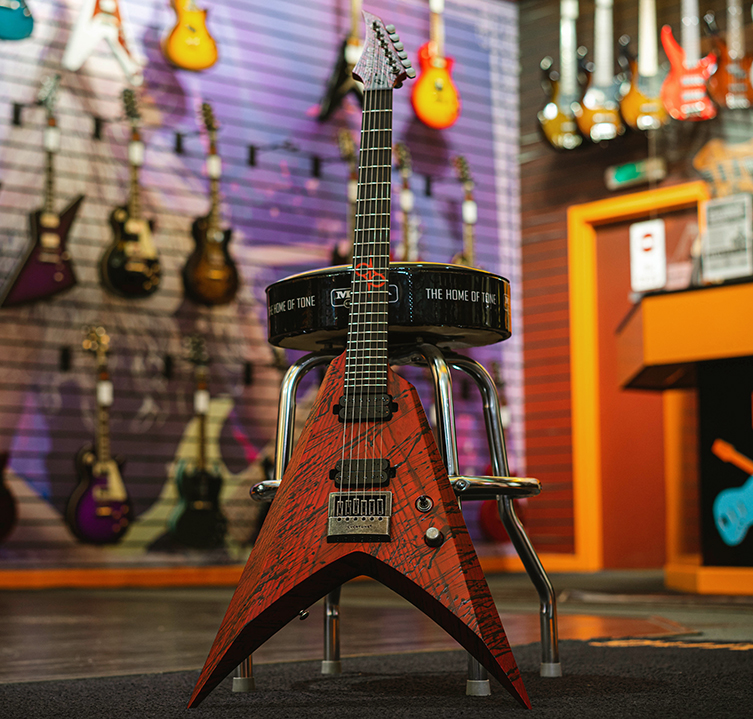
V-Adjacent Guitars
Some of the more extreme shape guitars are still closely based on a V, but with added elements. The first one that springs to mind for me is the Dean ML. This can be seen as either a Flying V with an ‘arm’, or a mix between a Flying V and an Explorer. Either way, it has lots of ‘V energy’ and is very much a stage-statement instrument.
The same goes for the Razorback, which is basically an extreme ML!
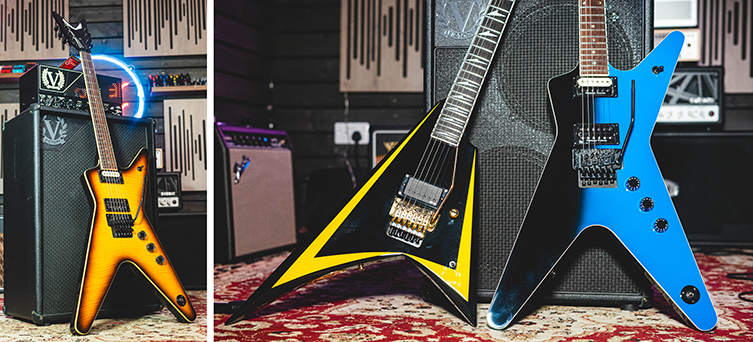
BC Rich are another brand famous for their uncompromising designs. Depending on how you class non-symmetrical guitar ‘legs’, you can see the V in shapes like the Warlock, Ironbird and others.
The Ibanez Xiphos is like a Jackson RR with upper horns, too. Can you see it?
Top V Guitarists
I’ve mentioned a few V-favouring guitarists throughout this blog already, but it’s probably quite good fun to put them all in one place, right? Or at least as many as I can reasonably think of right now. So, each of these names is a top player who is well known to use a V-shaped guitar in a significant way…
Albert King
Lonnie Mack
Dave Davies
Jimi Hendrix
Michael Shenker
Andy Powell
Marc Bolan
James Hetfield
Kirk Hammet
Dave Mustaine
Wes Borland
Al Jourgensen
Dimebag Darrell
Lenny Kravitz
Randy Rhoads
KK Downing
Brent Hinds
Rivers Cuomo
Paul Stanley
Tim Wheeler
Rick Neilson
Alexi Laiho
Wayne Static
Which V? A Brief Buying Guide
So, you feel like maybe you want a V-shaped guitar? Nice one! They are a great choice, and not just because they stand out visually. But as we’ve seen today, there are a lot of V-styles out there. Which is right for you?
I thought that it might help to put together a brief guide, one that will hopefully help you to identify what type of guitarist you are, and what type of V you’d be best suited to…
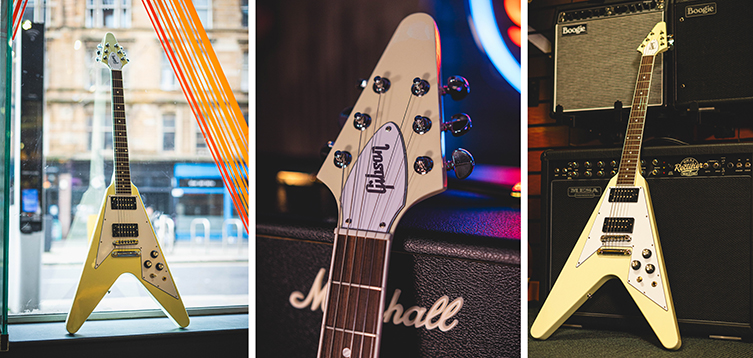
Classic Rocker: If you like classic 70s rock, prog and glam, then you should go with that era and stay classic. Go for a Gibson 70s Flying V for the right look, the right sound, and a classy vibe that can fit into a number of musical situations.
Thrash Riffing: If you play metal and like to stay on rhythm, then I think an aggressive looking V with a hard tail is what you need. Check out the Jackson American RR24 HT for a top tier experience, and an ESP LTD Arrow-200 for a cool, original take on the V.
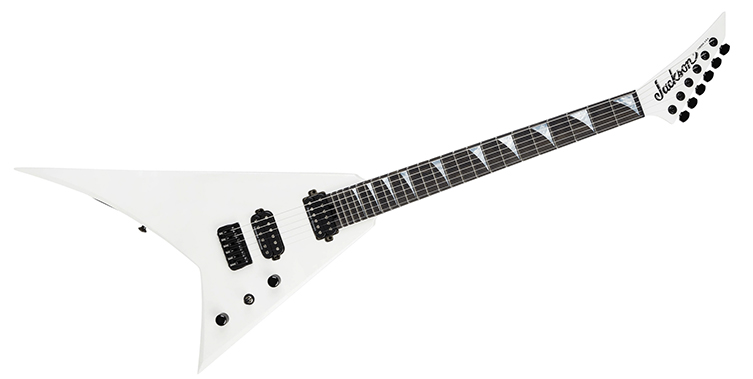
If your wallet is tight, then have a good look at the Jackson JS32 King V. It has the famous pointed headstock, the sharkfin inlays, and a lean, stripped down vibe that’s perfect for trash riffing.
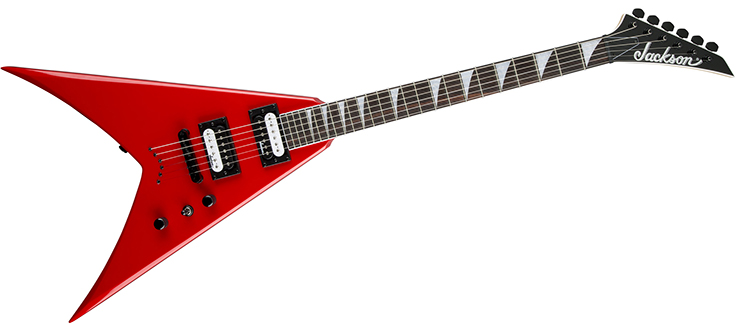
Lead Guitar Shredder: Let me put this another way. This is for a high output V that has a tremolo. Jackson have plenty here, including the Wes Borland signature and the Scott Ian signature King Vs, both of which provide a perfect shred platform.
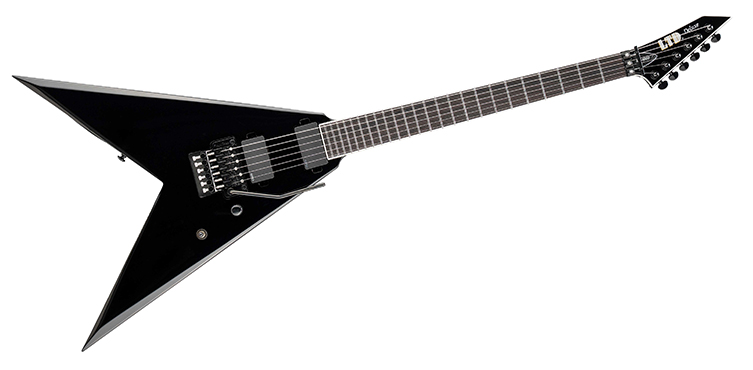
Have a look at the ESP LTD NV-1000 for an active EMG-equipped V that throws it down with dark, unfussy style.
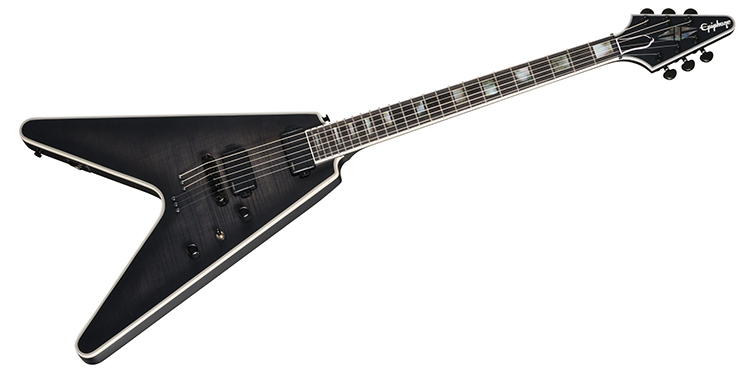
Contemporary rock statement guitar: If you don’t want a locking tremolo or an overly retro V guitar, there are still lots of cool options. After all, the V is a pretty iconoclastic instrument! I recommend the Epiphone Prophecy Flying V. It has an ebony fingerboard with block inlays and stainless steel frets, a set of Fishman Fluence pickups and a moody, classy look that is edgy without trying too hard.
Timelessly Futuristic
V shaped guitars have always been somewhat outside their own time. When they were released, they were ahead of their time, and now, 68 years later, they still have that far-off future vibe.
What’s interesting to me are the artists who use them. Yes, there’s a strong love for them in metal circles, but they are also total blues guitars, and a top choice for glam rockers, too. I think the statement of their shape actually transcends genre, and simply bonds them to any guitarists who are unafraid to cut a bold shape onstage. Sonically, they are interesting because they often have a mix of sustain and bite without being too ‘fat’ sounding. In many ways, they are the ideal sounding electric guitar, and given their easy upper fret access, the ideal playing guitar too.
And yes, you absolutely CAN sit down with one! So, is it maybe time you unleashed your inner rock-peacock and tried a V?
Browse All of our V-Shaped Guitars