If you are looking for a classic guitar with tons of heritage but that’s also a little bit different, then I bet Hagstrom is on your radar. Whether you’ve known about the brand since you were a kid, or you’ve been turned on to them after seeing Ghost perform with them in recent years, they are a significant brand who are perhaps underappreciated over here in the UK.
My aim today is to take a light trot through the company’s history, and highlight some of their famous instruments, not to mention the well-known players who’ve chosen Hagstrom over the years. I reckon you’ll find some surprises on the way, so what do you say: shall we get started?
Over 100 Years Ago
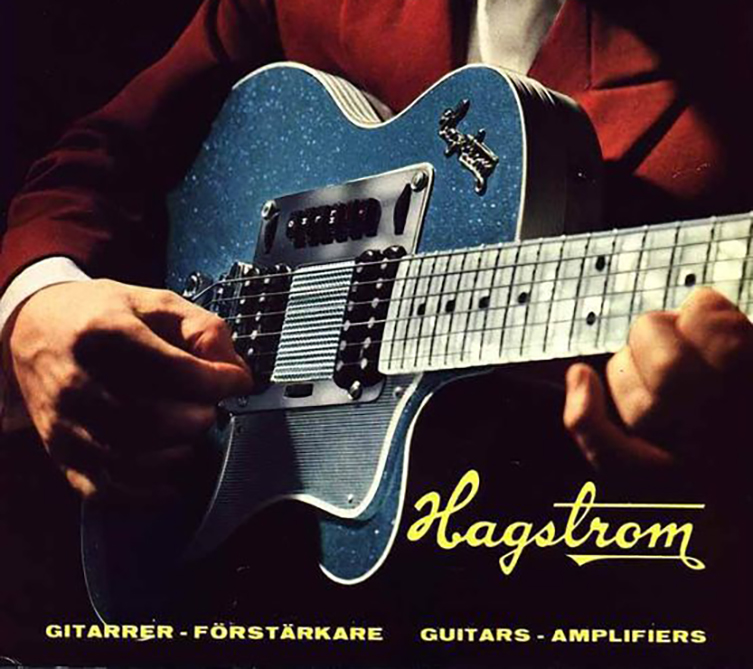
The Hagstrom story begins just over a century ago, in 1925. The company started out importing German and Italian accordions to sell from their base in Alvdalen, Sweden. A few years after that, they began creating and selling their own accordion models, with business expanding into Norway and Denmark. Hagstrom became a popular musical instrumental shop brand, and in 1936, they hired two master Italian accordion makers to improve the quality of their products.
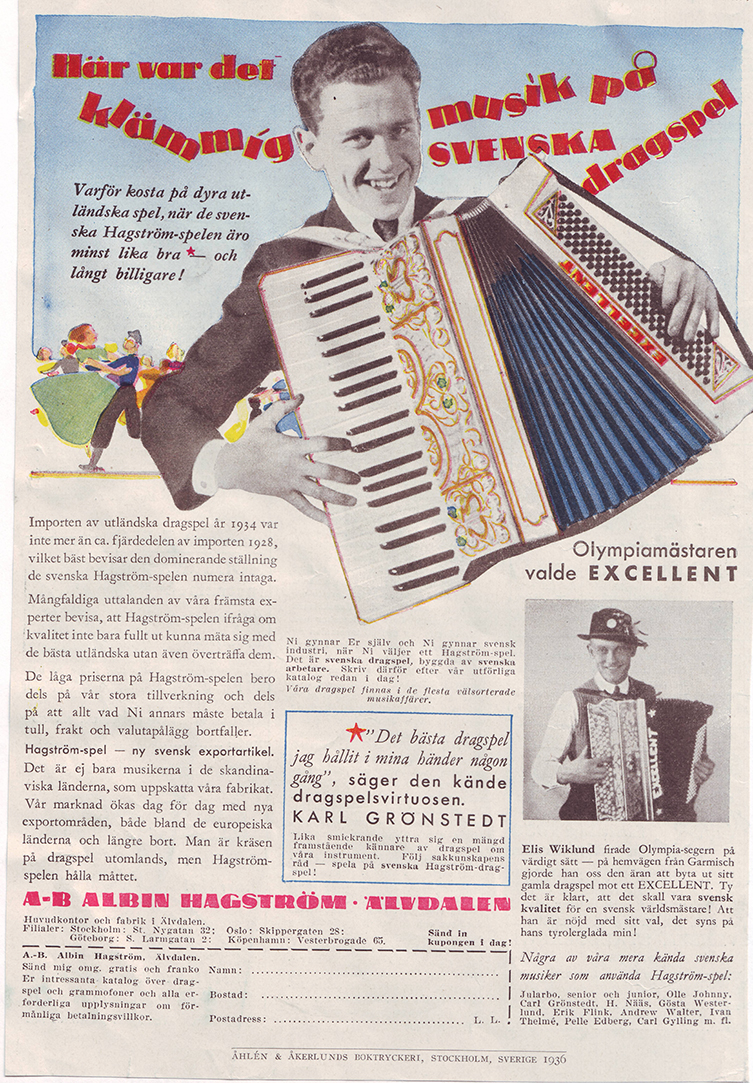
(A fantastic Hagstrom accordion advert from a Stockholm newspaper in 1936!)
The man who started all of this was the then-20 year old Albin Hagstrom, a Swedish entrepreneur and (surprise surprise) accordion player. Ever business minded, before starting with Hagstrom, he bought two accordions, one to use and the other to rent out to local players. His passion for the instrument undoubtedly fueled the success of his brand. For context, he was 16 years old when he began his business, and imported other things like kitchenware and bicycles too!
Switching to Guitars
Accordions, then, were what built the Hagstrom name around Scandinavia, and then internationally. In 1939, the company opened a US office, but World War II kicked off and stopped their US business for a while.
After the war, the world discovered rock ‘n’ roll. Accordions were still selling well (15,000 a year were being sold during the 50s), but the world wanted guitars!
As it happened, Hagstrom were actually the Swedish distributor for Gibson. Hagstrom had already been experimenting with guitar building in the late 40s, but when the company decided to begin guitar manufacturing, it may then be no surprise that their first efforts - the DeLuxe - closely resembled a Les Paul. Indeed, legend has it that Hagstrom builders actually took apart a goldtop LP Standard in order to understand the process! This guitar was initially sold under the Goya brand, who also used the Swedish manufacturer Levin to build acoustic guitars. Martin & Co eventually bought the Goya brand, but that’s a story for another day.
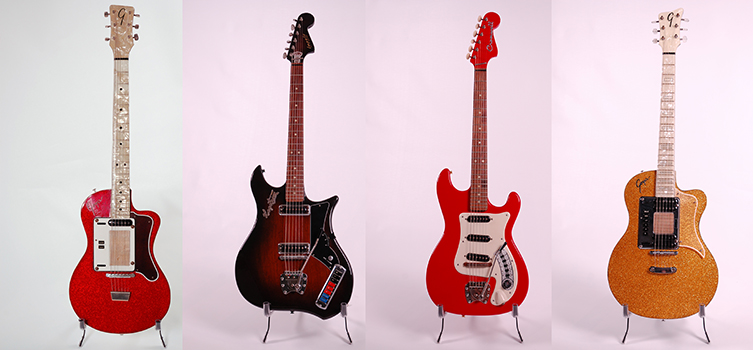
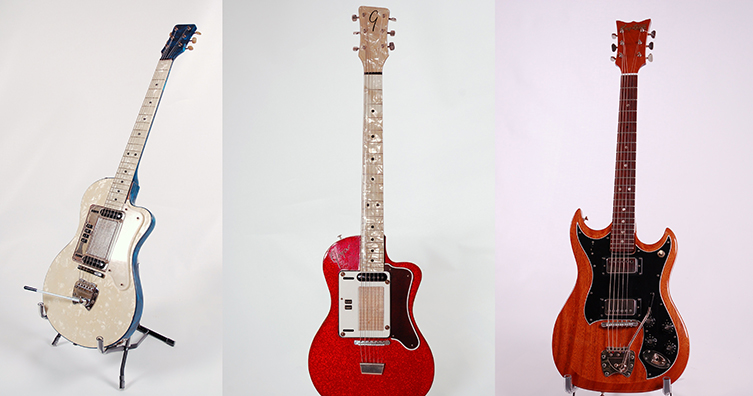
(Two Goya brand electrics (with the removable electronics panel!) flank a Hagstrom guitar and a Kent model similar to the one seen with David Bowie)
Albin’s Death, Karl’s Leadership
Sadly, Hagstrom’s founder Albin Hagstrom died of sepsis at the age of only 46. This was in 1952, and his son Karl-Erik took the reins in 1956. Together with designers Holger Berglund and Arne Harden, Hagstrom entered the guitar market in a significant way.
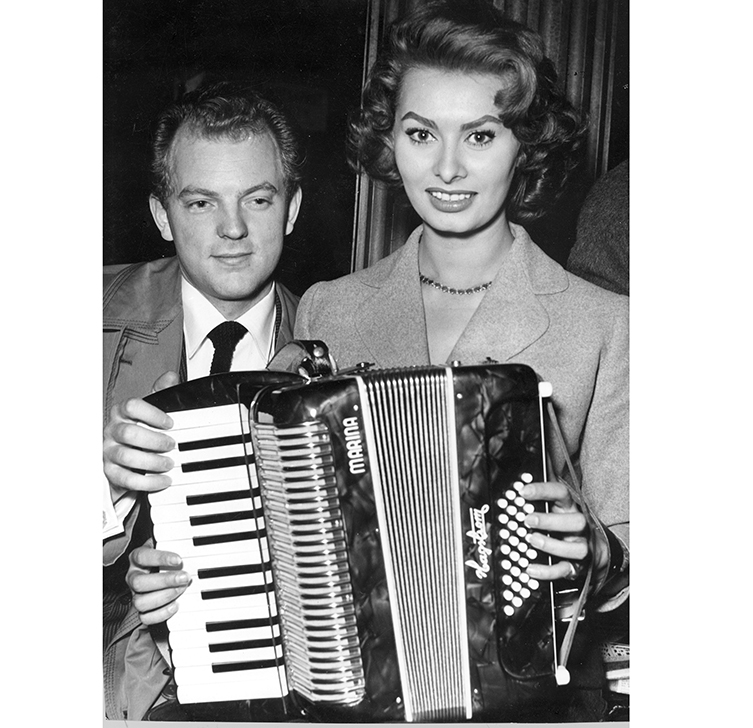
(Karl-Erik with noted accordionist Sofia Loren)
This is where you start hearing the cool/bonkers ideas happening…this like pearloid fingerboards (imagine replacing frets in one of those!), the sparkle colours and decorations that looked mysteriously (i.e. DIRECTLY) like they came from accordions, acrylic tops and one very interesting design principle that may have looked flashy, but also served a particularly practical purpose...
The pickups and electronics were built into a sort of ‘frame’ or panel (I hesitate to call them pickguards) that had metal around the edges. These were dropped into the guitar and could be swapped around and changed with the frames of other Hagstrom guitars, an excellent modular way to create interest in owning more than one Hagstrom! But that’s not even the main reason for the design: US customs. For whatever reason, the customs fees for acoustic guitars were less than those of electrics, so by shipping the electronics separately, the guitars were technically acoustic, and cheaper to export! Once the guitars and frames arrived separately, they two could be reunited and sold as an electric guitar.
Very crafty.
During the 60s, as much as 90% of what Hagstrom made was exported to the US. The guitars themselves were quickly picking up a reputation for being excitingly different, and full of innovative design and visual work:
Hagstrom Innovations
- Speed-o-matic fingerboard: a very thin slice of plexiglass used on top of the block fret markers on Kent guitars. Hard wearing.
- H-Expander truss rod: developed in 1958, this truss rod is roughly shaped like an ‘H’ and provides a high level of adjustability as well as strength to the neck. In addition, Hagstrom claim that the H-Expander truss rod increases treble frequencies and sustain.
- Resinator fingerboard: today’s Hagstrom guitars often have Resinator fingerboards. They are made from a wood composite that looks and feels like ebony, is hard-wearing and is eco-conscious.
- Drop-In Pickguard Frames: Certain Hagstrom and Kent electric guitar models had interchangeable acrylic pickguards, allowing players to mix and match. All of the electrics were attached to the pickguards for fast changes.
The Kent Brand
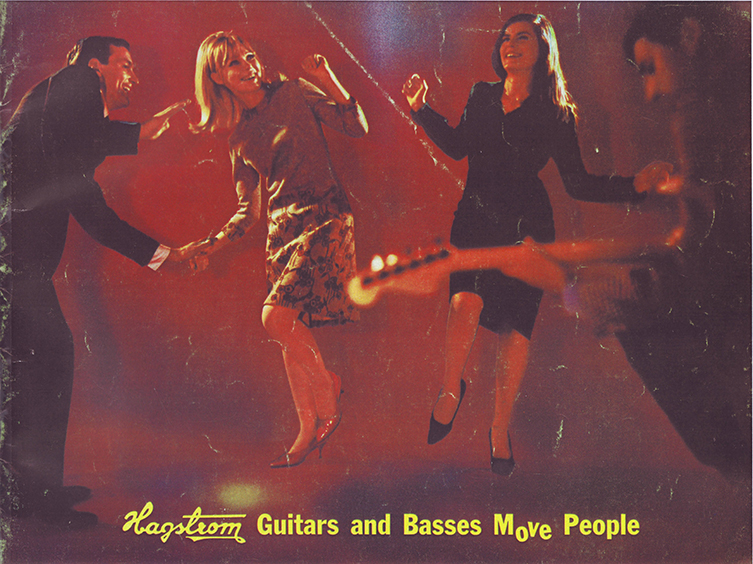
You can tell just by looking at today’s Hagstrom guitars that the 60s were of huge importance to the brand. Rock music (and Beatlemania in particular) brought unheard of business to the guitar industry, and that continued for the whole of the decade. Hagstrom enjoyed massive success, not only with their Hagstrom-branded guitars, but also with a subbrand called Kent.
Does Kent ring a bell with you? Maybe it’s because you’ve seen pictures of David Bowie in 1974, with red hair and an eyepatch, playing a red Kent guitar?
That’s jumping ahead slightly, because Kent guitars were actually manufactured between 1962 and 1966 for the most part. Their more overtly Fender-esque designs were popular, and because they were cheaper and quicker to build, also great for business.
So why were these guitars not simply called Hagstrom? It’s actually a pretty funny reason: company owner Karl Hagstrom was concerned about the amount of plexiglass and acrylic on each guitar, and worried that the parts would crack and break when they were connected together. If that happened, he didn’t want any association making the Hagstrom name look bad, so he used a separate brand name!
1966 saw further refinement of both the guitar and bass ranges, creating ever-more-playable instruments to cater to a rock world that was growing increasingly musically complicated.The Hagstrom H8 was released a year later in 1967 - apparently the world’s first ever 8-string bass. In case you’re wondering if you’ve ever even heard one of these, Noel Redding used to use them all over the Jimi Hendrix Experience's records.
Big Name Association
I’ve mentioned already that David Bowie took a post-Ziggy Stardust interest in Hagstrom electrics in the mid 70s, and Noel Redding before that. But even before then, some huge names were seen using their guitars. The most visibly significant one must be The King himself, Elvis Presley. When he made his 1968 comeback (the black leather jumpsuit era), he did it with a lovely red Hagstrom Viking II model, which you can get today as the Hagstrom 67 Viking Wild Cherry Trans.
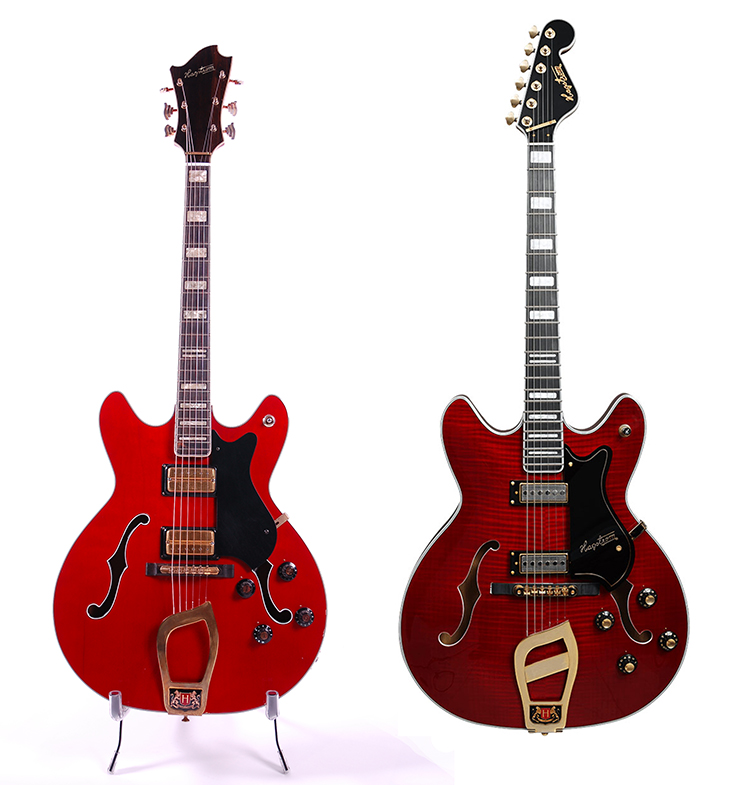
A certain band from Sweden took the brand onstage with them too. Yes, Bjorn Ulveus from ABBA was a fan of the Hagstrom Swede, using it live and in photoshoots. This means that the 70s were perhaps the time best associated with Hagstrom, thanks to how visible these huge artists had made the brand.
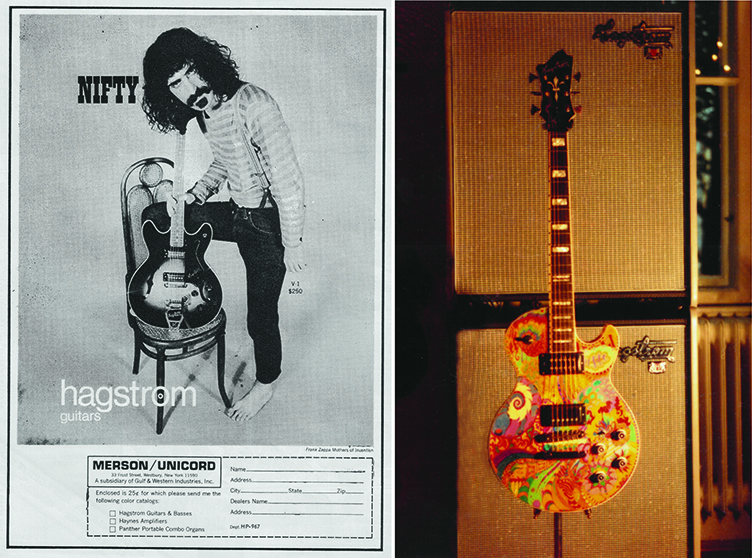
Frank Zappa was another high profile Hagstrom user, who ever had custom made (and then custom-finished) guitars created for his tours.
The Lean Years
As the late 70s became the early 80s, the landscape of guitar music shifted considerably. Punk happened, but that was neither here nor there in terms of equipment. Indeed, it was Dutch-American guitarist Eddie Van Halen and his imitators who created a new era of shred guitar, and this new era needed its own guitars. These would be lean, high performance guitars with hot pickups and locking tremolo systems, and the whole industry struggled to keep up.
Not only that, but by this point lots of East Asian companies were putting out inexpensive guitars that often competed with the established brands in terms of quality. The competition was too much for Hagstrom. They stopped making guitars in Sweden in 1983 (at this time, they had several factories in Sweden, Finland and Denmark, as well as one in Darlington, but only the Swedish facility built guitars) and tried Asian production, but it never worked for them and they ended up winding down the business.
The Resurgence
So it was that Hagstrom made no guitars for over 20 years. The brand lay dormant, though their old guitars would pop up time and again, played by lots of American alternative rock bands who found them available cheaply second hand, and who enjoyed their unusual looks and good build quality.
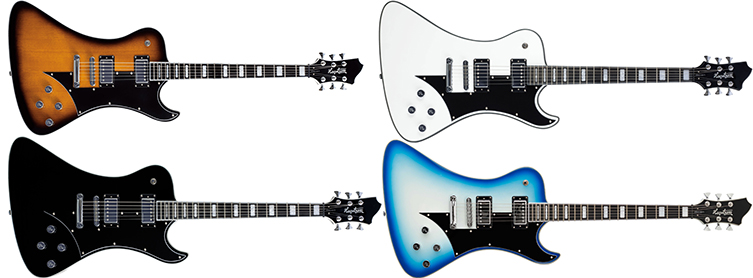
In either 2004 or 2005 (my sources differ here), Hagstrom came back to life, built mostly in China and offering newly refreshed takes on their classics like the Swede and the Viking. Nirvana’s Pat Smear has been a very visible user, as have spooky rockers Ghost. Signature models are available for each, bringing together the design elements of the past with some modern improvements. Several historic elements - the unique H-Expander truss rod among them - survive in today’s builds, and even some brand new models such as the Krona, the Megin and the Adina mean that Hagstrom are once again leading their own path with unique guitars that are built for pros.
100 Years of Hagstrom
This brings us to today’s Hagstrom. 2025 saw the company’s 100th Anniversary, a pretty incredible feat for any musical instrument manufacturer. Rather brilliantly, the Hagstrom family is back in charge, with family interests represented by majority shareholder Karl-Erik Hagstrom Jr.
Hagstrom are a legitimately classic brand with a heritage that includes Elvis Presley, David Bowie and stretches out to Nirvana and Ghost. How many companies outside ‘the big two’ could even begin to match that? They have original design instruments that blend classic styles with a strong and distinct identity. They are well-made, affordable and, to be plain about it, pretty badass.
If you want a classic guitar that’s not one of the obvious styles that we always see, Hagstrom seem pitched at just the right place to answer your needs. Iconoclastic players and performers who want to make their own statement onstage should check out the brand at their earliest convenience.
Happy 101st birthday, Hagstrom!
Click to View our Hagstrom Guitars and Basses