You love the Beatles. I love the Beatles. They are the world’s most significant band. Everything we’ve subsequently enjoyed in terms of popular music has been inspired and influenced by the Fab Four, to the point where it’s hardly worth trying to mention names. It’s everybody!
The Beatles broke new ground with almost every recording, so I thought it would be interesting and maybe helpful to investigate some of the instruments and musical equipment they used to make history with. Now, even a casual Beatles fan will know that they used an enormous amount of gear, so in today’s article, I’m going to focus on the guitar equipment: guitars themselves, amps, effects and maybe the odd sitar for good measure. This means of course that there’ll be scant reference to Ringo, but I think I’ll have my work cut out just trying to account for Beatles George, John and Paul!
I’ll hit the main targets today and as many ancillary bits of gear as I can. Let this article be a gearcentric way for you to enjoy the Beatles once again, as if you needed an excuse!
John’s Guitars
As one half of the most productive and successful songwriter duos in existence, John Lennon’s guitar contributions were far more about writing, structure and attitude than flashy solo moments. If fact, I’d say that’s true of all members, since even lead guitarist George Harrison favoured playing for the song, but we’ll get to him soon enough!
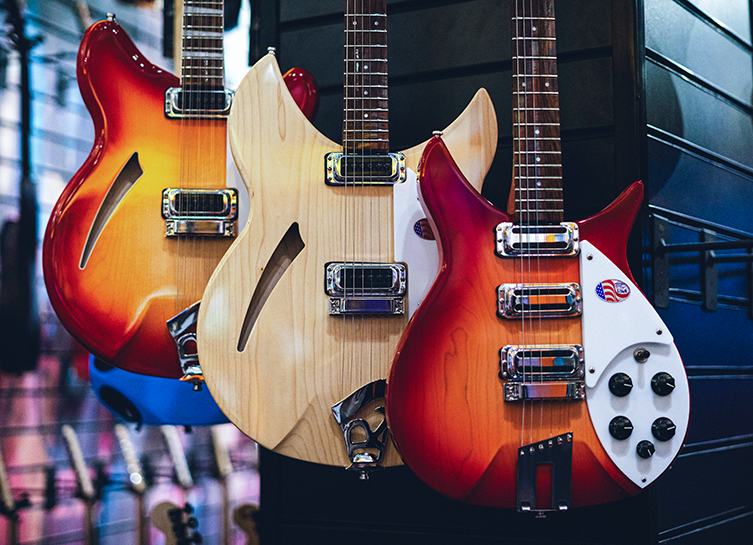
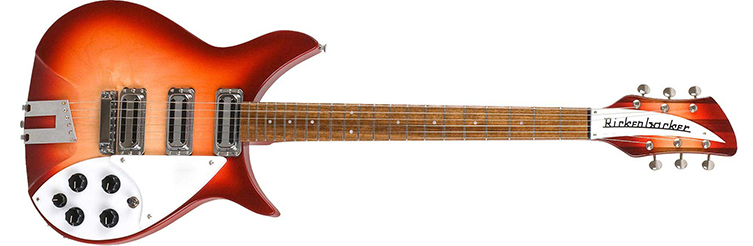
John loved songwriting machines over fancy pieces when it came to guitars. In his early Hamburg days, he played those gruelling sets (4 a day, if I recall correctly) on a Hofner Senator and then, famously, the downsized Rickbacker 325 Capri model. John’s was a Mapleglo finish (natural, basically) and he also had a black one, which Rickenbacker eccentrically called Jetglo. Another early Ricky for Lennon was the 325C58 model, a variation on the same smaller-scale instrument we’ve spoken about already.
These early era instruments still hold a fascination for Beatles fans. Indeed, Rickenbacker still offer a version of the 325 ‘Liverpool’ in direct tribute to the model’s most famous user, and a revised 350 Liverpool model with a full scale length for Beatles fans who want a less idiosyncratic playing experience!
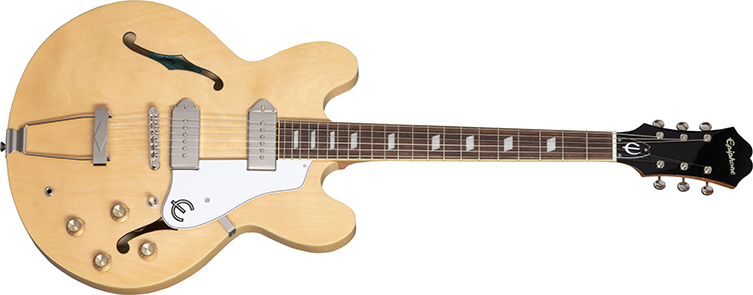
The Epiphone Casino is easily the guitar most identified with Lennon. His natural finish Casino was actually a Sunburst model with the finish removed, in order to distinguish it from George’s identical model. It was actually Paul McCartney who first found them whilst on tour. He was after something that would feed back, since that sound was starting to be used on recordings by various British Invasion guitarists. He bought a 1962 Casino (they were American-made back then), and his bandmates subsequently decided to get one each for themselves.
Lennon modified his Casino first by (badly) spraying the back grey, which came off pretty quick, and then sanding the finish completely, leaving only the natural wood underneath. This was on the advice of folk singer Donovan, who maintained that doing so would ‘open up’ the guitar’s sound. So it remained, and was Lennon’s main guitar until the end of his life.
The Epiphone Casino
Why did all three guitar-playing Beatles favour the Epiphone Casino so much? It’s a fair question, because back in the mid 60s - by which time Beatlemania was at its height - the Fab Four could afford to play absolutely anything they wanted. Why the Casino then?
Well, we already know that Paul was attracted to feedback and felt - quite rightly - that the hollow body of the Casino would be good for conjuring those howls. On top of that, I can certainly see the Casino’s attraction as a songwriting machine: it’s a light guitar, the hollow body makes it very resonant and acoustically alive whether it’s plugged in or not, and the P90 pickups deliver a tone that’s usefully in the middle ground between thick and bright. It’s also a fairly practical guitar, with its thinline body making it more ergonomic than other hollow body guitars such as, say, the Gibson ES175.
Whatever the case, the Casino is all over latter period Beatles music, played by all three musicians. I’d go as far as to say that it is THE Beatles guitar, more than any Rickenbacker, Gretsch or Fender.
As for acoustic guitars, the one most associated with John Lennon is of course the Gibson J-160E, with the pickup and control knobs on the top. It’s an unusual instrument (both then and now), though if you take away the electronics, it’s a fairly standard mahogany and spruce square-shouldered Gibson dreadnought. Lennon’s was a 1962 example, and was actually stolen in ‘63. Sadly, he never got to see it again (I believe he bought replacement models), but it did actually turn up 50 years after it was pinched, and subsequently sold in auction for over five million dollars.
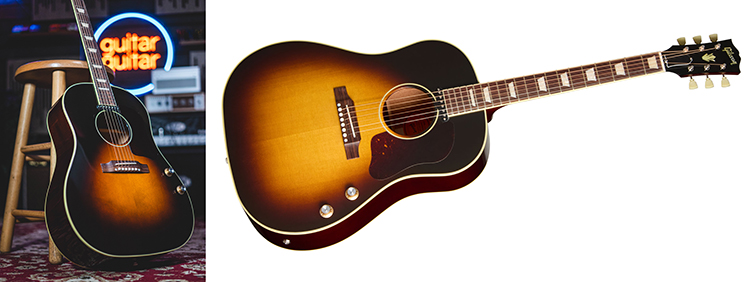
In addition to the J-160E, Lennon also used a Martin D-28 on the White Album, and a Framus Hootenanny 12-string on the Help! and Rubber Soul albums.
John Lennon Beatles Guitar Gear
- Hofner Senator
- Hofner Club 40
- Gallotone Champion
- Rickenbacker 325 Capri
- 1965 Epiphone Casino
- Martin D-28
- Framus Hootenanny 12-string
- Selmer amp
- Watkins amp
- Vox AC30
- Vox Super Beatle V1141 and V1142
- Fender ‘68 Twin Reverb (Silverface)
- Fender Vibrolux
- Maestro Fuzz
- Vox V828 Tone Bender
- Gibson J-160E
- Gibson SJ-200
George’s Guitars
Beatle George was ostensibly the band’s lead guitarist, but as we know, most members shared duties and crossed paths into other territories. A fair amount of lead guitar playing, then, was by Macca, but most of the embellishments on guitar at least were still Harrison’s.
Early era photos show Harrison wielding what I believe to be a very cool Futurama guitar, something that would be considered a little cheap ‘n’ cheerful back in the day. Eventually, he got around to owning the famous black Gretsch Duo Jet that many of us instantly think of when it comes to a ‘George Harrison’ Beatles guitar, which he bought in Liverpool from a merchant seaman who posted an advert in the local paper! It was a 1957 model with the serial number 21179, and he played it on most of the band’s early recordings.
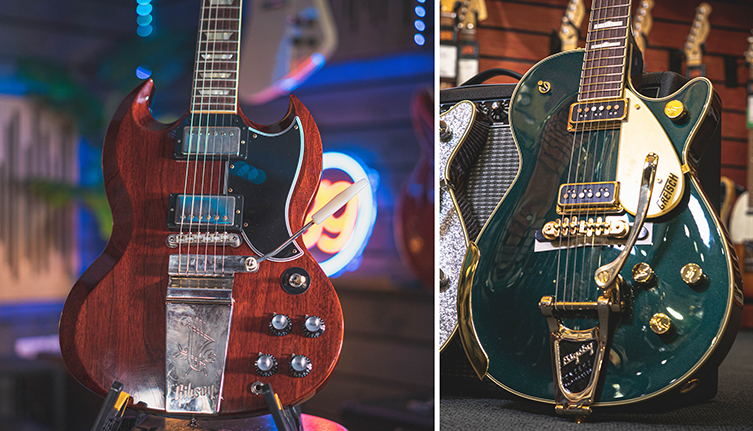
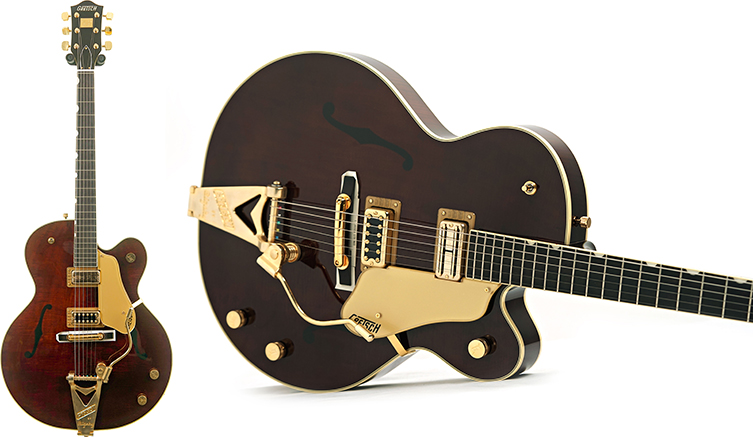
Harrison would go on to use a number of other Gretsch guitars, most famously a lovely Walnut coloured Country Gentleman which many fans will remember from the Ed Sullivan show performance.
I also associate Beatle George with Rickenbackers, but upon doing my due research, it seems that he only really played the Rickenbacker 360/12 to any great degree. This would give the band their famous early chime alongside Lennon’s small-scale 325 model, but I’m surprised that Rickies don’t favour more heavily in Harrison’s history.
So what was he playing? A bunch of very cool guitars, as it turns out! How about a ‘64 Gibson SG with Maestro? Or a ‘57 Les Paul Standard (goldrefinished in red, and named Lucy), gifted to him by no less a friend than Eric Clapton? There’s also his famous rosewood Telecaster, a heavy 1968 example, which has been reissued at various anniversaries of Beatles history by Fender.
Speaking of Fender reissues, there has been a very recent (and very limited) release of a Custom Shop George Harrison Bass VI, which you’ll of course have seen in the Hey Jude video. In fact, Harrison used this a fair bit from the White Album onwards, mostly to reinforce other parts with a little added heft. It was actually gifted to the band by Fender’s Don Randall in 1968. Perks of the job!
A further couple of Fenders are also notable. The first is the ‘Bangladesh’ Strat, which actually lies juuuust outside the Beatles’ timeline, but is a sanded back late 50s/early 60s model used in a benefit concert to aid Bangladesh. Was this actually owned by Eric Clapton too? Certain aficionados seem to think so!
The Rocky Strat
The other is the famous Rocky Strat, hand decorated by Harrison in an extremely distinctive manner! Here’s an interesting thing to know about the Rocky Strat…
Harrison had wanted a Strat for years, and eventually manager Brian Epstein said that he’d pay for both George and John to get a Strat each, with the one bizarre caveat being that both guitars be the exact same model and colour. Why? I can only speculate, but isn’t that interesting, when you think of the identical Casinos too?
Anyway, both guitars were 1961 Sonic Blue models, and you can still see a little of that original finish on the upper horn and back. George really went to town on this, and the jury’s out on whether it’s an inspired piece of artwork or a bit of an overstep, but it’s hugely iconic either way! Why have people largely stopped painting their guitars?
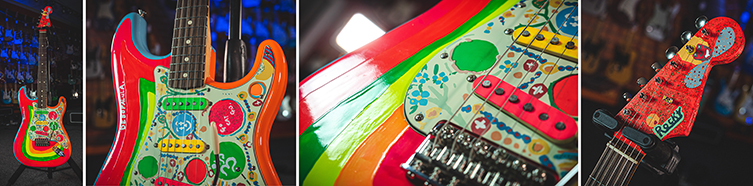
The Rocky Strat can be heard over significant amounts of Rubber Soul, and Sgt Peppers. Eric Clapton has popped up a fair bit in this blog already, and he’s about to do it again. Rumour has it that the image on the headstock - a ‘stylized’ face applied in nail varnish is none other than Eric himself!
Finally, the name itself. Why is it called Rocky? There seems to be no explanation. I always thought it was because the paint makes it look like a stick of seaside rock, but the internet tells me I’m wrong, without offering a substitute theory. So, your guess is better than mine!
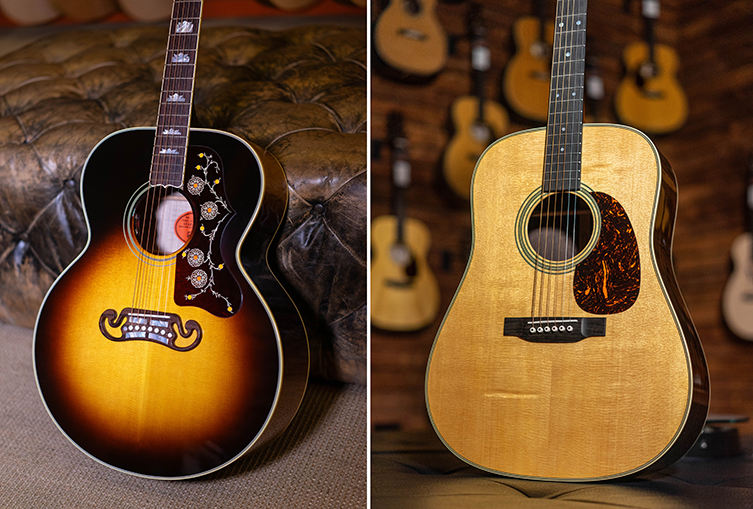
For acoustic guitars, the Fab Four often shared guitars, passing around a Gibson SJ-200, Martin D-28 or even John’s famous J-160E models. It’s difficult to determine the provenance of some of these acoustic guitars, and the Peter Jackson documentary Get Back has kind of proven the point that the Beatles simply picked up what was nearby in their working environment, with the exception of lefty Paul McCartney!
George Harrison Beatles Guitar Gear
- Resonet Futurama
- Rickenbacker 360/12
- 1965 Epiphone Casino
- 1957 Gretsch Duo Jet
- Gretsch Country Gentleman
- Fender ‘Rocky’ Strat
- Fender ‘Bangladesh’ Strat
- 1968 Fender Rosewood Telecaster
- Fender Bass VI
- 1964 Gibson SG with Maestro tremolo
- 1957 Gibson Les Paul Standard
- Indiacraft Sitar
- Hemen & Co Sitar
- Gibson J-160E
- Gibson SJ-200
- Martin D-28
- Maestro PS-1A Phase Shifter
- Fender Bassman 6G6A/B
- 1964 Vox AC30
- Vox Super Beatle
- Vox Conqueror
- Fender Silverface Champ
What is a Vox Super Beatle?
Have you seen this amp being mentioned today and wondered what it actually is? It’s a curious thing for sure. So, the Beatles were famous for using Vox amps, in particular the famous AC30. The trouble was, their audiences were growing too large and manic for the band to hear themselves when they performed, with PA systems not being what they are today.
What Vox’s US partners did was to construct a crushingly loud 120w solid state amp for the express purpose of giving the Fab Four more volume live. The Vox Super Beatle was an early stack, with an unusually trapezoid-shaped head and a vertical cabinet that housed 4 12” speakers and a couple of tweeters. The head also had built in effects! Reverb, tremolo and a mid-boost were all available to the user directly from the amp.
The Beatles did use these on their 1966 tour of the US, but that tour also proved to be some of their last ever live shows. Who knows how long they might have continued to use the Super Beatle amps if they’d continued touring?
Paul’s Guitars
Thinking of Macca as a bassist and songwriter may be accurate up to a point, but it’s also pretty reductive. Paul seems to be able to turn his hand successfully to most stringed and keyed instruments, and that’s whilst also being a left-handed player!
As the other half of the Lennon-McCartney songwriting partnership (or indeed McCartney-Lennon as it is today), he’s partly responsible for some of the most famous songs ever written. Where he differs from his late companion is in his lead guitar flourishes, something he’d do with relative frequency. Taxman and Helter Skelter are good examples of this!
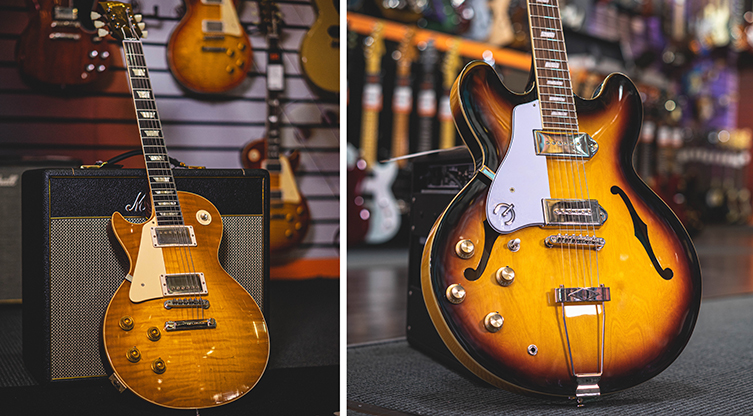
So, being a lefty back then, Beatle Paul didn’t have the same access to instruments that George and John had. An early noted bass of his was a cheap Rosetti Solid 7, which Paul modified with a Hofner pickup. His eyes were clearly on the prize, since he upgraded to his famous Hofner 500/I violin bass not long after. This iconic bass is the one most-associated with both McCartney and the Beatles at large. Epiphone actually made their version of this bass before Hofner, fact fans! Paul’s Hofner was stolen in 1972 - after the Beatles had called it a day - and was recovered only a couple of years ago in 2024.
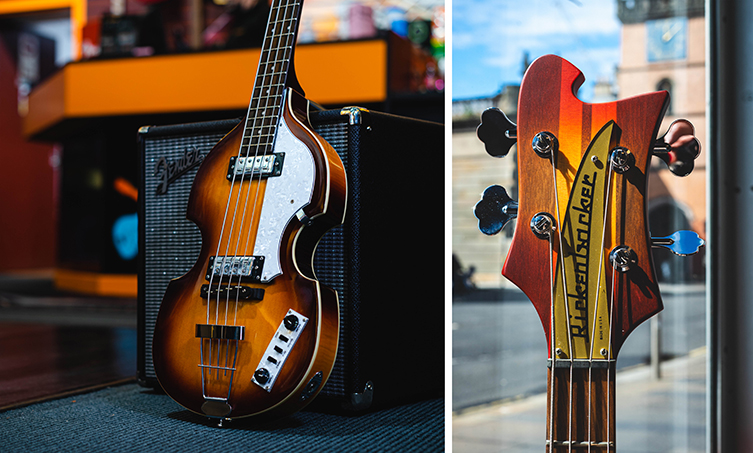
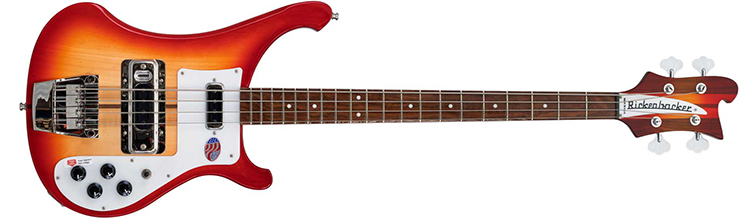
Another famous Rickenbacker user, this time of course it was a bass: a left-handed Rickenbacker 4001, to be precise. This was gifted to Paul by Rickenbacker in 1965 whilst he was in california, finished in Fireglo.
A famous acoustic of McCartney's harkens back to a brand we’ve heard a lot about today: Epiphone. Paul’s 1964 Epiphone Texan - turned upside down and restrung for him to play as a lefty - was the one he wrote Yesterday on. That guitar earned its rent!
Paul McCartney Beatles Guitar & Bass Gear
- Rosetti Solid 7 with Hofner pickup
- Hofner 500/I violin bass
- Rickenbacker 4001 LH Fireglo
- 1964 Epiphone Texan
- Martin D-28
- 1960 left handed Gibson Les Paul Standard
- 1964 Epiphone Casino
- Fender Jazz Bass
- Vox AC30
- Vox 7120
- Gary Hurst Tone Bender fuzz
The Gear that Influenced Everybody
So those are most of the main stringed instruments used by the Beatles. These are the main contenders for those looking to emulate something of that inimitable Beatles magic. Of course, no instrument or piece of equipment will make you write songs like they did, and by extension, I get the feeling that those four would get great results regardless of what they chose to use, gear-wise. But everything in this article was indeed chosen by John, Paul and George. They very quickly became the most famous band in the world, and could play whatever they wanted. It’s interesting to note how often brands such as Epiphone popped up in the list, and also relatively obscure things like Lennon’s short-scale Rickenbacker.
Whatever the Fab Four saw in these pieces of gear, it helped them to create the magical music that we all love; music that has endured more than half a century so far, with no signs of that changing any time soon!
Maybe some of this gear resonated with you for other reasons? If you’re a songwriter and haven’t sat down with a Casino, for example, then maybe you’re missing a trick? Put it this way, if this stuff was good enough for the Beatles, I reckon it’s gonna work for you and I pretty well too, eh?
Click to Browse All of our Beatles-related Gear